

How B2B buyers in India use ChatGPT to research software in 2026 isn't a trend piece anymore. It's a buying reality.
In 2026, 51% of B2B software buyers globally start their purchase journey in an AI chatbot instead of a traditional search engine, up from 29% in April 2025, and ChatGPT alone captures 63% of that research activity according to G2 coverage reported by Demand Gen Report. If you're an Indian SaaS CMO still treating ChatGPT, Gemini, Perplexity, and Claude as side channels, you're already behind.
The hard part isn't understanding that AI search matters. The hard part is accepting that your old SEO playbook no longer maps cleanly to how buyers discover, compare, and shortlist software. Indian buyers don't just Google category terms and click ten blue links anymore. They ask layered questions, refine the prompt, test alternatives, and then visit the few brands the model cites with confidence.
The AI Tipping Point is Here for Indian SaaS
The shift is bigger than a channel change. It's a control change.
When buyers begin inside ChatGPT, the first shortlist isn't shaped by your ad budget, your branded search volume, or your sales team. It's shaped by the model's understanding of your brand, your category fit, and the evidence it can retrieve across the web. For Indian SaaS companies, that creates a brutal split. Brands with strong entity signals and third-party validation get surfaced. Everyone else fades out before the first demo request.
Indian SaaS teams often assume this is still a US-led pattern that will take time to affect local demand. That's the wrong read. Indian buyers are already asking software questions with local constraints built in. They care about GST, data residency, procurement cycles, implementation speed, multi-entity finance, partner ecosystems, and whether your support team can handle regional complexity. AI assistants are now where those constraints get translated into vendor shortlists.
Why traditional SEO isn't enough anymore
Ranking for a category page still helps. It just doesn't guarantee inclusion in AI answers.
ChatGPT, Gemini, Perplexity, and Claude compress discovery. They synthesize. They compare. They turn a messy research process into a tighter set of recommendations. If your site is written for keyword matching instead of answer extraction, you lose visibility even if your Google positions look decent.
Practical rule: If your best page can't answer a buyer's full scenario in one clean pass, an AI system won't trust it enough to surface you.
Therefore, Indian SaaS teams need to think differently. Your market isn't won by broad traffic. It's won by being the brand an AI model can confidently name for a specific business situation.
What you should do this quarter
Start with a hard audit of how your brand appears across ChatGPT, Gemini, Perplexity, and Claude. Then compare that visibility with what your pipeline says about branded demand.
Focus on three immediate checks:
- Category clarity: Can an AI assistant clearly describe what your product is and who it's for?
- India-specific fit: Do your pages reflect local business use cases, compliance needs, and buying contexts?
- Third-party proof: Are G2, review sites, partner mentions, and industry references strong enough to support citation?
At LLMBuddy, we've seen this gap repeatedly in audits. Strong SaaS brands can rank on Google and still be weak in AI discovery. The winners in this cycle are fixing that before their competitors do.
From Keywords to Conversations The New Discovery Funnel
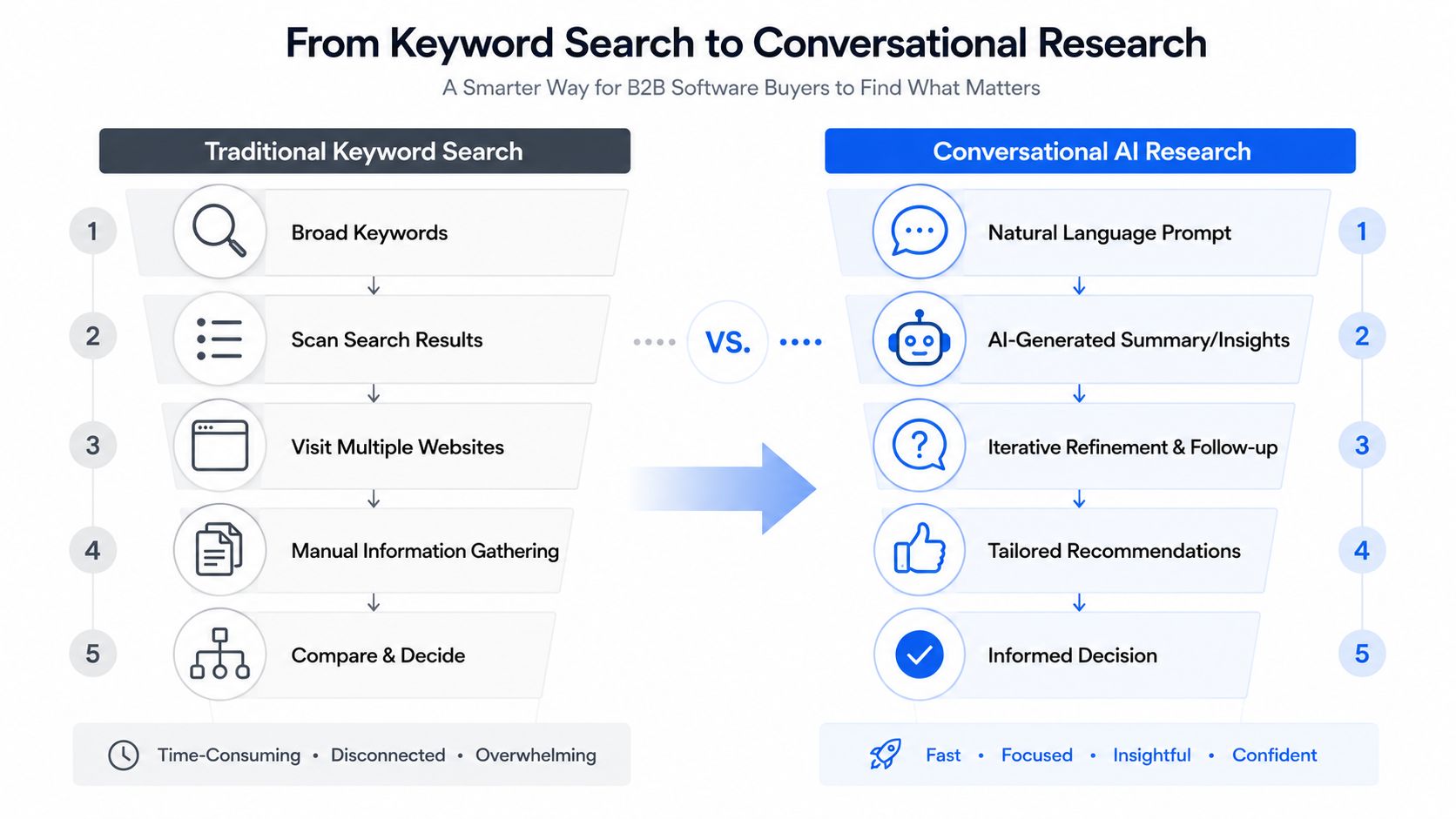
The old search model was blunt. A buyer typed "best HRMS India" and manually stitched the rest together.
The new model is conversational. A buyer asks a layered question, gets a synthesized answer, asks follow-ups, narrows the scope, and reaches a shortlist faster. That's the core change behind how B2B buyers in India use ChatGPT to research software in 2026.
73% of B2B buyers now use AI tools like ChatGPT in purchase research, and buyers are shifting toward "prompt-shaped demand," where they ask full questions or scenarios instead of keywords according to Finance Yahoo's report on AI use in B2B buying.
What prompt-shaped demand looks like in India
An Indian buyer rarely asks for a generic category anymore. They ask for fit.
They'll type something like "What HR software is best for a 150-person Indian SaaS company with hybrid attendance, payroll complexity, and fast onboarding needs?" That's a different retrieval problem than "HRMS India." The model now has to infer company size, geography, operational model, and desired outcome. Your content has to meet that shape.
Here's the practical contrast:
Old search query: best payroll software India
New AI prompt: what payroll software works well for an Indian company with multiple states, compliance needs, and a lean HR team
Old search query: CRM for startups
New AI prompt: what CRM is best for a mid-size healthcare company with a small sales team
The second format is what AI systems are built to answer. If your site still reads like a category landing page from 2022, you're forcing the model to guess.
What your content has to do now
Your pages need to answer complete buying situations in plain language. Not slogans. Not feature lists with vague subheads. Not generic SEO intros.
That means your product, solution, comparison, and industry pages should explicitly cover:
- Who the product fits
- What business problem it solves
- Which scenarios it handles well
- Where it may not be the best fit
- What proof supports the claim
A good starting point is tightening your ChatGPT optimization approach around real buyer prompts instead of keyword clusters. Write pages that sound like answers buyers would trust inside a conversation.
Your buyer no longer searches in fragments. Your content can't stay fragmented either.
If you're an Indian SaaS brand selling finance, HR, martech, vertical SaaS, or workflow software, rewrite your discovery pages around full-sentence buyer scenarios. That's where AI visibility starts.
The Indian B2B Buyers AI Research Journey
Indian buyers don't use AI once and move on. They return to it across the journey.
A procurement lead at a mid-market company might start in ChatGPT for broad discovery, shift to Gemini for a second opinion, use Perplexity to inspect cited sources, and then come back to ChatGPT with narrower prompts before speaking to sales. The model isn't replacing due diligence. It's compressing it.
Awareness starts with local business constraints
At the top of the funnel, buyers are trying to frame the problem correctly. They aren't loyal to your category language. They're translating business friction into a software search.
An Indian finance leader might ask:
- "List Indian SaaS companies that offer GST-compliant invoicing software"
- "What software is good for managing multi-entity billing for an Indian SaaS business"
- "Best support platforms for a B2B SaaS company serving customers in India and the UAE"
Your content goal at this stage is simple. Show that you understand the operating context. If your website only talks about generic automation benefits, you won't get picked up for a buyer asking country-specific questions.
Consideration gets comparative fast
Mid-funnel behavior is where buyers get much sharper. They ask AI systems to compare shortlisted vendors, summarize docs, and spot trade-offs they don't want to piece together manually.
A tech lead or RevOps manager in India might ask:
- "Compare Chargebee, Zoho Billing, and other subscription billing tools for an Indian SaaS company"
- "Which HR platform is better for a 100-person Indian tech startup with hybrid attendance"
- "Compare implementation complexity for CRM tools used by Indian B2B sales teams"
Many SaaS brands fall short. Their comparison content is weak, evasive, or missing. If buyers can't find clean explanations of trade-offs, AI assistants will cite another source that can.
Decision stage prompts are more skeptical
By the time a buyer is close to a decision, the prompts get more forensic.
They'll ask:
- "Analyze recent user reviews for security issues in [competitor name]"
- "Which vendor has better onboarding for an Indian mid-market team with limited admin capacity"
- "What are the downsides of choosing [product category] for a regulated healthcare business in India"
At this stage, buyers want contradiction handled transparently. They want implementation reality, review patterns, and fit guidance. If your brand only publishes polished marketing pages, the AI will pull confidence signals from review platforms and third-party sources instead.
Here's a working framework you can use with your team.
| Buying Stage | Example Buyer Prompt | Your SaaS Content Goal |
|---|---|---|
| Awareness | List Indian SaaS companies that offer GST-compliant invoicing software | Create category and use-case pages that tie product capabilities to India-specific business needs |
| Awareness | What software is good for managing multi-entity billing for an Indian SaaS business | Publish scenario pages built around operational complexity, not just features |
| Consideration | Compare HR platforms for a 100-person Indian tech startup with hybrid attendance | Build comparison pages with clear fit, trade-offs, and ideal customer context |
| Consideration | Which CRM works best for an Indian B2B sales team with a long buying cycle | Write decision-stage pages around sales motion, team size, and implementation needs |
| Decision | Analyze recent user reviews for security issues in [competitor name] | Strengthen third-party review presence and make trust content easy to extract |
| Decision | Which vendor has better onboarding for an Indian mid-market team | Publish onboarding, implementation, and support detail in plain language |
If your content map doesn't reflect awareness, comparison, and validation prompts, your AI visibility will stay shallow.
Your next move is to inventory every major page on your site and assign it to a real buyer prompt by stage. Anything that doesn't map to a prompt is a weak asset in an AI-led buying journey.
Building Trust in the AI Answer Economy
Buyers don't trust AI because it's AI. They trust AI when the answer looks well-supported.
That's already visible in buying behavior. A 2025 study found that 94% of B2B buyers use LLMs during the purchase journey, with usage peaking in the mid-funnel, and 90% of senior decision-makers in markets like the UK trust AI recommendations according to the 6sense-based analysis published by Testimonial Star. The lesson for Indian SaaS isn't "buyers trust machines blindly." It's that buyers trust synthesized evidence when it looks credible.
What makes an AI answer believable
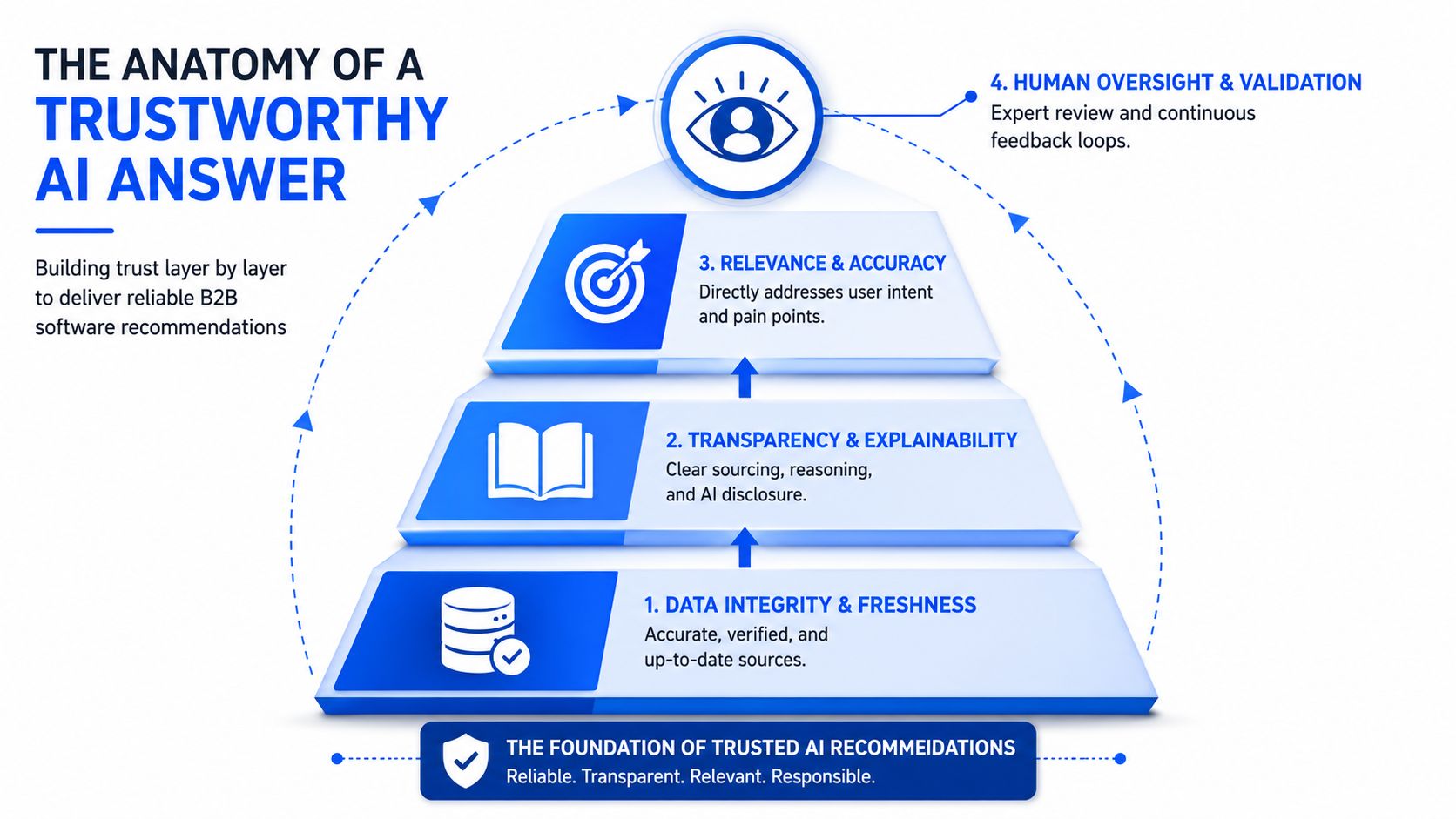
Trust in AI recommendations follows a hierarchy.
First, the model needs clear and current information. Then it needs relevance to the buyer's exact situation. After that, citations matter. A recommendation with visible support from review platforms, company documentation, and credible third-party references feels safer than a generic summary with no proof trail.
Use this trust hierarchy as a working model:
- Base layer: Your product pages, docs, pricing, category positioning, and use-case content have to be accurate and current.
- Middle layer: The answer has to fit the buyer's prompt tightly. Generic relevance isn't enough.
- Proof layer: Citations from places like G2, Capterra, industry publications, and customer evidence reinforce confidence.
- Validation layer: Human review still happens. Buyers click through, inspect the vendor, and test the claim.
A stronger AI content optimization process improves every layer because it gives the model clean material to summarize and cite.
Why citations decide who gets shortlisted
AI assistants don't just need content. They need confirmation.
This is why third-party presence matters so much for B2B software. If your brand claims category leadership but nobody else says it, the model has little reason to surface you confidently. Review platforms, analyst mentions, community discussions, integration directories, and trusted editorial references all help shape that confidence.
We've seen this directly in client work. Whatfix improved AI visibility by 84%, and that lift didn't come from rewriting a few landing pages alone. It came from tightening entity clarity and building a stronger citation environment so models had more trusted paths to reference.
Buyers don't need every source to agree. They need enough independent confirmation to believe the answer.
For Indian SaaS brands, this has a local edge. If your proof only exists in global category language and ignores India-specific use cases, you leave a trust gap. AI systems can name your brand, but buyers still won't feel certain you're right for their context.
The fix is simple in theory and demanding in practice. Build pages that speak clearly. Build citations that back them up. Keep both current.
Your GEO Playbook for Winning in AI Search
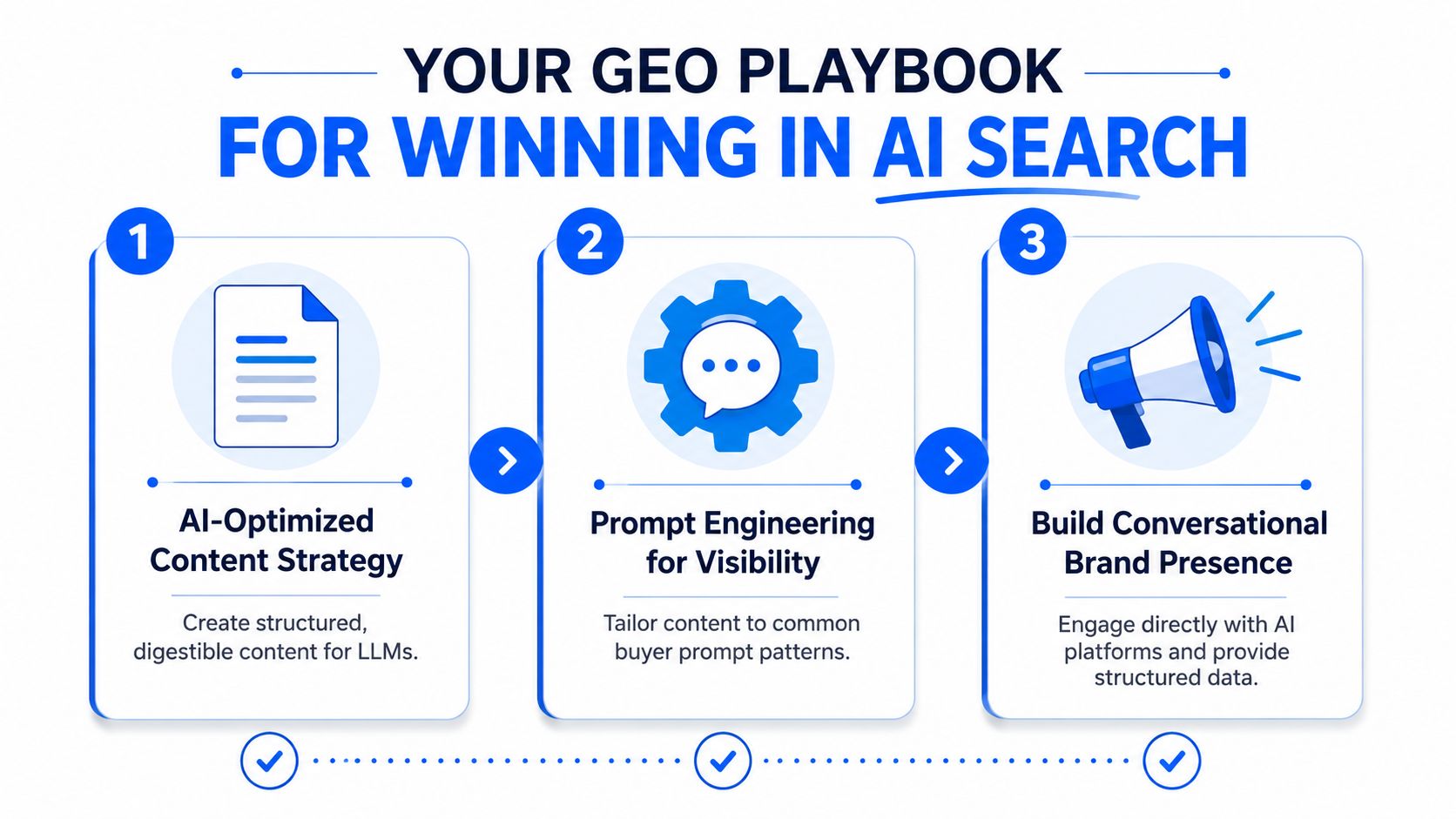
Half of B2B software buyers now start research with AI chatbots, according to PR Newswire's coverage of the latest G2 research. For Indian SaaS CMOs, that changes the job. Your website is no longer just built to rank. It has to be easy for AI systems to identify, retrieve, and cite.
Start with entity authority.
AI models need a clean answer to four questions. Who are you? What category are you in? Which use cases do you serve? Which buyers are the right fit? Many Indian SaaS sites still fail this basic test. They hide behind vague copy like "all-in-one platform for modern teams" or "future-ready solution for growing businesses." That language weakens retrieval because it gives the model nothing precise to repeat.
Fix the basics first:
- State your category in plain language: Use the exact terms buyers use in prompts.
- Define your best-fit account clearly: Mention team type, company size, industry, and region when relevant.
- Keep entity signals consistent: Your website, G2 profile, LinkedIn page, partner listings, and directory descriptions should say the same thing.
- Add India-specific context: If you serve Indian HR, finance, compliance, or operations teams well, say it directly.
We have seen this pattern repeatedly in agency work. Chargebee improved AI visibility by 74% after key pages were rebuilt around clear jobs-to-be-done language and tighter entity framing. That result came from reducing ambiguity.
Then fix retrieval architecture.
A page that reads well to a human can still fail in AI search. Models prefer content blocks they can segment cleanly, summarize accurately, and attribute with confidence. Your product pages, comparison pages, solution pages, and use-case pages should be built for that job.
A strong Generative Engine Optimization framework for SaaS brands should include:
- Scenario-based headings: Use questions and workflows buyers ask about.
- Direct summaries near the top: State product fit, category, and outcome in the first screen.
- Explicit capability statements: Spell out what the product does instead of implying it through design copy.
- Proof attached to claims: Add named customers, integrations, certifications, support coverage, and implementation details where possible.
- Structured markup and clean templates: Help machines separate product facts, FAQs, pricing signals, and trust indicators.
The best AI-cited pages are usually boring in the right way. They are clear, specific, and easy to quote.
The third piece is citation pathway development. Indian SaaS teams often treat this as a PR side project. That is a mistake. If your brand has weak third-party support, AI models hesitate in competitive prompts, especially when the buyer asks for "best tools for Indian mid-market companies" or "vendors used by finance teams in India."
Build citations where buyers and models already look:
- Review platforms such as G2 and relevant software directories
- Editorial mentions in credible B2B and SaaS publications
- Partner and integration pages that confirm product fit
- Community discussions where practitioners compare tools
- Regional proof assets that show India-specific adoption, workflows, or compliance relevance
Keka improved AI visibility by 82% by combining stronger brand-topic alignment with broader citation coverage. That is the playbook Indian SaaS teams should follow. Clear entity signals improve retrieval. Better retrieval improves answer inclusion. Strong citations improve confidence.
If you run marketing for an Indian SaaS company, use this order of operations:
- Find entity confusion across core pages and external profiles.
- Rewrite high-intent pages around use cases, buyer fit, and category clarity.
- Standardize brand descriptions across every profile AI systems may crawl.
- Build citation depth in the sources your category already depends on.
- Run weekly prompt checks across ChatGPT, Gemini, Perplexity, and Claude.
Do this now. Brands that fix retrievability early will shape the shortlist. Late movers will spend the next year wondering why branded traffic looks stable while consideration drops.
Measuring AI Influence Beyond Vanity Metrics
AI influence rarely shows up as a clean referral. An Indian buyer can ask ChatGPT for payroll software for mid-sized companies, read three vendor names, then visit your site later through branded search or direct traffic. If your team only tracks clicks from AI tools, your reporting will understate what is shaping demand.
Counting mentions is lazy measurement. Track whether AI visibility changes who enters pipeline, how prepared they are, and whether your brand appears earlier in shortlist conversations.
What to track instead
Use a measurement model your revenue team can act on:
- Demo form attribution: Add ChatGPT, Gemini, Perplexity, and Claude as explicit options in "How did you hear about us?"
- Sales discovery inputs: Require SDRs and AEs to log whether the prospect arrived with an AI-generated shortlist, comparison, or vendor summary.
- Prompt visibility reviews: Test recurring category, competitor, and use-case prompts every week. Track inclusion, ranking order, and how your brand is described.
- Pipeline quality signals: Watch for changes in win-rate on inbound, deal velocity, and the number of deals where your brand was already known before the first call.
- Geo-specific prompt performance: Check prompts Indian buyers use, such as requests tied to GST, Indian payroll, local data hosting, BFSI compliance, or mid-market pricing expectations.
Run an AI search audit for your category and buyer prompts before you rewrite pages or invest in citation building. Without a baseline, your team cannot tell whether better AI visibility improved discovery or just created more noise.
This is the standard I recommend to Indian SaaS CMOs. Stop reporting "we were mentioned 14 times" as if that proves anything. Report AI-influenced pipeline, shortlist penetration, and sales-call evidence. Those metrics show whether GEO is affecting revenue.
Questions Indian SaaS Leaders Ask About GEO
Is GEO just SEO with a new name
No. SEO helps buyers find your site in search results. GEO decides whether AI systems can retrieve your brand, understand what you do, and mention you in category prompts, shortlist requests, and comparison questions.
Indian SaaS teams that treat GEO as a relabelled SEO project move too slowly. You need page clarity, entity consistency, third-party citations, review signals, and comparison content built for AI retrieval, not just rankings.
Does GEO matter if we sell a niche B2B product
It matters more.
Indian buyers use very specific research prompts tied to implementation realities such as GST workflows, India data residency, payroll complexity, BFSI requirements, multi-entity accounting, and mid-market budget limits. A niche SaaS company can win these prompts if its site and citation footprint clearly connect the product to those use cases. A generic category page will not do that job.
Where should an Indian SaaS company start first
Start with pages that influence shortlist decisions.
Fix product pages, use-case pages, industry pages, integration pages, competitor comparisons, pricing context, and review profiles first. Then clean up entity signals across your website, LinkedIn, software directories, and founder or leadership mentions. Blog production comes later. If your commercial pages are vague, AI systems will describe you vaguely, or skip you entirely.
Which platforms matter most for Indian B2B software discovery
ChatGPT gets the attention, but Indian buyers do not stop there. They verify in Gemini, Perplexity, and Claude, especially for software comparisons, procurement justification, and implementation research.
That means your GEO program cannot depend on one platform trick. Build coverage that holds up across models. Keep naming consistent. Make feature descriptions precise. Publish pages that answer category-plus-context questions the way Indian buyers ask them.
How do we measure the dark funnel effect of AI research
Use a practical model. Do not wait for perfect attribution.
Buyers often research through AI, shortlist vendors, and then arrive direct, branded, or through sales outreach that gets credit instead. That is why teams miss the influence. The answer is to combine prompt tracking, CRM notes, self-reported attribution, and pipeline review. TraxTech's discussion of AI-driven supplier research shows the same pattern in B2B buying behavior: AI shapes vendor evaluation before a measurable click appears on your dashboard.
If your team still cannot answer whether AI visibility is improving shortlist entry, pipeline quality, or sales-call familiarity, fix that now.
If your brand is absent from AI answers, competitors get considered before your SDR team ever sees the account. LLMBuddy helps Indian B2B SaaS companies improve visibility across ChatGPT, Gemini, Perplexity, and Claude through AI SEO services and AI visibility optimization. If you want to see how this works in practice, review our case studies or request a demo. Written from the field by Ankur Pandey and the team working on GEO for Indian SaaS brands every week.