
Only a small share of SaaS brands get selected in AI answers buyers can act on. The rest are absent, buried in generic lists, or framed as weaker options.
If you're asking why ChatGPT is not recommending your SaaS brand, the problem is usually not prompt randomness. It is poor AI visibility. Teams still obsess over Google rankings, then act surprised when an assistant pulls a competitor with clearer positioning, cleaner entity signals, and easier-to-cite proof.
We see the same failures in audit after audit for B2B SaaS companies. Category pages are written for keyword coverage instead of extractability. Product marketing hides differentiation behind vague copy. Engineering ships crawl controls that block AI retrieval. The result is predictable. Your brand is harder to identify, harder to compare, and harder to trust inside model-generated answers.
This is the gap AI visibility optimization for SaaS brands is built to fix.
This article is a diagnostic guide, not another generic warning that AI matters. We audit SaaS brands for AI visibility every day, and the patterns repeat. Brands disappear because their content is structurally weak, their authority signals are scattered, and their websites fail basic retrieval checks. Fix those three areas first. That is what changes recommendation rates.
Your SaaS Is Invisible Where Buyers Now Look
That low recommendation rate mentioned earlier is not a vanity metric. It shows a distribution problem. Buyers are already using AI assistants to shortlist vendors, compare options, and sanity-check category leaders. If your brand does not appear in those answers in a clear, credible way, you lose consideration before a prospect ever visits your site.
Many SaaS CMOs still treat AI visibility like a side effect of SEO. That assumption is expensive. ChatGPT, Gemini, Claude, and Perplexity do not reward the brand with the most pages or the biggest blog archive. They surface the brand they can identify fast, verify fast, and explain fast.
That is why well-known SaaS companies still vanish.
In our audits, the pattern is blunt. Teams have traffic, branded search, and decent rankings, but their category pages are vague, their comparison pages are thin, and their proof is buried in PDFs, tabs, or product tour videos that are hard to retrieve. An assistant looking for a direct answer skips that mess and cites the competitor with cleaner evidence.
Mentioned is weak. Recommended is what drives pipeline.
A passing mention in an AI answer does little. Buyers act on the brands the model frames as a fit for a specific use case, budget, team size, integration stack, or compliance need.
That difference matters because AI compresses the shortlist. In a normal search flow, a buyer might open ten tabs and do the comparison work themselves. In an AI flow, the model does that compression for them. If your brand is not presented as a strong match, you are invisible in the moment that shapes the shortlist.
Practical rule: If AI assistants mention your brand but rarely present it as a top fit, your issue is not awareness. Your issue is weak evidence, poor structure, and bad retrieval readiness.
This is exactly what we diagnose in day-to-day audits. The problem is usually not a lack of content. It is content built for ranking reports instead of extraction. It reads like marketing copy, avoids direct comparisons, hides specifics, and gives the model nothing sharp enough to cite.
Your current playbook is built for clicks, not inclusion
Old SEO programs chase visits. AI visibility work chases answer inclusion. Different objective. Different inputs. Different content standards.
You need to test your brand across commercial, alternative, replacement, and best-for prompts in every major assistant your buyers use. Then map where you disappear, where competitors get cited, and which pages fail to support retrieval. Start with an AI visibility optimization audit for SaaS brands and fix the pages that should be earning recommendation-level treatment.
Stop asking whether AI search matters. Check whether buyers can find, compare, and trust your brand inside AI answers right now.
How AI Assistants Actually Choose and Cite Brands
Many organizations still talk about AI visibility as if it comes from vague "training data." That's lazy thinking. The systems your buyers use today often work through retrieval, filtering, and answer assembly. In plain English, the model doesn't just remember things. It looks things up, weighs source trust, and then writes the answer.
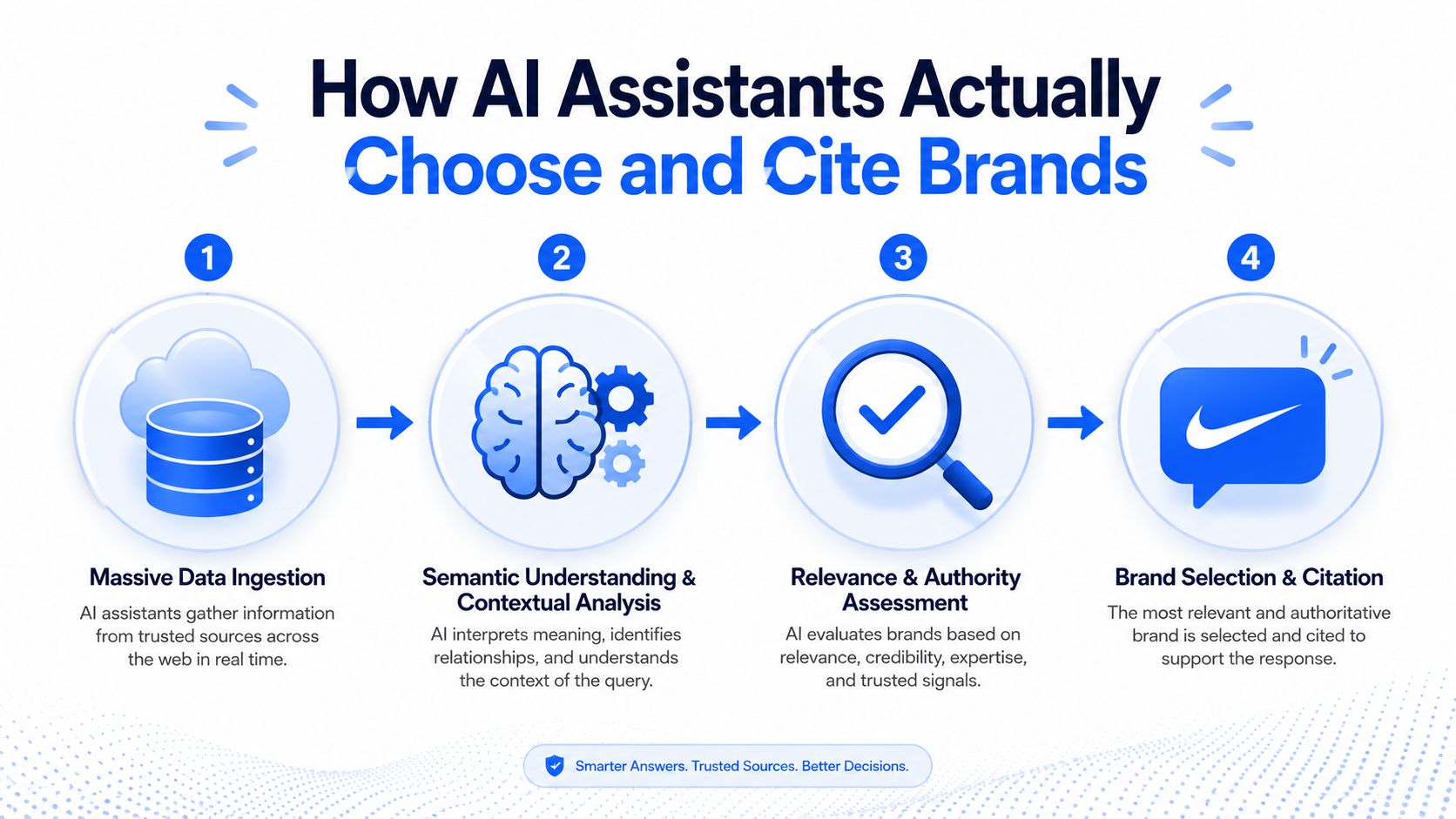
Think of RAG like a consultant with a tiny research stack
ChatGPT, Gemini, Claude, and Perplexity don't browse the whole internet in a neutral way for every answer. They behave more like a smart consultant under time pressure. The consultant already knows your category, but before giving a final answer, they check a small stack of recent, high-trust material.
If your brand isn't in that stack, you won't be cited. If your competitor is on G2, Capterra, review roundups, editorial comparisons, and recent press coverage, they look safer to mention.
A GEO program exists to increase the odds that your brand lands in that stack. That's the primary purpose of Generative Engine Optimization.
Why third-party context beats self-published claims
The strongest signal for AI visibility is contextual third-party brand mentions in authoritative editorial content, and those mentions outweigh backlink quantity or domain authority metrics, according to this video discussion on AI visibility signals. That should force a strategy shift immediately.
Your own website still matters. But AI systems trust consensus more than self-description. If ten good sources describe your product consistently, the model gains confidence. If only your homepage says you're a category leader, the model has no reason to repeat it.
A separate GEO case study also found that adding fact-dense content with external authority sources increased citation inclusion by 3X, as shown in Go Fish Digital's GEO case study. The lesson isn't "write more blog posts." The lesson is "create pages and references the model can safely cite."
AI doesn't reward your opinion of your brand. It rewards evidence that other trusted sources repeat.
Structure decides whether AI can extract your answer
Even when a model reaches your site, poor formatting kills visibility. LLMs prefer direct answers to natural language questions, clear headers, semantic HTML, and machine-readable structure. Pages built around vague headers like "Platform" or "Solutions" are weaker than pages answering buyer questions directly.
We've seen this with clients whose pages improved after restructuring feature content into buyer-led questions and making entity signals consistent across the web. Ankur Pandey and our audit team keep finding the same thing. Most invisible SaaS brands aren't under-published. They're under-structured.
Fix that before you publish one more generic comparison blog.
The Five Failures Keeping Your SaaS Brand Invisible
Nearly half of B2B SaaS brands miss AI recommendations for category searches. In our audits, the reasons are rarely mysterious. They are operational failures that show up again and again across sites, review profiles, and technical setups.
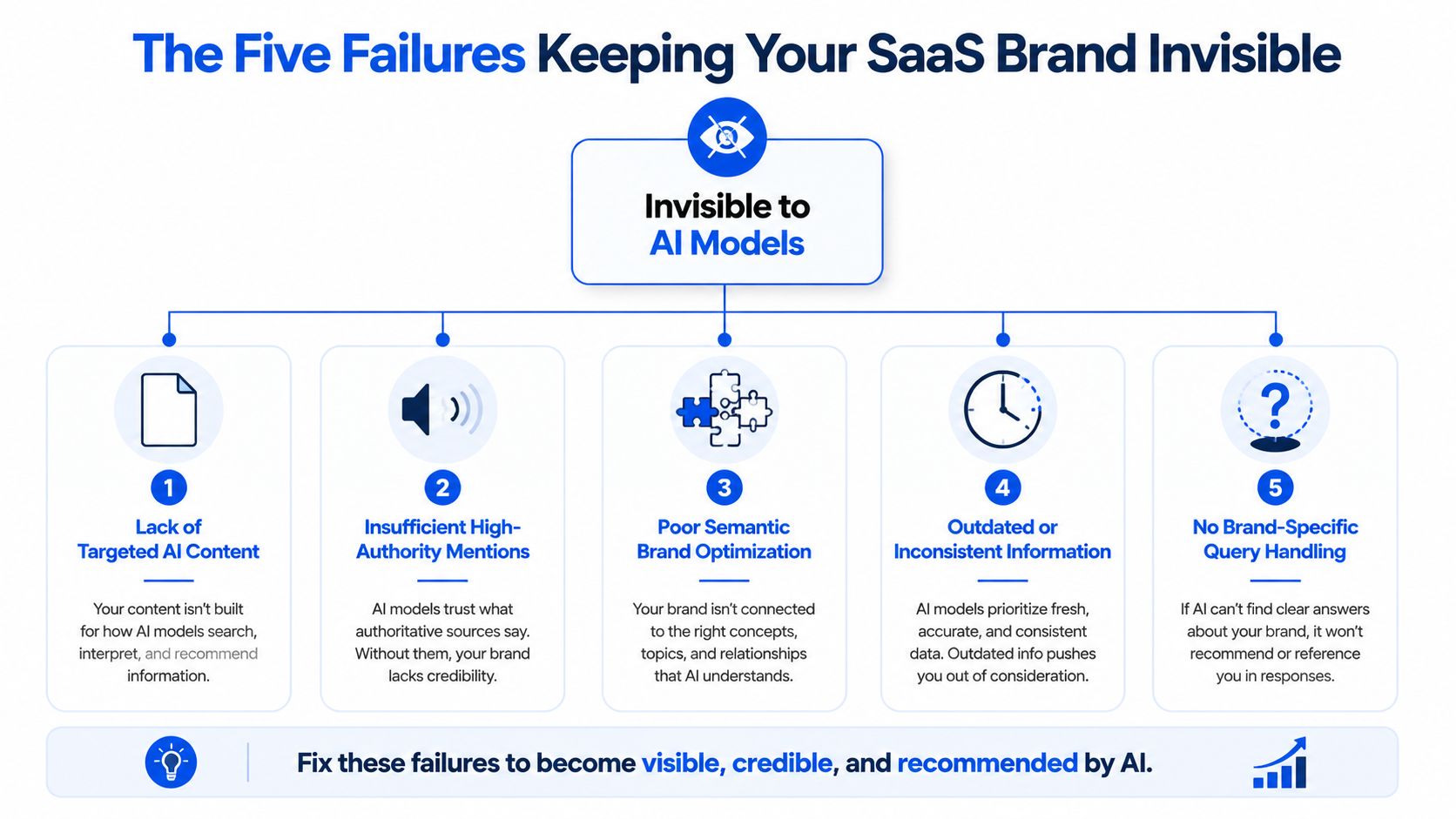
These are the five patterns we see every week when SaaS CMOs ask why competitors get named in ChatGPT while their brand gets ignored.
Failure one is entity ambiguity
AI systems need a clean answer to three questions. Who are you? What category are you in? What should your brand be associated with?
A surprising number of SaaS companies fail that basic test. Their homepage says one thing, LinkedIn says another, G2 uses a third label, and partner pages describe a fourth use case. Some even switch between product-led branding and vague category inflation depending on the page. That breaks retrieval and makes your brand harder to place in a buyer query.
What to fix now
- Standardize your category statement: Use one clear descriptor across your homepage, review profiles, company bios, and author pages.
- Align entity references: Keep your organization details, social profiles, and company metadata consistent everywhere your brand appears.
- Stop casual category drift: If you sell payroll software, do not call yourself a workforce OS, HR suite, and finance automation platform unless you have a deliberate entity strategy.
Failure two is weak citation pathways
AI assistants pull from sources they already trust. If your brand has no presence in those source sets, you stay invisible even if your site content is good.
This is the mistake outdated SEO teams keep making. They publish another feature page and expect inclusion to improve. It will not. If competitors are mentioned across review platforms, comparison pages, community discussions, and editorial roundups, they have more routes into the answer. You have fewer.
Diagnostic question: Run your core category prompts in ChatGPT, Perplexity, and Gemini. List the domains that show up repeatedly. If your brand is missing from those domains, you have a distribution problem, not a publishing problem.
Failure three is extraction-unfriendly content
A lot of SaaS sites are built for polished demos, not machine extraction. Tabs hide key answers. Pricing lives in images. Headers are vague. Important commercial details sit behind JavaScript components that fail to render cleanly.
That setup costs you citations.
LLMs respond better to pages that answer buyer questions directly and in plain text. "How much does it cost?" beats "Plans." "Who is this for?" beats "Solutions." "Does it integrate with Salesforce?" beats a generic integrations grid with no supporting copy.
| Page pattern | What AI sees |
|---|---|
| Vague headers and hidden tabs | Fragmented meaning |
| Direct question-based sections | Clear extractable answers |
| Heavy JS-rendered blocks | Missing or partial content |
| Plain text pricing and FAQs | Strong decision signals |
Pick one high-intent page and rewrite it this week. Use question-led headers, visible answers, and crawlable text.
Failure four is technical blockage
This failure is common and completely avoidable. AI crawlers get blocked by robots.txt rules, CDN settings, security tools, or front-end choices that hide content from anything that is not a browser.
Your traffic dashboard will not warn you clearly. Your SEO team may not catch it. Your developers may assume server-side rendering is working when key commercial copy still loads too late or not at all for retrieval systems.
Run an AI search visibility audit for crawler access and rendering issues. Check GPTBot and OAI-SearchBot access, rendered HTML output, and whether core product pages expose usable text without client-side dependencies.
Failure five is missing semantic structure
Good copy is not enough if the page gives weak structural signals. AI systems need help identifying what the page is, what the product does, and which blocks answer product, pricing, integration, or comparison questions.
That means schema. It means semantic HTML. It means consistent labels for your product, company, features, and use cases.
We keep seeing the same failure in audits. SaaS brands publish solid information, then wrap it in weak markup and inconsistent page architecture. The result is predictable. The model can read parts of the page, but it struggles to classify the page confidently enough to cite it.
If your brand is missing from AI answers, stop asking only what content to create next. Diagnose whether the model can identify, extract, and trust what you already published.
Why Brand Mentions Outweigh Backlinks for AI
Backlinks still matter for Google. They are not the deciding factor for whether an AI assistant includes your SaaS in an answer.
What matters more is whether your brand keeps showing up in credible, category-relevant sources with the right surrounding context. AI systems retrieve passages, synthesize patterns, and favor brands that appear repeatedly in buyer-facing discussions. That shifts the job from chasing raw link metrics to earning presence in the sources models keep pulling from.
AI reads category presence, not PageRank proxies
A search engine uses links to estimate authority and relevance. An LLM uses retrieved evidence to decide which brands belong in the answer set.
That distinction changes your priorities fast. A backlink from a generic site with inflated authority scores may help organic rankings a bit. An unlinked mention in a respected buyer guide, software comparison, industry publication, podcast transcript, community thread, or review profile often does more for AI visibility because it places your brand inside a believable category narrative.
This is the pattern we see in audits every week. The brands that get cited are rarely the ones with the noisiest link-building program. They are the ones mentioned consistently across review platforms, editorial lists, partner ecosystem pages, implementation discussions, and comparison content.
Third-party review and comparison ecosystems matter a lot here. G2, Capterra, analyst-style roundups, and alternative pages appear in retrieval far more often than SaaS teams want to admit.
What to change
Stop rewarding your team for link volume. Reward them for mention quality, source relevance, and retrieval frequency.
| Old SEO habit | Better GEO move |
|---|---|
| Chase links from any site with authority metrics | Earn mentions in category-relevant editorial and review sites |
| Publish top-of-funnel blogs for volume | Build comparison, pricing, and buyer-decision assets |
| Measure ranking movement only | Measure whether AI systems cite and recommend your brand |
| Treat PR as branding | Treat PR as input for AI retrieval and brand trust |
We have seen the same outcome across SaaS audits. Brands improve AI visibility when three things tighten up together: stronger third-party mention coverage, clearer entity consistency, and pages written so models can extract product facts without guesswork. No single tactic fixes invisibility. The stack does.
A mention without a link still helps if it puts your brand in the right category on a source AI systems trust.
That should change how you brief content and PR teams. Stop asking writers to "build backlinks." Tell them to publish source-worthy commercial pages, create comparison assets buyers search for, and support digital PR that gets your brand named in the publications and review hubs AI assistants retrieve from. If your product, pricing, and use-case pages still read like SEO copy instead of machine-readable evidence, fix them with AI content optimization for retrieval-ready commercial pages.
The LLMBuddy Playbook for AI Search Visibility
74% of SaaS brands ranking in Google's top three for “best [category]” still fail to earn AI mentions, according to RankZero's write-up on SaaS brands missing from ChatGPT. That gap exists because AI visibility is not a content volume problem. It is a retrieval, clarity, and trust problem.
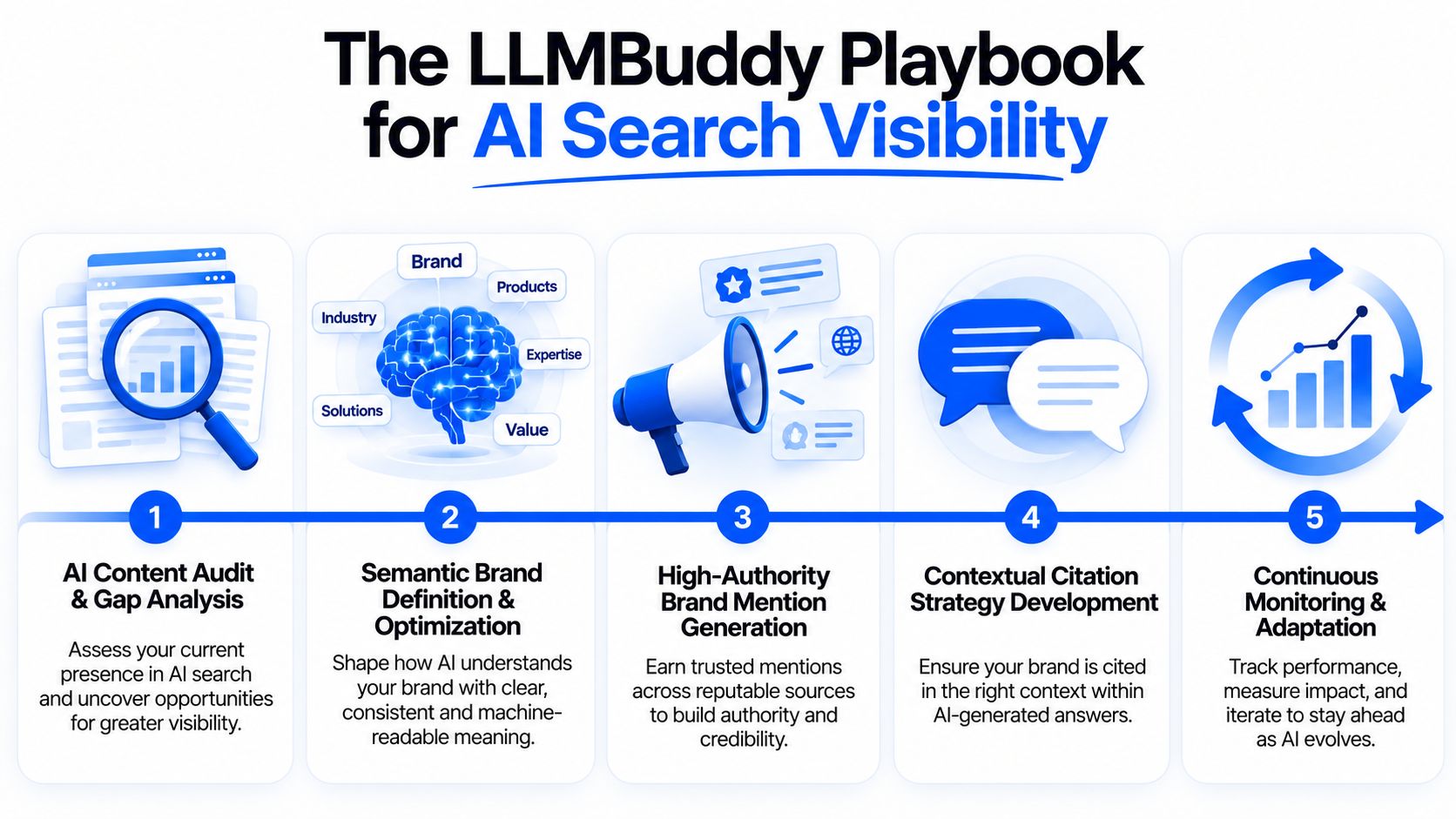
This is the playbook we use in audits. It is not theoretical. It is the sequence that exposes why a SaaS brand gets ignored in ChatGPT, Gemini, Perplexity, and Claude, then fixes the highest-impact failures first.
Start with an audit, not publishing
Publishing more blog posts before diagnosis wastes time.
First, establish a baseline across the prompts that influence shortlist creation: category queries, comparison terms, alternatives, migration searches, and direct brand questions. Check which competitors appear, which sources get cited, and which of your pages are accessible to crawlers and retrievers. Then inspect how your brand is described across your own site, review platforms, social profiles, and third-party editorial mentions.
LLMBuddy runs this as a structured AI search audit. Your team can do it internally if you have the discipline. What matters is that you measure visibility across assistants, source inclusion, and extractability before you touch the content roadmap.
Fix retrieval blockers before rewriting copy
CMOs often jump straight to messaging. That is backwards.
If your pricing page is blocked, your comparison pages rely on JavaScript rendering, or your core product facts sit inside tabs and accordions, the model has little to work with. It will cite the brand that made retrieval easy. That brand wins even with weaker traditional SEO.
Work through the machine-readable layer first:
- Open crawler access: confirm that AI-facing bots and standard search crawlers can reach pricing, product, comparison, and solution pages
- Reduce rendering friction: put key product facts in visible HTML, not hidden states or client-side scripts
- Add clear schema: use organization, product, and FAQ markup where the page content clearly supports it
- Clean up entity signals: keep your company name, product naming, category labels, and descriptions consistent across public profiles and databases
This work is technical, boring, and often the fastest path to results.
Rebuild the pages AI uses to make decisions
AI assistants do not recommend SaaS tools because the homepage sounds polished. They recommend the brands they can classify quickly and defend with cited evidence.
That means your commercial pages need to answer buying questions in plain language. No vague positioning. No filler copy. No hiding the hard details a buyer needs.
Use this standard:
| Page type | What it should answer clearly |
|---|---|
| Pricing page | Cost structure, packaging logic, what changes by tier, who each plan fits |
| Comparison page | Which buyer should choose you, where you differ, where you do not |
| Alternatives page | Why a switch makes sense, what improves after the move, what tradeoffs exist |
| Use-case page | The exact team, workflow, problem, and outcome the product supports |
If a model cannot extract a clean answer to “Who is this for?”, “What does it cost?”, and “Why choose it over X?”, your page is underbuilt.
Build source coverage that stays fresh
Once your site is retrievable and your commercial pages are usable, expand the source footprint around your brand.
AI systems pull from what they can retrieve and trust. If your brand has thin coverage in review sites, category roundups, community discussions, analyst pages, and current editorial mentions, you leave too much of the recommendation case for the model to infer. It usually will not. It will choose the brand with more direct evidence.
Set a recurring program:
- earn mentions in category-relevant publications and buyer research sources
- keep review profiles active with current descriptions and recent customer proof
- refresh pricing, comparison, and solution pages on a set cadence
- rerun prompt tests monthly across the major assistants
- track which domains appear in citations, not just whether your brand appears once
The goal is coverage, consistency, and recency across the exact questions buyers ask before they book a demo. That is the standard. If your team is still measuring success by traffic growth alone, they are looking at the wrong scoreboard.
Frequently Asked Questions on GEO Strategy
Does my pricing page really affect whether ChatGPT recommends us
Yes. It often decides whether you make the shortlist at all.
In AI visibility audits, one failure shows up constantly. The model finds the brand but cannot verify pricing, plan structure, implementation fit, or buyer type. That is enough to lose high-intent prompts like "best X for a mid-market team" or "alternatives to Y."
A weak pricing page creates the same outcome whether the problem is a hidden URL, a vague "contact sales" gate, or content buried in scripts a crawler struggles to read. The assistant has weak commercial evidence, so it cites the vendor with clearer, extractable facts.
Fix the page. State starting price, who each plan fits, what changes between tiers, what is capped, and when a buyer needs sales help.
Is GEO just SEO with a new label
No. Treating it that way is why so many SaaS teams stay invisible.
SEO is built to win visits. GEO is built to get your brand named inside the answer. That changes the job. Rankings still help, but they do not solve retrieval, entity clarity, comparison coverage, or citation trust.
Teams that frame GEO as a keyword project waste time on content volume. Teams that improve visibility fix evidence quality first.
Should we block AI crawlers to protect our content
If you want to be recommended, blocking broad AI access is usually self-sabotage.
These systems need to read your pricing, product pages, documentation, and comparison content. Shut that off and you remove the raw material they use to evaluate you. Competitors stay readable. You disappear.
If legal constraints require limits, apply them with precision. Keep core commercial and product content accessible.
How long does it take to improve AI visibility
It depends on what is broken, not on a generic benchmark.
Technical failures move fastest. If crawlers cannot access key pages, schema is broken, or your pricing and comparison pages are too thin to parse, fixes can change inclusion quickly. Off-site evidence takes longer because you need fresh mentions, updated profiles, and stronger third-party confirmation.
Stop asking for a single timeline. Identify the blocking issue, then fix the highest-impact one first.
Which platforms should we check first
Start with ChatGPT, Gemini, Perplexity, and Claude.
Do not stop at one prompt or one screenshot. Test category terms, competitor comparisons, alternatives queries, implementation questions, pricing intent, and direct brand checks. A brand can appear in one assistant and vanish in another. It can also show up for broad category prompts and fail completely when buyers ask for comparisons or budget guidance.
Use the same prompt set every month. Track inclusion and cited domains.
What should an Indian SaaS CMO fix this quarter
Cut generic thought-leadership output until the commercial layer is usable by AI systems.
Prioritize the work in this order:
- Make core product, pricing, docs, and comparison pages fully crawlable.
- Rewrite pricing, alternatives, and versus pages so buyer fit, plan logic, limits, and tradeoffs are easy to extract.
- Standardize brand entities across your site, review platforms, company profiles, and major mentions.
- Increase current coverage in buyer-trusted publications, directories, communities, and review sources.
- Run recurring prompt audits and track citation sources, not vanity screenshots.
This is what changes recommendation coverage. More top-of-funnel content usually does not.
If your brand ranks in Google and still fails to appear in ChatGPT, Gemini, Perplexity, and Claude, your team has a visibility problem, not a traffic problem. LLMBuddy works with B2B SaaS teams to diagnose why AI assistants skip them, fix the technical and content gaps that suppress citations, and improve recommendation coverage across the major platforms. If you need a next step, get an audit or book a working session.