
Most advice on LLM search optimization is still stuck in SEO logic. Publish a few FAQ pages, add schema, wait for ChatGPT to notice you. That's lazy advice, and for B2B SaaS it fails fast.
Your buyers aren't asking Google for ten blue links anymore. They're asking ChatGPT, Gemini, Perplexity, and Claude for vendor shortlists, pricing comparisons, migration options, and implementation risks. If your brand isn't present in those answers, your pipeline loses before sales ever hears the account name. That's why LLM search optimization isn't a side project for your content team. It's a visibility system for AI-led buying journeys.
At LLMBuddy, we've seen this gap repeatedly in Indian SaaS. Brands with strong SEO still disappear in AI answers because they never built machine-readable authority, retrieval-ready pages, or a reliable citation pathway. That's exactly the gap we've worked on with teams like Chargebee, Whatfix, and Keka.
Your Google Rank Is High But AI Answers Ignore You
If your team still assumes strong Google rankings will carry over into AI answers, fix that assumption first.
A 2026 report on LLM SEO for B2B SaaS found that 68% of top-10 Google pages for B2B SaaS queries are absent from ChatGPT, Perplexity, and Gemini answers. This is the core problem. Your SEO team may be winning rankings while your brand loses the recommendation layer that buyers now trust for shortlist creation.
Why SEO strength doesn't guarantee AI inclusion
Search engines rank pages. LLMs assemble answers.
That changes what matters. AI systems don't just look for keyword-targeted pages with backlinks. They look for clean facts, stable entity signals, third-party validation, and extractable answers. If your site reads well to humans but looks messy to machines, you get skipped.
Here's where most SaaS teams get this wrong:
- They overvalue rankings: A page can rank for a commercial keyword and still be absent from AI answers.
- They underinvest in entity clarity: If your pricing model, product category, customer fit, and differentiators aren't stated cleanly, models won't form a reliable brand profile.
- They ignore external trust signals: Review sites, comparison pages, and industry mentions often shape retrieval far more than your own product page copy.
High Google rank is distribution. AI citation is interpretation. You need both.
We've seen this with clients that came in with mature SEO programs but weak AI visibility. Chargebee is one example. After fixing the gap between search performance and AI retrievability, the brand saw a +74% visibility lift in our program. The point isn't that SEO stopped mattering. It didn't. The point is that SEO alone stopped being enough.
What your content strategy needs to change
Your content can't just persuade a human reader anymore. It must also support extraction, grounding, and citation by machines. That means your category pages, comparison pages, feature explainers, implementation docs, and FAQs need to be written for retrieval, not just ranking.
If your team hasn't reworked key pages for AI content optimization, start there. Don't publish another generic thought-leadership post until your money pages are properly usable by AI systems.
Your immediate move is simple. Stop asking, “Do we rank?” Start asking, “Do AI systems cite us when buyers ask commercial questions?”
Start with an AI Search Audit
Too often, page copy changes begin far too early. That's backwards. You need a baseline before you edit anything.
The market shift is already large enough to justify this work. TTMS' forecast on LLM-powered search projects that by 2030, LLM-based search systems will command over 50% of global search query volume, with some analysts forecasting that half of all informational searches could migrate to AI by 2028. If that trend is directionally right, waiting for “more proof” is a management mistake.
What a real audit should measure
A serious AI search audit doesn't track only rankings. It checks how often your brand appears, how often it's cited, what claims are attached to it, and which competitors are getting recommended instead.
Track these five things first:
| Audit area | What you need to inspect |
|---|---|
| Brand inclusion | Whether ChatGPT, Gemini, Perplexity, and Claude mention your brand for core commercial prompts |
| Citation pattern | Which pages, directories, and third-party sources show up with your brand |
| Category fit | Whether AI describes you in the right category and use case |
| Competitor displacement | Which rival brands are recommended in prompts you should own |
| Accuracy risk | Whether models state wrong pricing, features, integrations, or positioning |
That last point matters more than most CMOs think. If an AI answer misstates your implementation model or compares your feature set to the wrong competitor, your brand loses trust before the first demo request.
Benchmark against three real competitors
Don't audit in isolation. Compare your visibility against the three vendors your buyers most often evaluate alongside you.
If you sell HRMS software, compare against the names prospects inquire about. If you're in product adoption or billing infrastructure, do the same. A standalone score means nothing without context. What matters is whether you appear in recommendation sets and whether your competitors dominate those sets.
Practical rule: Audit prompts that reflect buying intent, not vanity. “Best tools for X,” “alternatives to Y,” “compare A vs B,” “enterprise solution for Z,” and “pricing for teams over 500 employees” are more useful than generic top-of-funnel prompts.
In our audits, we map prompts by funnel stage and platform. ChatGPT may surface one source set, Perplexity another, Gemini another. That breakdown shows where to intervene. One option for teams that want a structured baseline is LLMBuddy's AI visibility optimization workflow, which tracks platform-level presence and citation movement over time.
What to do after the audit
You should leave the audit with an opportunity map, not a spreadsheet graveyard.
That map needs clear decisions:
- Fix pages already close to inclusion: These usually need better structure, clearer answers, and stronger extraction points.
- Correct misinformation fast: If AI systems state outdated or wrong claims, update your site and the third-party pages that shape retrieval.
- Prioritize high-conversion prompts: Don't spread effort evenly. Put resources behind prompts that influence shortlist, demo, and vendor comparison behavior.
If your audit doesn't tell you where revenue risk sits, it's not an audit. It's reporting theater.
Define Your Entity and Build Your Knowledge Graph
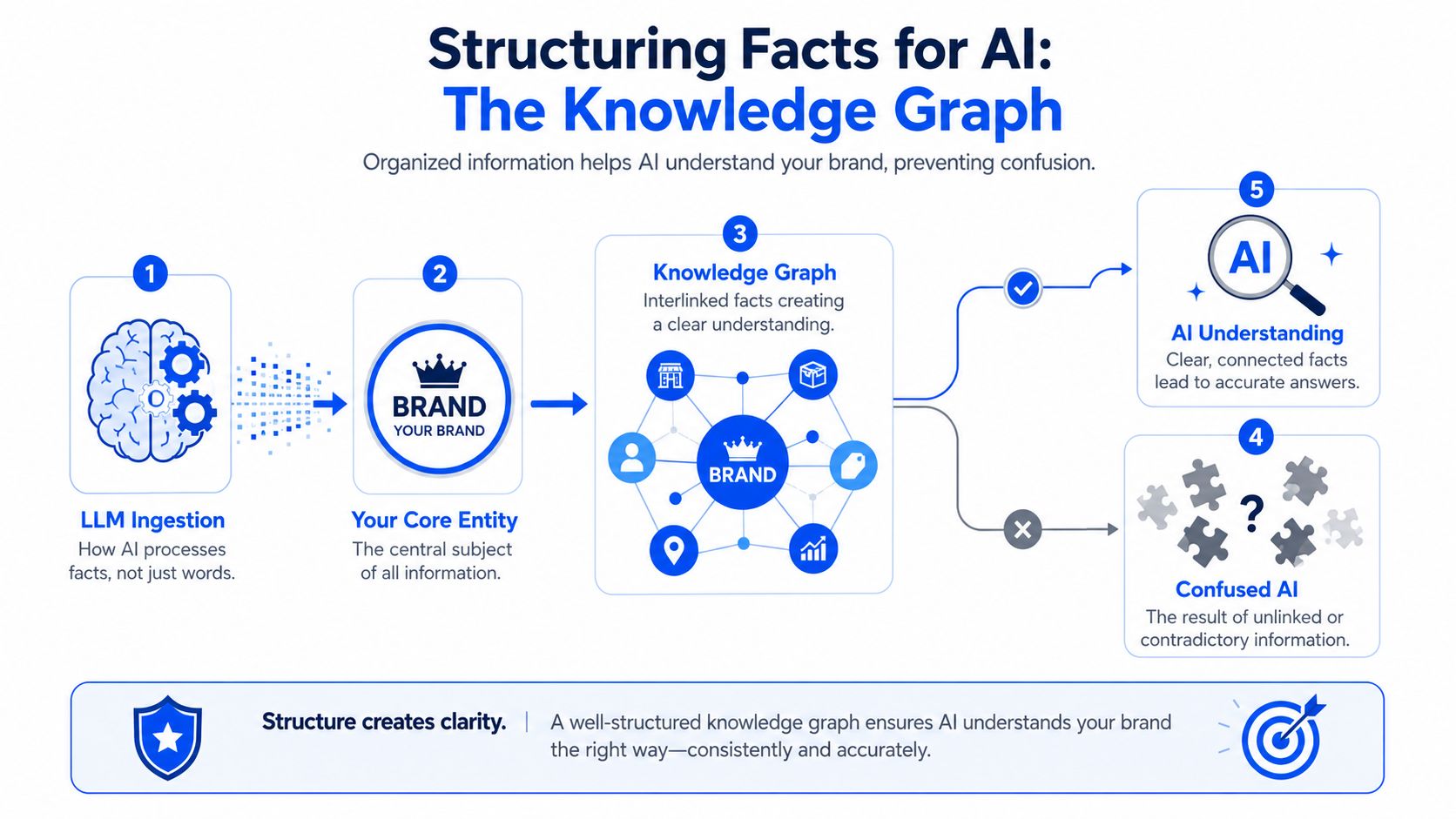
AI systems don't understand your company the way your sales team does. They build a probabilistic view from facts scattered across your site and the web. If those facts are inconsistent, incomplete, or buried, your brand becomes fuzzy.
That's expensive. According to the 2025 State of LLM Optimization Report, entities with high clarity receive 4–7× more AI mentions, while brands that maintain consistent citations across the web appear 38% more often in AI engine responses.
What your entity actually is
For a B2B SaaS company, your entity is the machine-readable version of who you are.
Not your brand campaign. Not your homepage slogan.
It includes facts like:
- Category definition: What software class you belong to
- Core use cases: The problems you solve and for whom
- Feature set: The capabilities tied to those use cases
- Buyer fit: SMB, mid-market, enterprise, industry-specific, region-specific
- Commercial model: Free trial, demo-led, custom quote, annual contract, usage-based pricing
- Proof points: Customer segments, integrations, certifications, review profiles, external mentions
If these details are fragmented across five pages and three wording styles, AI systems won't connect them cleanly.
How to build a usable knowledge graph
Start with a single source of truth. Your team should document the facts you want models to consistently associate with your brand. Keep it short, explicit, and stable.
Here's a practical structure:
| Entity layer | Example for a SaaS brand |
|---|---|
| Brand | Product name and company name |
| Category | Subscription billing platform, digital adoption platform, HRMS, etc. |
| Audience | CFO teams, product teams, HR leaders, enterprise IT |
| Jobs to be done | Reduce churn, improve onboarding, automate payroll, shorten implementation |
| Evidence | Review profiles, implementation docs, pricing pages, case studies, partner listings |
Then publish those facts repeatedly, with consistent wording, on your own site and trusted third-party properties.
If your homepage says one thing, your G2 profile says another, and your comparison pages imply something else, the model won't “figure it out.” It will downgrade confidence.
Many Indian SaaS brands frequently lose ground at this juncture. Their websites speak in broad positioning language, but buyers ask narrow operational questions. “Which billing platform supports enterprise subscriptions?” “Which HR software fits Indian payroll complexity?” “Which onboarding tool works for large product teams?” Your entity has to answer those patterns directly.
What we've seen in practice
This step has been central in our work with Whatfix and Keka. Both saw visibility growth above 80% in our program, with Whatfix at +84% and Keka at +82%, after clarifying entity signals, tightening message consistency, and improving how machine-readable facts appeared across owned and external surfaces.
The takeaway for your team is straightforward. Stop treating brand positioning as a creative exercise only. For AI visibility, positioning has to become structured data, repeated claims, category consistency, and externally reinforced facts.
If you can't describe your brand in a way a machine can parse without guesswork, you're not ready for inclusion at scale.
Implement Technical Foundations for AI Retrieval
A strong entity still won't help if crawlers can't read your site properly.
Many B2B SaaS teams undermine their own efforts. Product marketers create smart pages. Designers add tabs, accordions, animations, and JavaScript-heavy layouts. Then AI systems fail to extract the facts that matter. The result is predictable. According to LLM Refs' analysis of LLM SEO pitfalls, blocking AI crawlers through misconfigured robots.txt or hiding content in client-side JavaScript can cause a 40–60% drop in citation visibility compared to server-rendered, clean HTML pages.

The first pillar is clean page structure
Your key commercial facts should appear in server-delivered HTML. Not hidden behind tabs. Not loaded after user interaction. Not locked inside JS components that a crawler may miss.
Use obvious heading hierarchy. Keep your H1 to H3 structure logical. Put direct answers near the top of the page. If a buyer asks, “Who is this for?” or “What integrations does this support?” that answer should be visible in plain HTML.
A simple retrieval-ready page often includes:
- Short answer blocks: Clear responses under question-based subheads
- Scannable tables: Pricing, features, migration notes, implementation scope
- FAQ sections: Especially for commercial and category-level prompts
- Explicit claims: Named use cases, target customers, and product boundaries
The second pillar is structured data
Schema helps machines classify what they're seeing. For B2B SaaS, JSON-LD should expose core organizational and page-level facts cleanly.
A basic FAQPage implementation can look like this:
{
  "@context": "https://schema.org",
  "@type": "FAQPage",
  "mainEntity": [{
    "@type": "Question",
    "name": "What is GEO?",
    "acceptedAnswer": {
      "@type": "Answer",
      "text": "GEO is the practice of improving brand visibility in AI-generated answers."
    }
  }]
}
That pattern aligns with Goviral Digital's FAQPage schema example for GEO, and it matters because AI systems can directly recognize question-answer pairs more easily when they're labeled this way.
The third pillar is crawler guidance
You need to decide which pages AI systems should focus on.
That's where llms.txt earns its place. It gives you a way to point AI crawlers toward fact-dense, high-confidence URLs and away from thin or low-value pages. Pair that with a clean robots policy and make sure the pages you care about are accessible, current, and internally linked.
Technical check: If your pricing page, comparison page, or feature page depends on front-end rendering to show core claims, fix that before you spend another rupee on AI content production.
For teams working through a formal Generative Engine Optimization program, the technical review usually exposes the same issues over and over. Hidden content, weak schema coverage, broken heading hierarchy, and no clear extraction surfaces.
What your dev and content teams should do this quarter
Don't hand this off to one department and hope for the best. This is shared work.
Your next sprint should include:
- Audit crawlability: Check robots rules, HTML output, and whether key pages expose claims without interaction.
- Add schema to money pages: Product, organization, FAQ, and comparison-oriented pages should be first.
- Restructure for extraction: Convert dense paragraphs into answer blocks, tables, and visible snippets.
- Publish
llms.txt: Guide retrieval toward the pages that deserve citation.
Most brands don't have an AI content problem first. They have a retrieval problem.
Engineer Citations That AI Systems Trust
This is the part most agencies avoid because it's harder than editing metadata.
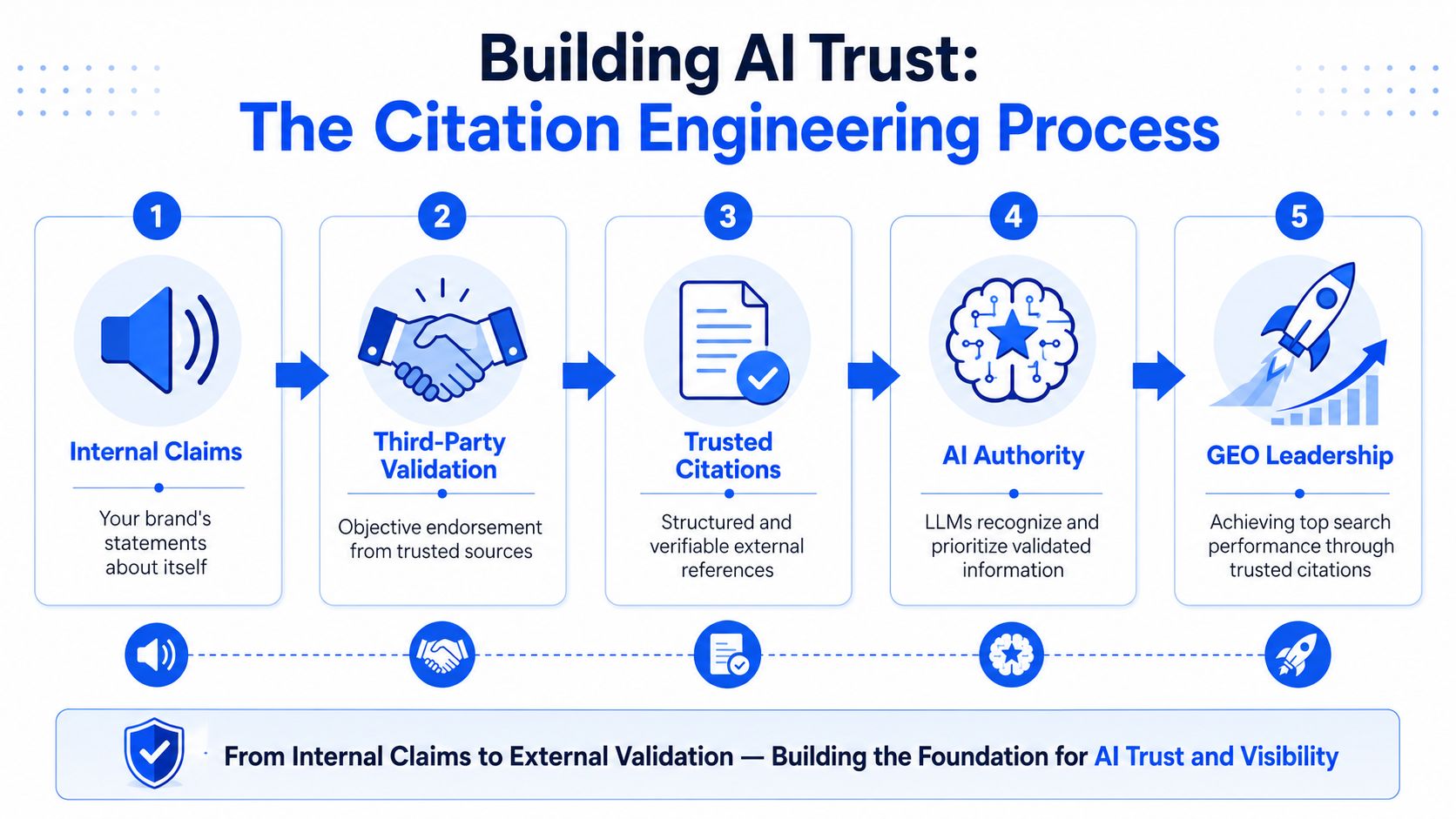
AI systems don't want only your own claims. They want corroboration. That means your website can describe your product, but third-party sources often help validate whether the model trusts that description enough to mention you in answers.
A GEO case study from Go Fish Digital showed 3X lead growth after pages were restructured to be fact-dense and grounded in external authority sources. That result matters because it reflects the actual mechanism at work. Better extraction plus stronger authority produces better inclusion.
What a citation pathway looks like
For B2B SaaS, your citation pathway usually runs through places like G2, Capterra, industry publications, comparison articles, partner directories, and expert commentary that gets indexed and retrieved.
This is not PR for vanity. It's trust engineering.
A strong pathway has three traits:
- Consistency: Your category, buyer fit, and core claims match across sources
- Specificity: Third-party mentions describe what your product does
- Coverage: You appear in the sources AI systems already use for your category
If your only strong description of the product exists on your website, you're underexposed.
Where CMOs should focus first
Don't chase random mentions. Go after the sources your buyers and AI systems both consult.
For most SaaS categories, that means:
| Source type | Why it matters |
|---|---|
| Review platforms | They give models standardized language around category, features, and buyer sentiment |
| Comparison pages | They frame vendor alternatives and commercial tradeoffs |
| Industry publications | They add editorial trust and category context |
| Partner ecosystems | They confirm integrations, implementation relevance, and ecosystem fit |
You don't need dozens of weak mentions. You need a small set of accurate, high-signal citations that reinforce the same entity story.
Your brand becomes easier to recommend when multiple trusted sources describe the same company in the same way.
That's why citation engineering is the most overlooked part of LLM search optimization. SEO teams often stop at on-page fixes. But the recommendation layer is heavily influenced by off-site validation.
If you want to see how this work shows up in practice, review real AI visibility case studies and compare what changed: tighter facts, stronger external references, cleaner entity alignment, better answer extraction.
What to tell your team this month
Give your content, SEO, PR, and product marketing teams one shared brief.
That brief should answer:
- Which external sources define our category in AI answers?
- Where do our top competitors appear that we don't?
- Which claims about our product need independent validation?
- Which high-intent comparison and review surfaces need correction or expansion?
Then work that list aggressively. Citation trust isn't built by publishing another brand manifesto. It's built by making sure the web says the same true thing about you in the places AI systems already trust.
FAQ About LLM Search Optimization
Is LLM search optimization just SEO with a new label
No. SEO still matters, but it doesn't solve the recommendation layer on its own. Search ranking focuses on discoverability in results pages. LLM search optimization focuses on whether systems like ChatGPT, Gemini, Perplexity, and Claude can identify, extract, trust, and cite your brand in direct answers.
For your board, track both. Keep your SEO metrics, but add AI share of voice, citation frequency, platform-by-platform inclusion, and answer accuracy.
What KPIs should a B2B SaaS CMO report
Report metrics tied to visibility and trust, not vanity.
Use a scorecard like this:
- AI share of voice: How often your brand appears versus competitors
- Citation frequency: Whether AI systems cite your site or trusted external sources associated with you
- Platform coverage: Your presence across ChatGPT, Gemini, Perplexity, and Claude
- Accuracy rate: Whether brand, pricing, product, and category claims are stated correctly
- Commercial prompt coverage: Your inclusion in comparison, shortlist, and “best software for” prompts
If your team can't show movement on those metrics after the initial audit, your program isn't focused enough.
How long does it take to see movement
Some fixes show up quickly, especially technical corrections and page restructuring. Citation development and entity reinforcement usually take longer because they depend on broader web signals and retrieval behavior.
What matters is sequence. Audit first. Then entity definition. Then technical retrieval. Then citation development. Teams that skip the sequence usually create noise instead of progress.
Should we prioritize our website or third-party profiles
Both, but not equally at every stage.
Start with owned assets if your site is technically weak or your messaging is inconsistent. Then build out the external citation pathway once your source facts are stable. If you push hard on third-party visibility while your own site says vague or conflicting things, you'll create a trust problem instead of fixing one.
How do we reduce hallucinated brand claims
Treat hallucination risk like a brand governance issue, not just a model problem.
Run weekly prompt audits for your highest-value commercial questions. Check whether AI systems get your pricing model, target customer, implementation scope, and feature claims right. If they don't, correct the underlying source pages and strengthen the external citations that reinforce the right answer. Your aim is tighter grounding, not more marketing copy.
What should an Indian SaaS company do next
Don't start with a content sprint. Start with diagnosis.
Audit your brand across major AI assistants, benchmark against the competitors that matter, identify misinformation and omission patterns, then fix the pages and citations most likely to affect shortlist behavior. If you're already ranking in Google and still missing from AI answers, that gap won't close on its own.
If your team wants a direct view of where you stand, talk to LLMBuddy. We work with B2B SaaS companies on AI search visibility, entity clarity, citation pathways, and retrieval-ready content. If you want a specific next step, request an AI search audit or book a demo. Written from the practitioner lens of Ankur Pandey and the LLMBuddy team.