

You’ve probably seen this already. A prospect asks ChatGPT about your product, and the answer is close enough to sound credible but wrong in ways that matter. It muddles your pricing model, assigns you a competitor’s feature, or describes your category in outdated terms. That’s not a minor content issue. It’s a pipeline issue.
If you’re asking how does ChatGPT get its information, you’re asking a business question, not a technical one. The answer determines whether your brand shows up accurately in ChatGPT, Gemini, Perplexity, and Claude, or whether those systems assemble a blurry version of your company from fragments scattered across the web.
Your Brand in the AI Blind Spot
Founders usually notice the problem late. Not when an SEO report drops, but when a buyer repeats an AI-generated summary that doesn’t match the product you sell. In B2B SaaS, that gap shows up in category confusion, weak differentiation, and bad-fit leads entering the funnel with the wrong expectations.
The root issue is simple. AI assistants don’t “know” your company the way your team does. They build an answer from patterns, public references, and whatever signals they can parse with confidence. If your site is vague, your third-party mentions are thin, and your positioning shifts across pages, the model fills gaps with probability.
What that means for a SaaS brand
A lot of teams still treat AI visibility as a future problem. It isn’t. Buyers already ask ChatGPT for vendor comparisons, migration advice, pricing summaries, and feature shortlists. If your brand sits in an AI blind spot, the assistant won’t wait for better information. It will answer anyway.
Practical rule: If an AI system can’t find a clean, repeated, public definition of your product, it will infer one.
That’s why the question isn’t just how ChatGPT gets information. The better question is this: what signals is your brand sending into systems that summarize the market for buyers?
What works and what fails
What works is boring, but effective. Clear product pages. Stable category language. Strong review-platform profiles. Documentation that explains what the product does in plain English. Repetition of the same core claims across your website and third-party mentions.
What fails is also predictable:
- Messy messaging: Your homepage says one thing, your pricing page says another, and your G2 profile frames you differently again.
- Feature inflation: Marketing copy tries to sound broad, so the product becomes hard to classify.
- Thin public evidence: You know your strengths internally, but the web doesn’t reflect them clearly enough for AI systems to repeat them back.
If you want better visibility in AI answers, you need a Generative Engine Optimization mindset. Not content for content’s sake. Not SEO copy stuffed with category terms. You need to shape the inputs these systems use so your narrative is easier to retrieve, interpret, and cite.
The Foundation Pre-training on a Digital Universe
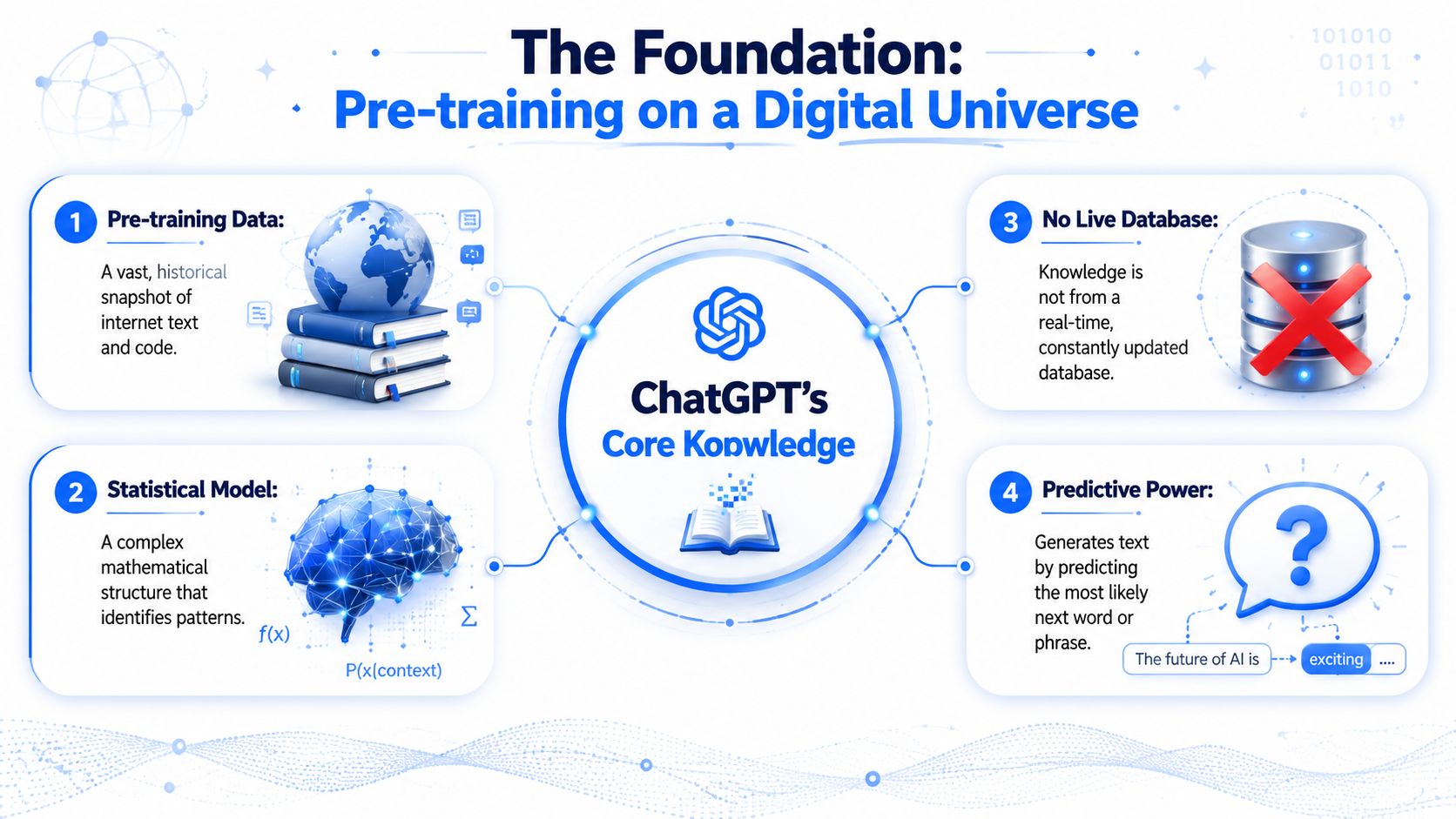
The first thing to understand is that ChatGPT’s base knowledge doesn’t come from a live fact database. OpenAI explains that its models are trained on publicly available internet content and other licensed or provided data, and that the model generates responses by predicting the next token from learned patterns rather than fetching facts from a live store. You can read that directly in OpenAI’s explanation of how ChatGPT and its language models are developed.
It reads patterns, not records
The easiest way to think about pre-training is this. ChatGPT is like an apprentice who has read a massive digital library but didn’t keep a neat card catalog of every source sentence. It learned relationships between words, topics, formats, and common ways people answer questions. Then it uses those relationships to generate a response that fits the prompt.
That creates a real trade-off for your brand. If your company had weak public presence, inconsistent descriptions, or very little machine-readable detail across the open web, your brand may be faint inside that learned pattern map.
That’s why broad digital presence still matters. Not because every page gets quoted directly, but because repeated signals across your site, docs, partner pages, review profiles, and category content help establish what your company is.
What a founder should do with this
If you’re building AI visibility, start by asking whether your public web presence teaches a model the right story about your company.
A useful review looks like this:
- Check your category definition: Does your homepage clearly state what product category you belong to?
- Audit repetition: Do pricing, product, use case, and integration pages describe the company with the same core language?
- Look beyond your own site: Are there public references that reinforce the same understanding?
A good Generative Engine Optimization approach starts here. Before you chase citations, you need a stable entity. The model can’t summarize what the web hasn’t described clearly.
The web is your training signal long before it becomes your traffic source.
The practical implication
Pre-training rewards consistency more than cleverness. Founders often want sharper copy. AI systems need clearer copy. If your site uses category jargon on one page, invented labels on another, and aspirational positioning everywhere else, the model has to guess what bucket you fit into.
For B2B SaaS companies, that means your digital footprint needs to do three jobs at once. It needs to explain the product to buyers, define the company for search systems, and give AI models enough repeated context to avoid mixing you up with adjacent vendors.
Refining Raw Knowledge into a Usable Assistant
A pre-trained model is knowledgeable in a rough way. It has seen huge amounts of text, but that doesn’t make it a useful business assistant yet. To become helpful, it goes through refinement.
ChatGPT resembles a smart analyst straight out of school. They’ve read a lot. They still need coaching on how to answer clearly, follow instructions, stay on topic, and avoid causing damage.

Why structure beats fluff
Refinement teaches the model to prefer answers that are useful, readable, and responsive to intent. That matters for your content because pages that answer clear questions in a direct format are easier for assistants to absorb and reuse.
A founder reading this should care about one point: the way you structure information affects whether AI systems can interpret it cleanly.
Pages that usually work well include:
- Pricing pages with explicit plan logic: Not hidden details, gated PDFs, or vague “contact sales” walls everywhere.
- Feature pages with boundaries: What the feature does, who it’s for, and what it doesn’t replace.
- Comparison pages with restraint: Clear differences without fake neutrality or unsupported claims.
What content gets ignored
Poorly structured pages often fail for the same reasons humans dislike them. They bury the answer under slogans, split the substance across tabs, or mix category education with self-promotion so heavily that the model can’t isolate a clean response.
If your page makes a buyer work to find the answer, an AI assistant will often struggle too.
That’s where a lot of “AI optimization” advice goes off track. Teams obsess over prompts and forget page architecture. But the assistant’s preference for directness is shaped by refinement. It has been coached toward clearer outputs, which means it’s naturally more compatible with clearer inputs.
A practical content test
Take one core page, such as pricing, integrations, or security. Then ask a blunt question:
Can a buyer, or a model, extract the answer in a few seconds without inferring anything?
If the answer is no, rewrite the page. Use headings that match user intent. Put definitions high on the page. State exclusions and edge cases plainly. Keep the message steady across related assets.
For teams working on ChatGPT optimization, this is usually where early wins come from. Not from clever prompt hacks. From turning vague brand copy into pages that are easy to quote, summarize, and compare.
The Impact of Live Data and Plugins
A prospect asks ChatGPT whether your product supports SSO, has a native Salesforce integration, and how long implementation takes. If the assistant can browse or call a retrieval layer, your current site can shape that answer in real time. If it cannot find clean, direct source material, it will fill gaps with weaker sources or generic category language.
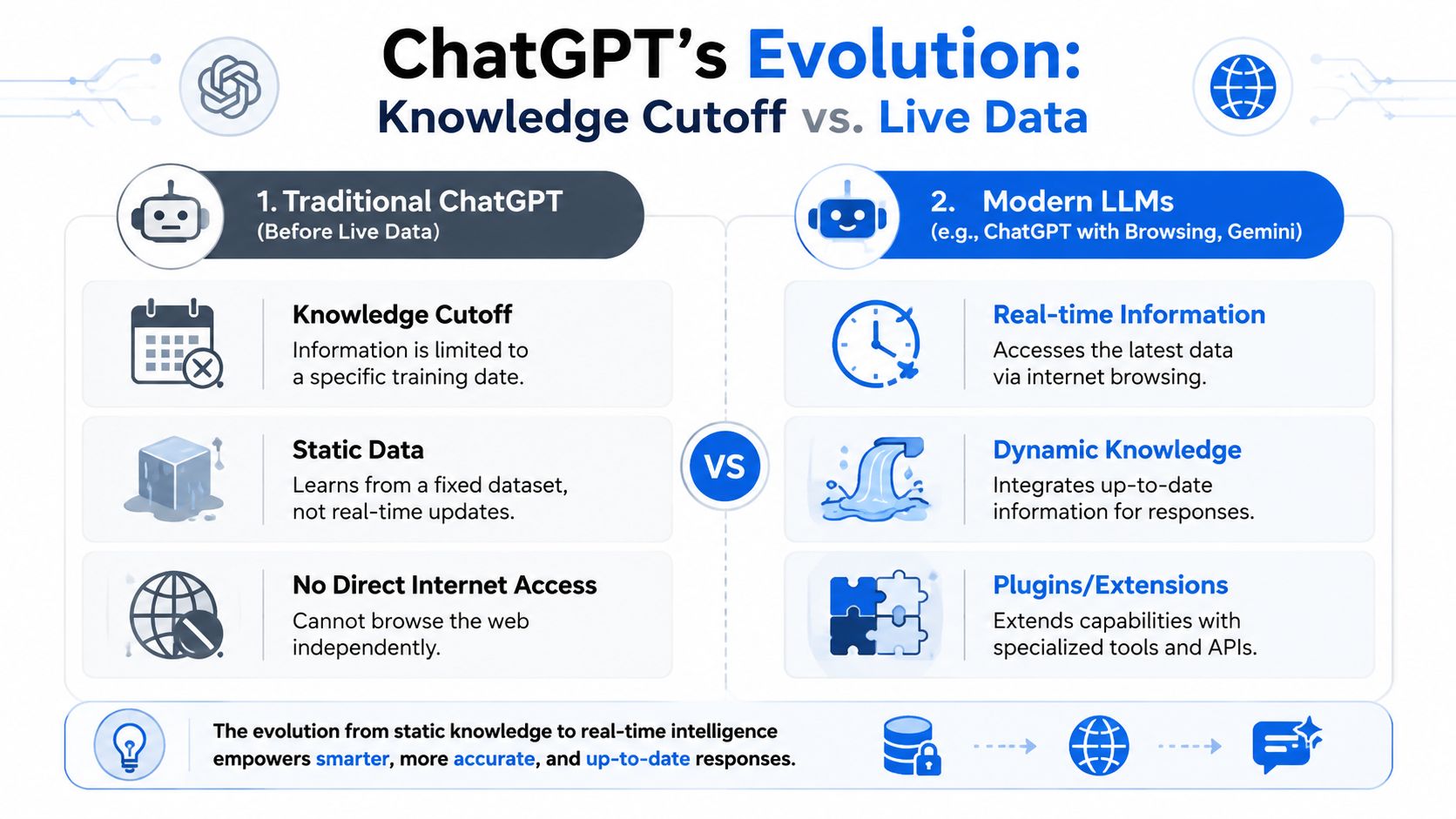
Earlier versions of ChatGPT were constrained by a training cutoff, which limited how well they could reflect product changes, launches, and policy updates after that point. Scribbr outlines that limitation in its overview of ChatGPT’s training data and recency constraints. Newer AI products reduce that problem by combining the model with browsing, retrieval, and tool use.
For a B2B SaaS company, that changes the GEO job. You are no longer optimizing only for what a model absorbed during training. You are also optimizing for what an assistant can fetch, parse, and quote at answer time.
Here is the practical difference:
| System mode | What it relies on | What your team should optimize |
|---|---|---|
| Pre-trained only | Historical patterns from prior training | Brand consistency across the public web |
| Retrieval-enabled | Current pages and external sources fetched at answer time | Crawlable, explicit, retrieval-friendly content |
Retrieval-friendly content is not a design style. It is a formatting and clarity standard. The system needs to identify the topic fast, pull the right passage, and restate it without guessing.
That usually means:
- Answer-first structure: Put the direct answer near the top of the page.
- Literal headings: Use headings like pricing, integrations, SSO, implementation, migration, and security.
- Clear scope: State what the feature does, what plan includes it, and where the limits are.
- Clean comparisons: If you mention alternatives, explain the difference in plain language.
I start with the pages buyers ask AI systems about most: pricing, security, integrations, implementation, migration, support, and alternatives. These pages drive citation quality because they map to high-intent prompts. A polished homepage matters less than a pricing page that clearly states packaging, exclusions, and onboarding requirements.
This is also where plugin and tool use create a real trade-off. Live retrieval improves freshness, but it increases dependence on page quality. If your product facts are scattered across tabs, hidden behind scripts, or softened by brand copy, the assistant has more chances to miss or distort them.
Run a regular AI search audit on the pages that matter most. Check whether assistants can find the page, extract the right passage, and cite your brand accurately in comparison-style answers. That is the operating model for GEO in B2B SaaS. Not abstract visibility. Source control at the moment of buyer intent.
Why AI Assistants Confidently Invent Facts
When ChatGPT invents a feature or blends your pricing with another vendor’s, it isn’t “lying” in the human sense. It’s completing a pattern with incomplete inputs.
That distinction matters because it changes the fix. You don’t solve hallucinations with brand policing. You solve them by reducing ambiguity in the information environment around your company.
Why the guessing happens
If your brand has sparse or inconsistent public signals, the model reaches for the nearest likely pattern. In SaaS, that often means adjacent competitors, common category assumptions, or generic product language.
A CRM might get described with a sales-engagement feature it doesn’t have. An HR platform might be framed like a payroll product. A security tool might get collapsed into a broader compliance category. The answer sounds polished because the language model is good at language. The underlying representation is what failed.
The real business risk
The risk isn’t only factual error. It’s buyer distortion.
A confused summary can hurt you in several ways:
- Wrong-fit leads: Prospects arrive expecting features you don’t sell.
- Lost comparisons: AI tools place you in the wrong vendor set.
- Weaker positioning: Your strongest differentiators get replaced by category clichés.
That’s why strong entity definition matters so much. Your website, docs, review profiles, partner listings, and thought leadership all need to reinforce the same product identity. If they conflict, the assistant gets permission to improvise.
AI systems are confident about language, not always about truth. Your job is to make the truthful answer the easiest one to generate.
What to do this week
Run a simple test across ChatGPT, Gemini, Perplexity, and Claude. Ask each one what your product does, who it’s for, and how it differs from two direct competitors. Save the outputs. Then compare them against your actual positioning.
You’re looking for three failure modes: invented features, vague category labels, and inconsistent differentiation. Those gaps usually point back to weak public signals, not random model behavior.
The GEO Playbook to Get Your SaaS Cited
Once you understand how these systems gather and shape information, the next question is obvious. How do you increase the odds that your brand gets mentioned correctly?
The answer is GEO, not as a buzzword, but as a practical operating model for AI visibility. A peer-reviewed analysis found that ChatGPT 4.0 outputs had higher similarity to Google Search results than ChatGPT 3.5, with mean TF-IDF similarity rising from 0.80 to 0.91 and p < 0.001, which suggests newer models increasingly reflect high-quality web sources. You can review that in the peer-reviewed analysis published on PMC.
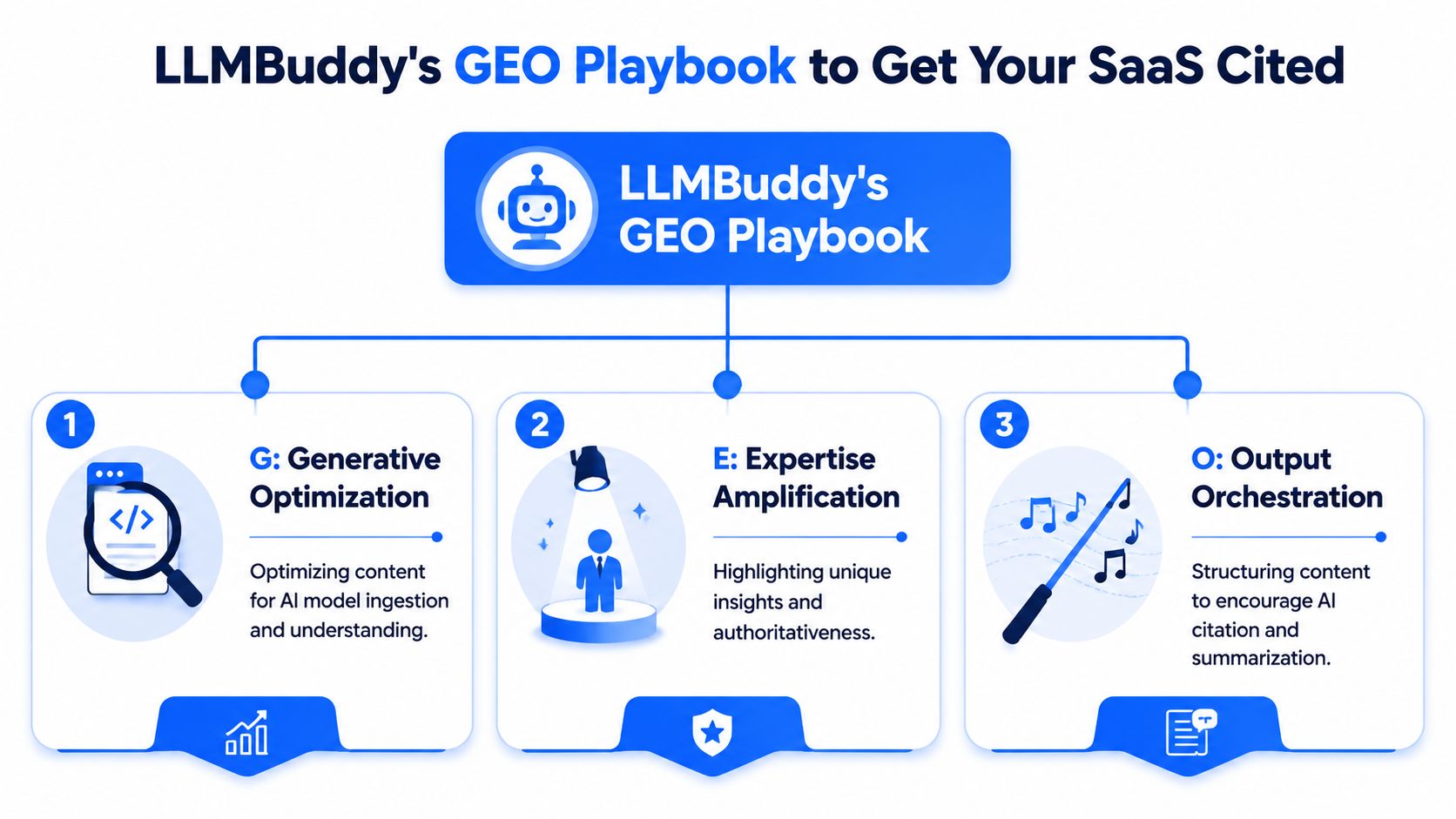
Pillar one builds entity authority
Your brand needs to become a distinct, repeatable concept on the public web. That means a stable company description, consistent category language, named use cases, and pages that define what the product is and is not.
A founder should care because weak entity authority makes every downstream AI outcome harder. If the model can’t lock onto your identity, it won’t cite you well.
Pillar two fixes content architecture
Here, many teams have hidden problems. The content exists, but it isn’t arranged for extraction.
Strong architecture usually includes:
- Answer-first page sections: State the point before the marketing story.
- Clear page intent: One page should answer one main buyer question well.
- Structured signals: Schema, predictable headings, and content blocks that are easy to summarize.
A lot of SaaS brands publish “good content” that still performs poorly in AI environments because the important details are buried under copy that sounds polished but says very little.
Pillar three creates citation pathways
AI systems don’t form opinions from your website alone. They also absorb or retrieve third-party context. That’s why review platforms, partner ecosystems, industry publications, and well-ranked comparison pages matter.
If your brand appears consistently on places like G2, Capterra, software directories, podcasts, founder interviews, and category explainers, you’re giving the model multiple pathways to arrive at the same understanding.
The best AI visibility strategy doesn’t ask one page to do all the work. It builds agreement across the web.
What this means in practice
For B2B SaaS teams, GEO should sit between SEO, product marketing, and content operations. It isn’t just rankings. It isn’t just brand. It’s the discipline of making your company easy for AI systems to identify, retrieve, and cite accurately.
That’s why AI visibility work has to be search-aligned. If newer models increasingly reflect high-quality web sources, your job is to improve the quality, consistency, and retrievability of the sources attached to your brand.
If your team is actively investing in this area, AI SEO services should be judged on one thing: whether they improve your inclusion and accuracy across real AI assistants, not whether they produce a stack of generic blog posts.
Frequently Asked Questions About AI Information Sourcing
A founder asks why ChatGPT describes their product incorrectly while Perplexity gets much closer. In practice, that usually points to an information sourcing issue, not a product problem. One system is relying more on learned patterns. Another is pulling fresher public sources. For B2B SaaS teams, that distinction matters because it tells you what to fix.
Does ChatGPT search the internet every time it answers?
No. Some answers come from the model’s trained knowledge. In other product experiences, it may use browsing, retrieval, or connected tools to pull current information.
That creates two different GEO jobs. If the model is answering from prior training, your broader web footprint matters more. If it is retrieving live pages, page clarity, crawlability, and source quality matter more.
Can ChatGPT cite my website directly?
Yes, sometimes. It depends on the interface, the model behavior, and whether retrieval is active.
Still, direct citation is the wrong success metric. The better goal is consistent representation. If your homepage, product pages, documentation, review profiles, and third-party mentions all describe the same company in the same terms, AI systems have a much easier time citing you accurately.
Why does Perplexity sometimes describe a SaaS product more accurately than ChatGPT?
Perplexity often relies heavily on live retrieval. That means it can pull from current pages while forming the answer.
If your site is well-structured, explicit, and easy to extract from, retrieval-first systems may reflect your positioning more accurately. If your messaging is vague, both humans and AI tools will fill in the gaps, and they often do it badly.
Is SEO enough for AI visibility?
SEO is still part of the job. Strong search pages often become strong AI inputs.
It is not the whole job. AI visibility also depends on whether your company is easy to identify as a clear entity, whether your claims are repeated consistently across the web, and whether your content is formatted in a way models can summarize without distortion. That is the practical difference between classic SEO and GEO.
Which pages should a SaaS company fix first?
Start with the pages buyers and AI assistants check first. That usually means your homepage, product overview, pricing, integrations, security, implementation, and competitor comparison pages.
If those pages are weak, every downstream answer gets weaker too.
How do I know whether AI tools are misrepresenting my brand?
Run the same prompts across ChatGPT, Gemini, Perplexity, and Claude. Use your company name, product category, core use cases, ideal customer, pricing approach, and top competitors.
Then compare those answers against your actual positioning. The gaps usually show up fast. Wrong category labels, outdated features, muddy ICP descriptions, and confused competitor comparisons are the common failure points. Those failures give you a working GEO roadmap because they show which signals need to be cleaned up on your site and across third-party sources.
If you want to see how your brand appears across ChatGPT, Gemini, Perplexity, and Claude, LLMBuddy can help you audit the gaps and fix them. You can also book a walkthrough through the demo request page.
Built with Outrank tool