
Most advice on how to rank in ChatGPT is lazy. It treats ChatGPT like Google with a chatbot wrapper. That’s the wrong model, and it leads B2B SaaS teams to waste months polishing pages that never get cited.
Your buyers aren’t searching the way they did before. They’re asking ChatGPT, Gemini, Perplexity, and Claude for vendor recommendations, product comparisons, and shortlist suggestions. Those systems don’t reward the same things in the same way a search results page does. They look for evidence, extractable answers, and external validation.
That changes the job. You’re not just trying to rank a URL. You’re trying to make your brand the most defensible answer.
That’s what Generative Engine Optimization is really about. You build a clear entity, publish content AI can extract without guessing, and create a third-party citation trail the model can trust. If your team still thinks this is about stuffing pages with category keywords, you’re already behind.

Introduction
The biggest mistake founders make is assuming strong Google SEO will carry over to AI answers. Sometimes it helps. Often it doesn’t. ChatGPT doesn’t owe you visibility because your homepage ranks for a commercial term.
AI systems assemble answers from whatever they can understand and trust. That means your website matters, but so do your review profiles, industry mentions, comparison pages, product definitions, and the consistency of your brand across the web. If your company is described three different ways in three different places, the model has to guess. You never want the model to guess.
What actually changes in AI search
In classic SEO, a page can win because it targets a term well enough. In AI search, your brand gets cited when the model sees a stable pattern. It needs to understand what you are, which category you belong to, what problem you solve, and whether other sources validate that claim.
That’s why a real GEO program is stricter than a content calendar. It forces precision.
Your website is not the whole story. For AI visibility, it’s one node in a larger evidence network.
The founder takeaway
If you want your SaaS brand mentioned in AI answers, stop asking, “Which keyword should this page target?” Start asking, “What proof exists that our brand belongs in this answer?”
That shift changes everything.
Forget Keywords Think Like an Entity
AI systems don’t think about your company the way your demand gen team does. They don’t see “brand messaging.” They see an entity with attributes, relationships, and supporting evidence. If those signals are weak, your inclusion will be weak.
A lot of B2B SaaS sites are messy on this point. The homepage says one thing, the product page says another, and third-party profiles use a broader or narrower category. That confusion hurts retrieval and citation.
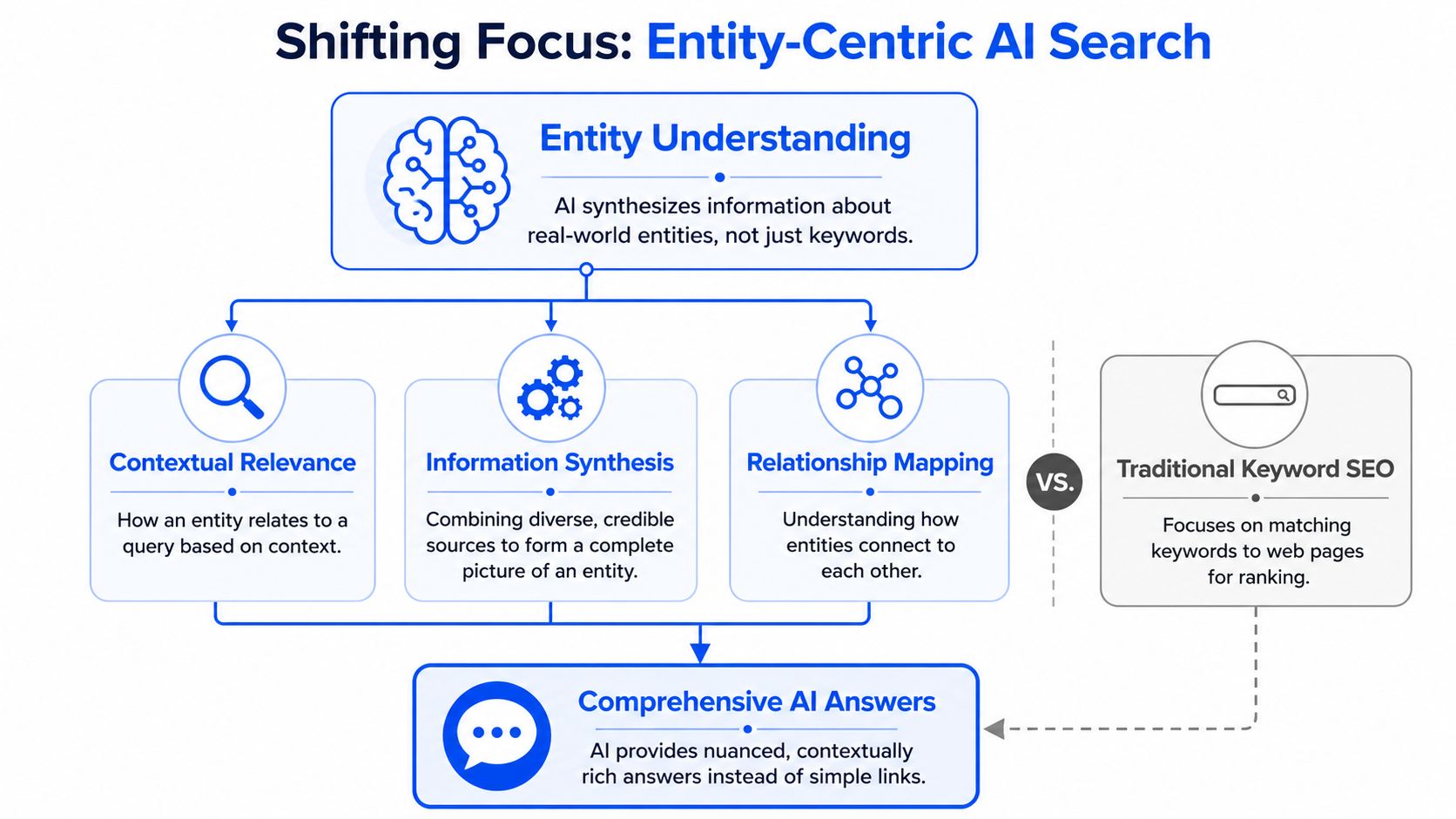
Define your entity in one sentence
Start with a single line that answers four things without fluff:
-
Who you are
Your company name. -
What you are
Your exact software category. -
Who you serve
The team, company type, or market. -
What problem you solve
One plain-English outcome.
If that sentence changes depending on which page someone visits, fix that first. The model needs consistency more than cleverness.
Build entity consistency across your owned assets
Your homepage, about page, product pages, pricing page, author bios, metadata, and social profiles should all reinforce the same category definition. Don’t call yourself a “revenue intelligence platform” on one page and a “sales acceleration workspace” on another unless you want AI systems to dilute your category relevance.
Many SaaS teams sabotage themselves. They write for positioning decks, not for machine understanding.
Independent research summarized by Rankability’s review of ChatGPT ranking factors points to brand mentions, authoritative citations, and web visibility as core drivers of ChatGPT inclusion. That same analysis notes a broader shift after November 2022, when ChatGPT’s public launch accelerated the importance of off-site discoverability and third-party evidence.
Treat your brand like a data object
You need a repeatable entity sheet. Keep it simple and strict.
| Entity field | What to lock down |
|---|---|
| Brand name | Exact spelling and formatting |
| Category | Primary software category |
| Alternatives | Secondary category labels you want associated carefully |
| Audience | ICP by role, company stage, or segment |
| Core problem | Main pain point solved |
| Proof sources | Review sites, analyst mentions, comparison pages, press |
Once this exists, your content team, PR team, SEO team, and founders should all use it. If they don’t, your market narrative fragments.
A lot of teams ask whether this is still “SEO.” It overlaps, but it’s closer to knowledge graph work than keyword work. That’s why services built for AI discovery, like AI SEO services, focus on entity alignment first instead of blog volume first.
Practical rule: If a stranger reads your homepage, G2 profile, LinkedIn company page, and one partner listing, they should describe your company the same way every time.
Structure Your Content for AI Extraction
Once ChatGPT understands your brand, it still needs something quotable. Most SaaS content fails here. The page may be accurate, but it’s written like a keynote. AI needs answer blocks, not speeches.
A major Ahrefs analysis of ChatGPT citations found that content with question-based headings was cited at 18% versus 8.9% for non-question headings. The same study found that cited text used definitive language at a much higher rate, with 36.2% of cited text using phrases like “is defined as” or “refers to,” versus 20.2% in uncited text.
That’s not a small stylistic preference. It tells you how the system prefers to extract.
Write answer-first sections
Each important section on your product and category pages should open with a direct answer. Don’t warm up for three paragraphs. Don’t start with market context. Put the answer first, then expand.
Bad version:
“Modern finance teams face increasing complexity and need agile systems to support scale.”
Better version:
“Revenue recognition software is a category of software that helps finance teams automate compliance, reporting, and recurring revenue workflows.”
The second one is easier to cite because it doesn’t make the model infer the definition.
Replace brand copy with definitional copy
Go page by page and strip out lines that sound impressive but say nothing. Phrases like “built for modern teams” or “powering future-ready operations” don’t help AI retrieval. They don’t clearly define the product, the user, or the use case.
Use this structure instead:
-
Question heading
Example: “What is digital adoption software?” -
Direct definition
One to three sentences using clear, final language. -
Context block
Explain who needs it and why. -
Specific sub-questions
Example: implementation, pricing model, integrations, deployment, or compliance.
A focused rewrite project like this is exactly what teams usually need from AI content optimization, because generic thought leadership rarely gives AI enough extractable material.
Build narrower pages, not broader essays
For AI answers, specificity beats broadness. A page about “employee engagement” is too loose. A page answering “How do HR teams measure employee engagement in distributed companies?” is far more likely to match a real prompt.
Use long-tail commercial and informational prompts to shape page architecture. Build pages for comparisons, workflows, buyer objections, deployment models, and use-case variations.
Write each section so it can survive on its own if an AI system lifts it out of the page.
That’s the test. If a paragraph gets quoted without the rest of the article, does it still make sense? If not, rewrite it.
Engineer Your Third-Party Citation Pathway
For commercial prompts, your website is not the final judge. External consensus is. If ChatGPT is asked for the best CRM for startups, best HR software for Indian SMEs, or top subscription billing platforms, it will look for patterns outside your domain.
That means many B2B SaaS brands are working on the wrong side of the problem. They keep polishing owned content while ignoring the exact third-party sources that shape AI recommendations.
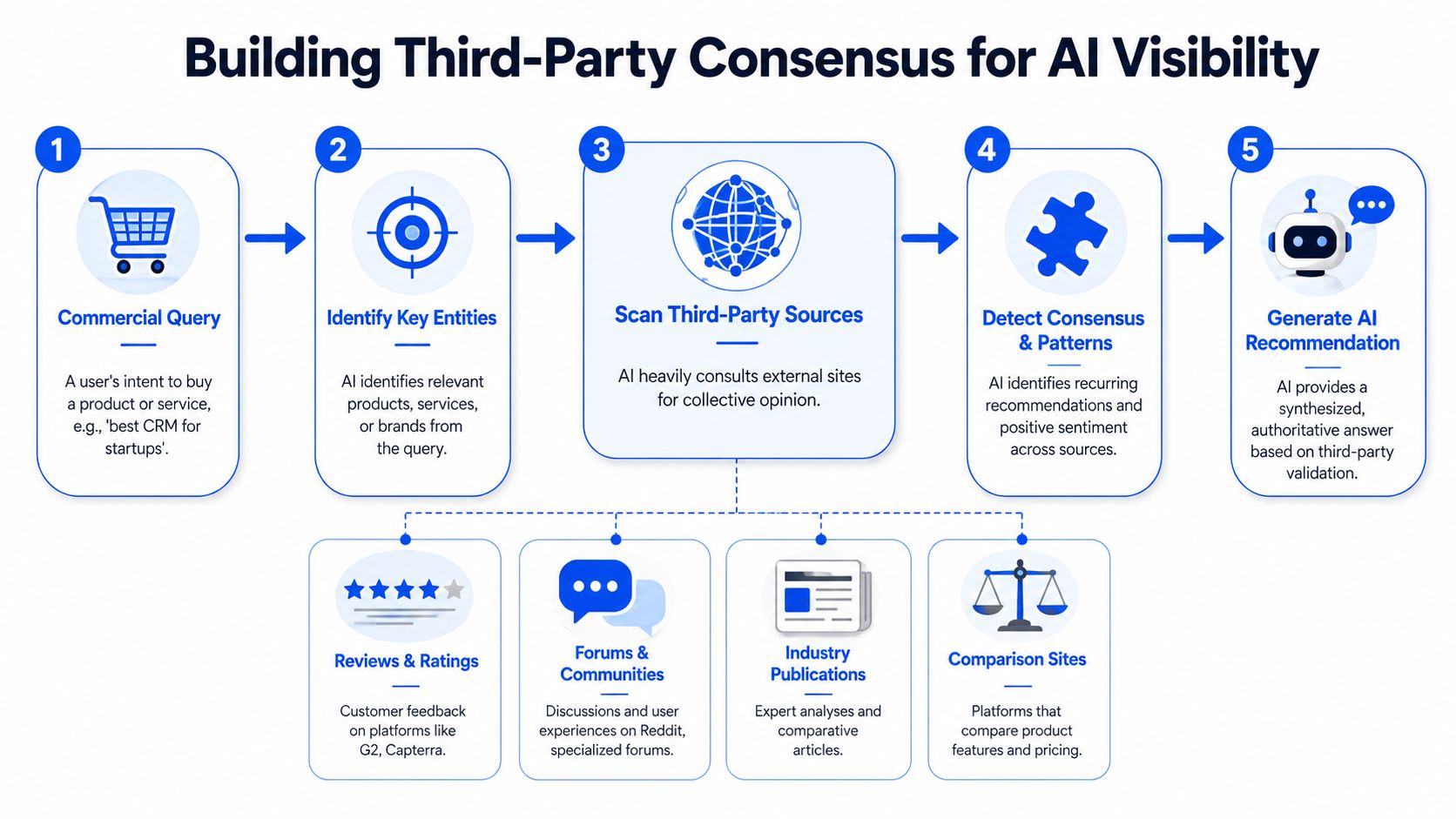
Your site is the claim. Third-party pages are the proof.
For recommendation-style answers, review sites, comparison pages, category lists, industry publications, and awards pages often carry more weight than self-published brand pages. Practitioner guidance discussed in StudioHawk’s analysis of ranking in ChatGPT makes this point directly: high-signal third-party comparisons, award pages, and category lists often matter more than on-site content for AI answers.
This should change your budget allocation. If your team has resources for one more content cluster or one more review-platform push, pick the second one for commercial AI visibility.
Prioritize citation sources in tiers
Not all mentions matter equally. Build a source map with clear priority.
| Tier | Source type | Why it matters |
|---|---|---|
| Tier 1 | G2, Capterra, TrustRadius, category directories | Strong product and category validation |
| Tier 2 | “Best X software” listicles, comparison pages, editorial roundups | Frequent recommendation sources |
| Tier 3 | Industry blogs, associations, partner ecosystems | Reinforces niche relevance |
| Tier 4 | Forums and communities | Adds language, sentiment, and buyer context |
The key is not random PR. It’s source selection based on the prompts you want to win.
Build for consensus, not vanity mentions
A founder interview in a startup blog won’t help much if it doesn’t connect your brand to the target category. You need mentions that repeat the same entity definition and market position across multiple trusted pages.
Focus your outreach on pages that already rank in Bing and already show up in AI answers. Then improve the accuracy of your profiles on review platforms. If your category, product summary, customer segments, and comparison positioning are weak there, your AI visibility will stay weak too.
A simple operating model works well:
-
Audit current citations
Run your target prompts and note every external page that keeps showing up. -
Fix controllable profiles
Review sites, marketplace listings, partner pages, founder bios. -
Pitch inclusion pages
Category roundups, competitor comparison pages, buyer guides. -
Refresh stale placements
Old writeups often use outdated category language.
If ten trusted pages describe your brand clearly, AI can recommend you confidently. If only your homepage does, it usually won’t.
Implement Technical Signals for LLMs
Technical work won’t save a weak brand story, but weak technical signals can absolutely slow down or confuse AI retrieval. This part is less glamorous than content or PR. It still matters.
The first thing to understand is that ChatGPT doesn’t behave in one fixed mode. Seer Interactive notes in its analysis of ChatGPT visibility that visibility changes depending on whether the query triggers live web search or relies on training data. That distinction matters because technical accessibility influences retrieval-heavy answers far more directly.
Use schema to remove ambiguity
Basic Organization schema is not enough. Most SaaS sites stop there and call it done. You need schema that reinforces entity relationships and topical authority across key pages.
At minimum, review these areas:
-
Organization markup
Keep your company name, sameAs references, and core identity stable. -
Product and service markup
Make product pages machine-readable, not just persuasive. -
About and mentions relationships
Connect your brand to the topics and categories you want to own. -
Author clarity
If you publish expert content, make authorship legible.
This work doesn’t need to be fancy. It needs to be accurate and consistent.
Add an llms.txt policy and stop blocking useful access
Many teams still treat AI crawlers as a nuisance. Then they complain that AI systems don’t cite them. If you want to be discovered, don’t make access harder than it needs to be.
An llms.txt file helps you communicate how LLM-related agents should interact with your content. It won’t magically create citations, but it does remove friction and makes your site’s AI access posture explicit. Think of it as part policy, part signal.
Build retrieval-friendly pages
Even with good schema, a badly built page is hard to process. Keep core content in crawlable HTML. Don’t hide the key product explanation behind tabs, accordions, or scripts that bury the primary answer.
Use this checklist on your money pages:
- Clear heading hierarchy
- Visible definitions near the top
- Stable internal links between related concepts
- Consistent canonical signals
- Minimal ambiguity in product naming
Technical GEO is not about tricks. It’s about reducing interpretation cost for machines.
Test Measure and Govern Your AI Visibility
If you are not running a fixed prompt test every week, you do not have a GEO program. You have content activity.
AI visibility is unstable by default. Prompts shift. Source preferences shift. Model behavior shifts. B2B SaaS teams that get cited consistently treat this like an operating system, not a one-time campaign.
Build a fixed prompt set tied to revenue
Random prompt checks waste time. Build a controlled prompt set based on the questions that influence pipeline, category perception, and deal selection.
Use three buckets:
-
Informational prompts
Category definitions, implementation questions, workflow questions, and problem framing prompts. -
Commercial investigation prompts
“Best”, “top”, “compare”, “alternatives”, and “vs” queries tied to your category and use case. -
Branded decision prompts
Your brand versus direct competitors, pricing questions, migration prompts, and fit-for-use-case queries.
Keep the list stable. Then run the same prompts across ChatGPT, Gemini, Perplexity, and Claude on a recurring schedule. Log whether your brand appears, how the model describes you, whether the answer is accurate, and which sources support the answer.
Track citation sources, not just brand mentions
A mention by itself is weak. What matters is whether the model can support that mention with sources it trusts.
Use a simple governance sheet:
| Prompt | Platform | Brand mentioned | Competitors mentioned | Source pages cited | Answer quality notes |
|---|
The diagnostic process unfolds. If a competitor shows up because they are repeatedly cited by review sites, comparison pages, or analyst-style roundups, your problem is not on-page copy. Your problem is off-site evidence.
That distinction matters because it changes the work. One issue calls for better source-page structure. The other calls for a deliberate citation acquisition plan.
Run a weekly review cycle
Keep the cadence simple and strict.
-
Monday
Run the prompt set and log changes across platforms. -
Tuesday or Wednesday
Fix answer-shaping pages that are being cited incorrectly or ignored entirely. -
Thursday
Push third-party citation work. Update outreach targets, refresh partner pages, and close missing placements. -
Friday
Review movement by prompt type, compare against competitors, and assign the next round of fixes.
If you need a baseline before building this process, start with an AI search audit. It will show where your brand is absent, which competitors own the answer layer, and which source pages are influencing AI responses.
Put one owner in charge
This breaks when nobody owns it.
Give one person responsibility for prompt testing, source review, issue logging, and follow-up with content, SEO, PR, and product marketing. Without clear ownership, teams publish updates, collect mentions, and still fail to improve citation share because nobody is checking whether the models changed their answers.
Governance is what turns GEO from a theory into a repeatable system. The teams that win do not publish and wait. They test, correct, and repeat.
Frequently Asked Questions About GEO
Does this also help with Gemini Perplexity and Claude
Yes. The mechanics differ by platform, but the core work transfers. A clear entity, extractable content, technical accessibility, and credible third-party citations improve your odds across ChatGPT, Gemini, Perplexity, and Claude because all of them need reliable information they can interpret and defend.
You should optimize for the ecosystem, not one interface.
How is this different from traditional SEO
Traditional SEO is mostly about getting a page to rank in a list of links. GEO is about getting your brand entity cited inside a generated answer. That changes the center of gravity.
SEO can tolerate a lot of page-level noise if backlinks and topical targeting are strong enough. GEO is less forgiving. If your category definition is muddy or your off-site evidence is thin, AI systems hesitate.
How long does it take to see movement
There isn’t one universal timeline because prompt types behave differently. Retrieval-led answers can shift faster if your site and third-party presence improve. Answers that rely more on model memory can take longer because you’re waiting for broader refresh cycles and source incorporation.
What matters is whether you can see directional movement in repeated prompt tests. If you can’t, your program is not specific enough.
Can a founder or in-house team do this without an agency
Yes, for the first layer. You can define your entity, rewrite your top pages with better extraction patterns, clean up review profiles, and start prompt testing yourself. That alone puts you ahead of most companies.
The hard part is scaling the third-party citation program and keeping governance tight across platforms. That’s where specialist support helps. If you need a structured operating model, a generative engine optimization program is the right frame.
What should I fix first if my brand is invisible in ChatGPT
Fix these in order:
-
Entity clarity first
Make sure your company is described consistently everywhere. -
Money pages second
Rewrite core pages around direct questions and clear definitions. -
Third-party proof third
Improve review sites, comparisons, and category mentions. -
Measurement fourth
Lock a prompt set and review it every week.
If you skip the first step and jump to outreach, you’ll spread inconsistent positioning faster.
If you want a direct read on where your brand stands in ChatGPT, Gemini, Perplexity, and Claude, talk to LLMBuddy. We run GEO programs for B2B SaaS teams that need stronger entity signals, cleaner AI-ready content, and a citation pathway that holds up in real buyer prompts. If you want the fastest starting point, request a demo or start with an AI search audit.