
Your team may still rank on Google for the terms you've chased for years. That no longer guarantees visibility where buyers are making shortlists. A prospect types a buying question into ChatGPT, Gemini, Perplexity, or Claude, and your brand doesn't appear. A competitor does. So does an old directory page, a forum thread, or a stale article with outdated product details.
That's the gap you need to fix if you want to know how to optimize for AI search in a way that affects pipeline, not vanity dashboards. For Indian B2B SaaS companies selling globally, the problem gets harder because entity recognition, multilingual prompts, and regional trust signals all affect whether AI systems understand and recommend your brand.
At LLMBuddy, we've seen this pattern repeatedly in client work. Chargebee improved AI visibility by +74%, Whatfix by +84%, and Keka by +82%. The pattern behind those wins isn't mysterious. It's a disciplined GEO process built around crawl access, entity clarity, extraction-friendly content, third-party validation, and weekly measurement.
Your Brand Is Invisible Where Buyers Are Asking
You already know the frustrating version of this story. Your SEO team has done the work. Your category pages rank. Your blog has authority. Yet a prospect asks Perplexity for the best billing platform, HR software, or customer education tool, and your brand is missing.
That happens because AI search doesn't work like a list of blue links. It synthesizes. It compresses. It chooses a small set of brands and sources, then presents them as the answer. If your content isn't easy to extract, your entity isn't clearly defined, or your brand isn't reinforced across trusted sources, you get filtered out.
For B2B SaaS teams in India going after US, UAE, and broader global demand, the problem is sharper. Your buyers may search in English, mixed-language prompts, or market-specific phrasing. Your site might be technically sound for Google while still being weak for AI retrieval. If that sounds familiar, start with your AI visibility optimization baseline before you touch content.
AI visibility is now a distribution problem, not just a ranking problem.
The practical takeaway is simple. Stop assuming first-page Google performance means you'll show up in AI answers. Audit AI platforms directly and treat them as their own acquisition channel.
First Run a Baseline AI Visibility Audit
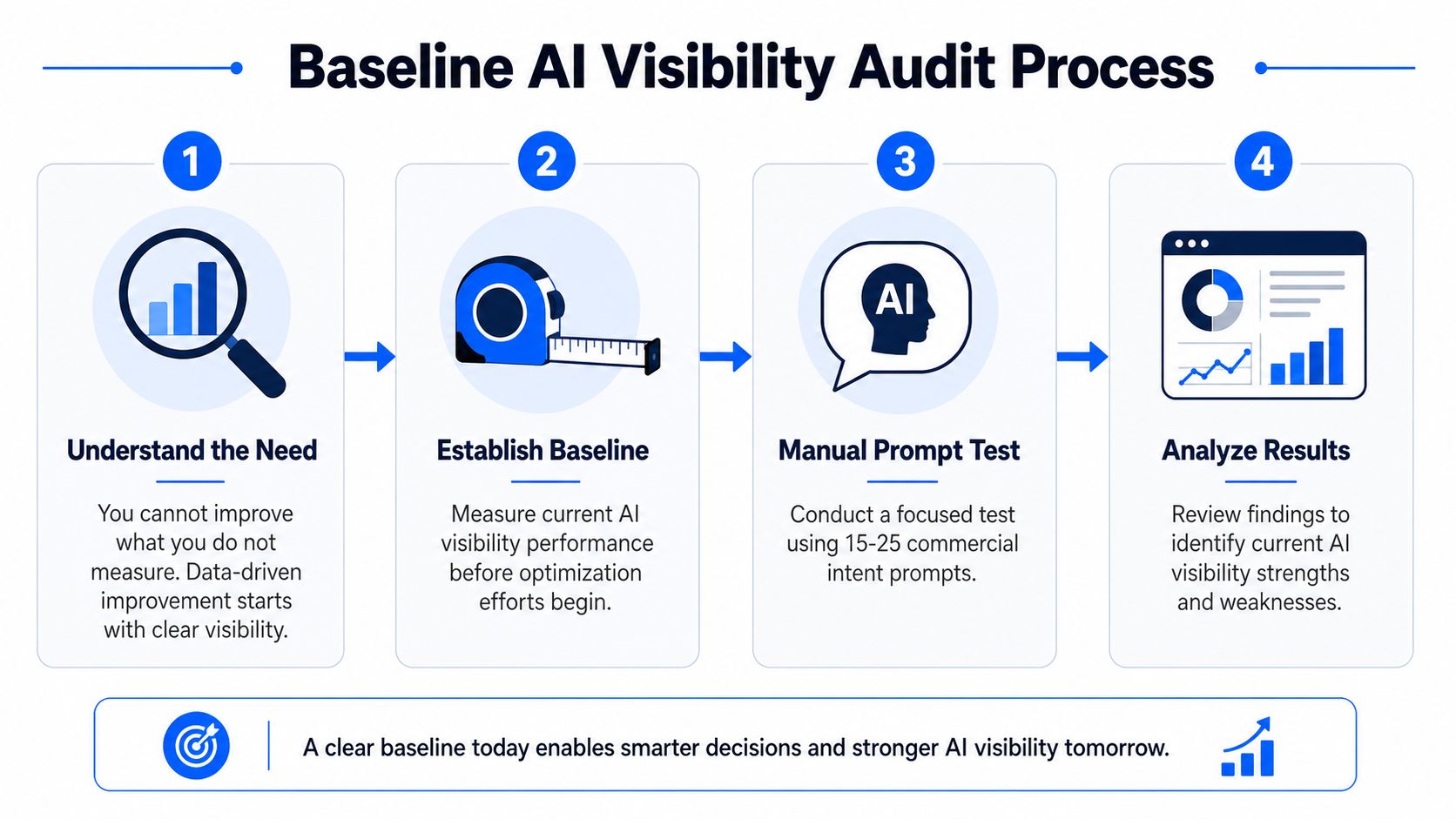
A global prospect asks ChatGPT for the best subscription billing platform for a mid-market SaaS company. Your competitor shows up. You do not. If you respond by rewriting landing pages before you know why you are missing, you burn time and budget on guesswork.
Start with evidence. Run a baseline audit across the AI platforms your buyers use, then document what each system says about your category, your competitors, and your brand. For Indian B2B SaaS companies selling into the US, UK, UAE, and APAC, this matters even more because prompt patterns vary by market. The same buyer intent appears as different category language, regional shorthand, and mixed-language phrasing.
What to test first
Do not start with broad vanity terms. Pull the exact questions your sales team, demo calls, and win-loss notes already surface.
- Category intent: "best HRMS for remote teams in India"
- Comparison intent: "alternative to Salesforce for SMBs"
- Buying fit intent: "best subscription billing software for SaaS"
- Regional intent: "best CRM for UAE distributors"
- Migration intent: "X vs Y for mid-market companies"
Run each prompt across ChatGPT, Perplexity, and Google AI Overviews. Save the outputs. Log the date, prompt, platform, cited sources, mentioned brands, and whether your company appeared. Use one sheet and keep the format rigid, otherwise trend analysis becomes useless after the first month.
Our advice for B2B SaaS teams is simple. Test enough prompts to cover category, competitor, use case, and regional buying language. Then repeat the same set on a fixed cadence so you can spot movement instead of collecting random screenshots.
What usually goes wrong
The first failure pattern is total absence on high-intent prompts. That points to a retrieval and authority gap. More content alone will not fix it.
The second is source mismatch. If AI systems keep citing old listicles, Reddit threads, or partner pages instead of your product, comparison, and documentation assets, your site is not being treated as the clearest source.
The third is access failure. Check whether AI crawlers are blocked in robots.txt or restricted on key directories. We regularly find Indian SaaS companies with strong Google visibility but weak AI presence because documentation, blog folders, or comparison pages are partially inaccessible to the systems that fuel AI answers.
Practical rule: Check crawl access and citation patterns before you brief writers or approve a content refresh.
A baseline audit should end with diagnosis, not just observations. Every missing mention should map to one of three causes: technical access, extractability, or off-site authority. If you want a faster starting point, run a structured AI search audit for B2B SaaS visibility and score your top commercial prompts by market. That will show you where revenue-impacting gaps sit.
Map Your Entity Across Languages and Markets
AI systems don't think in the same simplistic way many SEO plans still do. They don't just match keywords. They infer entities, relationships, categories, alternatives, geographies, and product meaning.
For Indian SaaS companies, that's where standard GEO advice often breaks. It assumes your buyers ask in clean English and that your product language is universally understood. That's false in real markets. Prospects in India and the UAE often search with mixed-language prompts, local category phrasing, and translated feature language. If your entity is only well-defined in English, your recommendation footprint shrinks.
Recent data shows that non-English queries to ChatGPT and Gemini yield 3.2x fewer brand citations for multilingual SaaS firms compared to English-only peers due to weak entity alignment in local-language content, according to OptimizeGeo's analysis of multilingual AI search performance.
What that looks like in practice
Say your product category is "billing automation." If your site, metadata, help content, partner pages, and regional assets don't consistently map that concept into Hindi or Arabic equivalents, AI systems may fail to connect those prompts to your brand.
That means your entity map should cover:
- Core product terms: your main category and feature language
- Use-case language: what buyers call the problem in each market
- Brand associations: integrations, competitors, founders, and product modules
- Regional phrasing: local buyer vocabulary that differs from US SaaS language
A good first move is to create a controlled glossary for every target market. Include brand name, product name, category, top features, deployment terms, and comparison language. Then enforce that wording across your homepage, product pages, docs, metadata, and local-language content.
Why this matters for global growth
This isn't just a language problem. It's a revenue problem. If your brand is visible in English prompts but weak in Hindi, Arabic, or mixed-language buying queries, your AI visibility will skew toward one segment of your market while disappearing in another.
If you're serious about international expansion, your generative engine optimization program has to include multilingual entity mapping, not just translated copy.
Implement Non-Negotiable Technical Foundations
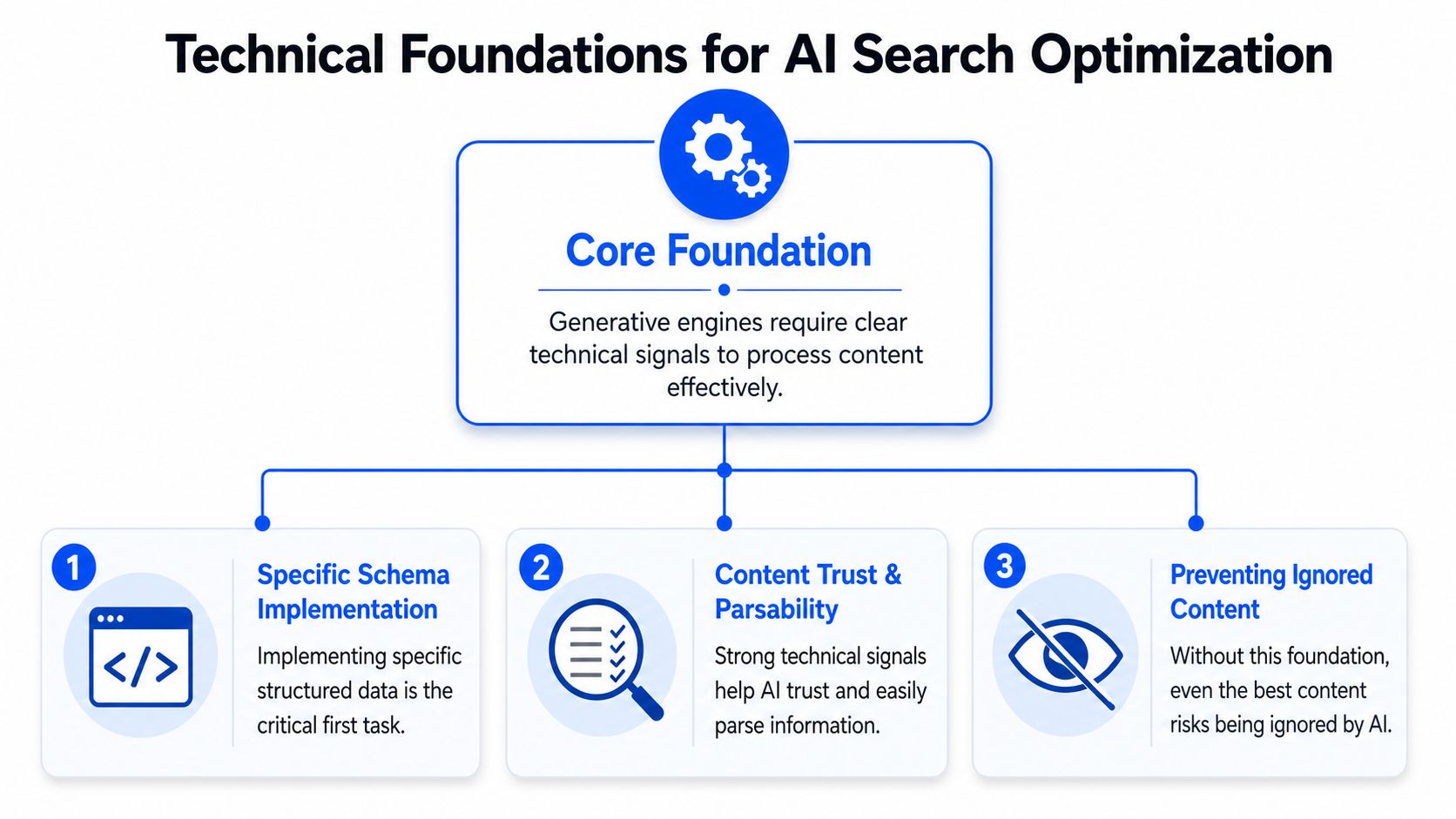
A common pattern shows up in Indian B2B SaaS teams selling into the US, Europe, and the Middle East. The brand publishes strong product pages, localized landing pages, and solid documentation, but AI engines still cite a review site, a reseller, or a US-based competitor first. The reason is usually technical, not editorial. If crawlers cannot read your pages cleanly or connect your product entity to a stable schema footprint, you lose visibility at the exact moment buyers ask category and comparison questions.
Start with structured data. SaaS Hackers' GEO guidance for SaaS companies recommends using schema types such as Product, HowTo, FAQPage, SoftwareApplication, and Review to define core fields like name, description, applicationCategory, and offers. For B2B SaaS, that is the baseline for helping AI systems interpret your product correctly across pricing pages, feature pages, docs, and comparison content.
The pages to fix first
Do not roll schema out randomly. Fix the pages that influence pipeline first.
| Page type | Schema priority | What to define |
|---|---|---|
| Homepage | Organization, Product | Brand identity, category, core offer |
| Product pages | SoftwareApplication, Product | Features, app category, supported environments |
| Pricing pages | Product, FAQPage | Offers, plan structure, pricing context |
| Comparison pages | Product, Review, FAQPage | Competitor context, feature distinctions |
| Help and explainer pages | HowTo, FAQPage | Step-based answers and direct questions |
Then test those pages in Google's Rich Results Test. Broken markup, conflicting fields, and missing required properties are not minor issues. They directly reduce how reliably AI systems can parse your product and quote it back to buyers.
For Indian SaaS companies targeting global demand, one technical gap matters more than teams expect. Your schema, metadata, canonical setup, and on-page entity references must stay consistent across English and localized market pages. If your English product page says "revenue recognition automation" and your regional page shifts to a vague translated label, you create entity drift. AI systems treat that drift as ambiguity, and ambiguity costs citations.
JavaScript-heavy rendering is the second failure point. If pricing tables, feature blocks, FAQs, or comparison content only appear after client-side rendering, many systems will not extract them cleanly. Serve important commercial content in crawlable HTML, use clear heading hierarchy, and keep primary facts visible without requiring interaction.
This is also where process discipline matters. Build a repeatable technical review into your AI content optimization workflow and assign ownership across marketing, product marketing, and engineering. If nobody owns schema updates, rendering checks, and localized entity consistency, your AI visibility will drift quarter by quarter, and revenue pages will lose ground to better-structured competitors.
Restructure Content for AI Extraction
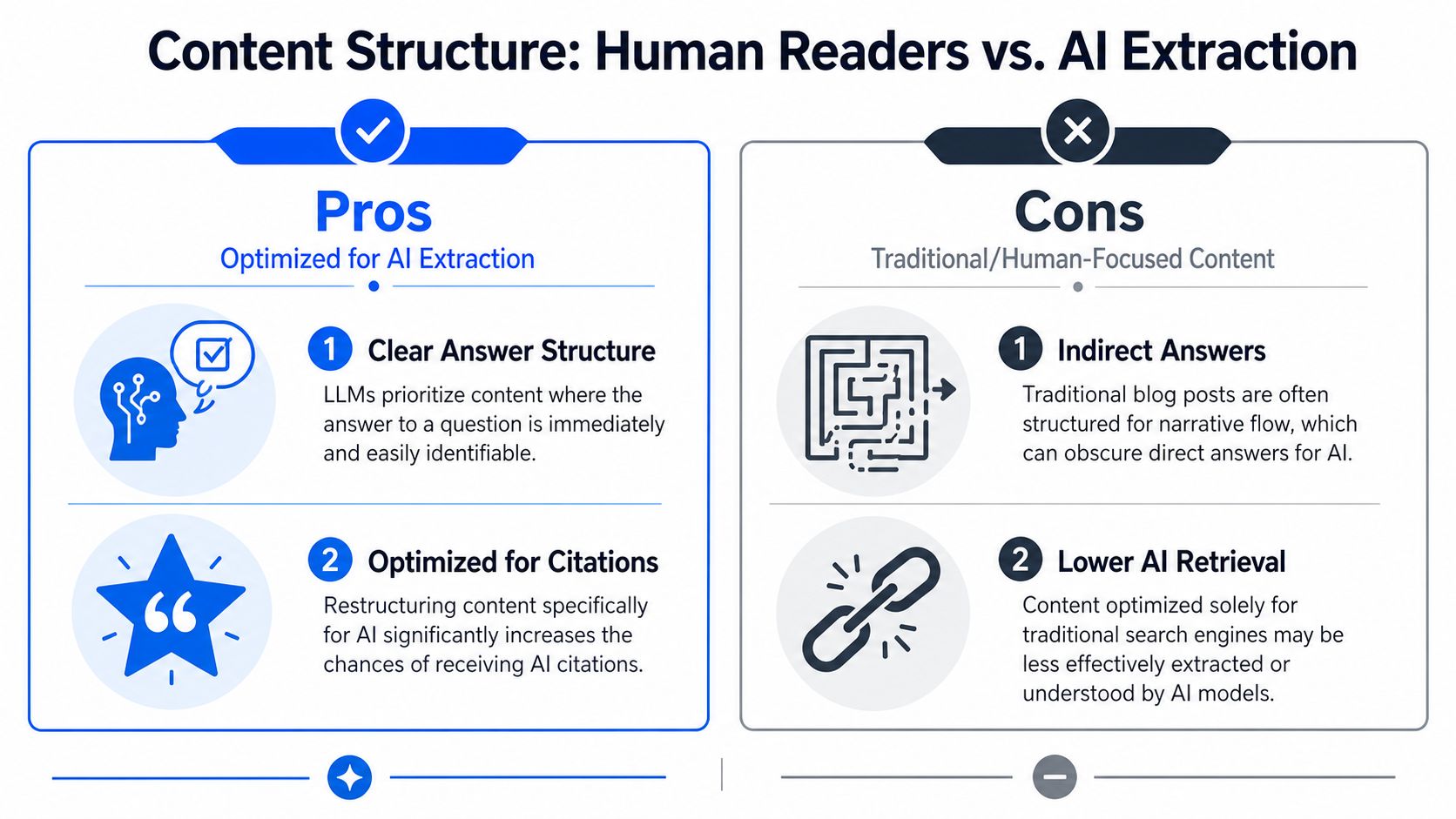
Most B2B SaaS content is written for scroll depth, brand narrative, and internal linking. AI systems don't reward that by default. They reward extractability.
One structural rule holds greater importance than many realize. AI search engines prioritize content that places the direct answer within the first 1 to 3 sentences after a heading, and they favor concise answers of 40 to 60 words, according to Xponent21's summary of featured snippet and AI citation behavior. The same source notes that content appearing in Google featured snippets is significantly more likely to be included in AI-generated responses, with higher citation rates in AI Overviews, Claude, and Perplexity.
What a high-citation page looks like
A retrieval-friendly page opens with a clean definition near the top. Its H2s and H3s often reflect real buyer questions. Each section answers the heading immediately, then expands with supporting detail.
A weak page does the opposite. It starts with brand storytelling, delays the answer, and buries the useful material under long prose blocks.
Put the answer first. Then earn the read.
For B2B SaaS comparison pages, structure matters even more. The content patterns that repeatedly win citation share include definition-first answer blocks, comparison tables in HTML, numbered framework steps, and verifiable proprietary data, with HTML tables specifically required on versus pages so LLMs can parse pricing tiers, features, deployment options, and standards like SOC2 or HIPAA, according to this B2B SaaS GEO guide focused on citation-winning page formats.
What to change this week
Pick your top five commercial pages and rebuild them around extraction:
- Rewrite intros: answer the core query in the opening paragraph.
- Turn questions into headings: use the same phrasing buyers use in demos and sales calls.
- Replace prose comparisons: use HTML tables for features, pricing context, integrations, and security standards.
- Create citation pages: publish focused pages for "best X for Y" and "X vs Y" queries on your main domain.
If your team needs a workflow for that rewrite process, start with AI content optimization.
Engineer Citation Pathways on Third-Party Sites
Your website is only one part of the recommendation graph. AI systems build confidence through repeated mentions across trusted sources. If your brand mostly talks about itself on its own domain, that's weak evidence.
That is why off-site citation pathways matter. Getting listed in trusted SaaS directories and review platforms like G2 and Capterra directly increases the probability of your brand being recommended because these third-party citations influence LLM training and retrieval, based on Bay Leaf Digital's guidance on generative engine optimization best practices.
Where to build authority first
Start with the sources that buyers and AI systems both trust.
- Review platforms: G2 and Capterra should have current positioning, clean category mapping, recent reviews, and accurate product descriptions.
- Community platforms: Reddit and Quora often surface in AI answers because they capture real user language and objections.
- Video platforms: YouTube transcripts can reinforce product explanations and category associations.
- Industry publications: Analyst roundups, software buyer guides, and vendor comparison sites help define your brand in market context.
ChatGPT still relies on Bing for live search results, so Bing visibility matters too. If your content is crawlable but invisible in Bing and absent from the sources Bing surfaces, your ChatGPT presence can stay weak even while your Google rankings look healthy.
A practical quarterly plan
Don't spread effort across ten channels. Pick one weak point and fix it fully.
If your G2 profile is thin, improve that first. If your review presence is strong but your category is poorly understood, answer the highest-intent Quora questions in your niche and tighten the wording. If your product demos live on YouTube, make sure transcripts clearly describe your category, audience, and alternatives.
Your goal isn't broad "brand awareness." It's repeatable, high-trust mentions that give AI systems enough outside confirmation to include you in buying answers.
Measure What Matters and Adapt
Traditional SEO reports hide the actual problem. Traffic can hold steady while recommendation visibility collapses. Rankings can look fine while AI assistants stop mentioning your brand. If you're still reporting only impressions, sessions, and backlinks, you're missing the channel that's reshaping software discovery.
Content freshness is one of the clearest examples. AI systems increasingly prioritize recent, verifiable data, and statistics older than 18 months are one of the fastest ways to lose citations, while Google's Generative AI performance report in Search Console now lets marketers monitor visibility specifically in generative AI features, according to Local Falcon's AI search optimization best practices.
The KPIs worth tracking
You need a measurement system built around citation presence and answer quality.
- AI share of voice: how often your brand appears across your priority prompts
- Citation source quality: whether AI systems cite your domain, reviews, or weak third-party pages
- Answer accuracy: whether your pricing, features, and positioning are represented correctly
- Lead-source overlap: whether cited queries correlate with pipeline, not just visibility
Keka's +82% gain in AI visibility happened because the work didn't stop at content publication. The team tracked where mentions increased, which prompts drove those appearances, and where factual errors had to be corrected. You can see the broader pattern in these case studies.
The operating rhythm that works
Add a visible last-updated date to your core pages. Review high-traffic commercial content quarterly. Replace stale stats, old screenshots, and outdated product claims before AI systems replace you with fresher sources.
Also file feedback with ChatGPT or Gemini when answers misstate your pricing, features, or category. AI search isn't passive brand monitoring. It's active narrative management.
If you do only one thing this week, track your top five buying prompts across two platforms every week for the next month. That simple habit will show you whether your visibility is compounding or slipping.
Frequently Asked Questions
How is AI search optimization different from traditional SEO
Traditional SEO tries to rank pages. AI search optimization gets your brand selected inside the answer itself.
That changes what wins. A page can rank on Google and still disappear in ChatGPT, Gemini, Perplexity, Claude, or AI Overviews if the content is hard to extract, your category is unclear, or trusted third-party sources do not reinforce your claims. In B2B SaaS, buyers often see a short list, not ten blue links. If you are not in that short list, you are out of consideration early.
For Indian SaaS companies selling into the US, UK, UAE, or Southeast Asia, the bar is higher. You need entity clarity across markets, naming conventions, and buyer vocabulary. If the model cannot connect your product, category, use case, and proof points across those contexts, visibility stays weak even when your SEO looks healthy.
Treat AI search as a revenue channel with its own audit, reporting, and content standards.
How long does it take to improve visibility in AI answers
Teams usually see progress fast when the problem is technical or structural.
If crawlers have access, your core pages are rewritten for extraction, and your third-party profiles are stronger, answer inclusion can improve within a few review cycles. If your site is hard to crawl, your schema is thin, and your comparison pages say nothing specific, the first phase is cleanup.
The fastest gains usually come from three actions. Open access where needed. Fix your pricing, product, and comparison pages first. Strengthen the third-party sources AI systems already trust.
For founders and CMOs, the better question is simple. What is blocking recommendation eligibility right now: access, structure, authority, or accuracy?
Do I need new content, or can I fix existing pages
Fix existing commercial pages first.
Publishing more articles will not solve a weak pricing page, vague product copy, or comparison pages written like brand fluff. AI systems reward clear answers and credible corroboration. They do not reward volume by default.
Start with the pages that affect pipeline:
- Product pages should define the product in plain language
- Pricing pages should explain plans, packaging, and fit without ambiguity
- Comparison pages should use real criteria and HTML tables
- FAQ pages should answer objections in short, extractable blocks
After that, add pages built for specific buying prompts and regional phrasing. That matters a lot for Indian B2B SaaS brands because global buyers often describe the same problem differently by market.
Does multilingual optimization really matter for Indian SaaS brands
Yes.
Indian SaaS companies targeting global markets often underestimate how messy buyer language gets. Prospects switch between English and local phrasing, use translated feature terms, and describe categories differently across India, the Gulf, Europe, and North America. If your entity mapping only works in one version of English, AI systems miss obvious connections.
Translation alone does not fix this. Your category labels, feature names, integrations, use cases, and brand associations need to stay consistent across languages and regional variants. We see this repeatedly in client work. Brands with strong product pages still lose AI visibility because the model cannot confidently map a Hindi-influenced, Arabic-influenced, or region-specific prompt to the same company entity.
Regional authority signals matter too. Reviews, directories, partner mentions, and local media references can strengthen trust in a market where your own site is not enough.
Which technical fixes matter most first
Start with the fixes that affect retrieval and extraction.
Crawler access comes first. Then add schema to your highest-value pages. Then make sure your core commercial content is present in clean HTML with headings, tables, lists, and direct answers that models can quote accurately.
Use this order:
| Priority | What to fix | Why it matters |
|---|---|---|
| First | Crawler access | No retrieval means no visibility |
| Second | Schema markup | Helps models classify your product correctly |
| Third | HTML structure | Improves extraction and quoting |
| Fourth | Page openings and headings | Increases answer selection odds |
| Fifth | Off-site mentions | Improves trust and recommendation confidence |
If your team has limited capacity, fix five pages first: homepage, one product page, pricing, one comparison page, and one high-intent FAQ or use-case page.
How do I know whether AI visibility is affecting revenue
Measure prompts, citations, and pipeline together.
Track which buying queries mention your brand, which sources AI systems cite, and whether those themes show up in demo requests, sales calls, and self-reported attribution. If visibility rises on low-intent prompts, revenue will stay flat. If you are absent from commercial prompts like alternatives, comparisons, pricing, implementation, or category fit, you are losing deals before a prospect reaches your site.
Accuracy matters just as much as presence. Wrong pricing, outdated feature claims, or weak category positioning can create confusion instead of demand. That is why strong teams review answers weekly and correct errors quickly.
If your brand is missing from AI recommendations, competitors are shaping buyer preference before your sales team gets a shot. LLMBuddy helps B2B SaaS teams fix visibility gaps, build citation pathways, and measure AI share of voice across the platforms influencing software purchases. If you want a practical rollout plan, book a demo.