

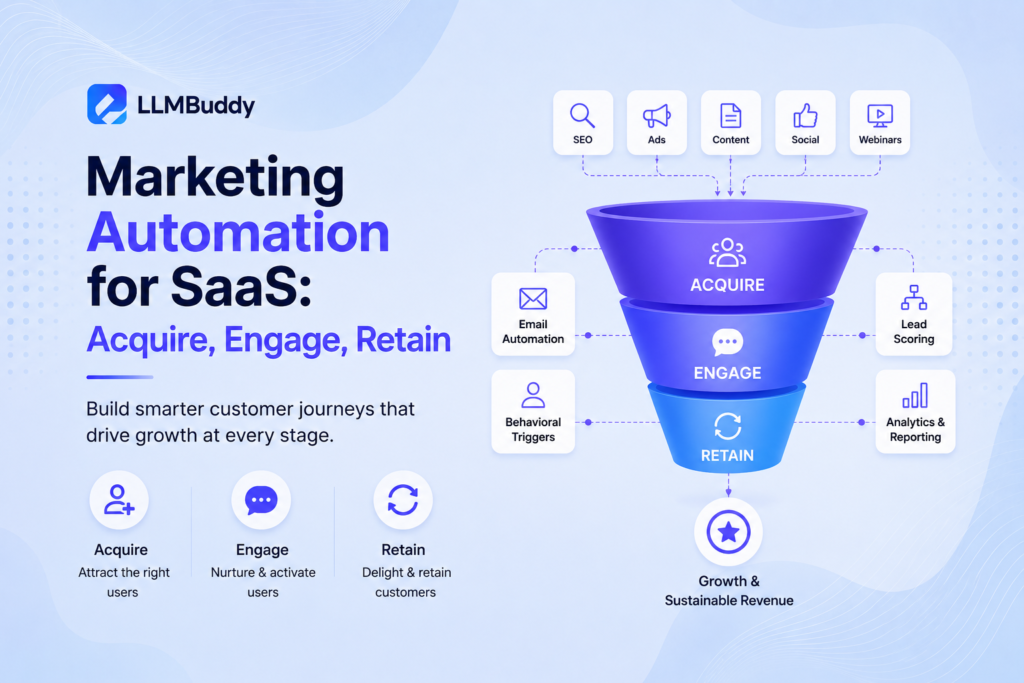
The companies that treat automation as basic email software are already behind. The global marketing automation market was valued at $6.65 billion in 2024 and is projected to reach $15.58 billion by 2030, while 70% of marketing leaders said they plan to increase automation investment in 2025, according to Emarsys marketing automation statistics. That matters because SaaS doesn’t win on lead capture alone. It wins on what happens after the signup, after the demo request, and after the first product session.
For B2B SaaS founders and marketing leaders in India, that shift is especially sharp. Teams are expected to grow pipeline, improve activation, support sales, reduce churn, and still operate lean. Manual follow-ups break first. Then reporting breaks. Then the handoff between marketing, sales, and product turns into guesswork.
That’s why marketing automation for SaaS should be treated like operating infrastructure. Not as a campaign tool. Not as a stack badge. Infrastructure.
The best teams build systems that react to behavior, move data cleanly across tools, and tell them whether automation is improving trial-to-paid conversion, expansion, and customer lifetime value. The same discipline now shows up in adjacent growth areas too, including AI discoverability. If you’re thinking about how your brand gets surfaced in AI search, this perspective on AI visibility for Indian SaaS brands across ChatGPT, Gemini, and Perplexity is worth reading.
Introduction From Manual Chaos to Automated Growth
Most SaaS teams don’t start with a broken strategy. They start with a handful of reasonable manual processes. A founder sends trial follow-ups from Gmail. A marketer exports webinar leads into a CSV. A sales rep checks product usage in one tab and CRM stage in another. That works for a while.
Then volume increases, and the cracks show fast. Prospects get the wrong message. Trial users don’t receive onboarding at the right moment. Existing customers keep seeing acquisition campaigns. Sales asks for better lead quality, and marketing can’t prove what influenced the deal.
Automation works when it removes delay from important moments in the customer journey, not when it simply increases message volume.
Marketing automation for SaaS solves a very specific business problem. It lets a company maintain timely, relevant communication across acquisition, activation, and retention without growing headcount at the same pace. But that only happens when the workflows are tied to actual customer behavior and business goals.
Why SaaS needs a different automation mindset
Ecommerce can often optimize around transactions. SaaS has to optimize around progression. Did the lead book a demo? Did the trial user invite teammates? Did the account adopt a sticky feature? Did product usage predict renewal risk?
That’s why generic drip campaigns underperform in SaaS. They ignore product context. They also ignore the fact that recurring revenue businesses need a system that keeps working after the initial conversion.
What changes when you build it properly
A strong automation engine changes three things:
- Speed of response: High-intent actions trigger immediate follow-up instead of waiting for manual review.
- Message relevance: Product behavior, funnel stage, and account context shape the next touch.
- Operational visibility: Teams can connect workflow activity to real commercial outcomes instead of only tracking email engagement.
Blueprint Your Strategy Before You Build
Most failed automation setups don’t fail because the platform is weak. They fail because the team starts with workflows before deciding what the workflows must achieve.
Enterprise guidance gets this right. Start with a defined KPI, map the full customer journey, audit the current tech stack, and only then design workflows. Teams are also advised to roll out slowly, starting with simple programs such as welcome emails before expanding complexity, as outlined in monday.com’s marketing automation strategy guide. If your team is also rethinking how structured discoverability works in AI environments, the same systems mindset applies in this guide on how to optimize for AI search.
Start with one business problem, not ten
If you’re a founder, don’t approve an automation project with vague goals like “better nurture” or “more efficiency.” Pick one KPI that matters now.
For most B2B SaaS teams, that KPI usually sits in one of three buckets:
-
Acquisition
- Improve demo request progression
- Improve lead qualification before sales engagement
- Reduce lag between inbound conversion and first response
-
Activation
- Move signups to first value faster
- Push trial users toward key setup milestones
- Increase hand-raisers from product-qualified accounts
-
Retention and expansion
- Re-engage underused accounts
- Drive feature adoption
- Support upsell conversations with behavioral signals
If everything is a priority, automation becomes a mess of overlapping rules. Pick the commercial bottleneck first.
Map the real customer journey
Most journey maps in slide decks are too clean to be useful. Real SaaS buying and usage paths are messy. A prospect may attend a webinar, ignore emails, start a free trial, disappear for a week, come back through a branded search, invite a teammate, and only then speak to sales.
Your journey map should reflect that mess.
Use a working model like this:
| Stage | Key user action | What the system should know | What automation should do |
|---|---|---|---|
| Awareness | Visits pricing or solution page | Source, company, page intent | Route into the right segment |
| Conversion | Fills form or starts trial | Persona, offer, acquisition path | Trigger immediate follow-up |
| Activation | Uses or ignores core setup flow | Product behavior | Send contextual onboarding |
| Sales assist | Requests demo or shows intent | Fit + engagement + usage | Alert sales with context |
| Customer stage | Feature adoption changes | Health and expansion potential | Launch retention or upsell sequence |
That map becomes your workflow logic. Without it, automation stays channel-based instead of journey-based.
Practical rule: If a trigger can’t be tied to a meaningful change in customer state, it probably shouldn’t trigger a workflow.
Launch a pilot that can break safely
Start small. A welcome series is still one of the best pilot programs because it tests the basics without operational chaos.
A good pilot validates:
- Data flow: Did form data, CRM fields, and event tracking sync correctly?
- Segmentation: Did the right users enter the right branch?
- Timing: Did messages fire when expected?
- Ownership: Does sales know when a handoff occurs?
- Attribution: Can you tell whether the workflow influenced the next step?
What doesn’t work is launching ten branching journeys on day one. Teams then spend weeks debugging field mismatches, duplicate contacts, and unclear handoffs. Complexity multiplies faster than value.
Designing Your SaaS Nurture and Engagement Engine
Generic email blasts don’t convert well in SaaS because they flatten different buyer states into one list. A person who just started a trial shouldn’t get the same sequence as a freemium user who has been active for months or a paying customer who has stopped using a critical feature.
The performance gap is real. Organizations using nurture workflows with lead scoring and behavioral triggers see MQL-to-SQL conversion rates 30% to 50% higher than teams using batch-and-blast email, with a 38% median lift in benchmark data. The lift can reach 62% when lead scoring is combined with AI intent signals, and behavior-triggered personalization also produced 41% higher click-through rates, while AI-generated subject lines delivered a 26% open-rate lift in nurture emails, according to Digital Applied’s marketing automation benchmark data.
Trial users need acceleration, not education overload
A trial user is racing against time. Your job isn’t to send a polished brand story. Your job is to get the user to the first meaningful outcome as fast as possible.
That usually means:
- Welcome immediately: Confirm value and set one clear next step.
- Watch activation events: Account creation, integration completed, teammate invited, first workflow built.
- Branch by behavior: If the user stalls, send help. If the user progresses, send the next advanced use case.
- Escalate human outreach selectively: A sales rep or founder should engage when fit and intent are both strong.
Here’s a practical starting point.
Sample SaaS Trial Nurture Flow
| Day | Trigger | Automated Action | Goal |
|---|---|---|---|
| 0 | Trial signup | Send welcome email with one setup action and login link | Drive first session |
| 1 | No key setup event | Send onboarding email with short setup guidance | Reduce early drop-off |
| 3 | Key feature used | Send advanced use-case email | Deepen product value |
| 5 | High-fit account with strong activity | Create sales task in CRM | Support timely outreach |
| 7 | No recent activity | Send re-engagement email with help offer | Recover stalled trials |
| 10 | Multiple active users in account | Send collaboration or team workflow content | Increase stickiness |
| 12 | Trial ending soon | Send outcome-focused reminder tied to account progress | Push decision |
| 14 | Trial ends without conversion | Move to post-trial nurture segment | Preserve future pipeline |
Freemium users and paid customers need different logic
Freemium users often don’t need more top-of-funnel persuasion. They need a reason to care about upgrading now. That reason usually comes from usage ceiling, team growth, admin needs, reporting gaps, or feature dependency.
For paid customers, automation should support retention, not annoy active accounts with irrelevant promotions. When usage drops or a high-value feature goes untouched, that’s the moment to trigger education, support, or customer success intervention.
A few patterns that work:
- Freemium upgrade motion: Trigger when a user repeatedly reaches a product limit, then show the paid outcome tied to that limit.
- Inactive customer recovery: Trigger when core feature usage declines, then send use-case content or offer support.
- Expansion motion: Trigger when multiple users adopt a feature or a team exceeds lightweight usage, then surface admin or enterprise capabilities.
The best nurture systems feel like the product is paying attention, not like marketing built another drip campaign.
What usually fails
Three mistakes show up repeatedly:
- Sending by calendar, not behavior. Time-based flows without product signals quickly lose relevance.
- Over-branching too early. Teams create complex logic trees before they’ve validated the core path.
- Optimizing for email output. More emails don’t mean more progression. Better state changes do.
Your Automation Tech Stack Integration and Data Hygiene
Automation breaks in the data layer before it breaks anywhere else. A beautiful workflow builder won’t save you if the CRM owner field is wrong, product events arrive late, or lifecycle stages mean different things across teams.
That’s why the technical core of marketing automation for SaaS is integration and segmentation. Your platform needs a clean connection to a central CRM, support for behavioral triggers, and analytics that monitor the full funnel rather than only clicks and opens, as explained in Copy.ai’s guide to marketing automation for SaaS companies. If you’re evaluating adjacent tooling for AI discoverability and reporting, this overview of AI visibility platforms with SEO capabilities is a useful comparison point.
The three systems that must agree
In practice, the core stack usually centers on three systems:
| System | Primary role | Common failure |
|---|---|---|
| CRM | Account and contact source of truth | Duplicate records, bad ownership, weak stage discipline |
| Marketing automation platform | Messaging, segmentation, orchestration | Trigger logic based on stale or incomplete data |
| Product analytics or telemetry | Usage and behavior signals | Events not mapped cleanly to lifecycle decisions |
If those systems disagree, reporting becomes fiction. Sales says the lead was ready. Marketing says the lead was nurtured. Product says the account was inactive. All three can be “right” inside their own tool and still leave leadership with the wrong conclusion.
Data hygiene is not admin work
Founders often underestimate how commercial this is. Data hygiene sounds operational, but it directly affects revenue.
A few non-negotiables:
- Define one lifecycle model: Inquiry, MQL, SQL, opportunity, customer, expansion-ready. Keep the definitions operational, not aspirational.
- Standardize key fields: Persona, company size, source, product plan, account owner, lead status.
- Protect UTM discipline: If campaign inputs are messy, attribution will be messy later.
- Audit duplicates and sync errors: A duplicate contact can trigger conflicting journeys and confuse reps.
- Align event naming: Product events must be clear enough to power segmentation.
Segmentation should reflect buying and usage reality
Segmentation based only on firmographics leaves money on the table. Good SaaS segmentation combines fit, intent, and behavior.
That can include:
- account type
- plan type
- trial status
- product milestones reached
- sales engagement status
- customer health indicators
The same contact record can represent very different opportunities over time, so your system must recognize those state changes. A user may start as a low-intent lead and later become a product-qualified account.
If your CRM says “hot lead” but product data shows no meaningful usage, your automation is amplifying noise.
A quick note on proof and instrumentation
This is also where measurement discipline matters outside classic marketing automation. In the Legitt AI case study, the reported AI Visibility Score went from 5 to 38, and the brand ranked #1 on ChatGPT above DocuSign. The broader lesson isn’t just about AI visibility. It’s about instrumentation. You can’t prove improvement without a reliable baseline, consistent tracking, and clean definitions.
The same rule applies to SaaS automation. If you want to know whether a nurture flow influenced pipeline, your contact data, campaign structure, and product signals have to be clean enough to support that conclusion.
Measuring What Matters SaaS KPIs and Optimization
The most common reporting mistake in SaaS automation is stopping at opens, clicks, and MQL counts. Those metrics are fine as diagnostics. They are weak as business proof.
A common gap in SaaS marketing advice is measurement beyond engagement metrics. Leaders need full-funnel attribution that connects the MAP, CRM, and product data to understand impact on pipeline and revenue, as discussed in GoRevX’s analysis of marketing automation measurement gaps. That’s where strong teams separate activity from actual contribution.
What to track instead of vanity metrics
Here’s the test I use. If a metric can improve while revenue quality declines, it’s not a primary KPI.
A stronger automation dashboard includes:
- Trial-to-paid conversion: Did onboarding and nurture increase paid adoption?
- Product-qualified leads generated: Did behavior-based workflows create sales-ready conversations?
- Pipeline influence by segment: Which journeys help move real opportunities?
- Churn or reactivation impact: Are retention workflows reducing risk or recovering usage?
- Customer lifetime value: Are automated lifecycle programs improving account quality over time?
You can still watch opens and clicks. Just don’t confuse them for the outcome.
The attribution problem most teams avoid
SaaS journeys rarely live in one system. A buyer may click an email, revisit your site, use the product twice, attend a sales call, and convert after an internal buying discussion. If your reporting model only credits the last touch or only reports campaign engagement, you’ll miss how automation contributed.
That’s why full-funnel attribution matters. The question isn’t “did this email get opened?” It’s “did this automation sequence help move the account toward revenue?”
A practical attribution setup should answer:
| Question | Data needed |
|---|---|
| Did marketing influence this opportunity? | Campaign membership + CRM opportunity linkage |
| Did product behavior increase sales readiness? | Product events mapped to account/contact records |
| Which workflow supports conversion best? | Workflow entry, branch path, and downstream progression |
| Are we improving account quality? | Segment-level conversion and retention reporting |
Optimization is continuous or it’s wasted effort
Automation is not a one-time implementation. Audience behavior changes. Messaging gets stale. Product flows evolve. Sales motions change.
That means your team should keep testing:
- Entry criteria: Are the right users entering the workflow?
- Timing: Does the delay match real buying or usage behavior?
- Content angle: Does the message push toward value, urgency, or support?
- Branch logic: Are active and inactive users still being treated differently?
- Handoff rules: Is sales being notified too early or too late?
A workflow that performed well six months ago can quietly become irrelevant if the product, buyer, or sales motion changes.
The mature view of marketing automation for SaaS is simple. You are not managing campaigns. You are managing progression across systems.
Your Path Forward to Scalable Growth
Founders usually ask when automation becomes worth the effort. The answer is earlier than commonly believed, but only if they build it in the right order.
Start with the commercial bottleneck. Build around one KPI. Map the actual customer journey, not the neat version in a strategy deck. Launch a pilot that tests your data flow and handoffs. Then expand into deeper nurture, activation, retention, and sales-assist logic.
That sequence matters because automation compounds both strengths and weaknesses. If your segmentation is sharp and your data is clean, automation amplifies success. If your lifecycle stages are muddy and your systems don’t sync, automation spreads confusion faster.
For B2B SaaS companies in India, this matters even more because lean teams need output that scales without adding process drag. Good automation makes the company feel responsive. Great automation makes the revenue engine measurable. That’s the real difference.
There’s also a broader growth lesson here. Your workflows make sure the right prospects hear from you at the right time. But before that happens, buyers and AI systems still need to find you, understand you, and trust your positioning. That’s becoming a parallel operating system for modern SaaS growth.
Frequently Asked Questions
1. What should a SaaS company automate first?
Start with a welcome or trial onboarding sequence tied to one clear KPI. It’s easier to validate data flow, segmentation, timing, and ownership with a simple high-impact workflow than with a large multi-branch setup.
2. Does marketing automation for SaaS only help with lead generation?
No. In SaaS, the bigger value often appears after acquisition. Good automation improves activation, supports sales handoffs, drives feature adoption, and helps retention teams respond to behavior changes.
3. Which team should own the automation system?
Marketing usually owns the platform, but the operating model must be shared. Sales needs visibility into handoffs, product teams often control key behavioral signals, and customer success may rely on the same data for retention workflows.
4. How do I know if my reporting is too shallow?
If your dashboard mostly shows email opens, clicks, and list growth, it’s too shallow. A stronger model connects workflow activity to pipeline progression, product behavior, conversion to paid, and customer value over time.
5. How does this connect to AI visibility and GEO?
The connection is measurement and system design. The same discipline used to build reliable automation also helps companies measure discoverability across AI platforms. LLMBuddy is India’s first GEO agency for B2B SaaS, focused on how software brands are found, cited, and recommended across AI search and assistants.
If you want to understand whether your SaaS brand is visible where modern buyers increasingly discover software, get a free AI Visibility Audit from LLMBuddy. They help B2B SaaS companies measure and improve discoverability across platforms like ChatGPT, Gemini, and Perplexity, with a reporting-led approach built for real growth decisions.