
The way B2B buyers research software has fundamentally changed – and most Indian SaaS brands have not caught up yet.
A growing number of decision-makers no longer start their research on Google. They open ChatGPT, type a question like “best HR software for Indian companies,” and build their shortlist based on what comes back. No clicking through ten blue links. No comparing multiple websites. One consolidated answer – with 3 to 5 brand recommendations – shapes their entire buying journey.
This shift raises a critical question for every Indian SaaS brand: are you in that answer? If not, your AI visibility gap is costing you leads every single day.
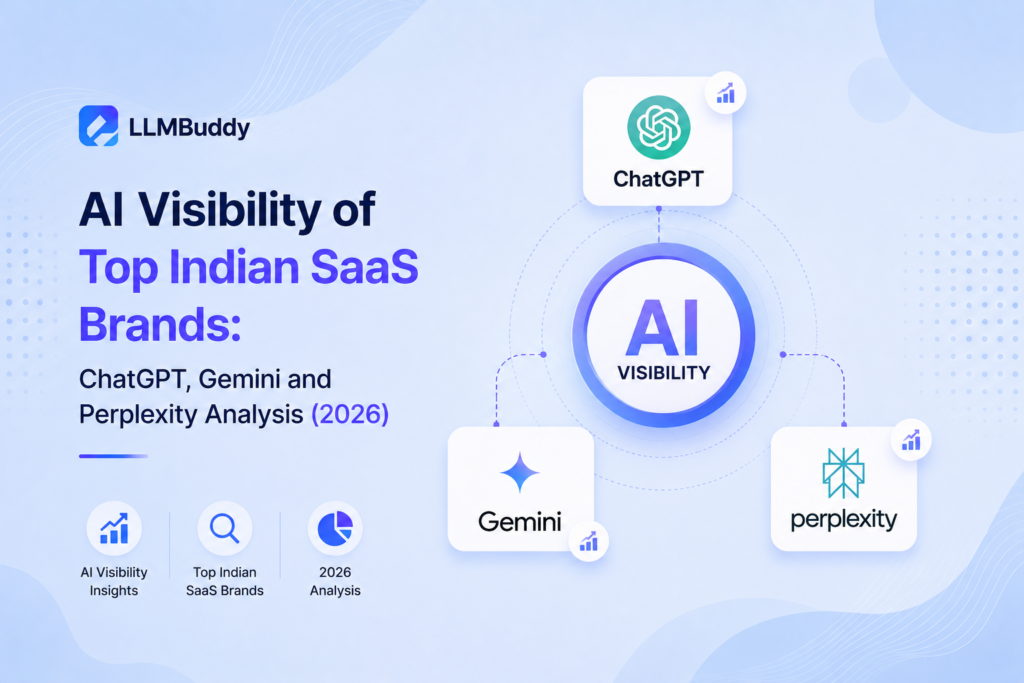
To find out, we ran a structured experiment across ChatGPT, Gemini, and Perplexity – three of the most widely used AI platforms among B2B buyers today. We tested two high-intent queries that Indian software buyers search for regularly, tracked which Indian brands appeared, and analyzed why certain brands consistently show up while others remain completely invisible.
Research Methodology
There is nothing complicated about how we ran this. We opened ChatGPT (GPT-4o), Google Gemini (Flash), and Perplexity AI on the same day – May 30, 2026 – and entered two queries that Indian B2B buyers search for regularly.
Query 1: “Best HR software for Indian companies”
Query 2: “Best subscription billing software for SaaS”
Every result was screenshotted immediately. We tracked which Indian brands appeared, where they appeared, and how AI platforms described them. The brands that showed up did so consistently across multiple query variations – this was not a one-time result.
Query 1 – Best HR Software for Indian Companies
ChatGPT Results
ChatGPT returned a clean, structured table with no preamble – a direct breakdown organized by company size:
| Company Size | Recommended Software | Best For |
|---|---|---|
| 10-100 employees | Zoho People | Affordable, easy setup, good for startups |
| 20-500 employees | greytHR | Payroll, PF/ESI/TDS compliance, attendance |
| 50-2,000 employees | Keka HR | Complete HRMS, payroll, performance management |
| 200-5,000 employees | Darwinbox | Enterprise-grade HR automation |
| Large Enterprises | SAP SuccessFactors | Global workforce management |
Keka sits in the 50-2,000 employee slot. That is not a minor segment – it covers the majority of growth-stage Indian companies. For a B2B HR software brand, this is the most valuable position in the entire table. Zoho People, greytHR, and Darwinbox are all present too – but Keka’s positioning is precise, well-described, and clearly matched to a specific use case.
Gemini Results
Gemini went deeper than ChatGPT. It added a fourth column – AI/Tech Level – that signals something important about where AI search is heading:
| Software | Target Audience | Standout Strength | AI/Tech Level |
|---|---|---|---|
| Keka | Tech startups and SMEs | Exceptional UI and Performance Management | Moderate (Smart Insights) |
| greytHR | Payroll-focused SMEs | Zero-error Indian statutory compliance | Traditional |
| Darwinbox | Enterprises and Corporates | Deep talent analytics and scalability | Advanced (Gen AI) |
| Zoho People | Tech-savvy teams | Deep integration with accounting/CRM | Moderate |
| RazorpayX | Micro-startups | Instant automated salary disbursement | Basic |
Keka leads the Gemini response as the top recommendation for tech startups and SMEs. The AI/Tech Level column is worth paying attention to – Gemini spontaneously evaluated software on its AI-readiness without being asked. This tells you something about where AI SEO is heading: platforms will increasingly weight a brand’s own AI adoption when deciding what to recommend.
Perplexity Results
Perplexity added something neither ChatGPT nor Gemini included – current 2026 pricing data, making it the most purchase-ready response of the three:
| Software | Best For | Starting Price | Key Strengths |
|---|---|---|---|
| Keka HRMS | Mid-market, complex workflows | ~Rs. 6,999/month | Comprehensive features, performance management, customizable workflows |
| greytHR | Payroll-focused SMEs | Rs. 2,495-3,495/month for 50 employees | Strongest payroll and statutory compliance |
| Craze | Fast-growing Indian companies | Transparent modular pricing | YC-backed, unified HR+Payroll+IT management |
Keka holds the top position here as well – with pricing and key strengths clearly stated for a buyer ready to make a decision.
HR Category Verdict
Three platforms. Three different response formats. One consistent outcome – Keka appears at or near the top every single time.
greytHR appeared on all three platforms. Darwinbox appeared on two. The cross-platform consistency is not luck. It is the output of a content and positioning strategy that has been working quietly in the background for some time.
Query 2 – Best Subscription Billing Software for SaaS
ChatGPT Results
ChatGPT ranked its billing software recommendations as a structured list. Stripe Billing came first as the best overall for early-stage PLG companies. Chargebee came second – with a description that is worth reading carefully:
Best when billing becomes a business function instead of just a payment function.
ChatGPT, describing Chargebee – May 2026
That is a sharp, specific positioning statement. ChatGPT is not just listing Chargebee – it is explaining precisely when a company needs it and why. The capabilities ChatGPT attributed to Chargebee included full subscription lifecycle management, 30+ payment gateway integrations, trial-to-paid conversion tools, ASC 606-compliant revenue recognition, and a customer self-service portal.
It is important to note that Stripe is payment infrastructure – a different category entirely. As a dedicated subscription billing platform, Chargebee is effectively the number one ChatGPT recommendation in its actual segment.
Gemini Results
Gemini placed Chargebee in its Industry Standards section – describing it as a dedicated billing logic layer built for complex subscription models covering trials, upgrades, downgrades, dunning, and multi-currency revenue recognition at scale.
Clear, specific, and accurate. Gemini knows exactly what Chargebee does and who it is for.
Perplexity Results
Perplexity organised its answer by use case – the most granular and buyer-useful format of the three responses:
| Use Case | Best Software | Why |
|---|---|---|
| Simple subscriptions (PLG startups) | Stripe Billing | Easy setup, low transaction fees |
| Mid-market B2B SaaS | Chargebee | Full lifecycle management; 30+ gateways; strong trial-to-paid conversion |
| Reducing involuntary churn | Recurly | Best-in-class Dunning engine |
| Finance-led B2B (ARR/NRR) | Maxio | GAAP-compliant revenue recognition |
| Hybrid pricing models | Solvimon | Built native to seats + usage + credits |
Chargebee owns the mid-market B2B SaaS row – precisely its stated ICP.
Billing Category Verdict
Chargebee appeared on all three platforms, with sharply defined positioning, consistent across every query variation we tested.
What stands out most is not just that Chargebee appears – it is that AI models describe it with surgical precision. They know who it is for, what stage of company needs it, how it compares to alternatives, and what specific problems it solves. Building that level of AI comprehension around a brand is the core work of generative engine optimization – and Chargebee has done it exceptionally well.
Five Reasons These Brands Win in AI Search
After analyzing both queries across three platforms, the same five patterns kept coming up. These are not theories – they are observable in how Keka and Chargebee are actually described and positioned by AI systems right now.
1. Review Platform Authority
Both brands have built substantial verified review profiles on G2, Capterra, Trustpilot, and GetApp. When ChatGPT constructs a recommendation, it draws heavily from these platforms as trusted data sources. Brands with thin or incomplete review profiles simply do not get recommended with the same confidence or frequency.
2. Structured Comparison Content
Both brands publish detailed comparison content – “Keka vs Darwinbox,” “Chargebee vs Recurly,” use-case breakdowns, and feature comparison tables. AI models extract structured content far more effectively than long unstructured prose. The table format ChatGPT used in its HR response mirrors the content structure Keka and similar brands consistently publish. This is exactly what AI content optimization looks like in practice.
3. Sharp Entity Definition
“Keka HR” and “Chargebee” exist as well-defined entities in AI knowledge systems. These platforms know precisely what each brand is, who it serves, what it does, and how it differs from alternatives. Vague or inconsistent brand positioning across the web produces vague AI recommendations – or no recommendation at all.
4. AI-Optimized Content Structure
Across both brands’ websites and blogs, the content architecture is structured for AI extractability – clear heading hierarchy, FAQ sections that AI can quote directly, explicit “Best for” and “Not ideal for” labels on product pages, and pricing pages with structured comparable data. Brands publishing long unstructured articles give AI models nothing easy to extract or cite.
5. Distributed Third-Party Citations
Chargebee is regularly cited by Inc42, YourStory, The Economic Times, and leading global fintech publications. Keka receives consistent coverage in Indian HR tech media and startup press. AI models crawl the web continuously – and the frequency and authority of external sources mentioning a brand directly determines its citation weight in AI recommendation systems. This is why ChatGPT optimization requires a PR and media strategy alongside website optimization.
What Happens When Your Brand Is Missing
Here is what is happening in your market right now, whether you are tracking it or not.
Potential buyers are opening ChatGPT, Gemini, and Perplexity and asking about the best solution in your category. They are receiving a consolidated answer with 4 to 5 brand recommendations. If your brand is not in that answer, your competitor is – and the buyer is forming their shortlist before they have seen your website, your case studies, or your pricing page.
By the time those buyers reach your homepage – if they reach it at all – they may already have a preference shaped entirely by AI recommendations you were not part of. This is not a future risk. It is happening today, at scale, across every SaaS category in India.
Check Your Own Brand Right Now
This takes less than 10 minutes. Open ChatGPT, Gemini, and Perplexity and run these queries for your category:
“best [your category] software for [your target market]”
“top [your category] tools India 2026”
“[your category] software comparison”
“alternatives to [market leader in your space]”
For each result, track whether your brand is mentioned, what position it holds, how it is described, and which competitors appear consistently across all three platforms. If your brand is absent from two or more of these queries, you have a measurable AI visibility gap. The first step to fixing it is understanding exactly where you stand – which is what our AI Search Audit is designed to show you.
A 30-Day Starting Framework
Based on the patterns observed in this research, here is a practical starting point for brands looking to improve their presence in AI search:
Week 1 – Technical Foundation: Add Organization Schema to your homepage. Audit your robots.txt file and explicitly allow GPTBot, PerplexityBot, and Google-Extended. Create your llms.txt file. Complete all fields on your G2 and Capterra profiles.
Week 2 – Content Optimization: Publish one comparison post covering your brand versus your top competitor. Add FAQ sections with a minimum of five questions to your five highest-traffic blog posts. Add explicit “Best for” and “Not ideal for” sections to your main product pages.
Week 3 – Citation Building: Pursue coverage in two to three Indian SaaS and tech publications. Run a structured review generation campaign with existing customers targeting G2 and Capterra. Publish consistent thought leadership content on LinkedIn.
Week 4 – Measure: Re-run your AI visibility check across all three platforms. Document what changed. Identify which actions produced the most movement and prioritize accordingly going forward.
Closing Thought
The brands winning in AI search today – Keka in HR software, Chargebee in B2B billing – did not get there by accident. They built AI visibility the right way: structured content, authoritative citations, precise entity definition, and a consistent presence on trusted third-party platforms.
They are capturing buyers at the very top of the funnel – before those buyers have visited a single competitor’s website. The brands that build AI visibility now will compound that advantage over the next 12 to 24 months. Those that wait will face an increasingly difficult catch-up challenge.
The question is not whether your brand needs to show up in AI search. It does. The question is how quickly you start building it.
If you want a precise picture of where your brand stands today, book a free AI Visibility Audit – we will show you your current score, how you compare to competitors, and exactly what to fix first.
Frequently Asked Questions
Traditional SEO focuses on ranking in Google search results as clickable links. AI visibility refers to how prominently your brand appears in AI-generated answers on platforms like ChatGPT, Gemini, Perplexity and Claude. The two share some foundations but require different strategies – AI places much higher weight on entity authority, structured content formats and the density of citations from trusted external sources.
Most brands see measurable improvement within 60 to 90 days of starting a structured approach. Significant compounding results – where your brand consistently appears in top AI recommendations for category queries – typically develop over 3 to 6 months. The key is consistency across content, citations and technical fixes rather than one-off actions.
No – AI visibility is determined by strategy and execution, not marketing budget. Brands of all sizes have built strong AI search presence by consistently publishing structured content, earning third-party citations and building entity authority over time. What matters is the quality and consistency of your approach, not how much you spend on advertising.
For Indian B2B SaaS, the priority order is ChatGPT (highest B2B adoption), Perplexity (fast-growing and research-oriented), Google Gemini (integrated with Google search), Microsoft Copilot (growing rapidly in enterprise), and Claude (popular for professional research). Optimizing across all five simultaneously produces the most durable results.
Generating new verified reviews on G2 and Capterra is consistently the fastest measurable win. AI models treat these platforms as high-trust data sources and draw brand recommendations directly from their data. A focused 30-day review generation campaign with existing satisfied customers can produce visible AI visibility improvements within 60 to 90 days.
Significantly. If GPTBot, PerplexityBot or Google-Extended are blocked in your robots.txt file, those platforms cannot crawl your content – which directly limits your AI visibility. Many websites accidentally block these crawlers without realising it. Checking and fixing your robots.txt file is one of the fastest technical improvements available and takes less than 10 minutes.
LLMBuddy’s free AI Visibility Audit is a detailed analysis of how your brand currently appears across ChatGPT, Gemini, Claude, Perplexity and Google AI Overviews. It includes your AI Visibility Score, a head-to-head competitor comparison, a gap analysis identifying exactly where you are missing, and a prioritized action plan. No credit card or long-term commitment is required.