
General SEO agency cost can be as low as $500 a month, but that number is mostly a distraction. If your B2B SaaS company wants real AI search visibility, a realistic starting point is $5,000 per month, and enterprise programs can run past $20,000.
Most advice on SEO agency cost is written for local businesses, broad e-commerce stores, or companies still treating Google's blue links as the whole game. That advice breaks the moment your buyers start asking ChatGPT, Gemini, Perplexity, and Claude for vendor recommendations, comparisons, and shortlist answers.
I'll be blunt. If you're an Indian SaaS founder reading generic SEO pricing posts and budgeting from those ranges, you're probably underfunding the work that matters. Traditional SEO still matters. But answer selection in AI systems is a different job. It requires entity clarity, citation pathways, structured pages, and monitoring across engines that don't behave like Google Search Console.
I'm writing this from the same place we approach audits at LLMBuddy. We've seen this with clients and in repeated B2B SaaS reviews. Brands like Chargebee, Whatfix, and Keka don't win in AI search because someone published a few blog posts and tracked vanity rankings. They win because their brand, product, use cases, and third-party signals are clear enough for AI systems to trust. That's why LLMBuddy's client results matter here too: Chargebee +74%, Whatfix +84%, Keka +82% in AI visibility. That gap doesn't come from bargain SEO.
Why Most SEO Cost Guides Are Wrong for You
Generic SEO pricing guides are built for the wrong buyer. They assume you are hiring an agency to improve rankings, publish content, and report traffic. That framework breaks for B2B SaaS companies whose buyers now ask ChatGPT, Gemini, Perplexity, and Claude for vendor lists, comparisons, and category recommendations before they ever click Google.
Your budget should match that reality.
A SaaS company selling into India, the US, or the UAE is not paying for the same job as a local service business or a mid-market Shopify store. You are paying for visibility across search engines and answer engines. That means your agency has to strengthen brand entity clarity, publish pages built for extraction, improve third-party mention quality, and track whether AI systems can correctly interpret your product, category, and use cases.
Google rankings and AI answer selection require different work
Traditional SEO still matters, but it does not cover the full job anymore. Generative Engine Optimization, or GEO, focuses on whether AI systems can identify your company as a credible entity, connect it to the right problems, and cite the right pages when users ask for solutions. Digital Agency Network explains this shift well in its piece on GEO and entity trust.
That difference changes how you should read agency proposals.
If an agency pitch is still built around keyword targets, generic backlinks, and ranking reports, treat it as old-model SEO. For B2B SaaS, you need a team that can explain how comparison pages, integration pages, schema, review platforms, documentation, brand mentions, and product positioning affect AI answer inclusion. A serious AI SEO services scope should spell that out in plain language.
Rule: If AI search is buried under “bonus optimization” or “experimental add-on,” the agency is not pricing the real work.
Standard SEO price ranges hide the work that actually drives AI visibility
The problem with broad pricing guides is not that the numbers are always false. The problem is that they bundle very different services into one range and call it SEO.
For a B2B SaaS company, the expensive part is rarely basic on-page edits. It is the extra layer required to become legible to AI systems. That includes entity mapping, source alignment, structured content design, comparison and use-case coverage, and citation paths from sites these models are likely to trust. Some agencies include that work. Many do not. They just rename a standard SEO package and charge more.
Ask one hard question before you sign: what work in this proposal improves answer engine visibility beyond normal SEO maintenance?
If the answer is vague, walk away.
The founder takeaway
Budget based on how your buyers research software, not on what a generic SEO blog says a monthly retainer should cost.
For modern B2B SaaS, that usually means paying for four things:
- Entity clarity so AI systems understand your brand, product, and category
- Structured pages that give models clear, quotable answers
- Trusted third-party references that support your claims outside your own site
- Cross-engine tracking across AI products, not just Google rankings
Cheap SEO still buys output. It rarely buys the kind of visibility that influences shortlist creation.
Decoding the Three SEO Agency Pricing Models
Pricing model matters because it shapes behavior. A cheap structure can still become an expensive mistake if it buys the wrong kind of work.
Monthly retainer works best when you need repeated execution
Retainers fit B2B SaaS companies that want search to influence pipeline every quarter, not just fix a few pages and stop. AI visibility is built through recurring work. You need technical cleanup, new page creation, content refreshes, comparison coverage, citation support, and ongoing review of how your brand appears across Google and answer engines.
That is why retainers remain the default model for serious programs. The problem is scope creep hidden behind a flat monthly fee. One agency includes strategy, technical implementation, content ops, and AI search tracking. Another includes a few blog posts, rank reports, and basic on-page edits. Both call it SEO.
Read the scope line by line. If you need a reference point, compare the proposal against a real AI SEO services scope for GEO and answer engine visibility.
For first serious budgets, this is usually the right choice.
Project fees work for defined problems with a clear finish line
Project pricing makes sense when the deliverable is specific and time-bound. Good examples include a technical audit, site migration support, schema plan, content architecture reset, or AI search visibility assessment.
This model is useful before a larger engagement because it shows how the agency thinks. You get to see whether they can diagnose category confusion, weak comparison-page coverage, poor entity signals, and citation gaps without committing to a long contract.
Do not buy a project and expect growth from the document itself. A project gives you a plan. Your team, or the agency you hire next, has to execute it.
Hourly consulting is for senior input, not program ownership
Hourly consulting works when you already have an internal team that can ship. The agency or consultant gives direction on information architecture, schema choices, product page structure, review-site strategy, or GEO measurement, and your team does the work.
This is the best option for founder-led teams with a strong content lead, a developer who can implement technical changes, and a clear category position. It is a poor option for teams that need someone else to manage the program. Advice without execution usually turns into a backlog.
Use hourly support to solve expensive decisions fast. Do not use it as a substitute for an operating system.
Which model should you choose
Use a simple rule:
- Choose a retainer if you need ongoing execution and want visibility across Google, AI search, and third-party sources to improve over time
- Choose a project if you need a diagnosis, migration support, or a strategic reset before committing more budget
- Choose hourly consulting if your in-house team can execute and only needs senior judgment on tough decisions
For B2B SaaS firms in India selling into the US or UAE, the usual path is project first, then retainer. Start with a focused assessment if your positioning, site structure, or AI search presence is unclear. Once the gaps are obvious, fund the team that will close them every month.
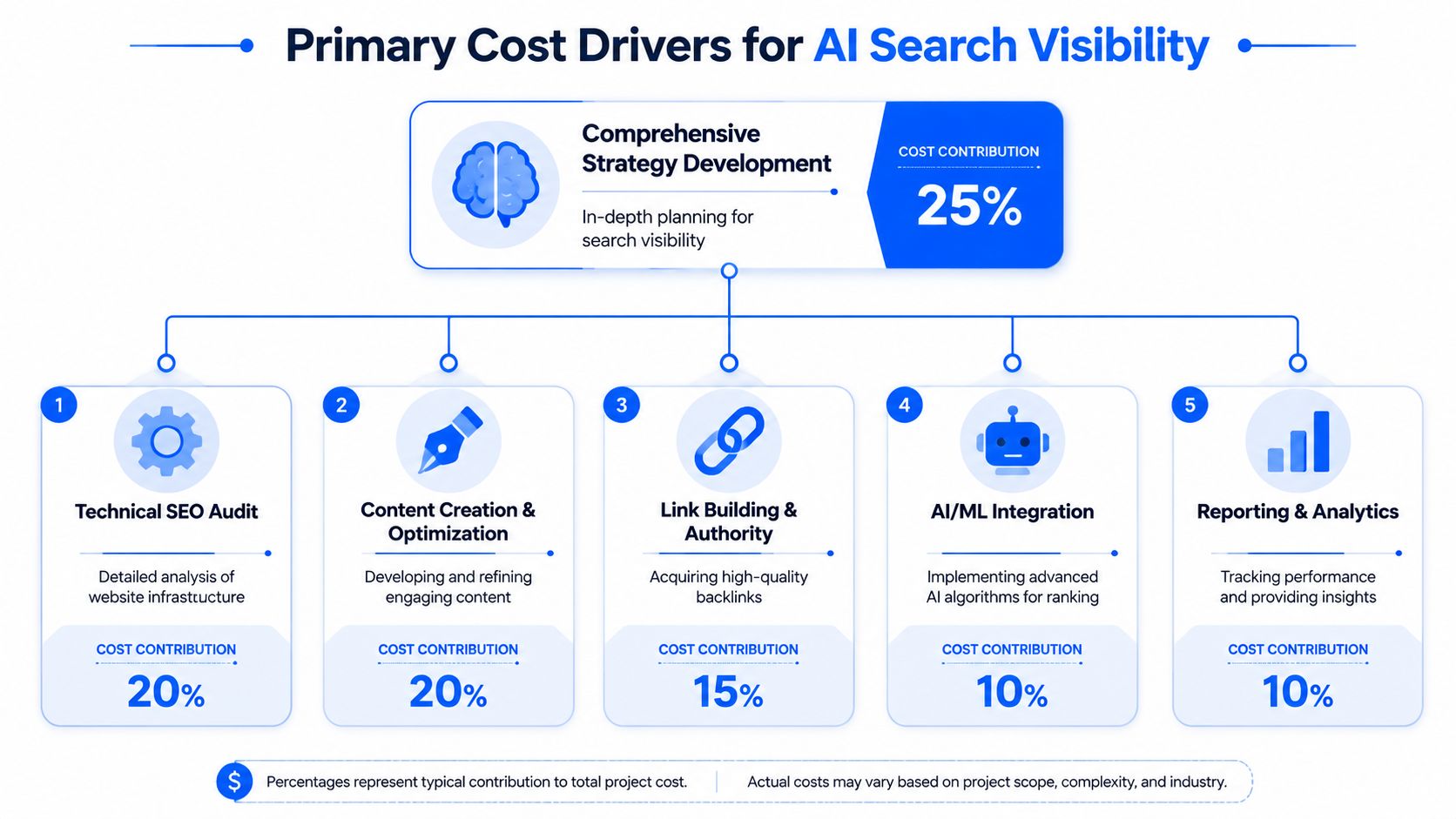
Primary Cost Drivers for AI Search Visibility
Two agencies can quote the same monthly fee and deliver completely different value. That's why founders who compare only the price almost always make the wrong call.
The cost comes from the workstreams hiding under the proposal. Not from the label on the package.
Technical depth changes the whole price
A real SaaS program starts with site architecture, internal linking, schema, page purpose, crawl hygiene, and content structure. Then it moves beyond that into retrieval-friendly page layouts, FAQ formatting, integration pages, and category clarity.
That second layer is where AI search cost rises. The work is more technical and more strategic. It also needs people who understand how AI systems read and summarize content, not just how Google indexes it.
Seoprofy's pricing analysis says the average hourly rate for SEO professionals with more than ten years of B2B expertise is about $150 per hour, which aligns with $3,000+ monthly consultancies. It also notes that this level is still insufficient for enterprise GEO programs that need cross-platform visibility tracking.
That's the right way to think about pricing. Senior talent is expensive. Multi-engine execution is more expensive.
Content format matters as much as content volume
A lot of founders still ask, “How many blogs do I get per month?” Wrong question.
The better question is whether the agency can build pages AI systems can cite. Stackmatix's GEO case study write-up describes a 2026 case where a GEO program drove 4,900% revenue growth and $90M pipeline generation by using first-party research and proprietary datasets as the core content pillar. The structure mattered too. Clear definitions early, tables instead of bloated prose, and step-by-step frameworks gave LLMs material they could extract directly.
For SaaS, this often means you need fewer generic blogs and more of the following:
- Comparison pages that answer shortlist questions clearly
- Integration pages tied to major ecosystems like Salesforce
- FAQ hubs covering pricing, security, and implementation
- Original research pages that become citation assets
Citation pathways are not old-school link building
Traditional link building asks, “Can we get backlinks?” AI visibility asks, “Will this source influence retrieval, trust, or citation?”
That's a different standard. Review platforms, category pages, industry publications, expert roundups, and community mentions matter because AI systems draw from them differently than search engines score generic links.
A proposal that bundles “20 backlinks” without naming source quality, relevance, or citation strategy is waving a red flag.
If your agency can't explain where AI systems are likely to encounter your brand outside your own site, they're not doing GEO.
Monitoring across AI platforms costs more because the job is harder
Google rank tracking is relatively straightforward. AI visibility monitoring isn't. You're checking how your brand appears in different prompt patterns, categories, competitor comparisons, and answer formats across multiple assistants.
That work deserves its own line item. It's one reason the budget rises once you add a platform like AI visibility optimization into your stack or agency scope.
The practical move is simple. Ask every agency to break the quote into workstreams. Strategy, technical implementation, content production, citation development, and AI visibility tracking should all be visible. If the proposal hides the labor, the cost comparison is meaningless.
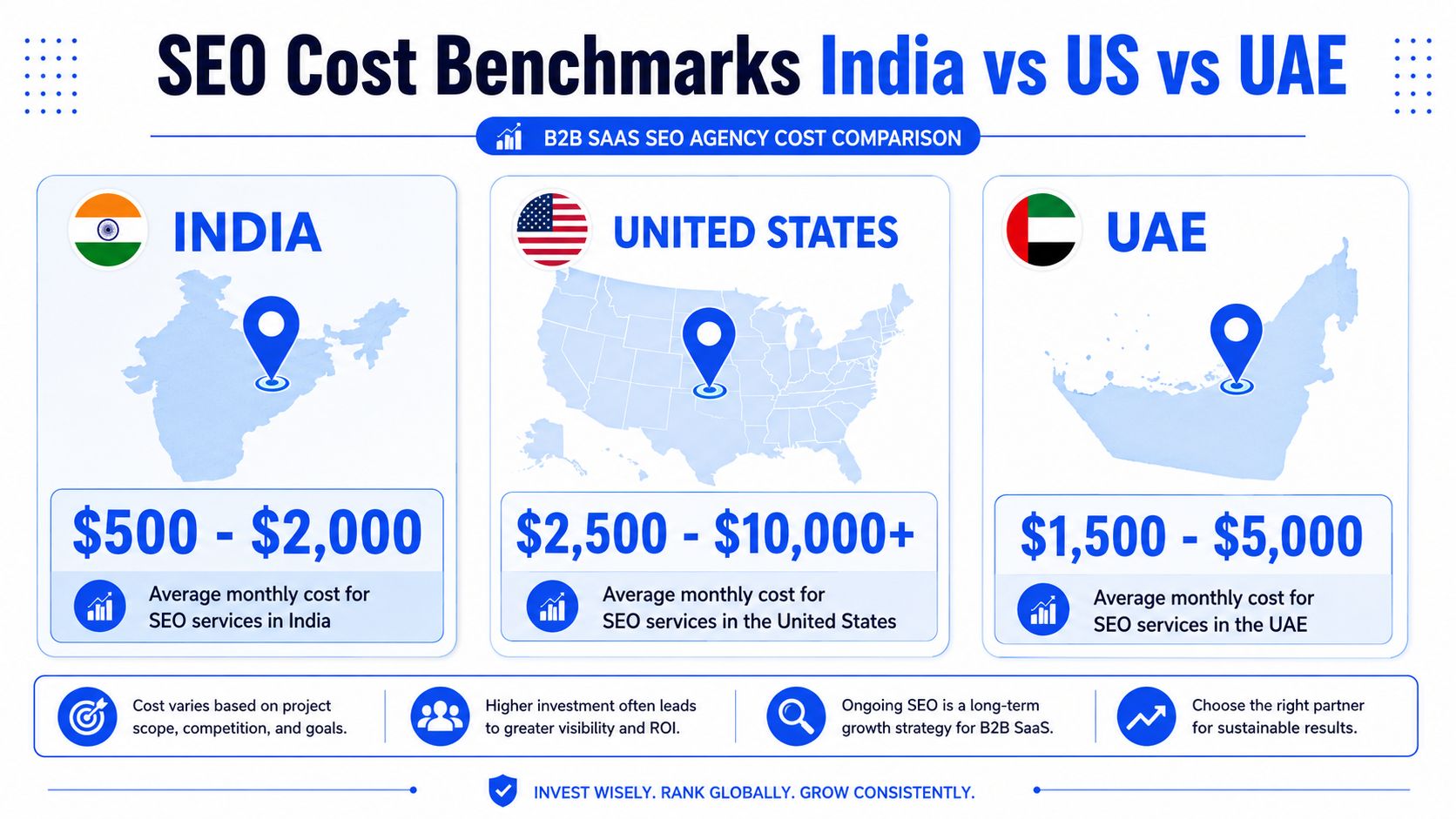
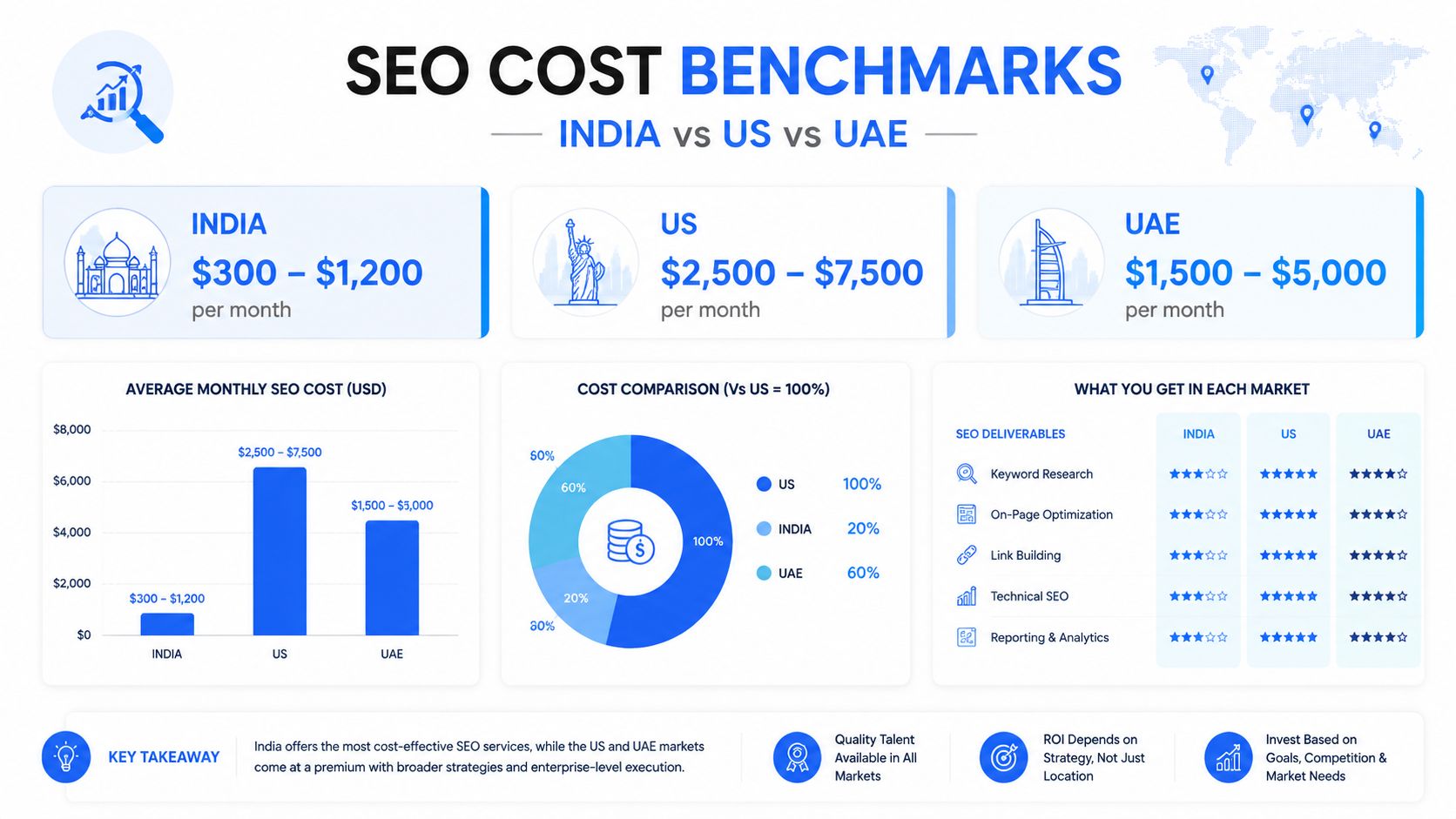
SEO Cost Benchmarks India vs US vs UAE
Your agency location does not set your SEO budget. Your target market does.
An India-based SaaS company selling to US buyers still needs US-level content quality, stronger category authority, and tighter execution across search and AI answer surfaces. Founders who price agencies by vendor geography usually underfund the program, then blame SEO when pipeline does not move.
Use standard SEO pricing as the floor, not the budget
Obelisk Infotech's 2026 global pricing overview places general SEO agency services at $300 to $10,000+ per month, with mid-size companies typically spending $2,500 to $7,500 monthly. For B2B SaaS, especially teams that want visibility in AI search, that range is the starting point. It does not cover the full cost of category-page development, comparison content, citation-source outreach, and AI visibility tracking.
That distinction matters. Generic SEO pricing guides are built for broad business categories. B2B SaaS firms competing for retrieval in Google, ChatGPT, Perplexity, and other answer engines need a different budget model.
Regional benchmarks that actually help
Here is the practical benchmark founders should use.
| Market | Entry-level spend usually buys | Serious B2B SaaS investment usually buys |
|---|---|---|
| India | Basic technical cleanup, limited content production, branded search support | A real SEO program for India demand capture, plus focused GEO work for AI citations and product-category visibility |
| US | Small-scope execution or partial support from a junior team | Senior-led SEO and GEO program with category content, comparison pages, technical work, digital PR, and ongoing AI visibility measurement |
| UAE | Regional SEO support, often with narrow English-only scope | Regional growth program with English and Arabic considerations, local authority-building, and GEO adapted to cross-border buying behavior |
The US is where budget mistakes get expensive fast. A cheap retainer can keep publishing content. It usually cannot build the authority and retrieval signals needed for a competitive SaaS category. If you want a reference point for what stronger execution looks like, review this Chargebee GEO case study for AI search visibility.
What founders should assume by market
For India-first SaaS, a lower monthly retainer can work if the category is narrow, the sales cycle is local, and the content bar is moderate. That same budget will not carry a US pipeline motion.
For the US, expect to pay for senior strategy, better editors, stronger technical implementation, and authority work outside your site. As noted earlier, specialist B2B SaaS retainers in North America sit materially above generic SEO packages, and full GEO scope pushes the budget higher.
The UAE sits between the two, but not in a simplistic way. Competition may be lighter than the US in some segments, yet execution gets harder because regional trust signals, multilingual content, and market-specific buying context matter more.
The right budgeting rule
Budget based on the market you want to win, not the country on your invoice.
If you sell to US buyers, fund a US-grade program. If you want traction in the UAE, pay for regional expertise instead of buying a generic offshore retainer and hoping it translates. That is how founders stop wasting money on cheap SEO and start buying visibility that can influence pipeline.
Sample B2B SaaS Budgets and Expected Outcomes
Founders waste money when they buy an SEO retainer before they decide what outcome they are funding. Your first serious budget should buy a clear change in visibility, not a vague monthly activity report.
For B2B SaaS, that means budgeting by growth stage and target market. A company selling into India with a narrow category can start smaller. A SaaS brand trying to get cited, compared, and recommended in US or UAE buying journeys needs a heavier GEO program from day one.
Three budget tiers that map to actual SaaS needs
Use these tiers as planning ranges, not promises. The point is to match spend to the work required for AI search visibility.
| Investment Tier (Monthly) | Focus Area | Typical Deliverables | Expected Outcome |
|---|---|---|---|
| $2,500 to $6,000 | GEO foundation and site cleanup | AI search audit, entity mapping, technical fixes, core commercial page rewrites, citation cleanup | Your brand becomes easier for AI systems to recognize, extract, and cite |
| $5,000 to $15,000 | Category-building SEO and GEO program | Strategy, steady content production, technical SEO, comparison page development, authority work, reporting | Better non-brand visibility, stronger category coverage, more chances to appear in AI-assisted research |
| $10,000 to $20,000 | Full GEO retainer for competitive markets | Traditional SEO plus AI visibility work, citation pathway development, deeper technical implementation, cross-platform monitoring, stronger editorial execution | A serious push to win consideration in US or UAE markets where generic SEO packages fail |
The lower tier is for companies with weak foundations. Pages are unclear, positioning is inconsistent, and AI assistants do not have enough structured evidence to understand the brand. You are paying to fix that first.
The middle tier is where SEO starts influencing pipeline. You can publish enough useful content, strengthen commercial pages, and build the off-site signals that support retrieval for comparison and solution queries. This is the minimum range I would consider for a B2B SaaS firm that already has product-market fit.
The top tier is the essential entry point for SaaS companies selling into competitive US categories or high-trust UAE segments. At that level, the agency is not just producing pages. It is improving entity clarity, expanding citation coverage, tightening technical signals, and tracking visibility across AI answer surfaces.
What each budget should realistically produce
A smaller budget should produce a cleaner site, sharper service pages, and a brand that is easier for search engines and AI systems to interpret. It should not be sold as a full market capture program.
A mid-range budget should produce measurable growth in qualified organic entry points. You should see stronger coverage for use-case, competitor, and category terms, plus more evidence that your brand is being surfaced in AI-assisted research paths.
A larger budget should produce market-level pressure. More comparison visibility. Better inclusion in assistant answers. More authority around the category themes that influence shortlists.
That is the standard.
If an agency offers a low retainer and promises aggressive outcomes in a competitive SaaS category, reject it. Cheap execution can keep a blog active. It rarely builds the retrieval signals, editorial quality, and entity trust needed to influence modern buying journeys.
A practical way to judge outcomes
Do not ask whether the budget will “do SEO.” Ask what the budget will change in 6 to 9 months.
Good answers sound like this:
- clearer category and use-case page architecture
- stronger brand recognition in AI systems
- broader presence across comparison and alternative queries
- better citation and mention quality beyond your own site
- more qualified organic visits to commercial pages
For a real benchmark, review this Chargebee AI visibility case study. Focus on the work behind the result. That is what funded GEO execution looks like.
The right budget buys enough senior strategy, technical work, content quality, and citation development to give your brand a credible shot at being selected.
How to Evaluate Proposals and Select Your GEO Partner
A cheap proposal can still be expensive if it wastes six months. That's the standard you should use.
The agency selection process changes once you accept that AI search is not just a reporting add-on. You need a partner that can explain how your brand becomes a trusted entity, not just a ranked page.
What good proposals mention directly
Start with the language. If the proposal talks only about keyword targets, blog volume, and backlinks, it's incomplete.
A credible GEO partner should talk about entities, citations, structured extraction, comparison queries, review-platform presence, and AI visibility by platform. That's because GEO shifts the unit of value from a page to an entity AI systems can recognize and trust, as outlined in Digital Agency Network's GEO explanation.
Questions worth asking in every sales call
Use these questions and listen for precise answers:
- How do you measure visibility in ChatGPT, Gemini, Perplexity, and Claude?
- What work in this proposal is different from standard SEO?
- Which pages will you build or rewrite for answer selection, not just rankings?
- How do you approach citation pathway development beyond link building?
- What does reporting include besides keyword positions?
If the team answers in abstractions, move on.
Red flags founders should stop tolerating
Some warning signs show up fast:
- AI as a buzzword add-on instead of a defined workstream
- No mention of entities or brand trust signals
- Reporting limited to Google rankings
- Very low monthly fees with broad promises
- No examples from B2B SaaS
The negotiation advice is simple. Don't push only on price. Push on scope. Remove lower-value deliverables and keep the work that drives answer selection, brand clarity, and citation trust.
That's how you buy a smaller program without buying the wrong one.
Frequently Asked Questions About SEO Agency Costs
Is cheap SEO ever worth it for a SaaS company
Cheap SEO is usually a bad buy for B2B SaaS.
Low-fee retainers rarely pay for senior strategy, technical fixes, high-quality category pages, comparison content, citation work, and reporting that goes beyond keyword rankings. You get junior execution, recycled playbooks, or a bloated client load. For a SaaS company trying to win both Google and AI answer surfaces, that setup fails fast.
If your budget is tight, reduce scope instead of buying a low-cost full-service retainer. Fund one clear workstream well, such as technical cleanup, commercial page rewrites, or citation and entity cleanup.
Should I hire an agency or build GEO in-house
Hire an agency first if you are building this function from scratch.
An in-house team works once you already have a content operator, technical SEO support, product marketing alignment, and someone who can own AI visibility across publishing, citations, and reporting. Most SaaS companies do not start there. They start with fragmented ownership and slow execution. A good GEO agency closes that gap faster, then helps you decide what to keep external and what to bring inside later.
Before you choose, model the economics with an AI search ROI calculator for B2B SaaS teams.
What's different about citation work in GEO
Citation work in GEO is about verification, not volume.
The question is simple. Can AI systems find consistent evidence that your company is real, relevant, and worth mentioning in answers? That means accurate company descriptions, category alignment, product context, review presence, partner listings, founder and expert mentions, and pages on your own site that clearly explain use cases, integrations, and comparisons. Standard link building misses this because it chases domain metrics. GEO focuses on retrieval and trust.
How long until SEO and GEO start paying off
Expect useful signals before you see full commercial impact.
The first gains usually show up as cleaner site architecture, sharper positioning on key pages, stronger branded search alignment, and better inclusion in the sources large language models pull from. Revenue impact takes longer because authority compounds over time, especially in SaaS categories with long sales cycles and multiple decision-makers. If an agency promises fast wins without talking about implementation pace and content quality, ignore the pitch.
Can one agency handle India, the US, and the UAE together
Yes, but only if they build separate authority plans for each market.
B2B SaaS founders often assume one English-language program should work everywhere. It should not. Buyer language, review ecosystems, local directories, publication targets, and proof points differ across India, the US, and the UAE. A capable partner will show how market priorities change by region, not hand you one generic retainer with three country names added to the proposal.
If they cannot explain those differences clearly, they are selling SEO services, not market-specific GEO execution.
If you're deciding how much to invest and want a clear answer before you waste another quarter, talk to LLMBuddy. We help B2B SaaS teams in India, the US, and the UAE improve visibility across ChatGPT, Gemini, Perplexity, and Claude through AI search audits, Generative Engine Optimization, and founder-level strategy. If you want a direct recommendation on budget, scope, and likely fit, request a review through LLMBuddy's demo page.