
AI brand visibility has stopped being a side project for SaaS teams. It's now a revenue channel. Between January and May 2025, AI-referred sessions jumped 527% according to McFadyen's analysis of AI traffic growth. If your brand isn't being cited by ChatGPT, Gemini, Perplexity, or Claude, you're missing the buyer conversation before they ever visit your site.
Most guides stay theoretical. That's useless if you're running pipeline targets in Bengaluru, Chennai, or Pune. What matters is simple. Can AI engines find your brand, trust it, and recommend it in commercial queries that lead to demos and revenue? In our audits of over 100 B2B SaaS brands, that's the only question that matters. I'm Ankur Pandey, and this is the playbook we use to fix it.
We've seen the pattern with companies like Chargebee, Whatfix, and Keka. The winners don't just publish more content. They build citation pathways, clean up entity signals, and track share of voice inside AI answers, not just rankings in Google.
Why Your Google Rank No Longer Guarantees Visibility
Only a few brands make it into an AI answer. In our audits of more than 100 B2B SaaS companies, page-one rankings often had little correlation with whether ChatGPT, Gemini, or Perplexity mentioned the brand in commercial prompts.
That gap matters because buyers are no longer scanning a results page first. They ask a question, get a synthesized answer, and shortlist from that response. If your company is absent there, your Google visibility is not translating into pipeline.
This is why AI brand visibility belongs in the same review as pipeline, CAC, and conversion rate. Treat it as a revenue metric, not a content metric.
Visibility now means citation, not position
The old question was, “Do we rank for this keyword?” The question that drives revenue now is sharper. “Do AI systems recommend us when a buyer asks for the best tool in our category?”
For B2B SaaS founders in India, that changes what good marketing looks like. A ranking page can still bring traffic, but AI systems prefer sources they can identify, verify, and summarize fast. Your site needs clean product-language, category clarity, proof points, and consistent third-party references. If you need the mechanics behind that shift, our guide to Generative Engine Optimization for B2B SaaS brands breaks it down.
Practical rule: If an AI system cannot explain who you serve, what problem you solve, and why your product is credible in two or three sentences, it is unlikely to recommend you.
Why this hits B2B SaaS harder
B2B software is not bought in one search. A CTO asks about security and integrations. A finance leader asks about pricing control and procurement risk. An operations head asks about rollout time and support quality. AI engines answer each of those questions separately, and your brand has to show up with consistent positioning across all of them.
Weak positioning gets exposed. We regularly see SaaS brands with solid SEO traffic disappear from AI answers because their product pages read like brochure copy, their comparison content is thin, and credible third-party mentions are missing. Google may still reward the page. AI systems often skip the brand.
The fix is simple. Stop treating rank as the win. Audit whether your brand is cited in buying-stage prompts across the AI engines your buyers use. If you are not showing up there, your current SEO program is leaving revenue on the table.
How AI Engines Find and Recommend Your Brand
Google's old model looked a lot like a phone book. It indexed pages, ranked them, and returned a list. AI systems work more like a research assistant. They retrieve likely sources, compare them, then write a synthesized answer.
That distinction matters because your site isn't being judged only as a page to rank. It's being judged as a source to trust. If you want the mechanics behind that shift, our page on Generative Engine Optimization is the right starting point.
Think like a library, not a search result
A useful analogy is a vetted library. An LLM doesn't always “read the whole internet” live. It pulls from a mix of training data, indexed sources, retrieval layers, and known entities. Then it assembles an answer. If your content is vague, contradictory, or isolated from trusted third-party references, the model has less confidence in using you.
That's why SEO habits alone often fail. A keyword-optimized landing page can rank in Google and still get ignored by Claude or Perplexity if it doesn't clearly define the brand, product category, use cases, and differentiators in a way the model can retrieve and summarize.
The recommendation layer is where revenue lives
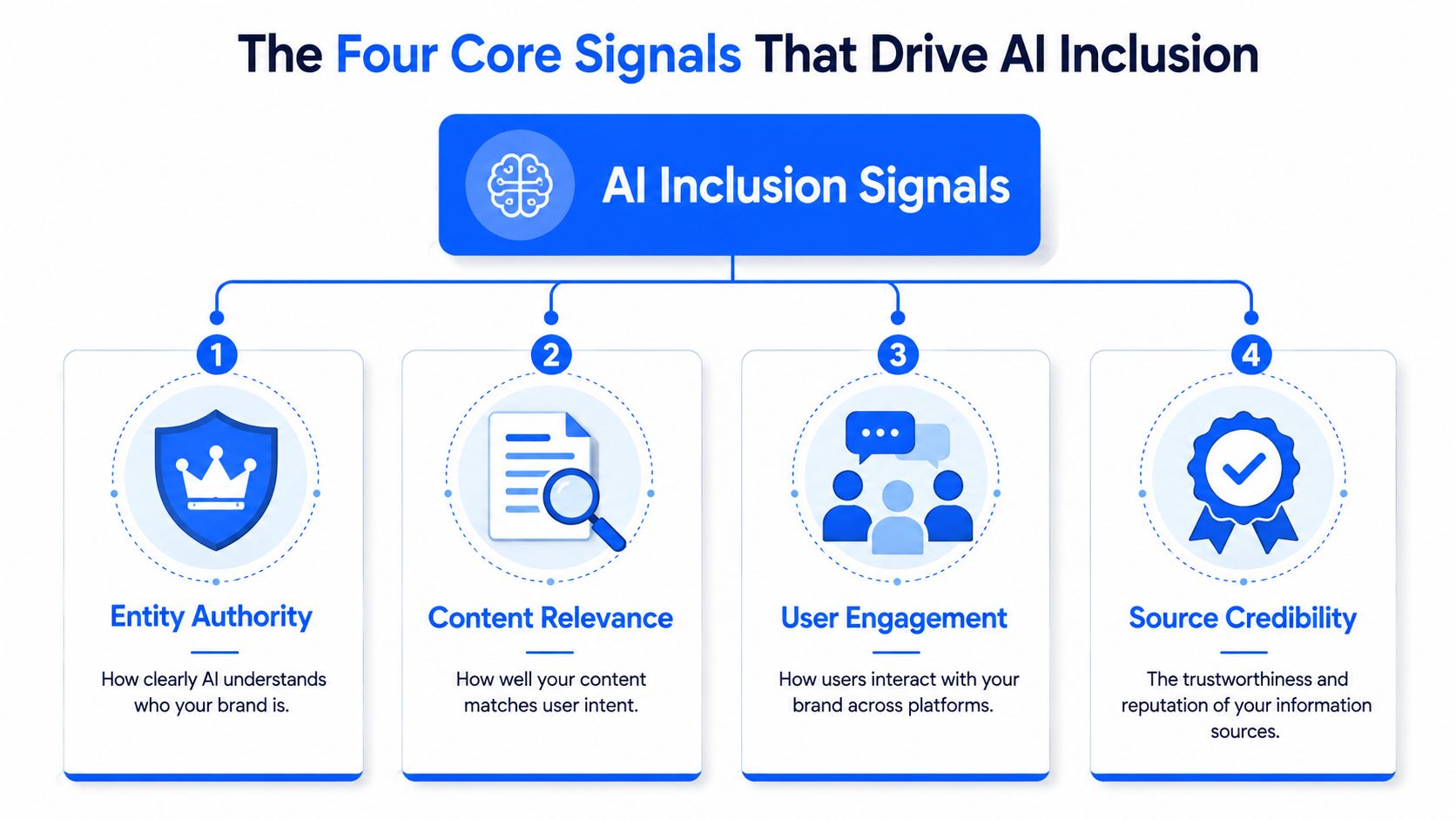
Getting mentioned isn't enough. You want recommendation behavior. That usually happens when an AI engine sees a clean set of signals:
- Entity clarity that tells the model exactly who your company is
- Retrieval-friendly content that answers commercial and category questions directly
- External validation from places buyers and models both trust
- Consistency across sources so the model doesn't see conflicting descriptions
Buyers don't ask one prompt. They ask a chain of prompts. “Best payroll software for Indian teams.” Then “How does it compare with X?” Then “Does it support compliance workflows?” If your brand only appears in broad awareness prompts and disappears in evaluation prompts, you won't win deals.
AI engines reward brands that are easy to verify. That means your homepage messaging, product pages, G2 profile, documentation, founder bios, and third-party mentions need to describe the same company, not five different versions of it.
A practical next step is to test your highest-value buyer questions manually in ChatGPT, Gemini, Perplexity, and Claude. Don't start with dashboards. Start with the exact prompts your sales team hears on calls.
The Four Core Signals That Drive AI Inclusion
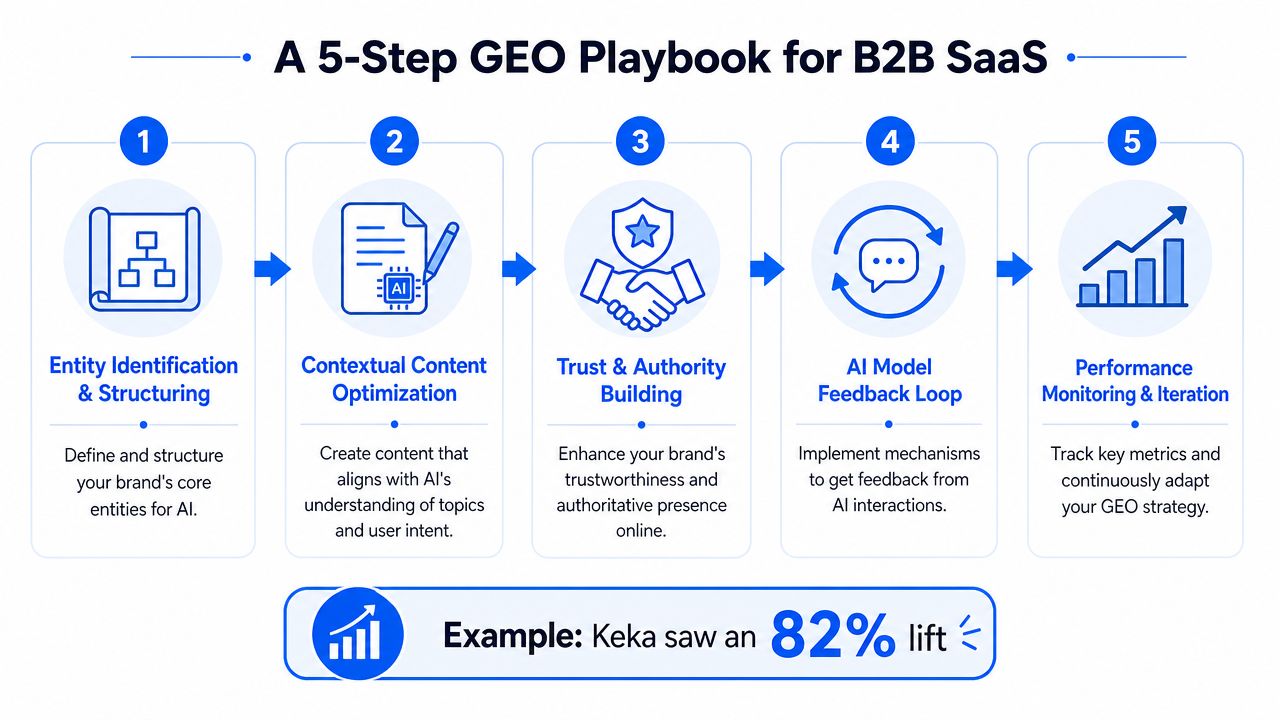
Across 100+ AI search audits we've run for B2B SaaS brands, the same pattern keeps showing up. Brands that get recommended in commercial prompts usually win on four signals at once. Brands that miss one signal disappear during evaluation, even if they still rank in Google.
The expensive mistake is treating AI visibility like a content problem alone. It is a distribution and validation problem. Analysts at Ahrefs found in their brand correlation study that branded web mentions had a much stronger relationship with AI Overview visibility than backlinks. That matches what we see in audits. Revenue-moving prompts are influenced by whether AI engines can verify your brand across multiple trusted sources, not whether you published another top-of-funnel post.
If you want a fast way to find the gaps, run an AI search audit for your highest-value prompts.
Entity authority
AI engines need a clean answer to a basic question. Who are you, exactly?
Your brand name, product category, target buyer, use cases, founder profile, and core differentiators should match across your homepage, product pages, docs, founder bios, review profiles, and third-party mentions. If your website says “HRMS,” your sales deck says “workforce management,” and your review listings say “payroll automation,” the model has to guess where to place you. That weakens inclusion in category and comparison prompts.
We see this often with Indian SaaS companies selling globally. The US positioning says one thing. India-focused pages and partner collateral say another. The result is fragmented retrieval.
Content structure and schema
AI engines prefer pages they can extract from quickly. That means direct definitions, clear comparisons, specific feature language, and obvious answers to buying-stage questions.
A good page for AI inclusion does not try to sound polished at the cost of clarity. It names the category, states who the product is for, explains where it fits, and covers objections directly. Schema helps, but structure matters more than markup if the copy is vague.
| Signal | What AI needs to see |
|---|---|
| Brand definition | A clear statement of what your company does |
| Topic depth | Strong coverage of category and sub-category queries |
| Page structure | Headings, comparisons, FAQs, and direct answers |
Citation pathways
Here, a lot of revenue gets won or lost.
AI engines rarely trust your website alone for commercial recommendations. They look for supporting evidence across the places buyers already use to validate vendors. For B2B SaaS, that usually means review platforms, niche directories, comparison pages, implementation partner sites, product communities, analyst mentions, and technical discussions tied to real use cases.
The key is relevance. A generic PR mention helps less than a strong G2 profile, a category directory listing, a partner integration page, or a community thread discussing your API, onboarding, pricing model, or support quality. In our audits, the strongest brands build citation pathways that connect category prompts to proof points outside their own domain.
Start there. If your buyers compare vendors on G2, Capterra, Reddit, Slack communities, or ecosystem partner pages, strengthen those assets before you publish more blog content.
Technical directives
Technical access still matters. AI crawlers need clean discovery paths, crawlable pages, and signals that point them to your priority assets.
That includes basics like indexable product pages, clean internal linking, stable canonical setup, and documentation that is easy to parse. It can also include llms.txt, but founders often overrate that file and underrate the rest of the stack. If your entity is inconsistent and your third-party validation is weak, technical directives alone will not get you recommended.
Use this checklist:
- Clarify your entity: Use one consistent brand and category description across key pages and profiles
- Restructure core content: Answer commercial, comparison, and use-case questions directly
- Build citation pathways: Prioritize third-party domains buyers trust during vendor evaluation
- Tighten technical access: Make product, docs, and proof pages easy for crawlers and models to discover
A 5-Step GEO Playbook for B2B SaaS
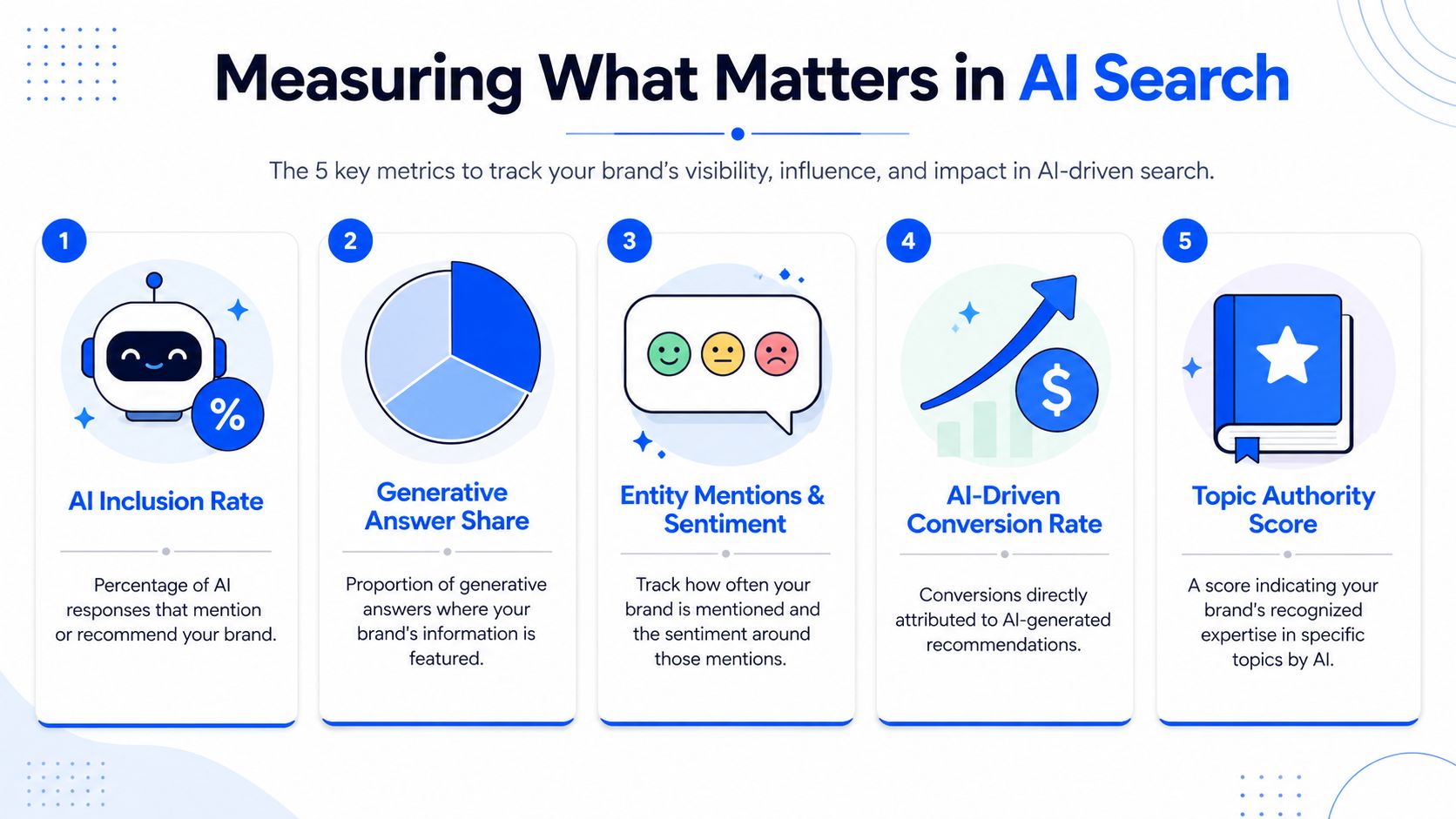
This is the operating model we use in practice. Not slides. Not theory. Execution.
We've seen this pattern work across Indian SaaS categories. Keka saw +82%, Whatfix saw +84%, and Chargebee saw +74% in client results from our work. The point isn't the logo parade. The point is that AI visibility moves when you treat it like a cross-functional growth system, not a blog content task.
If you need hands-on implementation support, that usually falls under AI SEO services. But you can start applying the framework yourself.
Step 1 with baseline visibility
Start by checking how your brand appears across ChatGPT, Gemini, Perplexity, and Claude for buying-stage prompts. Don't aggregate too early. Model behavior varies.
Pick prompts across three buckets: category discovery, comparison, and decision support. Then record whether your brand is mentioned, recommended, or absent. Include competitor names. This gives you an honest baseline.
A founder usually learns two things fast. First, visibility is inconsistent by model. Second, the prompts that influence pipeline are rarely the same prompts the SEO team tracks.
Step 2 clean up your entity
Your website, product pages, founder profiles, about page, and third-party listings should describe the same company in the same category. If they don't, AI gets mixed signals.
We often find the hidden problem in these inconsistencies. The homepage says one thing, docs say another, and review sites use stale copy from two years ago. You can't expect recommendation consistency from that mess.
A fast fix is to create one internal source of truth for brand definition. Product category, ICP, use cases, differentiators, deployment type, and integrations should stay consistent across all public surfaces.
Step 3 rewrite pages for retrieval
AI-friendly pages don't read like ad copy. They answer questions.
Start with your top product and solution pages. Lead with a direct explanation of what the product does, who it's for, and how it differs. Add comparison sections. Add structured FAQs. Add tables where buyers expect them.
Content structure directly affects whether AI can cite you accurately. If your strongest product page buries the answer under vague copy, the model will often cite a clearer source instead.
Step 4 build citation pathways that support buying journeys
Most SaaS teams underperform; they chase generic backlinks and ignore the places AI systems and buyers both treat as evidence.
Think about your evaluation path. If you sell HR software, buyers may check G2, implementation partner pages, comparison blogs, founder interviews, and community threads. If you sell devtools, they may check docs, GitHub-adjacent discussions, and technical forums. Those are your citation pathways.
Here's the technical move too. According to Stackmatix's explanation of llms.txt for AI retrieval, implementing llms.txt at your domain root is a critical step because it acts as a machine-readable guide telling AI crawlers which pages matter most, influencing retrieval prioritization in models like ChatGPT and Perplexity.
Use that file to point crawlers toward the pages you want cited. Your core category page. Your best product page. Your strongest comparison page. Your original data or benchmark page if you have one.
Don't treat llms.txt as magic. It works best when the pages it points to are already clear, useful, and supported by external mentions.
Step 5 measure and iterate by model
Once your core assets and citation pathways are in place, track changes at the prompt level. Not just traffic. Not just rankings.
You want to know whether recommendation behavior improves in the prompts tied to demos and influenced pipeline. A brand might become more visible in Gemini for informational queries while staying weak in Perplexity for comparison prompts. That gap matters. It tells you where to adjust.
A simple operating rhythm works best:
- Weekly review: Check movement in high-value prompt clusters
- Monthly review: Compare brand presence against two or three direct competitors
- Quarterly review: Refresh core pages, citations, and entity consistency
This is the point most founders miss. AI visibility compounds when the system stays consistent. One rewrite won't fix weak market authority. One press mention won't fix poor retrieval structure. But a coordinated program does.
Measuring What Matters in AI Search
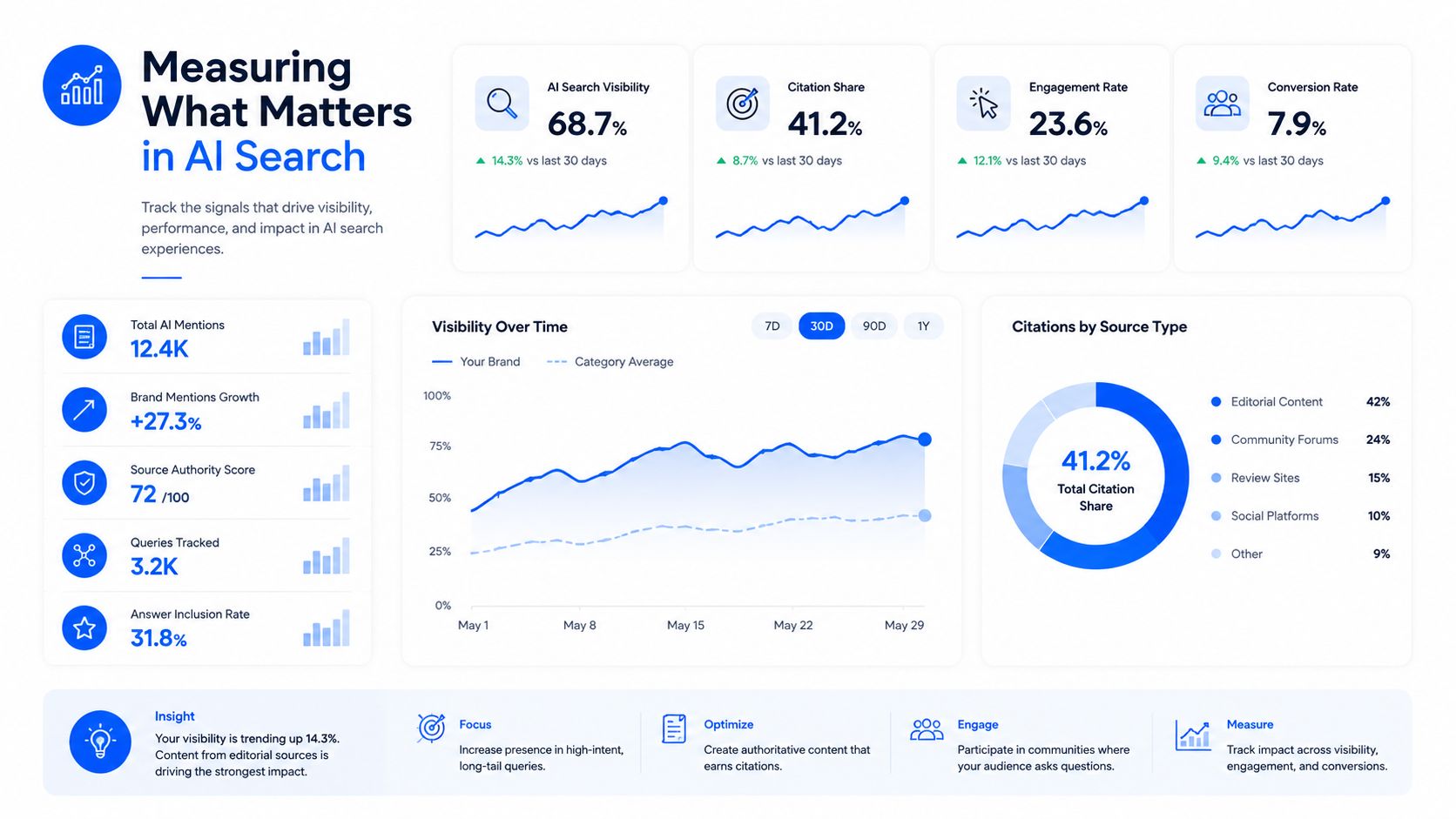
Many organizations still measure the wrong thing. They celebrate traffic, impressions, and rankings while buyers are getting answers directly from AI interfaces. That reporting gap hides the underlying problem.
What you need are visibility metrics that reflect whether AI engines include and recommend your brand. The core set includes Brand Mention Rate, Recommendation Rate, and Share of Voice, and these should be tracked per model rather than rolled into a blended average, as explained in Visiblie's framework for AI visibility metrics. ChatGPT and Gemini don't behave the same way. If you merge them, you lose the signal.
If you want to model business impact, a simple ROI calculator for AI search programs helps connect visibility work to attributed opportunity.
Start with manual share of voice
Early on, manual testing beats fancy dashboards. Ask the models the exact questions your buyers ask. Record which brands appear, who gets framed as the best fit, and what proof points show up.
That gives you practical share of voice inside AI answers. Not theoretical market share. Actual answer share.
A simple audit sheet should track:
- Prompt cluster: Discovery, comparison, implementation, pricing, compliance
- Model: ChatGPT, Gemini, Perplexity, Claude
- Brand presence: Mentioned, recommended, absent
- Narrative quality: Accurate, weak, or incorrect
Recommendation rate matters more than mentions
A mention can be neutral. A recommendation moves revenue.
If your brand gets named in a list but competitors get described as the better fit, your visibility isn't doing much for pipeline. That's why recommendation rate is the metric I trust more in board-level conversations. It's closer to commercial influence.
The first goal is presence. The second is preference. Don't confuse the two.
The practical move is to run a small prompt set every week, keep it stable, and compare outputs over time. Once patterns stabilize, then add automation. Dashboards are useful later. Manual review is how you learn what the models are saying.
Common Pitfalls and How to Avoid Them
The first mistake is treating ChatGPT as the whole market. It isn't. A brand may appear there and still be weak in Gemini or Perplexity. Buyers don't stick to one tool, and your team shouldn't either.
The second mistake is acting as if GEO is just SEO with new vocabulary. It's not. Search ranking can reward a decent page. AI recommendation usually requires stronger structure, cleaner entity signals, and third-party validation. That's one reason some brands with good SEO still lose mindshare inside AI answers.
Three failure patterns I see repeatedly
- Single-platform obsession: Teams test only ChatGPT and declare success. Then sales calls show buyers used Gemini or Perplexity and never saw the brand.
- Backlink-first thinking: Teams spend on classic link building while ignoring software review sites, partner pages, and industry mentions that shape recommendation confidence.
- Fluffy product pages: Teams write polished marketing copy that sounds fine to humans but gives AI almost nothing concrete to extract.
There's a direct fix for the third problem. Alexandros Xenofontos' GEO write-up on structured, entity-clear content notes that optimizing for entity clarity, structure, and contextual flow can increase citation frequency by up to 58% compared with non-optimized pages. That tracks with what we've seen in client work. Clear pages get cited more often than clever pages.
What the better approach looks like
Chargebee's +74% result didn't come from one tactic. It came from balanced execution. Entity cleanup, stronger content structure, and deliberate citation building all mattered together.
The takeaway is blunt. If your AI strategy lives entirely inside your blog calendar, it will underperform. Fix the system. Not just the content.
Frequently Asked Questions for SaaS Leaders
How long does AI brand visibility take to improve
Analysts at LLMBuddy have audited more than 100 brands, and the pattern is consistent. On-site clarity fixes can improve AI retrieval and citations faster than market-level authority work. Citation pathways usually take longer because you are changing how review sites, partner pages, and industry sources describe your company.
Judge progress by prompt-level movement tied to buying intent. If your brand starts showing up more often in comparison, category-fit, and implementation prompts, you are moving in the right direction.
Should we prioritize ChatGPT or Google AI results first
Prioritize the engines your buyers use during evaluation. Then test across all major surfaces. For most B2B SaaS teams, that means ChatGPT, Gemini, Perplexity, and Claude.
Do not build your strategy around one model. We see brands look strong in one engine and invisible in another. Revenue comes from consistent presence across the full buying journey, not isolated wins in a single tool.
Is AI brand visibility just an SEO extension
No. SEO helps pages rank. GEO helps AI systems retrieve your brand, verify what you do, and decide whether to recommend you in an answer.
That difference matters for budget and execution. A team that only tracks rankings will miss the prompts that shape shortlist creation.
What should an Indian SaaS founder fix first
Start with the pages and profiles that influence commercial prompts. Category pages, product pages, software review listings, partner pages, and founder or company profiles should all describe the same use cases, buyer, and category position.
Then run manual prompt tests on the questions that sit closest to pipeline. If your brand disappears on “best X for Y,” comparison, migration, pricing-fit, or integration prompts, fix those gaps first.
Does this work only for large SaaS brands
Large brands usually begin with more third-party validation. That helps. It does not decide the outcome.
Smaller SaaS companies can still win in AI answers if they are clearer about who they serve, easier to verify, and better cited in a narrow category. We see this often in focused prompt clusters where a specialist brand beats a broader competitor.
How do we tie this back to revenue
Track the prompts that influence purchase decisions. Vendor comparisons. Best-fit recommendations. Integration questions. Migration concerns. Implementation queries.
Then connect recommendation rate and citation presence to assisted pipeline, demo requests, and AI-referred conversions. That is the share of voice that matters.
If you want a practical benchmark, use this framework as a 5-step operating model. Clean up entity clarity. Build citation pathways. Improve external validation. Test prompt clusters. Measure recommendation share against revenue-adjacent queries. That is the work that gets results.
If your team wants a direct read on where you stand, get an AI Search Audit from LLMBuddy or request a demo. We work with B2B SaaS companies in India to improve visibility across ChatGPT, Gemini, Perplexity, and Claude, with one goal: more qualified demand from AI-driven discovery.