
Your team is probably already seeing this. A prospect asks ChatGPT for the best payroll software for Indian companies, or asks Perplexity whether your product supports a compliance workflow you shipped months ago. Your brand appears sometimes, disappears on other prompts, and in a few answers the AI gets the details wrong.
That's why brand monitoring for AI results can't stop at mention tracking.
If you run a B2B SaaS company in India, the bigger risk isn't only invisibility. It's bad visibility. AI systems can cite outdated G2 reviews, old blog posts, stale partner pages, or comparison content that no longer matches your product. In practice, that means your buyers can get a distorted version of your company before they ever visit your site.
I'm Ankur Pandey, and this is the playbook we use in audits for SaaS brands that care about revenue, not vanity screenshots.
Defining Your AI Visibility Signals
Teams often start too narrowly. They track the company name, run a few prompts in ChatGPT, and call that monitoring. That misses how AI systems represent a software brand.
Your entity footprint is wider than your logo name. It includes your product name, category labels, flagship features, integration names, founder names, pricing language, compliance claims, and the ugly stuff too, common misspellings and outdated descriptors. If you don't define those signals first, every dashboard you build later is weak.

Start with entities, not prompts
For a B2B SaaS company, I'd map signals in four buckets before touching any tool.
- Core brand signals like your company name, product names, and abbreviations
- Commercial signals like pricing, free trial, implementation, support, and security
- Category signals like “best HRMS for Indian SMEs” or “CRM for SaaS startups”
- Proof signals like G2 presence, integrations, compliance, customer support, migration, and alternatives
Take a CRM example. Your primary query set shouldn't only include “Brand X CRM.” It should include discovery queries such as “best CRM for Indian startups,” comparison queries like “Brand X vs HubSpot,” and validation queries like “is Brand X SOC 2 compliant?” or “does Brand X integrate with WhatsApp.”
Practical rule: If a prompt can influence pipeline, it belongs in your monitoring set.
Build a query map your GTM team will recognize
A good baseline starts with a focused list of 50 to 100 queries across core topics, chosen based on how your audience searches, with tracking run at least weekly for most businesses, as noted in Frase's AI search tracking guidance.
This is the structure we prefer:
| Query type | What it reveals | Example |
|---|---|---|
| Discovery | Whether AI sees you as a category candidate | Best CRM for Indian startups |
| Comparison | Whether you enter shortlists | Brand X vs Zoho CRM |
| Validation | Whether AI trusts your proof points | Is Brand X SOC 2 compliant |
| Use-case | Whether your product gets mapped to real jobs | CRM for inside sales teams |
| Objection-handling | Whether AI can kill or save deals | Is Brand X expensive for small teams |
A lot of founders underestimate the bottom of funnel prompts. That's where inaccurate AI summaries do the most damage. The buyer already has intent. They're looking for reasons to remove risk.
What to do this week
Open a spreadsheet and create three tabs. One for entities, one for prompts, one for competitors. Then force yourself to cover top, middle, and bottom funnel in the same file.
If you want a better benchmark structure for platform-level tracking, look at how AI visibility optimization is framed around prompts, inclusion, and trend movement rather than rank positions.
Engineering Your Data Sources and Ingestion
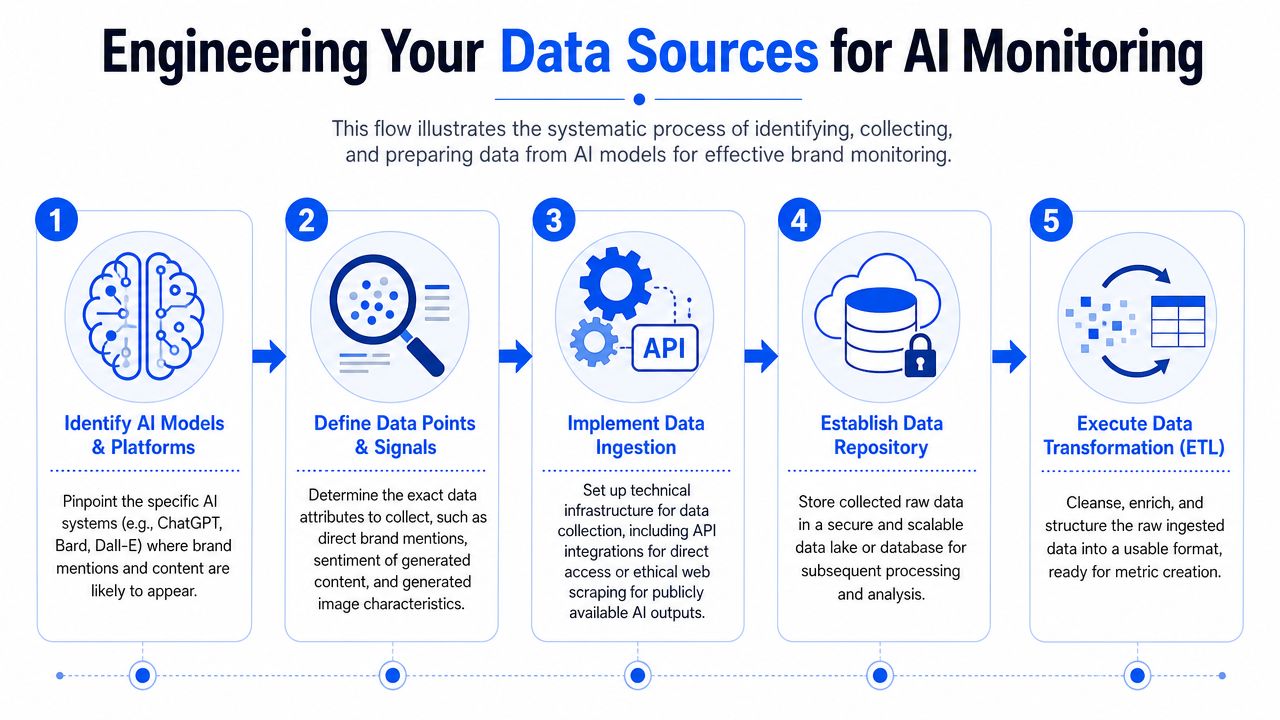
Once your query set is clear, the next problem is collection. At this stage, a lot of startups stay in screenshot mode for too long.
The raw inputs usually come from four places. The AI outputs themselves, the cited URLs inside those outputs, your owned pages, and the third-party pages that keep getting pulled into answers. For B2B SaaS, that third-party layer often includes G2, Capterra, review roundups, integration directories, and industry blogs.
Manual checks are fine until they aren't
If you're an early-stage company, manual checks still make sense for a short period. They're cheap. They force your team to read the outputs. They surface obvious problems fast.
But they break as soon as the prompt set grows, competitors shift, or your leadership wants trends instead of anecdotes. Built In reports that brands using automated AI monitoring tools achieve a 92% mention-frequency capture rate across 50+ LLMs, compared with 54% with manual workflows. The same analysis also notes that 61% of users still fail to monitor sentiment framing or source-shift dynamics.
That second point matters. A mention isn't enough. If ChatGPT names you as an option but frames you as expensive, complex, or weak on implementation, your “visibility” number can hide a real sales problem.
How I'd choose by company stage
Here's the trade-off in plain terms.
| Setup | Works for | What you gain | What you lose |
|---|---|---|---|
| Manual spot checks | Seed to early Series A | Fast setup, low initial cost, close reading of outputs | Weak coverage, poor repeatability, limited trend analysis |
| Semi-structured tracking | Mid-market SaaS | Better consistency, basic competitor benchmarking | More ops overhead, still fragile |
| Automated monitoring | Multi-product or competitive category teams | Broad capture, alerts, source change detection, cleaner dashboards | Higher setup effort and tooling cost |
If you're a startup with one category and one market, start manually. If you're already selling across India, the US, and the Middle East, manual workflows won't hold. Not if your sales team needs dependable signal.
What the ingestion layer should capture
Every record should answer five questions:
- Which platform produced the answer. ChatGPT, Gemini, Perplexity, or Claude.
- Which prompt triggered it. Exact wording matters.
- Was your brand mentioned. Yes or no is the first layer.
- How were you positioned. Primary recommendation, secondary mention, comparison mention, or exclusion.
- Which sources informed the answer. Owned page, review site, press mention, partner page, or unknown.
Add a qualitative framing field too. Don't overengineer it. Start with tags like positive, neutral, negative, inaccurate, outdated, and competitor-favored.
Don't collect more data than your team can review weekly. But don't collect so little that every decision turns into guesswork.
A clean ingestion pipeline matters because it turns AI outputs into something your GTM team can act on. If your content team, product marketing team, and SEO lead can't see the same underlying record, they'll all “fix” different problems.
If your current search work still treats AI engines as a side project, you'll need a different operating model than standard SEO. That's exactly where Generative Engine Optimization starts to become practical instead of theoretical.
Creating AI Visibility Metrics and Dashboards
A founder does not need a spreadsheet full of prompts. A founder needs a view of where AI is helping pipeline, where it is excluding the brand, and where bad source selection is creating risk.
For B2B SaaS, I want the dashboard to answer three questions every week. Are you present in the prompts that matter commercially. Are you beating the competitors buyers compare you with. Are AI systems pulling from the sources you would be comfortable sending to a prospect.
The three metrics that actually matter
Keep the scorecard small. If you track ten metrics, nobody owns any of them.
Mention Rate
This is the percentage of tracked prompts where your brand appears at all.
It sounds basic, but it tells you something useful fast. If your Mention Rate is healthy on branded and review-intent prompts but weak on category and comparison prompts, you have a discovery gap. That usually points to weak category-page coverage, thin third-party validation, or poor entity association across the sources LLMs keep citing.
AI Share of Voice
This compares your mention frequency against the direct competitors that show up in the same prompt set.
I do not use the competitor list from a board deck for this. I use the names that repeatedly appear in live AI answers. For clients like Chargebee and Keka, that usually means tracking a tight comparison set first, then revising it monthly. New competitors enter AI recommendation sets earlier than they enter your CRM reports, so this metric often gives the first signal that the category narrative is shifting.
Citation Share
This is the one I care about most.
Citation Share measures how often AI systems rely on your owned pages when they mention you, instead of a review site, old press coverage, or a random affiliate article. A lot of teams celebrate visibility gains while AI is citing outdated pages or third-party summaries that flatten their positioning. That is not a win. It is borrowed visibility with weak control.
At LLMBuddy, we also add one operational layer under these three metrics: inaccurate mention rate. That is the share of answers where the brand appears, but the claim is outdated, incomplete, or wrong. I would not put it in the board summary first, but your PMM and SEO team should review it every week because it highlights source decay before revenue teams notice.
What the dashboard should show
A useful dashboard separates commercial signal from vanity signal.
The minimum setup I recommend includes:
- Trend lines for Mention Rate, AI Share of Voice, and Citation Share
- Platform splits for ChatGPT, Gemini, Perplexity, and Claude
- Prompt clusters for category discovery, competitor comparison, and buyer validation
- Source-type breakdowns showing owned pages, review sites, media coverage, partner pages, and uncited answers
- Accuracy flags for wrong pricing references, legacy feature claims, outdated integrations, and competitor-favored summaries
For Indian B2B SaaS founders, one more split matters. Separate India-intent prompts from global prompts. We have seen brands look strong on generic global queries and still disappear on commercially loaded searches like payroll, HRMS, or billing software for Indian companies. If your dashboard rolls those together, you will report progress while losing the queries that influence qualified demand.
How we set thresholds in practice
Benchmarks across AI platforms are still inconsistent, so I would not chase a universal target.
Set a baseline over the first four weeks. Then use thresholds that force action. For example, if Citation Share drops by more than 10 points for a high-conversion prompt cluster, review source changes that week. If a competitor enters the top recommendation set across five or more prompts in the same cluster, inspect what sources the model started trusting. If inaccurate mention rate rises across one platform only, check whether that platform has shifted toward older citations or weaker review sources.
This is the difference between a reporting dashboard and an operating dashboard.
For a mid-market SaaS client, we usually review 75 to 150 prompts per week, grouped into 6 to 10 clusters. The founder sees the summary. PMM gets the source and accuracy view. SEO and content teams get page-level actions. That workflow matters more than fancy visualisation.
If you want this tied to content fixes instead of sitting in a reporting silo, build the dashboard around a Generative Engine Optimization workflow that maps each visibility drop to a source, page type, and correction owner. That is how you catch the hidden problem competitors rarely discuss. AI can keep mentioning your brand while the underlying sources decay, and your dashboard should expose that before it turns into bad recommendations at scale.
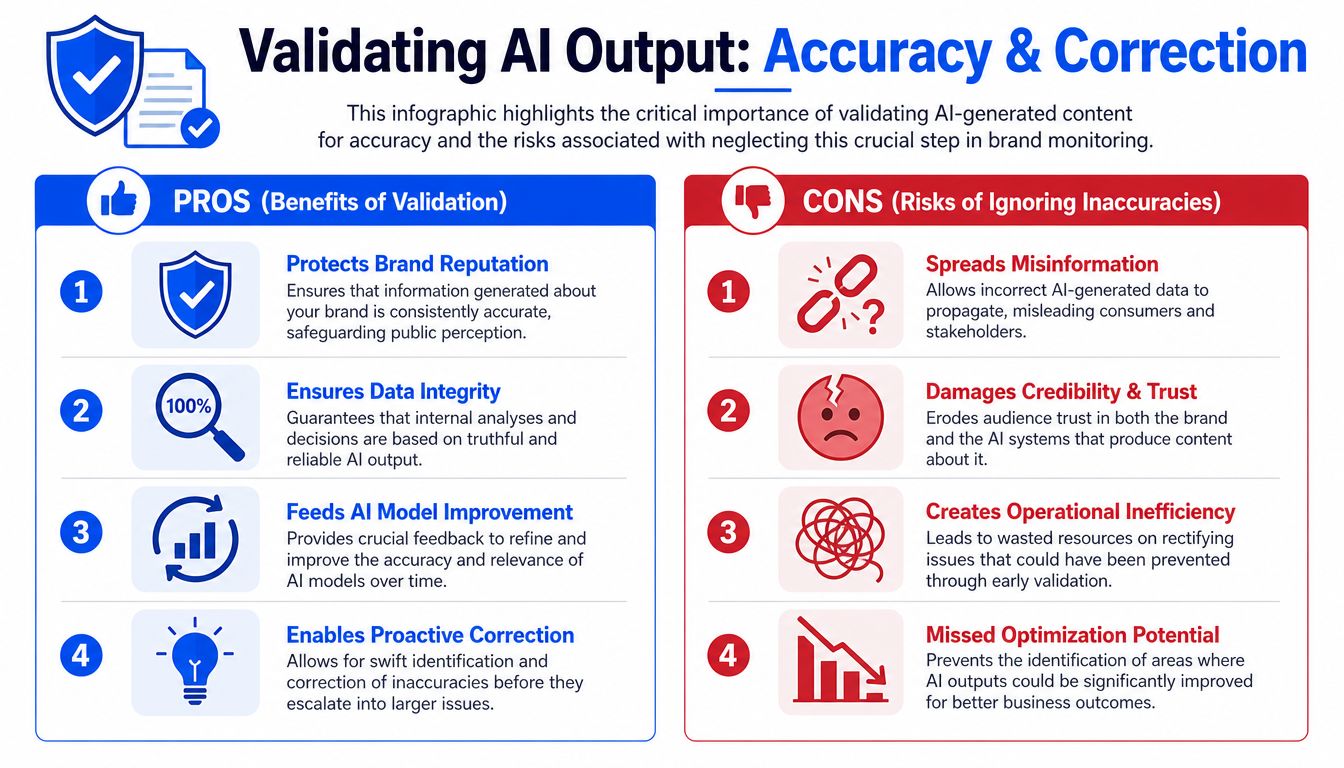
Validating and Correcting AI Output Inaccuracies
At this point, most monitoring programs fail.
They track whether the brand appeared. They don't check whether the answer was right. For a B2B SaaS company, that's the difference between a useful dashboard and a false sense of security.
Source decay is the problem most teams don't see
A lot of AI answers are built on old material. Adobe's analysis of AI search behavior says 68% of AI citations in late 2025 originated from content published over 18 months ago, and 22% pointed to pages that no longer reflect current product claims.
That changes the job. Brand monitoring for AI results isn't just about mention frequency. It's about whether AI is trusting content you would never send to a buyer today.
I've seen this show up in the same pattern across SaaS categories. Old pricing pages. Legacy feature descriptions. Integration pages that still mention old workflows. Review snippets that no longer match the current product. AI systems don't care that your PMM team updated the homepage last quarter if the older citation footprint is stronger.
A working correction loop
When you spot an inaccurate answer, don't jump straight to “we need more content.” First identify the exact citation path that created the problem.
Use a correction loop like this:
- Capture the answer with prompt, platform, date, and cited URLs.
- Mark the error type. Pricing, feature set, compliance, implementation, integrations, competitor comparison, or positioning.
- Check whether the source is owned or third-party. The fix path differs.
- Replace or refresh the source with a page that has clearer structure and current facts.
- Re-test the prompt weekly until the answer shifts.
That fourth step matters more than is generally realized. Pages optimized for entity clarity, structured data, and contextual flow were cited up to 58% more often in AI-generated summaries than non-optimized pages, according to this GEO analysis on LinkedIn. If your correction page is vague or bloated, the AI may keep citing the stale one.
What to fix first
Not every inaccuracy deserves the same effort.
| Priority | Example issue | Response |
|---|---|---|
| High | Wrong pricing or compliance claim | Update source immediately and create a cleaner canonical page |
| High | AI recommends competitor for your strongest use case | Build or revise comparison and use-case pages |
| Medium | Outdated integration description | Refresh integration page and related FAQ |
| Medium | Weak framing from old review summaries | Strengthen current third-party proof and owned explanation |
| Low | Minor wording issue with no buyer impact | Monitor before investing time |
If a wrong answer can stall procurement, legal review, or a category shortlist, treat it as a revenue issue, not a content issue.
A correction program usually needs both owned and third-party work. Updating your own site helps, but if the AI keeps citing review sites and listicles, you need better citation pathways there too. That often means new FAQ hubs, comparison pages, integration pages, and tighter fact blocks across proof-oriented assets.
If your team needs to clean up extraction quality on pages that AI keeps misreading, start with AI content optimization rather than publishing more generic blogs.
Establishing Alerting Triage and Governance
A dashboard that nobody checks is dead weight. You need a system that forces review and assigns ownership.
The most reliable operating model I've seen is simple. Set alerts for the problems that affect pipeline or reputation, route them to one accountable owner, and review trends on a fixed cadence. That's what turns monitoring into execution.
What deserves an alert
Not every fluctuation matters. Focus on changes that need a decision.
- Mention drop alerts when your brand disappears from prompts where it was previously included
- Competitor surge alerts when one rival starts appearing across a cluster of comparison or category prompts
- Accuracy alerts when a platform returns a wrong claim about pricing, compliance, features, or integrations
- Citation shift alerts when AI starts citing a different source set, especially stale or low-trust pages
A good triage model doesn't depend on memory. It depends on documented response paths.
A simple triage model for B2B SaaS teams
Use three levels.
Level one
Minor shifts with no direct sales impact. Example, a neutral framing change on an educational prompt. Owner is usually SEO or content.
Level two
Commercial impact likely. Example, your brand drops from a “best tools” query or loses ground in a comparison cluster. Owner should be product marketing with support from content and search.
Level three
Revenue or trust risk. Example, wrong security claim, outdated pricing, or a competitor recommendation replacing you in a high-intent use case. Owner should be a growth or marketing lead with escalation to leadership if needed.
A useful alert includes the prompt, platform, previous state, current state, source URLs, and named owner. Anything less becomes Slack noise.
Weekly review beats random panic
A five-step monitoring methodology documented by Digital Hothouse delivered a 78% improvement in tracking accuracy over ad-hoc manual checks and enabled brands to close 3.2x more citation gaps within 90 days. The point isn't the framework branding. The point is that repeatable process beats reactive checking.
For a B2B SaaS team, I'd use this reporting rhythm:
| Cadence | Audience | What gets reviewed |
|---|---|---|
| Weekly | Growth, SEO, content, PMM | Prompt changes, citation shifts, inaccuracies, competitor movement |
| Monthly | Leadership | Trend summary, key wins, unresolved risks, category-level visibility changes |
A practical weekly report for a CMO should fit on one page. Opening summary, top prompt movements, top citation issues, fixes shipped, and risks still open. That's enough.
If you want a reference point for how these monitoring programs translate into business outcomes, review the examples on client case studies. The takeaway isn't that every brand gets the same result. It's that visibility gains come from operating rhythm, not one-off audits.
Frequently Asked Questions about AI Brand Monitoring
How often should you monitor AI mentions for a SaaS brand?
For most B2B SaaS companies, weekly is the right starting point. That lines up with the baseline tracking guidance covered earlier from Frase. If you're in a fast-moving category, actively shipping new product pages, or running a focused AI visibility push, monthly audits on top of weekly checks help catch source and framing changes before they become sales objections.
Which AI platforms should you track first?
Start with ChatGPT, Gemini, Perplexity, and Claude. Those four give you broad coverage across conversational research and answer-style discovery. Don't rely on one platform screenshot. The same brand can be framed differently depending on where the buyer asks.
What should a founder care about most, mentions or accuracy?
Accuracy. Mentions are only useful if the answer supports the sale. A wrong compliance statement, a stale integration summary, or an outdated pricing description can do more damage than being absent on a low-intent prompt. If you have limited time, check high-intent prompts first.
Can you do this manually before buying software?
Yes. In fact, you should start manually so your team understands the outputs. Run a focused prompt list, log mention status, position, and cited sources. But don't stay there too long. Once your query set gets large or multiple teams need the data, manual tracking becomes unreliable.
What kind of content actually helps fix AI visibility problems?
Pages with clear entities, direct answers, current facts, and strong structure tend to help the most. In practice, that usually means use-case pages, comparison pages, integration pages, pricing and security FAQs, and proof-rich product explainers. We've also seen that structured, machine-readable content is far more likely to correct bad source patterns than broad thought leadership posts.
How do you connect AI visibility work to pipeline?
Track prompt classes that map to buying stages. Discovery prompts tell you whether you enter the conversation. Comparison prompts show whether you survive shortlist formation. Validation prompts show whether procurement blockers are being reduced or reinforced by AI answers. That's how you connect monitoring to revenue conversations instead of turning it into a reporting hobby.
I get asked this one a lot too. “Does this move results for Indian SaaS brands?” Yes, if the work is tied to commercial prompts and source correction, not vanity tracking. In our category work, we've seen strong visibility movement with brands such as Chargebee (+74%), Whatfix (+84%), and Keka (+82%) when entity clarity, citation pathways, and answer-focused content were aligned. The exact mix differs by market and category, but the pattern is consistent.
If you want a serious answer on where your brand stands today, don't start with another SEO rank report. Start by checking what AI says about your product, your proof points, and your competitors on the prompts that influence deals.
If you want that mapped properly, LLMBuddy can run a custom AI search audit for your SaaS brand. We review how you appear across ChatGPT, Gemini, Perplexity, and Claude, identify stale or harmful citation paths, and show where source decay is hurting commercial visibility. If you'd rather start with an assessment first, request an AI search audit.