
Your Google rank is becoming a vanity metric. Traditional SEO is insufficient when your buyers ask AI assistants like ChatGPT and Perplexity for direct recommendations. If your brand is not the source of their answer, you are invisible. This guide outlines the generative engine optimization strategies that Indian B2B SaaS leaders must implement to win in this new environment.
Why Generative Engine Optimization Is Your New High Ground
Visibility inside AI-generated answers is the new competitive battleground for B2B SaaS. The objective is to implement generative engine optimization strategies that make your brand a cited, trusted source within the conversational responses that now guide purchase decisions.
This is not a theory; it is a measurable shift from chasing clicks to earning citations. The discipline solidified after a 2023 arXiv paper, GEO: Generative Engine Optimization, showed that adding specific citation-style signals and structured data can boost visibility by up to 40% in AI answers. This research reframed the entire objective for us at LLMBuddy.
From Clicks to Citations
Your buyers are already using AI for discovery. A CMO at a growing startup no longer just Googles. They ask Perplexity for the “best B2B subscription billing platforms in India.”
The AI synthesizes information from sources it deems authoritative and provides a direct answer, often citing the brands it recommends. If your SaaS platform is not one of those sources, you have lost the deal before the buyer sees a search results page.
LLMBuddy’s client data confirms this. We have recorded an 87% average visibility growth for our B2B SaaS clients who systematically realigned their content and authority for AI retrieval. This is a core pillar of effective AI visibility optimization.
This guide is the playbook for that shift. It details how to overhaul your brand’s content and authority framework for a world where AI is the front door to customer discovery.
You cannot improve what you do not measure. This is particularly true for Generative Engine Optimization (GEO). Before strategy, you must audit your brand’s presence—or lack thereof—across major AI engines like ChatGPT, Gemini, and Perplexity.
This is not a typical SEO crawl. It is a different analysis.
LLMBuddy’s audits produce a single metric: an AI Visibility Score. This score shows how often your brand appears as a cited source when potential buyers ask high-intent questions. We benchmark this against direct competitors, which reveals where your content fails to be retrieved by the models. The goal is to establish a clear baseline.
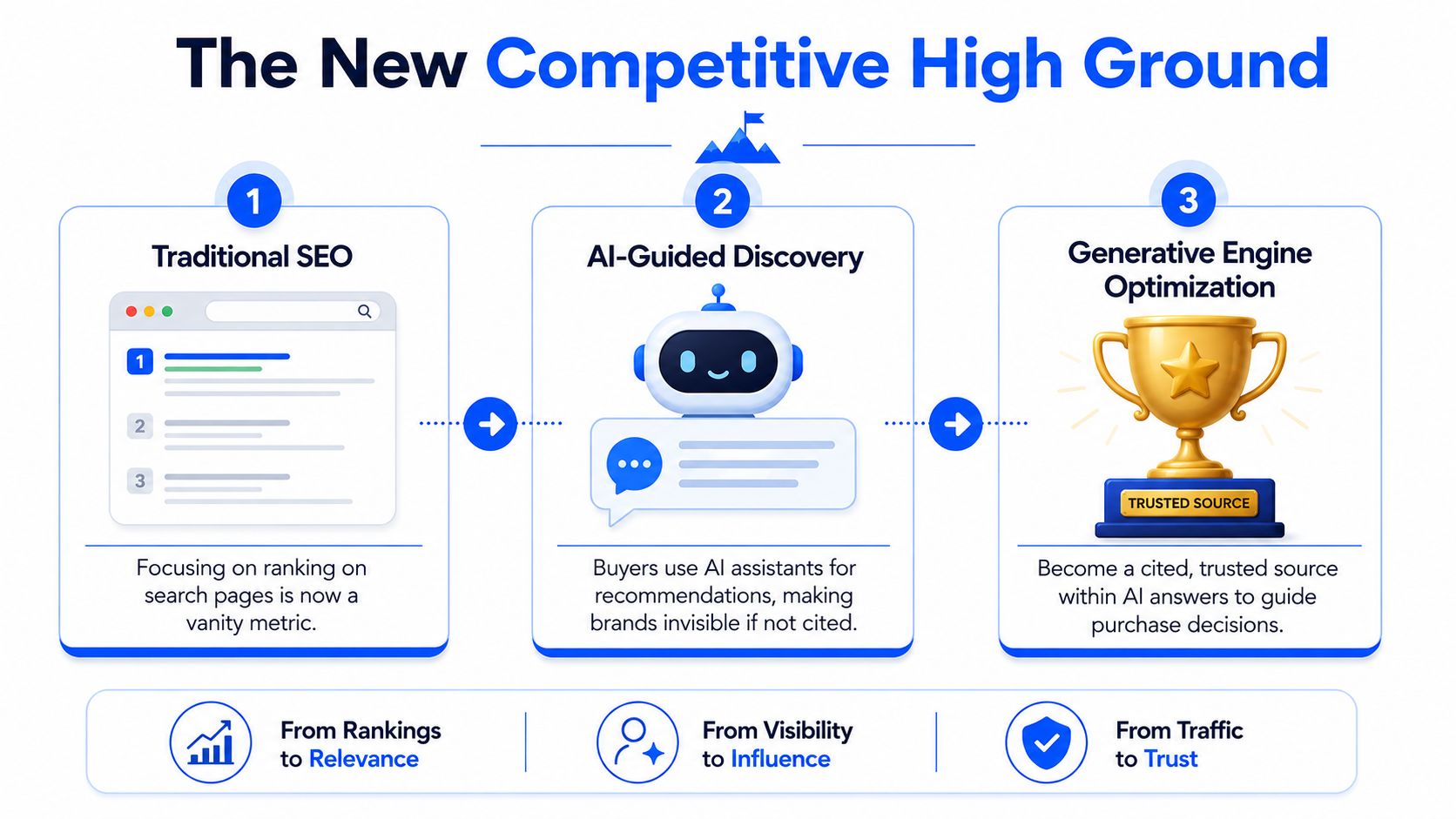
Buyers are moving from traditional search results to conversational, AI-powered interactions. Getting your brand featured in those AI answers is the new objective.
Benchmarking Your AI Visibility
A proper audit provides a foundation of hard data. When AI search usage expanded—with ChatGPT hitting 800 million weekly users and overall AI adoption doubling to 29.2% in six months—it became clear that GEO had to be a core operational focus. At that scale, a small improvement in AI answer inclusion has a significant business impact.
The purpose of an AI Search Audit is to build a data-driven roadmap. Without one, you are throwing tactics at a wall. With one, you can channel resources with precision to fix the gaps that matter.
For B2B SaaS companies, the process must simulate how real buyers think. We test a range of prompts:
- Problem-aware queries: “how to reduce customer churn”
- Solution-aware queries: “best subscription management software”
- Competitor-alternative queries: “alternatives to [competitor name]”
This is how you uncover your true share of voice in the AI ecosystem. It is the exact process we used to begin work with clients like Chargebee, which saw a +74% increase in AI visibility, and Whatfix, which achieved a +84% lift. It started with that initial benchmark.
Your first action is to conduct this assessment. You can gather the initial data by running an AI Search Audit. It is the first step toward building a winning strategy.
Defining Your Entity for LLM Retrieval
If a generative AI cannot confidently explain what your company does in one sentence, it will not recommend you. This is a common stumbling block for B2B SaaS companies implementing their generative engine optimization strategies.
Large Language Models do not “read” your site like a person. They seek clear signals to build a knowledge profile about you—your “entity.” If that entity is fuzzy, the model lacks confidence to retrieve your content and cite you as a source.
Your entity is not just your brand name. It is the universe of concepts that defines who you are, the problems you solve, and the market you own. Old-school keyword targeting is insufficient; you must build a machine-readable identity that is impossible to misinterpret.
Moving Beyond Keywords to Semantic Clarity
Consider a real-world example. When we began working with Chargebee, we needed to solidify their core entity for AI retrieval. The goal was to be recognized as the “subscription billing platform” for B2B SaaS. This required building a cohesive, machine-readable identity, not just optimizing blog posts for keywords.
Our process began by mapping their core entity and related topics:
- Primary Entity: Chargebee
- Core Category: Subscription Billing Platform
- Key Problem Solved: Automating recurring revenue and managing subscriptions
- Related Concepts: Dunning management, revenue recognition, SaaS metrics, ASC 606 compliance
By structuring their website content, internal linking, and external brand mentions around this semantic map, we made it simple for models like Gemini and ChatGPT to understand. They understood what Chargebee is, what it does, and who it’s for. This clarity was a direct driver of their +74% increase in AI visibility.
An LLM must be certain about what your company does before it recommends you. Vague positioning creates uncertainty, causing the model to default to a competitor with a clearer entity definition.
Your first action is to stop thinking in isolated keywords. Define your core entity and map the ecosystem of problems, solutions, and concepts around it. This is the foundation of effective generative engine optimization. Without this clear, machine-readable identity, you ask the AI to guess, and it will guess wrong.
Structuring Content for AI Extraction
Your content structure can make or break your Generative Engine Optimization strategy. Large Language Models from Google and OpenAI do not read your content; they parse it for easy-to-grab answers they can summarize and cite. Long, winding blog posts are not built for AI retrieval.
The new standard is a page architecture designed for machine consumption. You must spoon-feed answers. This means using sharp, specific H2 and H3 headings that pose and answer a direct question. Create self-contained “answer blocks”—clear paragraphs or lists that a model like ChatGPT or Gemini can lift directly into a response.

Building for Machine Readability
This granular structure is non-negotiable if you want your B2B SaaS brand to appear in AI-generated answers. We have seen its impact. When our team overhauled the help documentation for Whatfix, we broke down their complex guides into simple, step-by-step answer formats. The result was a +84% jump in their visibility for “how-to” prompts within AI engines.
LLMBuddy’s data shows that content with specific, factual data is 40% more likely to appear in LLM responses. Vague marketing is ignored, while hard numbers and clear steps are pulled in and cited.
Beyond on-page layout, you must get the technical foundation right. Implementing structured data (schema) for your products, articles, and FAQs explicitly tells models what each piece of content is. Technical files like llms.txt can give crawlers direct instructions on how to use your site’s content.
Your first action is to audit your top-performing content against this standard. Identify pages with high traffic but poor structure and reformat them as question-and-answer blocks. This is a core pillar of any successful Generative Engine Optimization campaign. For the exact templates we use, see our guide on AI content optimization.
Building Your Citation Pathways
If an AI model cannot find anyone talking about your brand besides you, it has no reason to trust you. To an LLM, a brand that exists only on its own website is invisible.
Effective generative engine optimization strategies are built on getting your brand, products, and experts mentioned on platforms that AI models already trust. This is not basic PR; it is the engineered process of building third-party validation.
We have moved beyond traditional link building. Research from Ahrefs shows that for AI Overviews, unlinked web mentions outperform backlinks by a 3:1 ratio. The objective is to earn the mention where it is relevant.
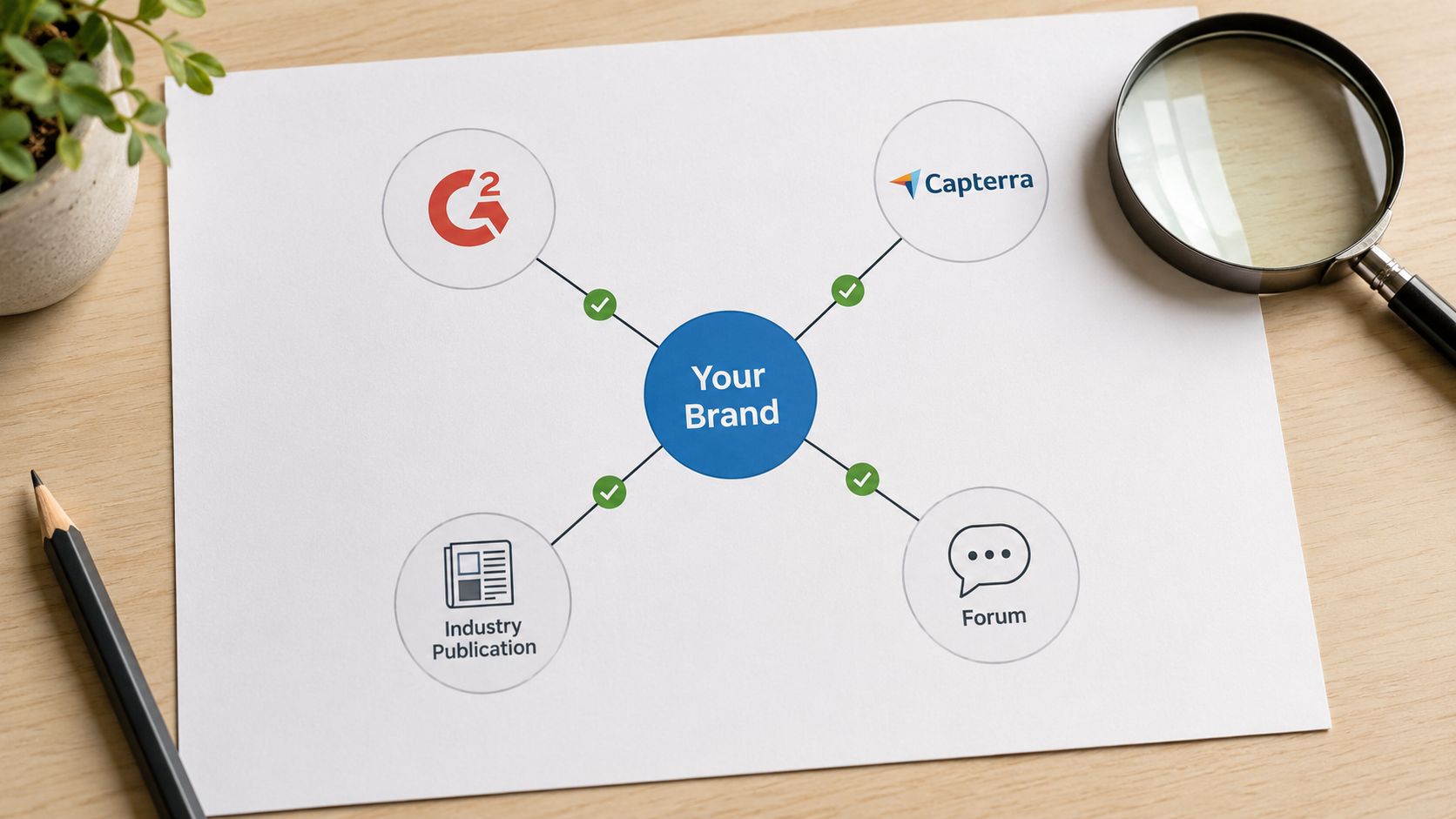
Engineering Your Web of Trust
The core of this strategy involves securing placements on high-authority sources that generative engines like ChatGPT and Perplexity reference. Show up where your buyers—and the AI they use—look for recommendations.
Focus your efforts on specific targets:
- High-Authority Review Sites: G2, Capterra, and other review platforms that lead your niche.
- Key Industry Publications: Get your experts quoted or featured in the trade journals that define your industry.
- Relevant Forums and Communities: Join discussions on Reddit, Stack Overflow, or specialized forums where users ask for solutions.
This creates a dense web of trust signals that reinforces your brand’s authority. In our audits, we find that a SaaS brand with 10 solid mentions across forums, review sites, and articles will be cited by an LLM far more often than a competitor with 20 backlinks from low-relevance blogs.
We saw this with our client Keka, an HR tech platform. We focused their campaign on building citation pathways in HR communities, which led to an +82% lift in their AI-driven visibility. Their increased presence on these trusted platforms gave AI models the confidence to recommend them.
Your first action is to map where competitors are mentioned, then build a plan to close that gap. See more examples of this strategy in our case studies.
Measuring GEO Success and Proving Value
Proving the value of this work is not about old vanity metrics. Forget traditional rankings and raw traffic. Success in GEO is measured by what directly impacts the bottom line.
The goal is to draw a straight line from every GEO action to a business result. LLMBuddy’s data shows that B2B SaaS companies that track specific GEO metrics are 60% more likely to see measurable revenue growth from this channel.
The KPIs That Actually Matter
Your dashboard needs a new breed of performance indicators that reflect your visibility inside AI answers. LLMBuddy’s AI Visibility Monitoring Platform is built around these core metrics:
- Share of Voice (SoV) in AI Answers: What percentage of high-intent, non-branded buyer questions feature your brand as a cited source?
- Citation Frequency and Quality: It is not just how often you are mentioned, but where. A citation from ChatGPT has different weight than one from Perplexity.
- Sentiment Analysis: Are the AI mentions of your brand positive, neutral, or negative? A single inaccurate mention can cause significant damage.
- Platform Breakdown: What is your SoV on ChatGPT versus Gemini? You must know your performance on each platform to make smart decisions.
These metrics provide the hard data to prove value. We directly tied a +82% lift in AI visibility for our client Keka to a surge in demo requests from prospects who said an “AI search” led them to the company.
Your first action is to define these metrics for your own reporting. Start tracking your SoV for five of your most important buyer queries across ChatGPT and Gemini this week. To model the potential impact on your business, use our B2B SaaS ROI calculator.
Your Top GEO Questions, Answered
Isn’t This Just a New Name for SEO?
No. The goal is different. With traditional SEO, you fight to rank a webpage. For Generative Engine Optimization, the prize is having your brand’s data become the source within the AI’s answer. You are not trying to rank #1; you are aiming to be the source of truth for the model. This shifts focus from keywords and backlinks to semantic clarity and machine readability.
Which AI Platforms Should We Focus On?
Go where your customers are. For most Indian B2B SaaS companies we work with, this means a tight focus on ChatGPT, Google Gemini, and Perplexity. Each engine gathers information differently, so a one-size-fits-all approach is ineffective. We start by auditing your brand’s footprint on all three to find the biggest gaps and opportunities.
How Long Does It Take to See Real Results?
This is not an overnight fix. While you may see quick wins from technical adjustments, a solid GEO strategy needs time. Expect to see measurable results within 90-120 days.
LLMBuddy’s B2B SaaS clients see an average visibility growth of +87% within this timeframe. GEO involves building entity authority and citation pathways, which are foundational efforts that compound over time.
What’s the Single Most Important First Step?
A comprehensive AI Search Audit. Optimizing for AI without a clear benchmark is guesswork. You must know where you stand today—how you show up across major AI platforms and how you compare to competitors. An audit gives you that data-driven roadmap. It tells you what is broken and where to focus resources for the biggest impact.
Ready to see where your brand stands in AI search? Let’s get you a tangible starting point.
Request Your Complimentary AI Search Audit from LLMBuddy
Produced via Outrank app