
Knowledge graph optimization decides whether AI assistants can recognize your company as a credible software vendor or skip you for a competitor with cleaner entity signals.
At LLMBuddy, we treat this as a revenue program for B2B SaaS, not a side task for technical SEO. Generative engines such as ChatGPT, Perplexity, Gemini, and Claude build answers from entities, relationships, corroborating citations, and structured evidence. If your brand, product, category, and proof points are ambiguous, you lose visibility during evaluation-stage prompts even when your site still performs in traditional search.
That gap is why smart SaaS teams have shifted from publishing more content to building stronger machine-readable company profiles. Our AI visibility optimization framework starts with entity clarity, then fixes schema coverage, source consistency, and third-party confirmation. That sequence works because assistants do not reward volume. They reward confidence.
We see the pattern repeatedly in B2B SaaS audits. Brands with a defined entity layer, clean taxonomy, and repeated external validation get cited more often in commercial prompts. Brands with scattered naming, weak category alignment, and thin structured data get ignored, even with solid domain authority.
Chargebee is the right benchmark here. The gain did not come from chasing another blog calendar. It came from tightening how the company, product lines, use cases, and market category were represented across the web so AI systems could retrieve and verify them without guesswork.
If you want pipeline from generative AI, start with the graph.
Why AI Search Demands a New Growth Playbook
B2B SaaS teams that earn assistant mentions see a different traffic profile. The visit starts later in the buying cycle, with more context already established, because ChatGPT, Perplexity, Gemini, and Claude often do the first round of vendor filtering before the click.
That changes the job of search. Your team is no longer competing only for rankings. You are competing for retrieval, citation, and inclusion inside generated answers. If an assistant cannot identify your company cleanly, connect your product to the right software category, and verify your claims across trusted sources, your brand stays out of the answer even when your pages rank well.
This is why knowledge graph optimization belongs in pipeline strategy, not in a technical SEO backlog. At LLMBuddy, we treat it as part of the revenue system for SaaS companies that want to win high-intent prompts, not just collect more sessions. Our AI visibility optimization framework is built for that exact job.
Why conversion economics changed
Assistant traffic behaves differently from classic organic traffic. Users often arrive after the model has already summarized the category, compared vendors, and narrowed options. In B2B SaaS, that means fewer exploratory clicks and more evaluation-stage visits.
Chargebee is a useful example. The win did not come from publishing another stack of top-of-funnel articles. It came from making the company easier for machines to resolve and trust across product lines, category definitions, use cases, and third-party references. Once that structure is clear, assistants have a stronger basis to mention the brand in commercial prompts.
Treat that as the operating model:
- Define the entity clearly: company name, product names, category, use cases, leadership, and differentiators must be consistent and machine-readable.
- Back claims with corroboration: review platforms, editorial mentions, partner pages, and data aggregators need to reinforce the same story.
- Measure mention quality weekly: track whether assistants name you, describe you accurately, and cite reliable sources when they do.
Practical rule: If ChatGPT explains your competitor's category fit better than yours, your problem is entity resolution and trust, not content volume.
Why old SEO isn't enough
A strong ranking still helps. It does not guarantee inclusion in AI answers.
Assistants pull from a wider evidence set than a traditional search click. They use structured metadata, editorial citations, review sites, product databases, and public entity references to decide which brands are safe to mention. Your website remains one source among many. For B2B SaaS, that means authority now depends on consistency across the open web, not just page-level optimization.
The right question is simple. How do you become the company an assistant can retrieve quickly, verify confidently, and cite in buying-stage prompts?
Build for that standard, and AI search becomes a growth channel with real sales impact. Ignore it, and competitors with cleaner entity signals will keep taking the mentions that shape shortlist decisions.
Auditing Your Existing Entity Signals
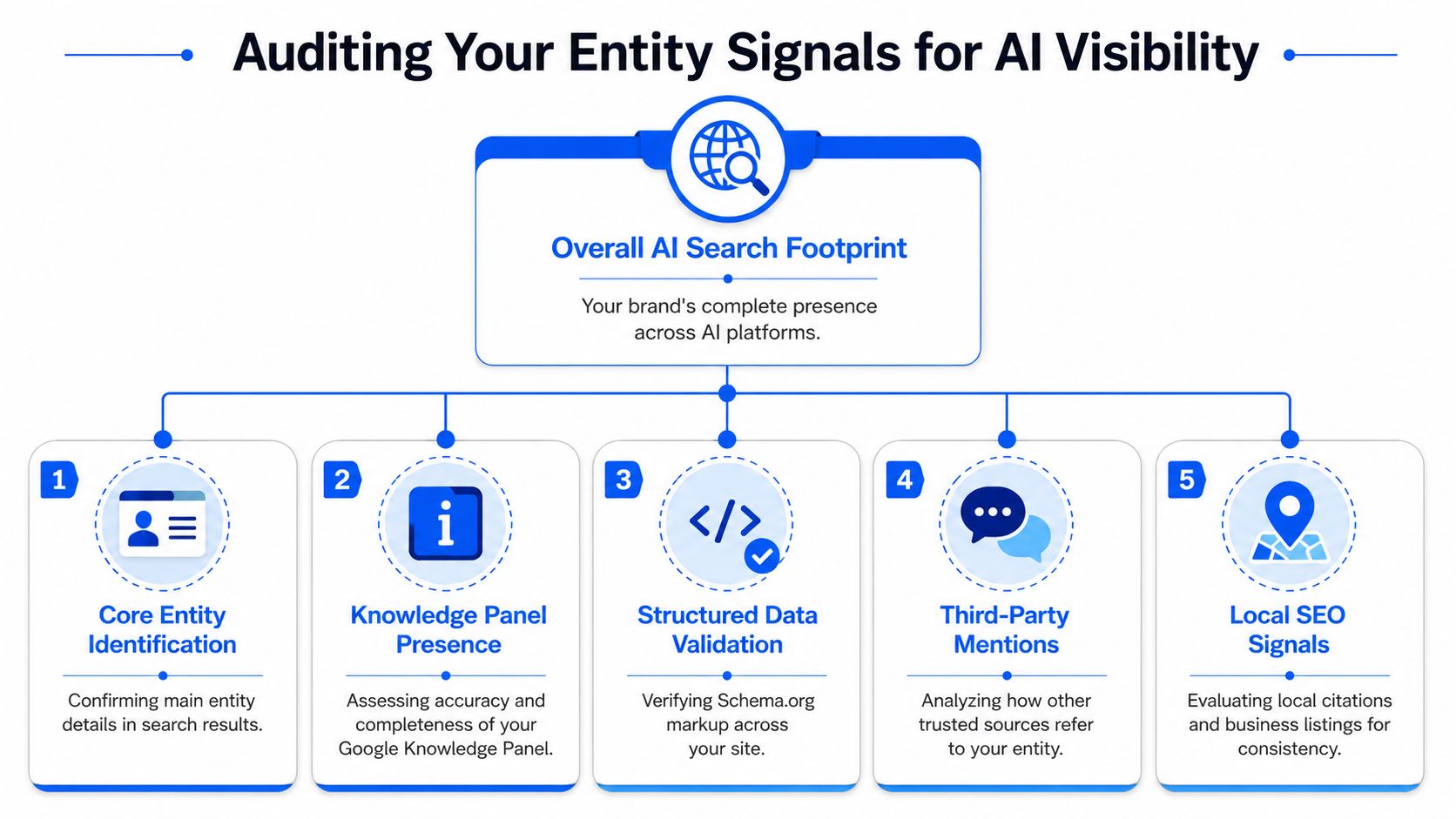
LLMBuddy audits usually find the same problem first. AI assistants can mention a B2B SaaS brand, but they often describe it inconsistently, cite weak sources, or skip it on commercial prompts that drive pipeline. That gap is where GEO work starts.
Before you touch schema, taxonomy, or content production, verify how ChatGPT, Gemini, and Perplexity currently resolve your brand. Run the audit the way a buyer would, not the way your internal team talks about the company. Buyers ask for best tools, comparisons, use cases, and category leaders. If your entity signals are weak, assistants will retrieve competitors with cleaner evidence across the open web.
Run prompt audits against buying-stage queries
Start with prompts tied to shortlist creation and vendor evaluation.
Use a set like this:
- Category intent: “Best subscription billing software for SaaS”
- Comparison intent: “[Your brand] vs [competitor]”
- Feature intent: “Which platforms support revenue recognition for B2B SaaS?”
- Persona intent: “Best HRMS for Indian mid-market companies”
- Trust intent: “Top tools for enterprise onboarding with strong integrations”
For each platform, record three checks:
| Audit check | What to look for | Why it matters |
|---|---|---|
| Brand presence | Is your company mentioned at all | No mention means the assistant is not retrieving you for that query class |
| Entity accuracy | Are product, category, and positioning correct | Bad labels distort every later answer about your brand |
| Citation source | Which domains support the answer | Those domains shape whether assistants trust and repeat the mention |
This exercise is more useful than another rank tracker export. It shows whether your brand can win citations in generative answers.
Look for the failure patterns that suppress AI visibility
The first pattern is entity confusion. Assistants merge your company with another vendor, attach the wrong category, or summarize your product from stale third-party listings. We see this often in B2B SaaS markets with overlapping terminology such as billing, finance automation, HR tech, and customer onboarding.
The second pattern is citation asymmetry. Your competitor is supported by review sites, partner pages, editorial coverage, founder profiles, and product databases. Your brand is supported by your homepage and a few scattered mentions. In GEO, that usually means the competitor gets named more often, even if your website is stronger in traditional search.
The third pattern is message drift across platforms.
If ChatGPT describes you as subscription billing software, Perplexity calls you revenue management, and Gemini barely recognizes the brand, your entity layer is fragmented. Fixing that inconsistency produces faster gains than publishing five more blog posts.
Build a baseline your team can act on
Capture the first audit in a shared sheet this week. Keep it simple and strict.
- Top buying queries: List the 20 prompts tied to demos, free trials, and shortlist decisions.
- Raw platform outputs: Save the exact responses from ChatGPT, Gemini, and Perplexity.
- Entity errors: Mark wrong category labels, outdated product claims, missing competitors, and bad founder or company facts.
- Citation map: Note which domains each assistant relies on when your brand appears.
- Competitor pattern: Track which vendors show up repeatedly and which sources keep reinforcing them.
This is the same baseline we build before recommending fixes for B2B SaaS clients. It tells you whether your problem is retrieval, accuracy, trust, or all three.
If you want a faster starting point, request an AI search audit for your current entity visibility. A manual review still works. What matters is getting a clean read on how AI assistants currently understand your company before you start rebuilding the graph.
Designing Your SaaS Entity and Taxonomy Model
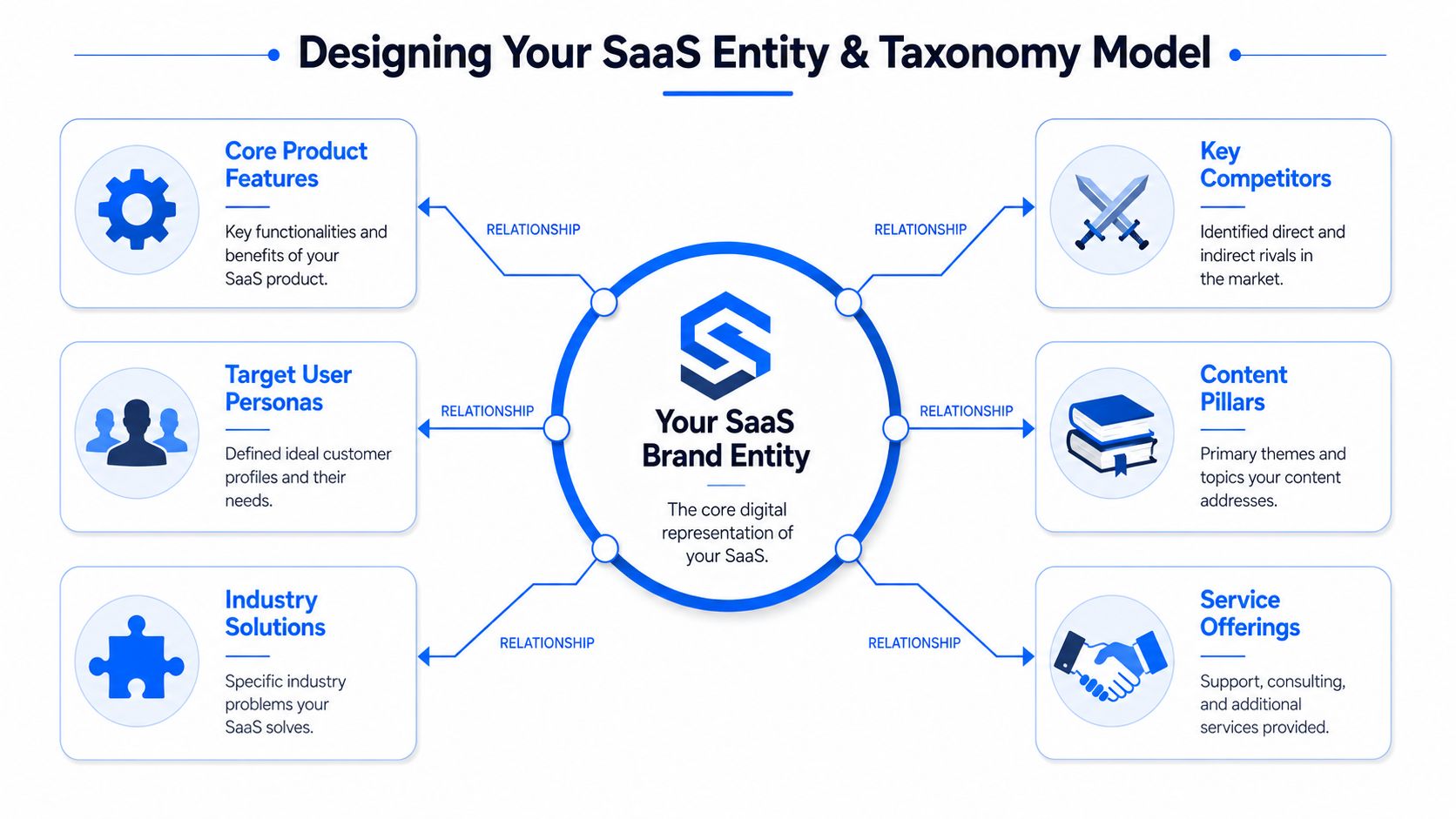
AI assistants think in entities and relationships. Keywords still matter, but they're downstream. First the model has to understand who you are, what you sell, who it serves, and how all those pieces connect.
That means your SaaS brand needs a defined internal graph. Not a vague site structure. A real taxonomy with canonical names, page-level ownership, and relationship logic.
Start with entity classes, not URLs
Founders and CMOs often begin with pages. I'd start one layer above that.
For a B2B SaaS company, your core entity set usually looks like this:
- Organization entity: Your company, official name, alternate names, legal identity, category, market.
- Product entities: Main platform, modules, product lines, or plans.
- Person entities: Founders, executives, in-house experts, public-facing authors.
- Use case entities: Payroll automation, customer onboarding, subscription billing, employee performance management.
- Audience entities: HR teams, RevOps leaders, finance teams, IT admins.
- Comparison entities: Direct competitors and adjacent alternatives.
Now connect them. Your company owns the product. The product solves specific use cases. Those use cases map to buyer personas and industries. Founders and experts publish content that reinforces those relationships. This is how AI systems move from “brand mention” to “brand recommendation.”
Canonical identity is not optional
Every important entity needs a single canonical name, slug, and URI. No exceptions.
If your site alternates between “HRMS,” “HR software,” “people platform,” and “employee suite” without a clear hierarchy, assistants won't know which concept is primary. The same goes for product naming. If your homepage uses one product name and your review listings use another, you're introducing avoidable confusion.
For SaaS teams, I recommend a simple working model:
| Entity type | Canonical field you define | Example |
|---|---|---|
| Company | Official name and URL | Keka, one primary company page |
| Product | Stable product name | Keka HRMS |
| Feature | One term per feature | Payroll, Attendance, Performance |
| Persona | Standard buyer label | HR Manager, CFO, Founder |
| Industry | Fixed vertical tag | IT services, manufacturing, SaaS |
Keka is a useful example. In a mature HRMS entity model, “attendance,” “payroll,” “performance management,” and “employee onboarding” should be distinct but related nodes, each tied back to the product and to the buyer questions they answer. That kind of modeling is part of why Keka's AI visibility rose +82% in our work.
Connect your site to public entity systems
Your internal taxonomy matters, but it isn't enough on its own. Public entity validation is where many brands separate themselves.
According to UseOmnia's guide on entity knowledge graph optimization, synchronizing website data with Wikidata QIDs, Wikipedia pages, and major third-party profiles creates a single canonical identity that AI assistants map queries to, and organizations that claim and edit those public sources report a measurable rise in brand mention share in AI responses.
That should shape your operating model immediately.
Your site declares who you are. Public entity sources confirm that declaration. AI assistants trust the combination.
What your taxonomy should produce
A strong taxonomy creates downstream consistency in four places:
- Page architecture: Product, feature, industry, competitor, and FAQ pages map cleanly to entities.
- Schema markup: Your JSON-LD reflects the same relationships you've defined internally.
- Editorial planning: Content answers buyer questions from the perspective of known entities, not random keywords.
- Third-party profiles: G2, Capterra, Crunchbase, LinkedIn, and public databases all describe the same brand identity.
If your team can't sketch your entity relationships on one page, your website probably isn't clear enough for AI retrieval either.
Implementing the Technical Foundations
A taxonomy sitting in a Notion doc won't help ChatGPT. The model needs machine-readable signals on your website.
That's where schema markup, JSON-LD, page structure, and crawler guidance come in. This work isn't glamorous, but it's where your abstract entity design becomes executable.

Implement the four schema types first
For most SaaS companies, I'd start with four schema families and get them right before adding anything else.
- Organization schema: Defines the company, official website, logo, sameAs references, and brand identity.
- Product schema: Defines the software product or module, plus its relationship to the organization.
- Person schema: Ties founders, executives, and authors to expertise and published content.
- FAQPage schema: Helps assistants parse question-answer sections that match buyer prompts.
The implementation detail that matters most is nesting and relationship clarity. Your Product entity should point back to the Organization. Your expert-authored pages should connect Person to Organization and relevant topics. Your FAQ markup should sit on pages where the topic entity is already clear.
Here's a stripped-down example pattern:
{
  "@context": "https://schema.org",
  "@type": "Organization",
  "name": "Example SaaS",
  "url": "https://www.examplesaas.com",
  "sameAs": [
    "https://www.linkedin.com/company/examplesaas",
    "https://www.g2.com/products/examplesaas"
  ]
}
Then extend that with Product and Person entities on relevant pages instead of dumping one bloated schema block sitewide.
Validate every page type
Schema that exists but fails validation is dead weight.
PingCAP's knowledge graph optimization guide notes that properly validated schema markup using Schema.org and JSON-LD can increase visibility in search results by up to 40% when errors are eliminated through tools like Google's Structured Data Testing Tool. That makes validation a baseline requirement, not a cleanup task for later.
Use a repeatable validation workflow:
- Template review: Check core page templates such as homepage, product, feature, comparison, and FAQ pages.
- Relationship review: Confirm each schema type links to the right parent entity.
- Error review: Remove duplicate fields, invalid types, and stale references.
- Change log: Record updates so content and engineering teams don't break the graph later.
Add llms.txt and retrieval-friendly page structure
I wouldn't treat llms.txt as magic, but I would still publish one. It gives AI crawlers a clean reference point for preferred content paths, core pages, documentation, and sections you want machines to parse efficiently. Keep it simple and accurate. Don't turn it into a manifesto.
This technical layer works best when paired with strong content formatting:
- Clear H2 and H3 structure
- Short answers under real buyer questions
- Ungated explanatory pages
- Transcripts for webinars and videos
- Consistent terminology across templates
That's also where Generative Engine Optimization services differ from standard on-page SEO. The job isn't just to help crawlers index a page. It's to help AI systems retrieve the right fact, attach it to the right entity, and cite it without confusion.
Implementation rule: If your engineering team ships schema without a relationship map, they'll create markup that looks complete but still leaves the model guessing.
Building Authoritative Citation Pathways
Your site can define your brand. It can't prove your authority by itself.
AI assistants look for external confirmation before they recommend software, especially for comparison queries and category prompts. If your off-site footprint is thin, your on-site work won't carry enough trust. Most SaaS teams underinvest in this area.
Why third-party mentions decide trust
For software categories, review platforms and editorial mentions carry unusual weight because they combine category labeling, product description, buyer feedback, and repeated references to your brand in one place. That's exactly the kind of evidence AI systems like to pull from.
Mersel's GEO guidance is blunt on this point. To build AI trust, B2B SaaS brands need at least 3+ editorial mentions in high-authority trade publications, consistent brand entity data across external properties, and presence on G2 and Capterra, which it identifies as primary sources for LLM training on software comparisons.
That should reset your priorities. A random backlink campaign won't do the job. You need citation pathways that reinforce your category identity.
What a good citation pathway looks like
A strong external trust layer usually includes a mix of these signals:
- Review platforms: G2, Capterra, and category-specific marketplaces with accurate product descriptions.
- Trade publication mentions: Editorial articles, expert commentary, or vendor lists in software and industry media.
- Third-party company profiles: Crunchbase, LinkedIn, partner directories, and public knowledge sources.
- Buyer communities: Slack groups, Reddit threads, founder communities, and niche forums where your product is discussed in context.
Chargebee is a good example of why this matters. In our work, a deliberate citation pathway strategy contributed to +74% AI visibility by improving how often the brand showed up in recommendation-style queries. Not because one page ranked better. Because the external evidence got stronger and more consistent.
Prioritize quality over volume
A common error here involves teams chasing mentions everywhere instead of thoroughly fixing a few high-trust sources.
Use a priority model like this:
| Source type | What good looks like | Common mistake |
|---|---|---|
| Review platforms | Accurate category, features, positioning | Empty profile or outdated copy |
| Trade media | Named editorial mention with brand context | Paid placement with weak relevance |
| Public profiles | Same company description everywhere | Inconsistent naming and category labels |
| Communities | Real user discussion and references | Dropping links without participation |
If your product is on G2 but your positioning is weak, fix that first. If your founder appears in trade publications but the company description is inconsistent, standardize it. If communities mention your category but not your brand, your outreach and content angles need work.
There's a content layer to this too. External citation work performs better when paired with pages built for extraction and summarization. That's why AI content optimization belongs next to citation building, not months later.
Buyers trust software recommendations that show up repeatedly across independent sources. AI assistants follow the same pattern.
Testing and Measuring Your AI Visibility
Weekly testing separates real GEO programs from teams guessing their way through AI search.
For B2B SaaS, that matters because generative assistants do not hold rankings steady the way traditional search often does. ChatGPT, Perplexity, and Gemini can shift which brands they mention, which sources they trust, and which pages they cite from one week to the next. If you are not running a fixed testing process, you will miss those changes until pipeline slows.
What to track every week
At LLMBuddy, we judge GEO performance on two outcomes first. Can the model find and mention you? Can that visibility turn into commercial action?
Everything else supports those two questions.
Use a weekly scorecard with five fields:
- AI visibility rate: The percentage of target prompts where your brand appears in the answer
- Citation frequency: How often assistants cite your site, documentation, or trusted third-party profiles tied to your entity
- AI share of voice: How often you appear versus direct competitors across the same prompt set
- AI-referred traffic: Sessions from AI assistants and AI-assisted discovery paths
- AI-referred conversions: Demo requests, trial starts, contact form submissions, or pipeline actions from that traffic
Track these by query cluster, not as one blended number. Brand queries, category queries, comparison queries, and problem-aware queries behave differently. A SaaS company that looks strong on branded prompts but disappears on "best [category] software" prompts does not have market visibility. It has recall from people who already know the name.
That distinction matters in client work. With Chargebee-style B2B SaaS motions, the biggest gains usually come from comparison and replacement prompts because those are the moments where buyers are actively evaluating vendors.
Pair manual testing with a fixed prompt set
Dashboards help. Manual review catches what dashboards miss.
Run the same prompts every week across ChatGPT, Perplexity, and Gemini. Keep the wording fixed. Log whether your brand appears, where it appears, which competitors show up, and which domains get cited. Then compare those answers against the prior week and prior month.
Blue Compass makes a useful point here. Repeated prompt testing across AI platforms is one of the clearest ways to spot visibility shifts before they show up in standard organic reporting: https://www.bluecompass.com/blog/how-to-measure-success-for-generative-engine-optimization-geo
Use a monthly review format like this:
- Run the same prompt set across ChatGPT, Gemini, and Perplexity
- Record answer inclusion for your brand and named competitors
- Review cited sources to see which domains are shaping the response
- Check analytics and CRM data for changes in assisted traffic, demo volume, and sales-qualified actions
- Tag prompt intent so you can separate awareness wins from buying-stage wins
Keep the prompt set small enough to run every week without fail. Twenty to forty high-intent prompts is enough for most mid-market SaaS teams. Consistency beats breadth here.
Measure prompt-level gaps, then fix the specific failure
B2B teams waste time when they see weak AI visibility and respond by publishing more content everywhere.
Do not do that.
Diagnose the exact gap:
- If you appear on feature queries but not vendor comparison prompts, strengthen comparison pages and third-party review coverage
- If Perplexity cites your docs but ChatGPT does not mention you, clean up entity consistency across your site, review profiles, and company descriptions
- If you earn AI traffic but conversions stay weak, the page is satisfying the model more than the buyer. Tighten positioning, proof, and conversion paths
- If competitors appear with stronger framing, your category language and external citations are still letting them define the narrative
This is the playbook we use in LLMBuddy engagements. Test a controlled prompt set. Identify the missed query class. Fix the weakest retrieval or conversion layer. Re-test. Repeat weekly.
Whatfix is a good example of why this operating rhythm works. In our client work, AI visibility improved because the team kept measuring inclusion patterns, adjusting source coverage, and refining page structure instead of treating GEO like a one-time technical rollout.
Operator rule: test, fix, re-test. If a prompt matters to revenue, review it every week.
The teams that win AI visibility do not publish and hope. They run GEO like a revenue channel with weekly QA, prompt tracking, and hard conversion feedback.
Frequently Asked Questions on GEO
How is knowledge graph optimization different from regular SEO?
Regular SEO helps pages rank. Knowledge graph optimization makes your company legible to AI assistants as a distinct business entity with defined products, buyers, competitors, integrations, and subject-matter experts. For B2B SaaS, that difference matters because ChatGPT and Perplexity often summarize brands from entity relationships and citations, not just from a single high-ranking page.
Do we need a Wikipedia page or Wikidata entry?
No. A clean public entity footprint matters more.
Start with what you control. Your company name, product naming, founder and leadership bios, pricing references, review profiles, partner listings, and category descriptions should all match across the web. In LLMBuddy client work, the faster gains usually come from fixing inconsistent brand and product signals, not from chasing a Wikipedia page.
Which schema types should a B2B SaaS company implement first?
Start with Organization, Product, Person, and FAQPage. That set gives AI systems the clearest read on who you are, what you sell, who speaks for the company, and which commercial questions your site answers.
Do not add extra schema just to look fancy. Validate the core markup first, then expand only if it improves retrieval on prompts that matter to pipeline.
How long does GEO take to show results?
Results track with execution quality. If your site structure, schema, and third-party citations are aligned, you can start seeing cleaner brand representation and better inclusion on commercial prompts within a normal testing cycle. If your entity signals are fragmented, progress slows because the models keep pulling from conflicting sources.
Chargebee is a good benchmark for how this works in practice. Strong product categorization, clear commercial pages, and consistent off-site references give AI systems less room to misclassify the company.
Is GEO only for large enterprise SaaS brands?
No. Mid-market SaaS companies often have an advantage because their product set, buyer journey, and category footprint are easier to standardize.
That makes GEO easier to operationalize. A focused team can clean up entity definitions, tighten schema, improve source consistency, and monitor prompt coverage faster than a large company with multiple product lines and messy naming conventions.
What should we do first if we're invisible in AI answers?
Run a manual visibility check across the prompts that influence revenue. Ask ChatGPT, Perplexity, and Gemini the commercial questions your buyers ask. Then document three things: whether your brand appears, how the product is described, and which sources the model relies on.
From there, fix the weakest layer first. If the answer is wrong, clean up entity and taxonomy signals. If the answer is incomplete, strengthen the page and citation set behind that query class. If the answer mentions you but does not convert, improve proof, positioning, and page structure.
If your SaaS brand is missing from AI recommendations, the problem usually sits in your entity layer, citation network, or prompt coverage. LLMBuddy helps B2B SaaS teams fix those gaps with the same GEO operating model used in serious AI visibility programs. If you want a direct assessment of where your brand is losing inclusion, book a demo.