
If you’re still treating GEO vs SEO for B2B SaaS as a branding debate, you’re late. AI search reached about 4.5% of organic traffic by September 2025, grew 127% in three months, and AI-referred sessions jumped 527% year over year in the first five months of 2025, according to this 2026 GEO statistics summary. The same source says 89% of B2B buyers now consider AI search a top source during the buying process.
That changes budget decisions for every serious SaaS CMO.
At LLMBuddy, we’ve seen this shift clearly in AI search audits for Indian SaaS companies selling into India, the US, and the UAE. Buyers don’t always start on Google anymore. They start on ChatGPT, Perplexity, Gemini, and sometimes Claude. If your brand isn’t cited there, your category story gets written by someone else.
SEO still matters. A lot. But if your 2026 growth plan only funds rankings and ignores citations inside AI answers, you’re underinvesting in where software buying intent is moving.
Why This Conversation Matters in 2026
Most CMOs still ask the wrong question. They ask, “Is GEO replacing SEO?” The right question is, “How much of my non-branded pipeline is now shaped before a prospect ever clicks a search result?”
The answer is enough to affect budget allocation right now.
The clearest signal is buyer behavior. AI search isn’t a future channel anymore. It is already influencing discovery, evaluation, and vendor shortlists. That matters more in B2B SaaS than in many other categories because software buyers ask high-context questions. They want comparisons, category definitions, migration advice, and implementation trade-offs. That’s exactly where AI interfaces win.
Why Indian SaaS teams should care first
Indian SaaS companies are often selling in global markets with leaner teams than US competitors. That creates a simple problem. You can’t outspend bigger brands on every demand channel, so you need to win in channels where structure, authority, and execution can beat sheer media spend.
GEO gives you that opening.
We’ve seen this with clients like Chargebee, Whatfix, and Keka. The pattern is consistent. Brands that define their category clearly, strengthen third-party references, and make product pages easier for AI systems to extract become easier to surface in buyer prompts. That’s one reason our client work has included visibility gains such as Chargebee +74%, Whatfix +84%, and Keka +82%.
Practical rule: If your ICP uses ChatGPT during evaluation and your brand isn’t cited in those answers, your SEO program is no longer enough on its own.
The budget implication
You shouldn’t move all SEO budget into GEO. That would be sloppy.
You should stop treating GEO as an experiment and start treating it as a visibility layer with its own operating model. For most B2B SaaS companies, that means keeping SEO as the foundation and carving out dedicated work for AI citation coverage, entity consistency, review-platform presence, and answer-ready content updates.
Use a simple planning split in your head. SEO captures demand. GEO shapes who gets mentioned while that demand forms.
Defining the Arena SEO and GEO
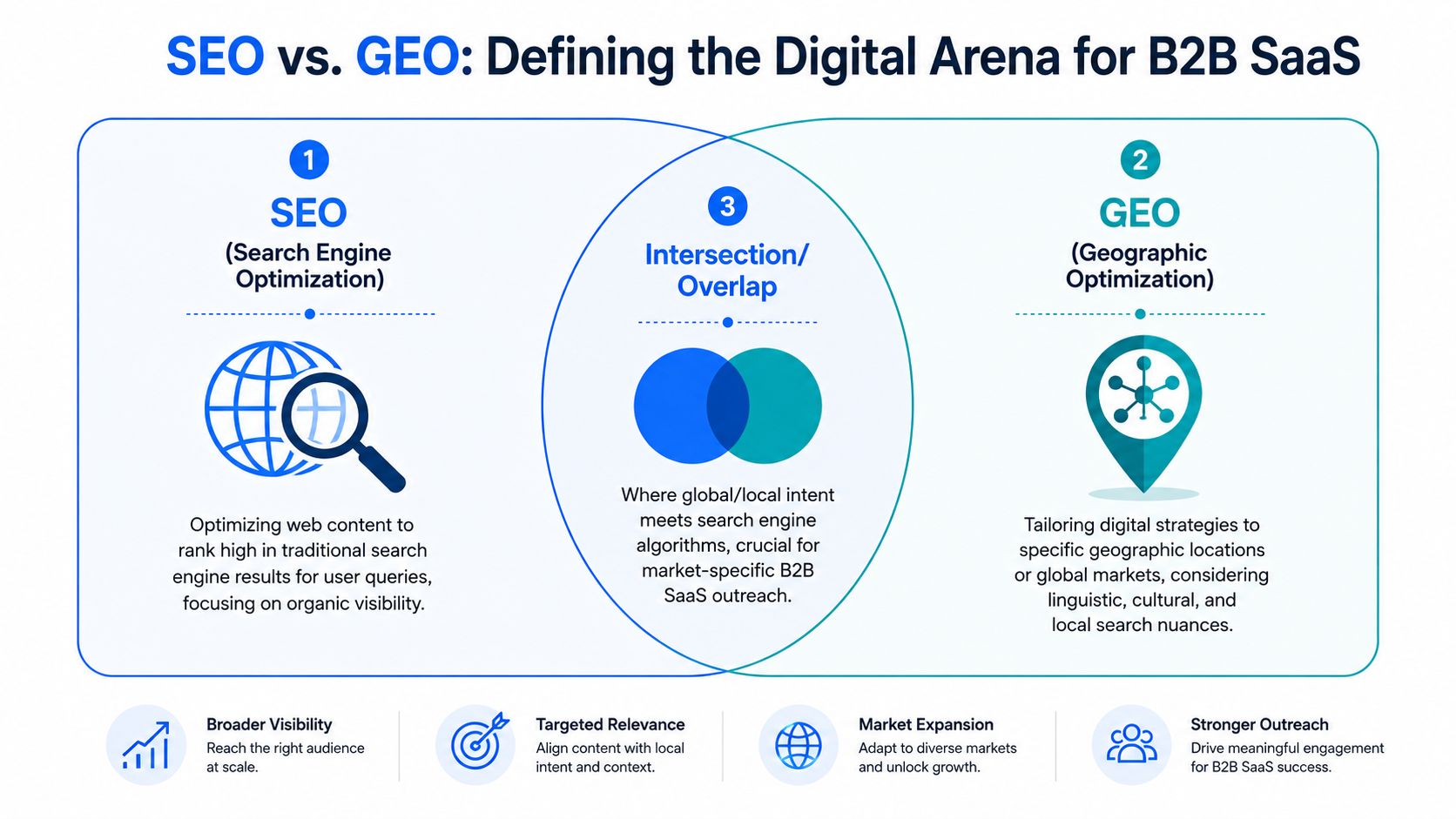
SEO and GEO overlap, but they are not the same job.
SEO is about helping your pages rank in traditional search engines so people click through to your site. GEO is about helping AI systems retrieve, trust, and cite your brand or content inside generated answers. One is list-based visibility. The other is answer-based visibility.
That sounds subtle. It isn’t.
SEO wins the click
Traditional SEO is still built around rankings, impressions, click-through rate, and page-level authority. You publish a page, improve internal links, earn backlinks, tighten on-page relevance, and try to move up in Google.
That system still drives pipeline. Ignore it and you lose.
GEO wins the mention
GEO works on a different retrieval target. AI systems don’t need to send the user to you to use your content. They can summarize your point, cite your brand, compare you to competitors, and shape buyer perception before a visit happens.
A useful way to think about it is this. SEO asks, “Can I rank?” GEO asks, “Can I be extracted and trusted?”
That changes what your content needs to do.
According to this AEO vs SEO analysis, AI systems increasingly reward content structured for extraction, including clear definitions, comparison tables, and schema. It also notes that 50% of content cited in AI answers is less than 13 weeks old. The same source says only 5 brands capture about 80% of AI responses in a given category.
That should reset how you think about content decay and category leadership.
The old SEO mindset was, “rank once and defend.” The GEO mindset is, “stay current or disappear from answers.”
What this means for your team
If your content team writes long narrative posts with weak definitions, no comparison blocks, fuzzy product positioning, and inconsistent terminology, you are asking AI systems to do extra interpretive work. They won’t. They’ll cite a clearer competitor.
For B2B SaaS, that means your category pages, alternatives pages, use-case pages, implementation pages, and review-platform profiles need tighter language and cleaner structure than is typically published.
Core Differences in Strategy and Execution
The biggest mistake I see is teams saying they are “doing GEO” when they’re just publishing SEO content with AI buzzwords added. That’s not strategy. That’s relabeling.
For B2B SaaS, the technical break between the two disciplines is the retrieval target. As noted in this B2B SaaS GEO review, SEO is optimized for ranked link positions and click-through, while GEO is optimized for direct citation inside AI-generated answers. The same source notes that GEO treats reference rate or citation frequency as a primary KPI rather than organic CTR.
Here is the cleanest way to audit the difference.
GEO vs SEO at a glance
| Component | SEO (Search Engine Optimization) | GEO (Generative Engine Optimization) |
|---|---|---|
| Target | Ranked positions in search results | Inclusion inside AI-generated answers |
| Primary KPI | Organic traffic, rankings, CTR | Citation frequency, mention quality, reference rate |
| Core signals | Backlinks, internal links, technical SEO, page relevance | Entity clarity, third-party validation, structured data, source consistency |
| Content format | Full pages built to rank and earn clicks | Retrieval-friendly passages built to be summarized and cited |
| Conversion path | Click first, convert later | Mention first, click may never happen |
| Reporting lens | Sessions, landing pages, assisted conversions | Citation share, prompt coverage, influenced pipeline |
What good SEO work looks like
SEO teams usually focus on site architecture, keyword mapping, search intent alignment, internal links, technical fixes, and backlinks. That’s still the right work for traditional search.
If your site has weak crawlability, poor page hierarchy, or thin commercial pages, fix that first. GEO won’t save a weak website.
What good GEO work looks like
GEO work is more specific than often expected:
- Entity definition cleanup: Your brand, product, category, integrations, and use cases must be described consistently across your site and third-party sources.
- Passage-level restructuring: Key sections need short, extractable answers, not long intros and vague copy.
- Citation pathway building: You need stronger presence on review sites, partner ecosystems, and trusted category sources.
- Freshness operations: Important pages need regular updates because AI-visible authority decays faster.
You can see this directly in our AI content optimization work. The highest-impact changes usually aren’t cosmetic. They are structural. We rewrite sections so an LLM can lift the right answer without guessing what your product does.
What to fix first: Audit your top 20 revenue pages and ask one brutal question. If ChatGPT lifted two paragraphs from this page, would the buyer get an accurate and differentiated understanding of our product?
Where teams waste money
They waste it in three places.
First, they overfund net-new blog production while money pages stay weak. Second, they chase backlinks without cleaning up entity confusion across their own site. Third, they report GEO success through traffic alone, which misses the point.
If your CMO dashboard still treats organic sessions as the only proof of search value, you are blind to answer-engine influence.
Platform Specific Playbooks for SaaS
You don’t need equal effort across every AI platform. That’s lazy planning.
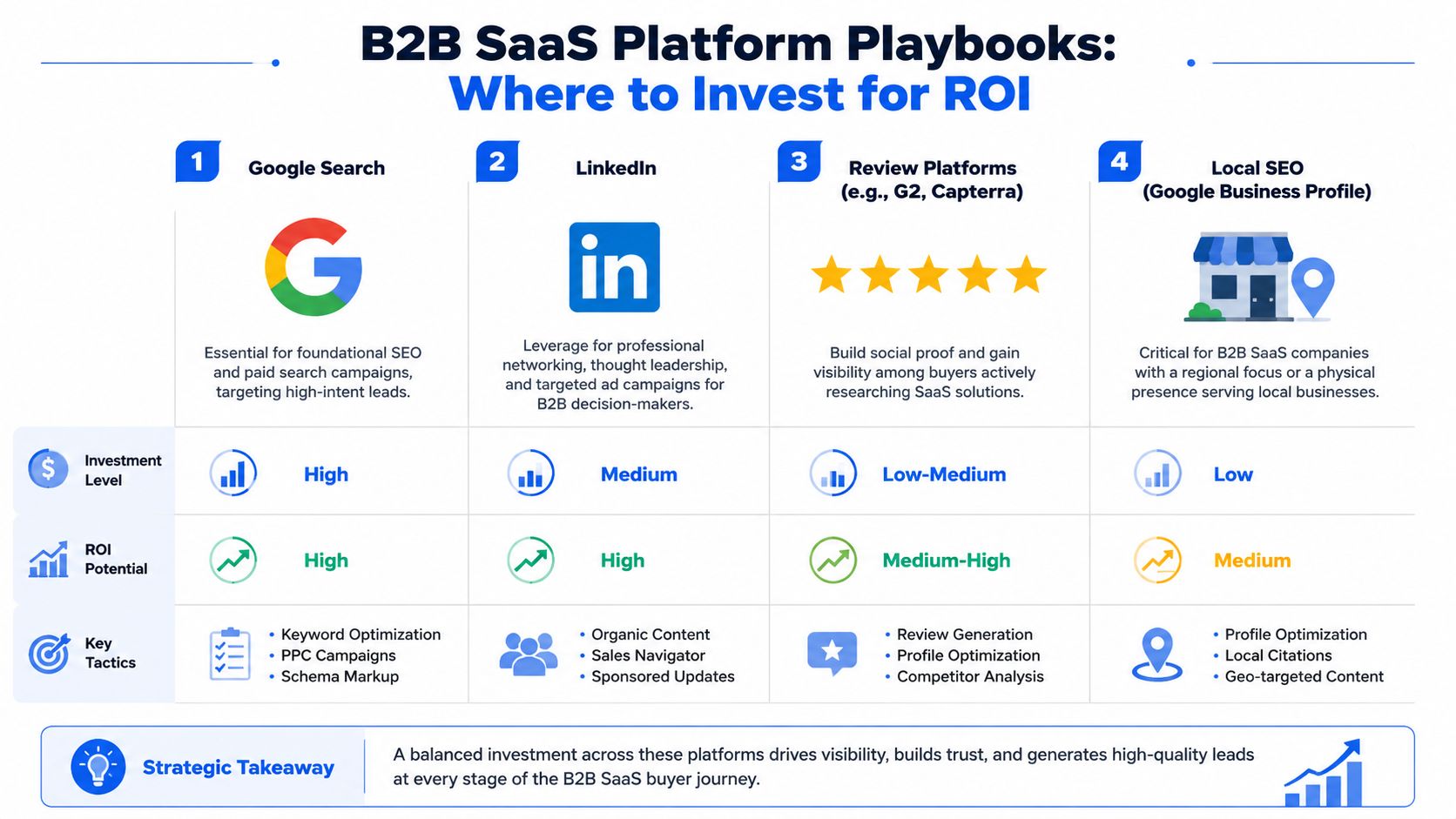
According to Conductor’s 2026 AEO/GEO Benchmarks Report, 87.4% of AI referral traffic across 10 industries came from ChatGPT. For B2B SaaS, that means one thing. Prioritize ChatGPT first, then validate what carries over to Gemini and Perplexity.
ChatGPT first
If you’re a SaaS CMO with limited bandwidth, start here.
ChatGPT rewards strong entity signals and trusted citations around your category. In practice, that means your website alone isn’t enough. Your G2 profile, category language, implementation pages, comparison content, and third-party mentions all matter because they reinforce who you are and what problem you solve.
With Whatfix, we saw this clearly. The work that drove +84% visibility wasn’t random content production. It centered on stronger entity authority around the “Digital Adoption Platform” category, cleaner retrieval paths, and better alignment between on-site definitions and off-site validation. That is the kind of work that helps ChatGPT mention the right vendor for the right prompt.
Your immediate move is simple. Track the prompts your buyers ask. Then inspect which sources ChatGPT appears to trust in your category and close those gaps fast.
Gemini second
Gemini often benefits from what strong SEO already built, but you still need to make pages easier to interpret. For most SaaS sites, that means improving schema, clarifying page purpose, and making category language more explicit.
If your product pages try too hard to sound clever, Gemini usually gets less precise about your positioning. Clear beats clever here.
A good next step is to pair your SEO team with product marketing and rewrite key commercial pages in plain language. Add comparison tables, implementation context, and direct definitions near the top.
Perplexity rewards proof
Perplexity tends to surface content that is easy to verify. It likes pages with direct claims, named sources, and clear structure.
That means your thought leadership can’t just be opinion dressed up as authority. If you’re making category claims, back them up. If you’re publishing guides, include source-backed context. If you’re discussing alternatives, be specific about buyer fit.
This is also why review platforms matter more than many internal teams admit. AI systems trust third-party corroboration.
You can support this work through AI SEO services for answer engines, especially if your in-house team already owns core SEO but lacks a process for prompt monitoring and citation pathway work.
ChatGPT gets the first budget line. Gemini gets structural cleanup. Perplexity gets proof-heavy content and better source discipline.
What about Claude
Claude matters for some B2B research journeys, especially among technical and knowledge-worker audiences, but for most SaaS teams it shouldn’t be your first operational priority. Monitor it, don’t build your whole program around it.
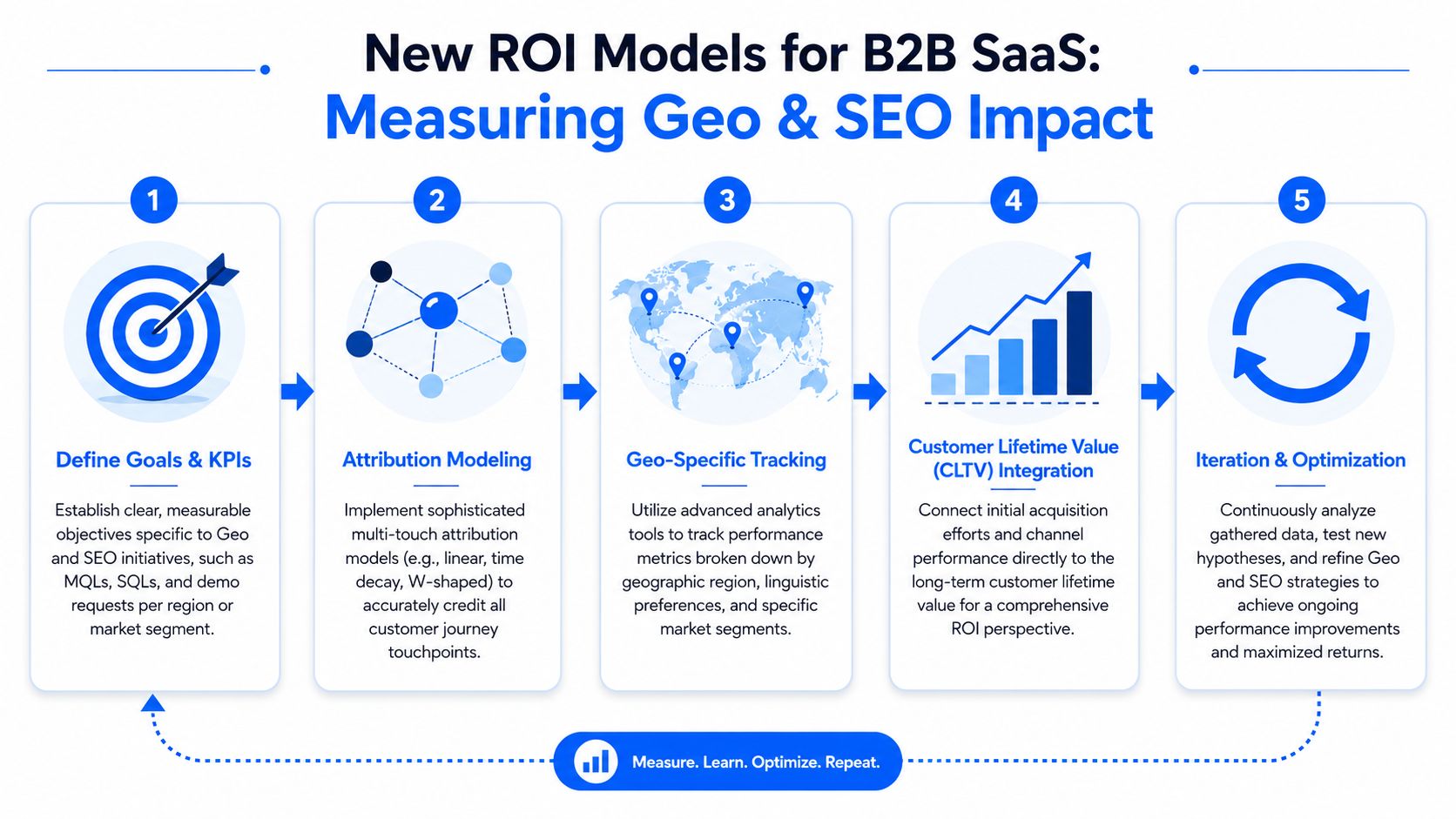
Measuring What Matters New ROI Models
Most GEO programs fall apart here. Not because the work is wrong, but because the reporting is lazy.
Traditional SEO has a familiar model. Rankings drive traffic. Traffic drives conversions. Conversions drive pipeline. It isn’t perfect, but most finance teams understand it.
GEO doesn’t fit that model neatly because citation can shape a deal before any click happens.
Why last-click thinking breaks
One of the more useful framing points comes from this GEO measurement analysis, which notes that Google drives 345× more traffic than all AI platforms combined, while 76.1% of AI Overview citations also rank in Google’s top 10. That tells you two things.
First, SEO still carries the heavier traffic load. Second, GEO often amplifies authority your SEO program already built rather than replacing it.
So if a prospect sees your brand in ChatGPT, later clicks a Google result, then converts through direct traffic, who gets credit?
All three touched the deal.
A better ROI model for B2B SaaS
For practical reporting, I advise CMOs to stop forcing GEO into a pure traffic metric and instead track four layers together:
- Citation share: Are you present in the prompts that matter?
- Mention quality: Are you recommended, compared fairly, or ignored?
- Branded demand lift: Do more buyers search your brand after AI exposure?
- Influenced pipeline: Do deals with AI-assisted discovery patterns close more often or move faster?
That’s a boardroom-friendly model because it connects visibility to commercial movement, not just vanity metrics.
What to report monthly
A useful monthly GEO dashboard should include:
- Priority prompt coverage: Your presence across the buyer questions that map to pipeline.
- Competitor overlap: Which rivals appear where you don’t.
- Money-page citation readiness: Whether your key pages can support accurate extraction.
- Assisted conversion patterns: Demo requests and opportunities where AI discovery likely played a role.
We also like pairing this with a visibility tracking layer. One option is the AI search ROI calculator, which helps teams estimate impact scenarios without pretending every AI mention turns into a direct session.
If your GEO report only shows referral traffic, you’re underreporting value. If it only shows mentions, you’re overreporting value.
The main job is to connect answer visibility to pipeline influence without double-counting SEO.
Building Your 2026 Visibility Program
By now the choice should be clear. You don’t need an “SEO or GEO” plan. You need a visibility program that knows which job each discipline does.
The mistake is trying to build that program all at once.
The 90-day path for teams getting started
If you’re new to GEO, keep the first phase tight. Don’t launch a giant content initiative. Fix the assets that already matter.
Start with an AI search audit across your core commercial queries. Then update your category pages, product pages, alternatives pages, and top-of-funnel guides so they are easier to extract, easier to verify, and more aligned with how buyers ask questions in ChatGPT, Gemini, Perplexity, and Claude.
For Keka, a focused program built around core visibility gaps helped drive +82% visibility. That’s the right lesson. The fastest gains usually come from sharpening existing authority, not publishing twenty fresh blog posts.

A good first-quarter plan usually includes:
- Audit prompts that influence revenue: Focus on category, comparison, migration, pricing-fit, and implementation queries.
- Fix your money pages first: Product, solution, and comparison pages should carry direct definitions and clear buyer-fit language.
- Add retrieval-friendly structure: Use concise sections, comparison tables, FAQ blocks, and schema where relevant.
- Clean up citation pathways: Strengthen review profiles and third-party category mentions.
- Set a refresh rhythm: Your top pages need routine updates, not annual neglect.
The enterprise path for mature SaaS brands
If you already have strong SEO, content, and product marketing teams, the next step is deeper entity work and systematic monitoring. That usually includes knowledge graph alignment, structured brand definitions across the web, advanced schema implementation, and ongoing prompt-level competitor tracking.
This matters even more if you sell into multiple markets.
In India, category education often needs stronger terminology alignment because buyers may use a mix of local and global phrasing. In the US, comparison and alternatives prompts tend to matter earlier in the journey. In the UAE, regional trust signals and local market context can influence how your brand is interpreted. One global content library rarely handles all three cleanly without adjustment.
If you need a baseline before deciding which path fits, start with an AI search audit for your brand. That gives you the current picture fast.
Frequently Asked Questions for SaaS Leaders
Do I need a separate GEO team
No. Most B2B SaaS companies don’t need a new department. They need one owner across SEO, content, and product marketing who can coordinate AI visibility work. GEO is cross-functional. It fails when nobody owns it.
Should I move budget from SEO to GEO
Don’t gut SEO. Google still drives far more traffic than AI platforms, as covered earlier. Shift part of your content and organic budget into citation tracking, entity cleanup, review-platform work, and commercial-page restructuring.
How long does GEO take to show results
In our work, brands usually see directional visibility movement inside roughly 90 days when the scope is focused and the site already has some authority. That’s consistent with our broader average of +87% visibility growth within about 90 days across client programs.
Can GEO work if my SEO is weak
Not well. GEO can create visibility gains, but weak SEO usually means weak site architecture, poor content quality, and low authority signals. Fix the foundation and layer GEO on top.
Which platform should we optimize for first
Start with ChatGPT. It dominates AI referral traffic based on the benchmark cited earlier. Then extend the playbook to Gemini and Perplexity, and monitor Claude based on your audience.
What should I ask an agency before hiring them
Ask how they measure citation share, how they handle attribution, what prompts they track, how they improve third-party validation, and whether they can show real B2B SaaS results like Chargebee, Whatfix, and Keka.
If you want a direct read on where your brand stands in AI search, talk to LLMBuddy. We help B2B SaaS companies improve visibility across ChatGPT, Gemini, Perplexity, and Claude with audits, structured optimization, and ongoing monitoring. If you want a working baseline before you commit budget, request a customized review through LLMBuddy’s demo page.