
Indian SaaS AI visibility is already splitting winners from passengers. In a 2026 cross-platform analysis of 50 B2B SaaS companies, ChatGPT and Gemini mentioned 100% of the companies tested, while Perplexity mentioned 90% and Claude 88%. Gemini also had the best average position at 1.0, ahead of 1.2 for ChatGPT, 1.3 for Perplexity, and 1.2 for Claude, based on the Derivate X cross-platform B2B SaaS citation study. That should change how you think about search.
If you’re an Indian SaaS founder, this is the problem. Your brand can rank on Google and still fail to appear when a buyer asks ChatGPT, Gemini, or Perplexity for a shortlist. We’ve seen that gap in audits across SaaS categories, and we’ve also seen what happens when teams fix it. Chargebee’s AI visibility improved by 74%, Whatfix by 84%, and Keka by 82% through focused GEO work. That’s the context for this Indian SaaS AI Visibility – ChatGPT Gemini Perplexity Analysis 2026. It’s not a generic AI SEO article. It’s the operating model we use to judge whether your brand is recommendation-ready.
Why Your Google Rank Is Not Your AI Rank
A strong Google position doesn’t guarantee inclusion in AI answers. Buyers aren’t just clicking ten blue links anymore. They’re asking for “best HR software for mid-market India to US expansion” or “top digital adoption platform alternatives,” and the engine returns a synthesized answer, not a results page.
That changes the game because AI engines don’t only reward page-level relevance. They also look for entity clarity, trusted citations, structured product context, and consistency across the web. A page can rank and still be ignored if the model doesn’t trust the brand enough to recommend it.
Ranking and recommendation are different jobs
Traditional SEO is mostly about retrieval. AI visibility is about retrieval plus selection. Your page has to be found, understood, and then judged worthy of inclusion inside the answer.
That’s why founders get blindsided. They see stable organic traffic and assume brand discovery is covered. Then a prospect says, “We found your competitor in ChatGPT,” and suddenly the blind spot becomes obvious.
Practical rule: If your team isn’t testing category, comparison, and problem-aware prompts across engines every week, you don’t know your actual market visibility.
We’ve seen this pattern with companies that looked healthy in search reports but weak in AI outputs. The fix usually isn’t one more blog post. It’s better entity definition, cleaner product explanations, and stronger third-party proof. That’s the work behind ChatGPT optimization for B2B SaaS.
What Indian SaaS teams usually miss
Indian SaaS brands expanding into the US and UAE often have an extra layer of complexity. Their website may be solid, but their off-site footprint is fragmented. Product messaging changes by region. Review profiles don’t match core pages. Community mentions exist, but the product positioning is inconsistent.
AI engines notice that inconsistency faster than human buyers do.
Here’s the takeaway. Stop treating AI search as an SEO extension. Treat it as a recommendation system. Your goal isn’t just to rank. Your goal is to be named, placed early, and described correctly.
The AI Visibility Benchmark for Indian SaaS
In LLMBuddy’s 2026 analysis, inclusion was only half the battle. Indian B2B SaaS brands that appeared in AI answers still lost ground when they showed up late, were framed vaguely, or were backed by weak citations.
That is why we use an AI Visibility Score instead of ad hoc prompt checks. The score measures how a brand performs inside real buyer-facing answers across four factors: mention frequency, citation quality, answer sentiment, and answer position. Founders should care about all four. A brand named first with credible support will win more attention than a brand mentioned fourth with generic framing.
| Component | What it checks | Why it matters |
|---|---|---|
| Mention frequency | How often your brand appears across target prompts | Shows whether the engine connects you to the category and use case |
| Citation quality | Which sources support the mention | Shows whether the answer is built on credible evidence |
| Answer sentiment | How your brand is framed in the response | Weak framing can reduce trust even if you are included |
| Answer position | Where your brand appears in the output | Early placement captures more attention and more downstream clicks |
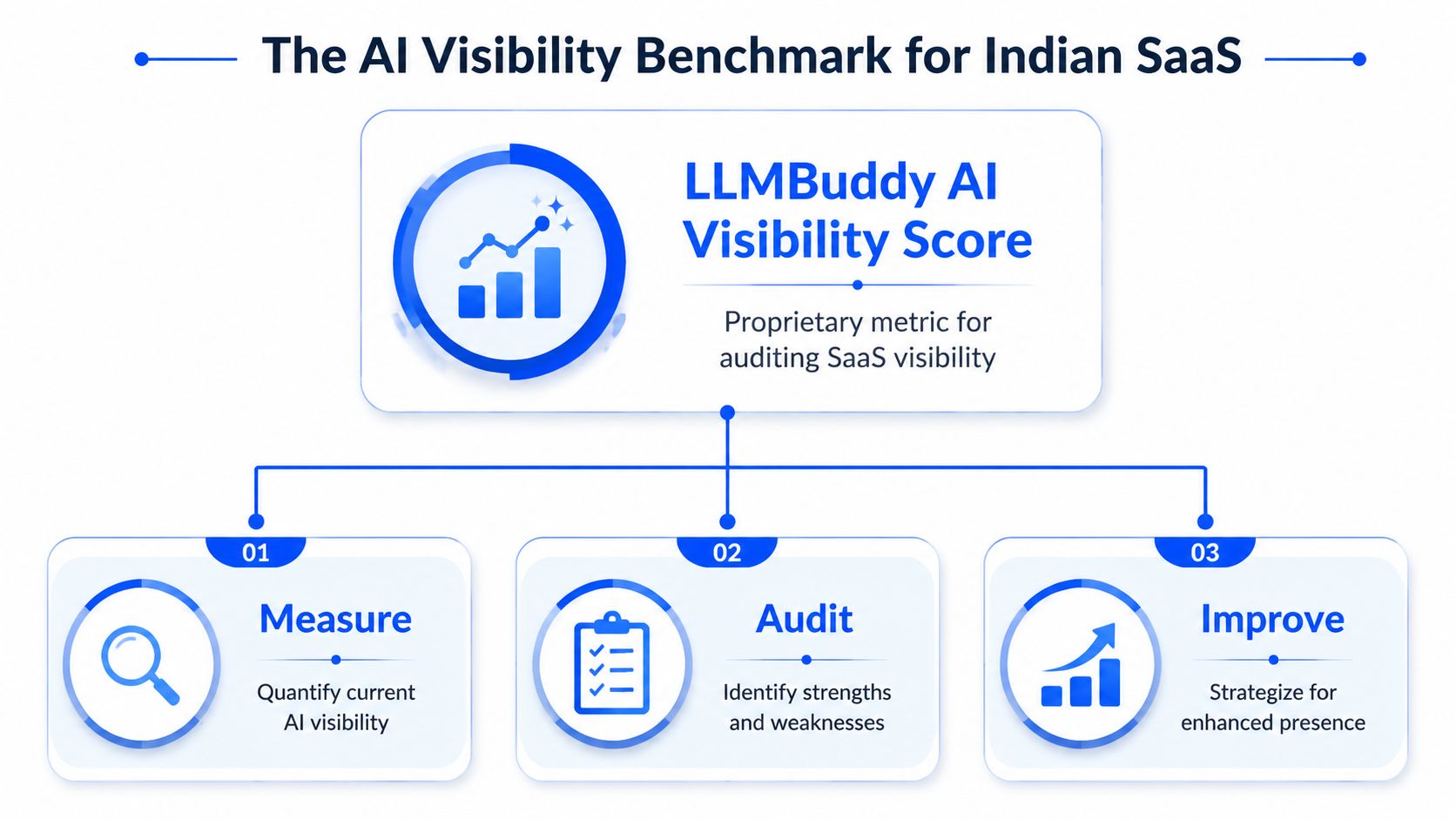
This benchmark is built for Indian SaaS, not generic AI SEO commentary. The methodology tests non-branded category prompts, comparison prompts, and problem-aware prompts across engines, then scores whether the brand is retrieved, how confidently it is described, and where it appears in the answer. That is the practical standard behind generative engine optimization for B2B SaaS.
Why Perplexity belongs in the benchmark
Ignoring Perplexity is a mistake. It exposes its source logic more clearly than other engines, which makes citation quality easier to diagnose and easier to improve. For Indian SaaS teams selling into India, the US, or the UAE, that matters because weak reviews, thin comparison pages, and inconsistent third-party mentions get exposed fast.
Perplexity also forces discipline. If your product pages are vague and your off-site proof is scattered, it will usually show in the answer quality.
How founders should use the score
Use the score as a diagnostic system, not a reporting trophy.
- Low mention frequency means your category association is weak, your entity profile is thin, or both.
- Poor citation quality means AI engines are finding low-trust sources, stale writeups, or inconsistent third-party coverage.
- Negative or muddy sentiment means your messaging is not controlling how the product is described.
- Bad answer position means you are relevant but not credible enough, specific enough, or established enough to lead.
The priority is simple. Fix the weakest factor first. If your brand is absent, publish clearer category and use-case pages. If your citations are weak, strengthen third-party proof. If sentiment is off, tighten message consistency across homepage, product pages, review profiles, and comparison content. If position is poor, improve all three until the model has a stronger reason to rank you early.
Cross-Engine Performance Breakdown
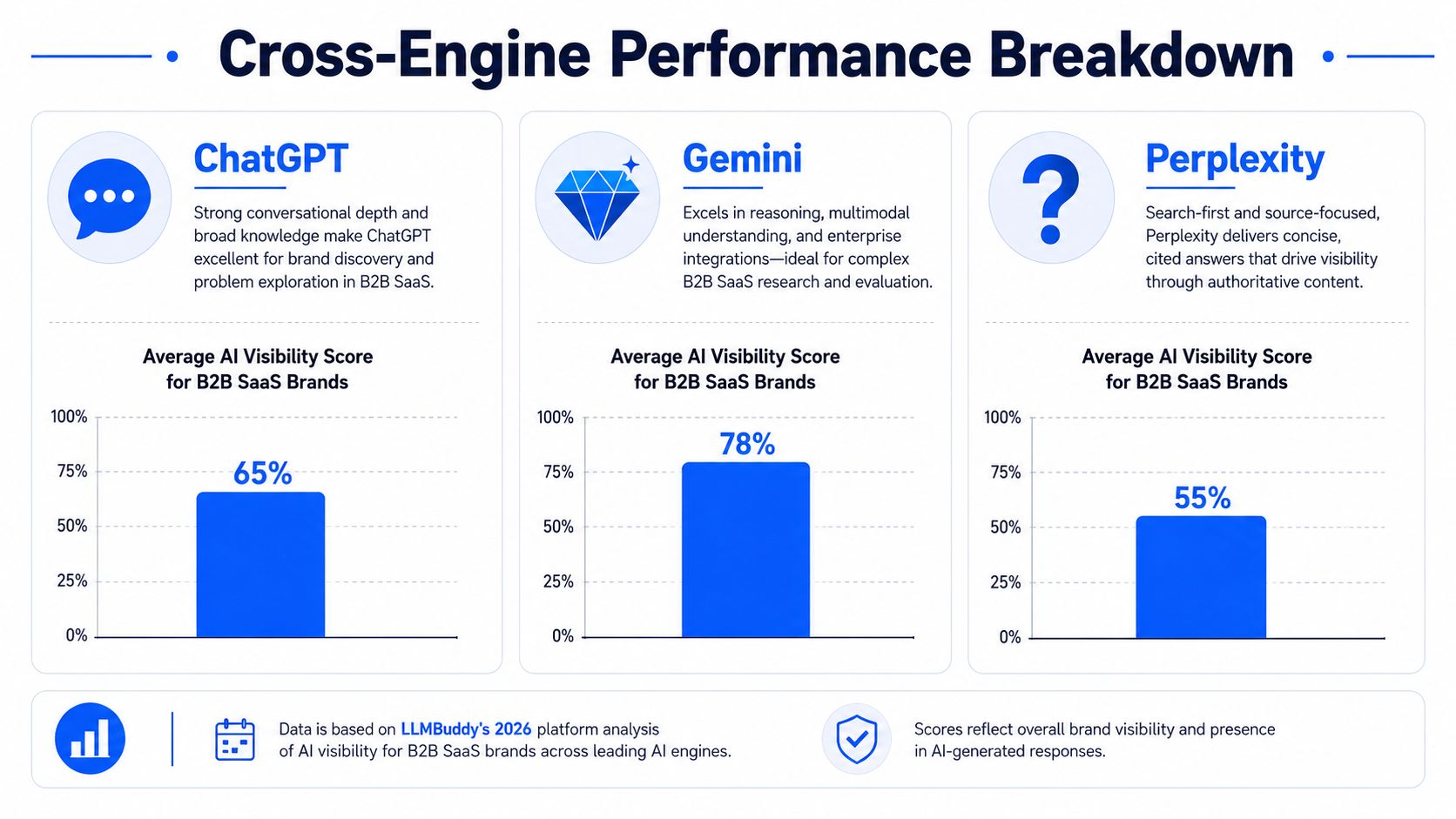
The biggest mistake in AI visibility work is treating ChatGPT, Gemini, and Perplexity like they evaluate brands the same way. They don’t. Each engine has its own retrieval habits, confidence signals, and recommendation style. Your strategy has to match those differences.
The benchmark data gives a clean starting point. In the 2026 cross-platform analysis already cited above, ChatGPT and Gemini mentioned all tested B2B SaaS companies, while Perplexity and Claude had lower mention coverage. Beyond mention coverage, Gemini had the strongest average placement. That tells you one thing fast. Inclusion alone isn’t enough. Position matters.
How ChatGPT tends to behave
ChatGPT is often broad and commercially useful, but it can be inconsistent if your brand has weak entity framing. It usually performs better when your product category, ICP, use cases, and comparisons are stated plainly across your site and reflected in third-party mentions.
For Indian SaaS brands, that means your homepage slogan isn’t enough. If your product pages don’t clearly state what you do, who you serve, and what problems you solve, ChatGPT may still mention you, but not in the right queries.
A simple rule works here. Write for extraction, not just persuasion.
Why Gemini often rewards cleaner entities
Gemini tends to reflect stronger entity structure and cleaner brand understanding. In practice, that means it favors companies with coherent product architecture, clear category labeling, and fewer contradictions between homepage claims, documentation, and external profiles.
If your site says one thing, your G2 profile says another, and your LinkedIn company description says a third, Gemini is less likely to place you strongly for the category you want to own.
Better Gemini performance usually follows cleaner category ownership, not louder publishing volume.
That’s why generative engine optimization for SaaS brands starts with entity alignment before content expansion.
Where Perplexity is different
Perplexity is more transparent about sources, which makes it useful for diagnosis. If you’re absent, you can often see the kinds of citations it preferred instead. If you’re present but weakly framed, you can inspect the source pattern behind that result.
For B2B SaaS brands, Perplexity tends to expose whether your external footprint is doing any real work. Thin review profiles, weak analyst mentions, and messy product pages show up faster here than they do in traditional SEO reporting.
Use this quick comparison to guide priorities:
| Engine | What usually helps most | Common failure mode |
|---|---|---|
| ChatGPT | Clear use-case pages and consistent brand framing | Generic copy that doesn’t define the product precisely |
| Gemini | Strong entity alignment and clean category signals | Mixed positioning across site and third-party profiles |
| Perplexity | Credible citations and easy-to-verify product information | Weak review and publication footprint |
What founders should do with this
Don’t ask, “Which engine matters most?” Ask, “Where are we weak, and why?” If your brand shows up in ChatGPT but not Perplexity, your citation pathways probably need work. If you appear in Perplexity but rank lower in Gemini-style outputs, your entity structure may be muddy.
That’s the point of cross-engine analysis. It tells you which problem to fix first, instead of sending your team into another quarter of random content production.
The GEO Playbook for B2B SaaS
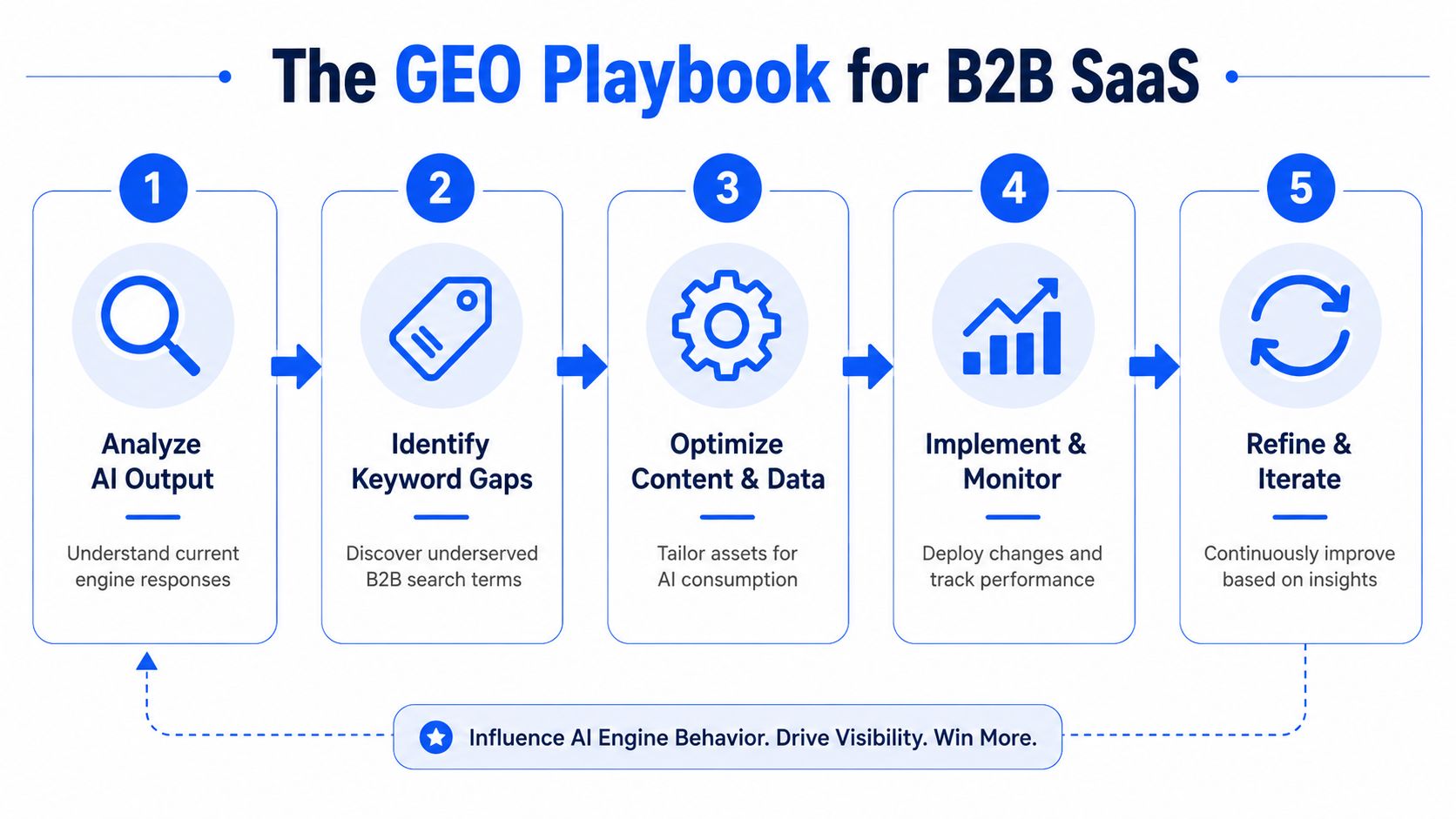
Most AI visibility advice is still too abstract. Add schema. Publish thought leadership. Get more mentions. Fine. None of that tells a SaaS team what to do on Monday.
The playbook that works has four moving parts. Not ten. Not a bloated checklist. Four.
Start with entity mapping
If a model can’t tell what your company is, who it serves, and which category it belongs to, nothing else lands. Entity mapping fixes that. You define your primary category, adjacent categories, use-case clusters, competitor set, and product proof points in a way that stays consistent across the site.
Many Indian SaaS companies falter here. They want to sound broad, so they describe themselves in vague platform language. Buyers may tolerate that. AI engines won’t.
Fix your structured product context
Schema matters, but not as a magic trick. It matters because it helps your pages become easier to parse. Product pages, feature pages, comparison pages, and integration pages should be structured so an engine can extract core claims without ambiguity.
That means fewer fluffy headers and more explicit statements. Say what the feature does. Say who it’s for. Say what systems it connects to. Say where it fits in the workflow.
Field note: The page that converts best for humans isn’t always the page that’s easiest for an LLM to understand. You need both jobs done well.
Build retrieval-friendly content
A lot of content is written to rank. Very little is written to be cited. Retrieval-friendly content is different. It answers category questions directly, uses tight definitions, compares alternatives fairly, and gives the model language it can safely reuse.
This doesn’t mean stuffing pages with FAQs. It means reducing ambiguity. If you sell payroll software for multi-entity companies, say that clearly. If you’re strong in compliance-heavy workflows, say that clearly too. Ambiguous positioning kills recommendation quality.
Treat citation pathways as a growth channel
Many organizations underinvest in this aspect. A 2026 playbook noted that consistent information across directories such as G2, Capterra, Product Hunt, and industry listings helps AI models build a confident entity, and that community discussions plus structured product pages can work as a two-stage discovery-and-verification model, as outlined in Hamster Garage’s AI visibility metrics playbook.
That should change your priority stack. On-site SEO still matters. But if your off-site signals are weak, your recommendation quality will stay weak.
Use this operating order:
- Clean your core profiles first: Review sites, company pages, and directory listings should use the same category language.
- Match proof to claims: If your site says enterprise-grade and your external footprint looks thin, the model will hesitate.
- Support discovery with verification: Community mentions can introduce the brand. Structured product pages confirm it.
- Track source spread: Don’t depend on one review site or one publication.
This is also the part of the process where a monitoring tool becomes useful. The AI visibility optimization workflow can be managed in-house, through a specialist team, or through a platform like LLMBuddy that tracks mentions, citations, share of voice, and platform-level movement across ChatGPT, Gemini, Perplexity, and Claude.
Keka’s 82% visibility improvement didn’t come from one trick. It came from this kind of system. Clearer product framing. Better page structure. Stronger citation consistency. That’s what moves AI recommendation behavior.
Whatfix Case Study A Deeper Look
Whatfix is a useful example because the company didn’t have a classic SEO problem. The underlying issue was different. It had enough brand presence to be findable, but not enough structured clarity and external confirmation to be consistently recommended in AI answers for its category.
That’s the gap many B2B SaaS teams miss. Being known isn’t the same as being selected.
What changed
The first move was simplifying how the product was described across high-intent pages. Instead of relying on broad platform messaging, the page set needed tighter explanations around digital adoption use cases, audience fit, and product outcomes. That gave AI systems cleaner language to extract.
The second move was improving the external proof layer. AI engines don’t want just your version of the story. They want corroboration. So the work focused on strengthening the pathways between on-site product claims and the third-party sources that buyers and models both trust.
Why the result mattered
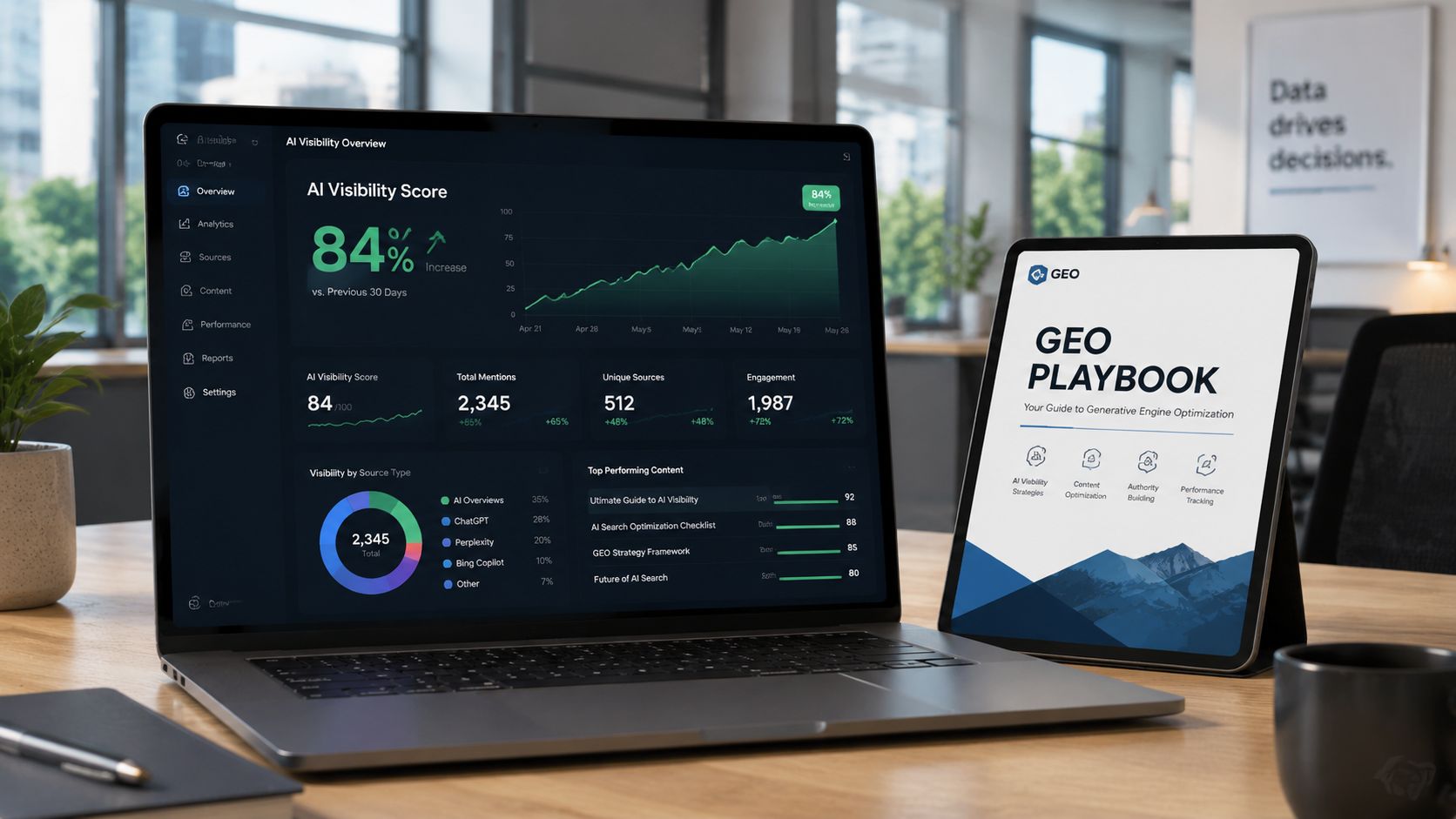
Whatfix’s AI Visibility Score improved by 84%. More importantly, the brand began to appear as a recommended option in higher-intent AI answers where buyers were actively comparing solutions. That’s the shift founders should care about. Not vanity mentions. Commercially relevant inclusion.
You can see the broader pattern in the Whatfix case study. The lesson isn’t that every SaaS company needs the same template. The lesson is that recommendation visibility responds to structure, consistency, and proof.
If your AI visibility is weak, don’t assume the market doesn’t know you. Assume the engines don’t understand or trust your positioning enough yet.
That’s also why we tell teams to stop over-focusing on homepage polish. In AI search, the category explanation layer often matters more. Product pages, comparisons, use-case pages, review profiles, and external mentions carry far more weight than founders expect.
Monitoring Your AI Search Presence
Weekly monitoring separates teams that spot AI visibility loss early from teams that notice it after demo volume drops. In our 2026 benchmark work on Indian B2B SaaS, the biggest reporting failure was simple. Teams checked rankings. They did not track recommendation presence, citation strength, or framing quality across engines.
That is a mistake.
AI search monitoring needs to answer a commercial question, not a vanity question. Are ChatGPT, Gemini, and Perplexity putting your brand into buying conversations with the right positioning?
What you should track every week
Start with prompt-level share of voice across your target query set. One mention means very little. You need to know how often you appear, for which use cases, against which competitors, and in which engine.
Then track these four inputs every week:
- Prompt coverage: the percentage of priority prompts where your brand appears
- Citation pattern: how often answers cite your site, review platforms, analyst pages, directories, or media mentions
- Answer framing: whether the model describes you as a category leader, niche tool, secondary option, or weak fit
- Engine-level movement: where visibility is rising or falling across ChatGPT, Gemini, and Perplexity
Founders should review this by prompt cluster, not as one blended score. Category prompts, comparison prompts, integration prompts, and use-case prompts behave differently. If you merge them, you hide the problem.
What founders should demand from reporting
Ask for evidence. Every report should show the exact prompt, the full answer, the cited sources, competitor mentions, and the week-over-week change.
Do not accept summary slides with a score and two screenshots. That is not monitoring. That is decoration.
Separate branded and non-branded prompts in every dashboard. Branded prompts mostly measure existing awareness. Non-branded prompts show whether AI engines will recommend you to buyers who have not decided on a vendor yet. That is where pipeline growth happens.
A useful reporting workflow also needs human review. Models can mention your brand and still position you badly. If the answer frames you as enterprise-only, too expensive, hard to implement, or weaker than a competitor on a core use case, the mention does not help revenue.
If you need a starting point before building internal reporting, use an AI search audit for SaaS brands. Then turn the findings into a weekly operating cadence with fixed prompts, fixed competitors, and fixed review criteria. That is how Indian SaaS teams improve visibility deliberately instead of reacting late.
Frequently Asked Questions
Is AI visibility just SEO with a new name
No. SEO helps pages get found. AI visibility helps brands get recommended. There’s overlap, but the decision layer is different. AI engines need confidence in your entity, your category fit, and your third-party proof. That’s why pages that rank well can still fail to appear in AI answers.
Which engine should Indian SaaS companies prioritize first
Start with the engines that match your buying journey and existing footprint. If your category depends heavily on explicit citations and comparison behavior, Perplexity deserves attention. If your entity structure is messy, Gemini often exposes that weakness quickly. ChatGPT usually sits in the middle and is a practical benchmark for broad recommendation coverage. Don’t pick one and ignore the others. Use cross-engine gaps to decide priority.
How fast can a SaaS brand improve its AI visibility
You can usually diagnose the problem quickly. Actual movement depends on what’s broken. If the issue is page clarity and category definition, progress can start once those assets are fixed. If the issue is weak citation pathways, it takes longer because third-party proof doesn’t appear overnight. The right way to think about it is not speed alone. Think compounding. Stronger pages and stronger citations reinforce each other.
Does llms.txt matter
It can help with clarity and crawler guidance, but it isn’t the main driver of recommendation quality. Founders should treat it as a supporting technical control, not the center of the strategy. If your messaging, structure, and citations are weak, llms.txt won’t save you.
Should we focus more on our website or third-party mentions
Both matter, but many SaaS teams underweight third-party mentions. Your website explains the product. External sources help validate it. If the two don’t match, the engines hesitate. If you’re choosing where to start, fix the site pages that define the category and product first, then strengthen the citation layer around them.
What should our first 90 days look like
Keep it tight. First, audit non-branded prompts and identify where you’re absent, mispositioned, or weakly cited. Next, rewrite the core category, use-case, and comparison pages so the product is easier to extract and verify. Then clean every major third-party profile so your category language stays consistent. After that, monitor outputs weekly and adjust based on what the engines are doing, not what your team assumes they’re doing.
If your SaaS brand ranks on Google but still disappears in AI answers, that gap won’t fix itself. LLMBuddy works with B2B SaaS companies to audit visibility across ChatGPT, Gemini, Perplexity, and Claude, then improve the entity, content, and citation signals behind recommendation quality. If you want a concrete baseline and a prioritized plan, request a demo or start with an AI search audit.