
If you're trying to figure out how to get your B2B SaaS brand featured in ChatGPT, stop treating it like a nicer version of Google SEO. By 2025, over 60% of initial vendor discovery happened inside AI-powered overviews or chat interfaces rather than traditional search results, according to an industry benchmark cited by this research reference. That one shift changes the job for every Indian SaaS founder, CMO, and growth lead.
I've seen the pattern repeatedly in audits led by Ankur Pandey. A company ranks well on Google, publishes content every week, and still gets ignored by ChatGPT, Gemini, Perplexity, and Claude. The reason is simple. AI assistants don't reward only relevance. They reward clarity, corroboration, and citation paths.
The generic advice floating around online is weak. “Get on G2.” “Add llms.txt.” “Write better blogs.” None of that is wrong. It's just incomplete. If you want your brand to show up in AI recommendations, you need one connected system: entity management, citation engineering, and retrieval-friendly content architecture. That's the blueprint we use in India-focused B2B SaaS work, and it's the reason teams pay attention when they see results like Chargebee +74%, Whatfix +84%, and Keka +82% in AI visibility programs.
Why Your High Google Rank Is Invisible to ChatGPT
Google rankings still help. They just do not decide whether ChatGPT mentions your brand.
That gap catches a lot of Indian SaaS teams off guard. You can rank for category terms, publish comparison pages, and still get excluded from buyer-intent prompts inside ChatGPT, Gemini, Perplexity, and Claude. We see this pattern constantly in GEO audits at LLMBuddy, especially with companies that built solid SEO programs but never built a trust layer outside their own site.
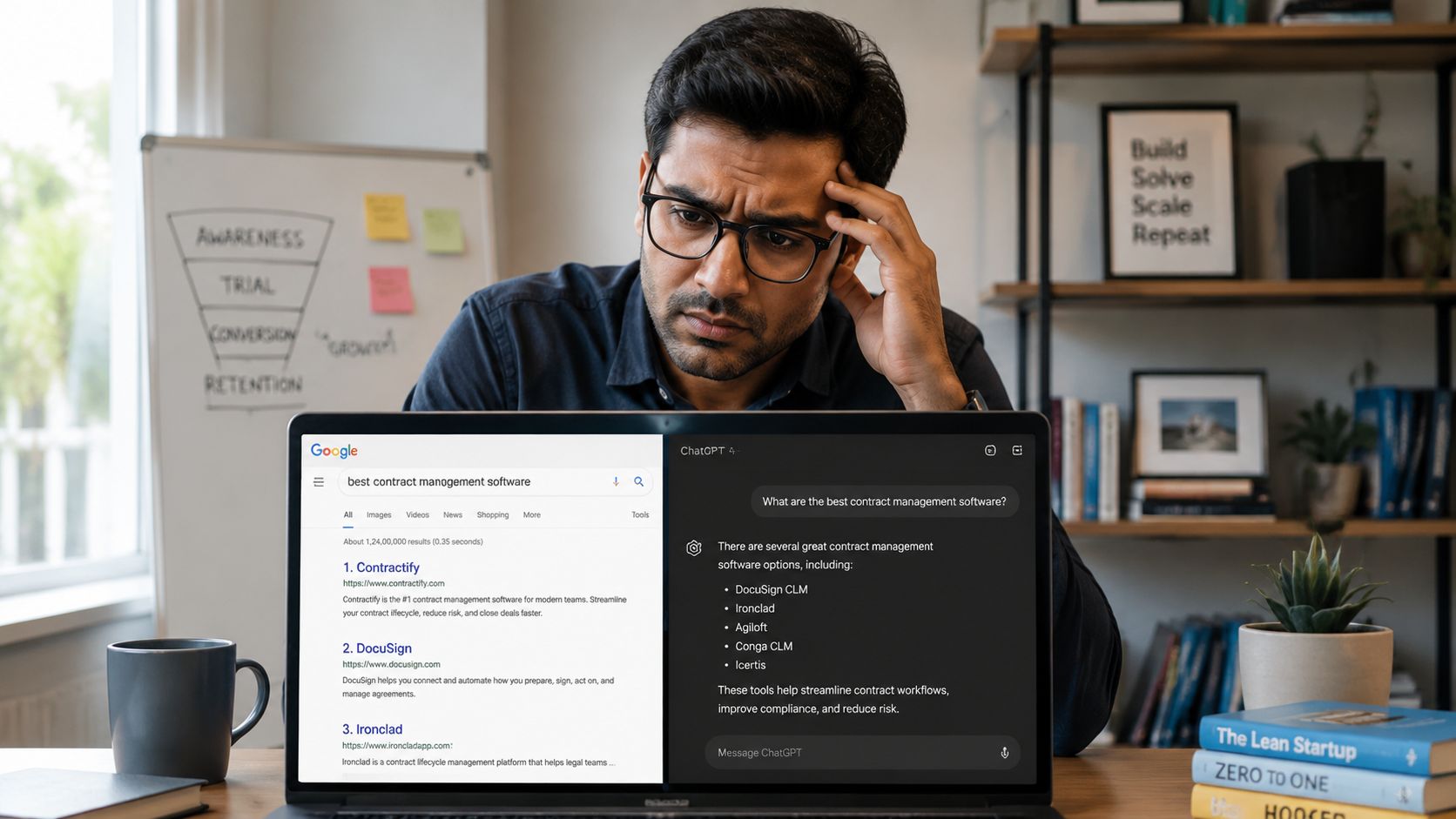
Google rank measures pages. ChatGPT evaluates evidence.
Google can reward a page for query match, links, and authority signals. LLMs work differently. They assemble answers from repeated claims, consistent brand descriptions, third-party validation, and content they can retrieve cleanly.
That is why a company can rank on Google for a term like “subscription billing software” and still disappear when a buyer asks, “Which billing platforms are best for SaaS companies?” The model is not looking at your rankings dashboard. It is checking whether the web agrees on who you are, what you do, and whether enough credible sources support that claim.
Your website is one source. AI systems prefer corroboration.
AI recommendation depends on off-site trust
B2B SaaS growth teams often overinvest in pages they control and underinvest in pages that validate them. That is a bad trade if your goal is AI discovery.
Review sites, partner directories, analyst mentions, founder interviews, customer proof, and category listings do more than send referral traffic. They create citation pathways. Those pathways help LLMs connect your brand to a category, use case, geography, and buyer segment. Without them, your site reads like self-description. With them, your brand starts to look verifiable.
For Indian SaaS companies selling to US or EU buyers, this problem gets sharper. The buyer may never visit your blog first. They ask an AI assistant for options, then inspect the names that show up repeatedly. If your brand lacks external confirmation, you lose before the first click.
Run an AI search audit across your commercial prompts. A large gap between Google visibility and AI visibility points to weak trust architecture.
What your growth team should do next
Stop treating AI visibility as an SEO side quest. Treat it as a separate acquisition layer with its own inputs and measurement.
Start with three actions:
- Test buyer-intent prompts: Use the exact questions prospects ask before they shortlist vendors.
- Check cited domains: Look at which sources AI assistants rely on when competitors appear.
- Find evidence gaps: Identify missing reviews, weak profiles, inconsistent positioning, and absent third-party mentions.
If your reporting still centers on keyword positions and organic sessions, your team is tracking the wrong system. AI discovery rewards entity clarity, citation coverage, and retrieval-friendly content. That is the operating model that closes the visibility gap.
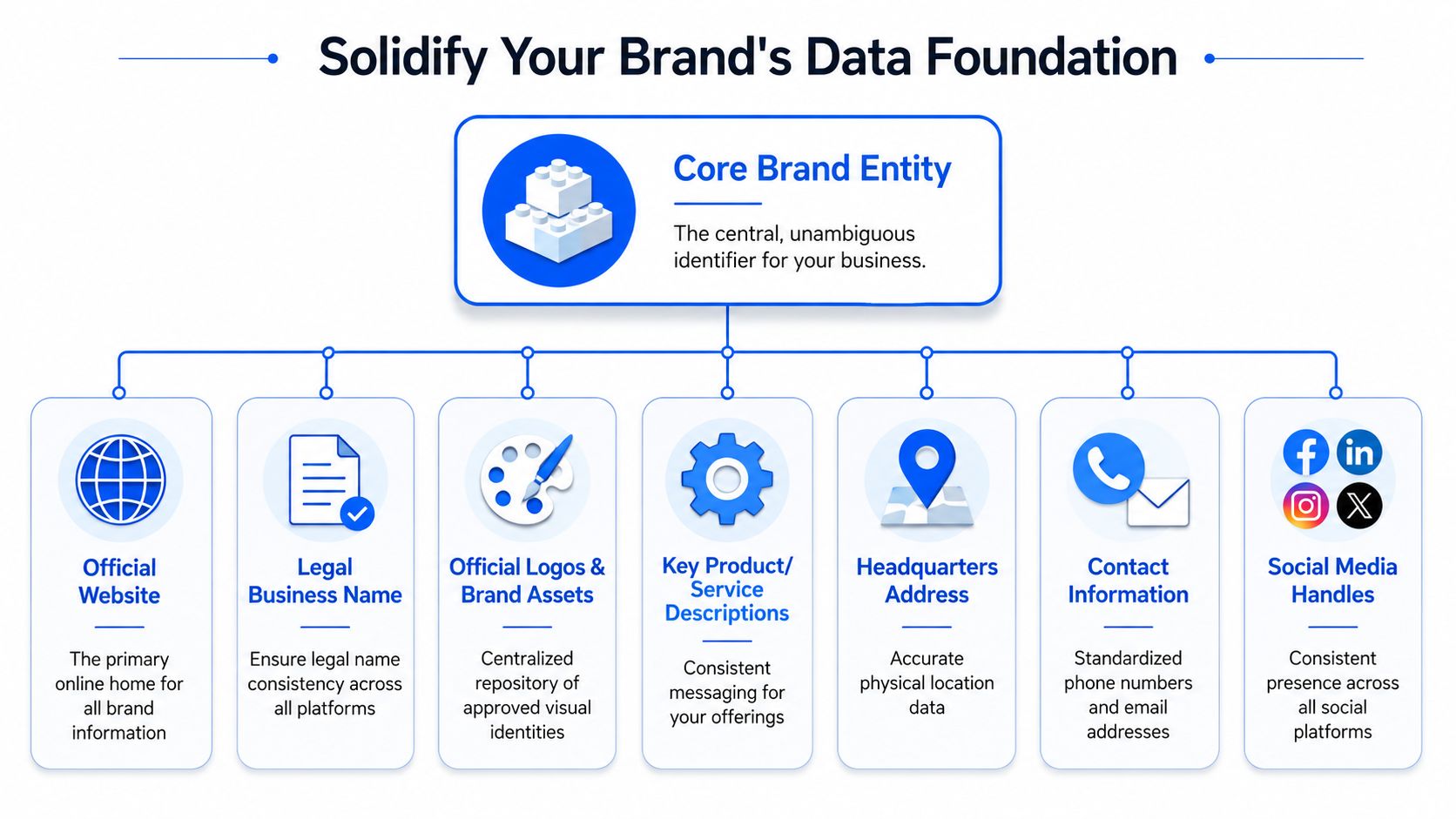
The Foundation A Consistent Brand Entity
Most brands don't have an AI visibility problem first. They have an identity problem.
In practice, your company exists as a scattered set of fragments across your homepage, LinkedIn, Crunchbase, G2, Capterra, founder interviews, review snippets, and partner directories. If those fragments disagree, LLMs read confusion. They don't know what category to place you in, which use case to associate with you, or how confidently to recommend you.
A documented pattern across B2B SaaS brands shows that brands with entity clarity receive 4.6 to 6.3 mentions per set of 15 to 25 buyer-intent prompts, versus about 1.8 mentions for brands with inconsistent positioning, based on this cited GEO analysis. The same source recommends a cross-platform audit every 4 to 6 weeks.
Start with a canonical description
Every B2B SaaS brand needs one approved description block. Not three. Not seven versions written by different teams.
Your canonical description should lock four things:
- Company name: The exact spelling you want repeated everywhere.
- Primary category term: The market label you want AI systems to associate with you.
- Core use case: The specific business problem you solve.
- Main differentiator: The reason you belong in a shortlist instead of a generic category pile.
If your homepage says “workforce platform,” LinkedIn says “HR tech,” Crunchbase says “employee engagement software,” and G2 says “payroll,” you've created semantic noise. AI assistants won't clean that up for you.
The platforms that matter most
Founders often ask where to fix things first. Start with the places AI systems keep encountering.
| Platform | What must match |
|---|---|
| Website homepage | Company name, category, one-line description |
| LinkedIn company page | Same category and value framing |
| Crunchbase | Company summary and product classification |
| G2 and Capterra | Product description, category, differentiators |
That doesn't mean every platform should use identical long-form copy. It means the meaning and the category signal must stay aligned.
Practical rule: If a category-defining sentence can't be copied from your homepage to LinkedIn without changing its meaning, your entity system isn't stable.
What we see in audits
In audits, the most common issue isn't lack of content. It's inconsistency.
You'll find abbreviated company names on one platform, outdated positioning on another, old logos in a directory profile, and a product description written before the current ICP was defined. That's enough to weaken recommendation confidence.
The fix is boring, which is why it's often skipped. But it works.
- Build a source-of-truth sheet: Include approved company name, category, short description, and differentiators.
- Check every public profile: Website, LinkedIn, Crunchbase, G2, Capterra, and major directories.
- Set a review cadence: Recheck every 4 to 6 weeks so drift doesn't return.
If you do only one thing this quarter, do this. It's the base layer everything else depends on.
Engineering Citation Pathways for LLM Trust
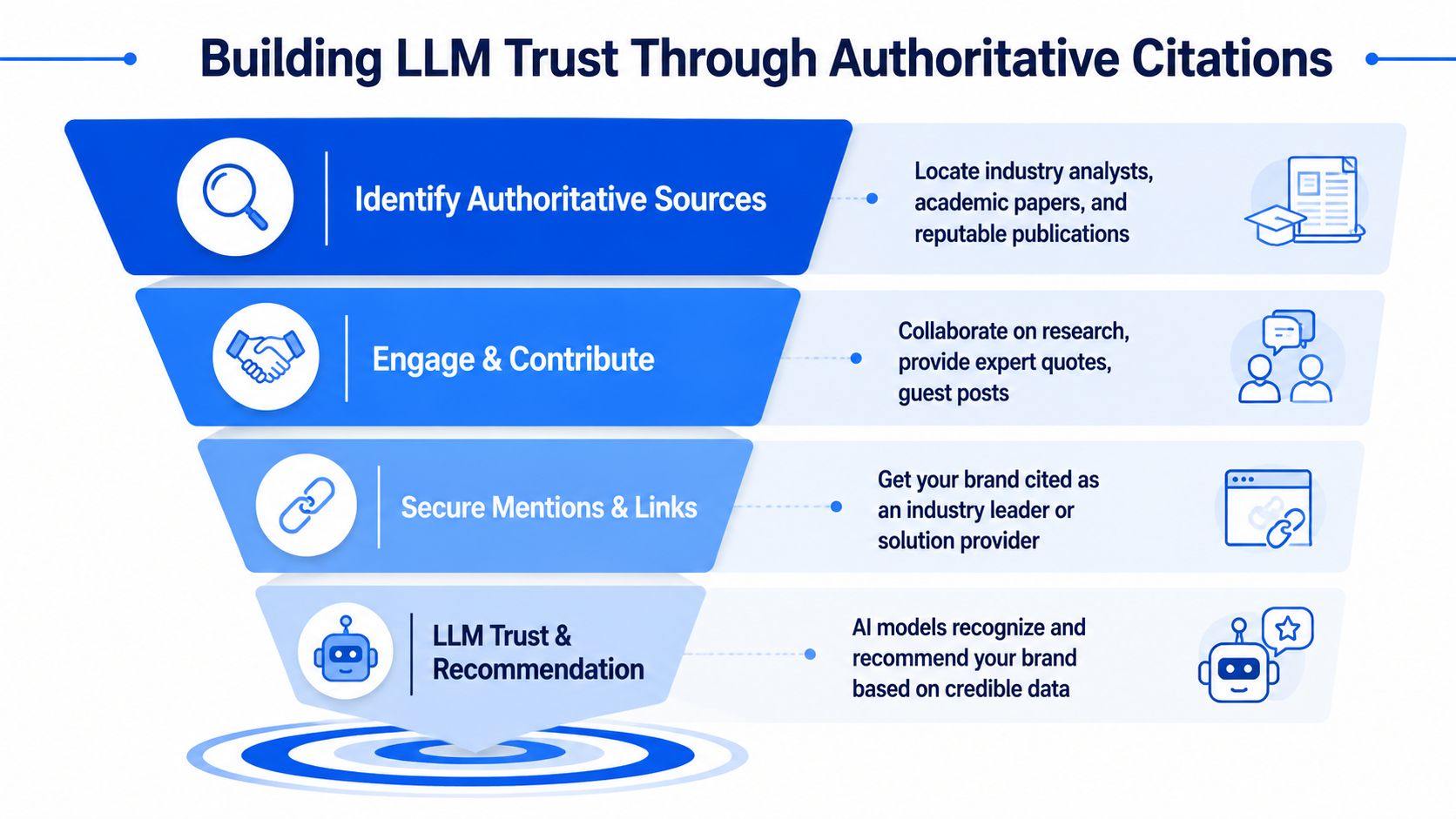
ChatGPT doesn't trust your marketing copy the way your content team hopes it will. It trusts what other credible sources say about you.
That's why citation pathways need to be engineered. Not admired. Not left to chance.
A 2025 study of B2B SaaS brand visibility in ChatGPT found that AI assistants drew roughly 60 to 70% of vendor recommendations from third-party sources. Within that pool, review platforms such as G2 and Capterra accounted for 38% of cited vendor lists, while industry roundups from major trade publications contributed another 29%. By contrast, self-published vendor blogs made up less than 12% of directly cited sources, according to the cited research summary.
Your blog is not enough
Many Indian SaaS teams waste time. They publish long articles on their own domain and assume AI systems will reward that effort proportionally. They won't.
Your site helps define you. It rarely proves you.
If you want to improve the odds of being recommended by ChatGPT, Gemini, Perplexity, or Claude, your brand needs external references from sources those systems repeatedly lean on.
Build a citation portfolio, not a random list
The right way to think about this is portfolio design. You need different citation types serving different trust functions.
- Review platforms: G2 and Capterra help confirm that your product is a real, categorized software option.
- Trade publication roundups: These often shape shortlist language and comparative positioning.
- Niche communities and expert mentions: These support context, especially for use-case-specific prompts.
A founder selling developer tooling will need a different citation map than one selling fintech infrastructure. The principle stays the same. Get mentioned where AI systems already look.
If your competitors appear in three comparison articles and two review platforms while you appear only on your own domain, you've already lost the trust comparison.
What to push first
Don't chase every mention opportunity. Prioritize the paths that can shape recommendation behavior fastest.
First, clean and strengthen major review profiles. Then target inclusion in category roundups written by known software publications or respected vertical blogs. After that, work on expert commentary and community mentions where your product category is discussed in plain language.
A good citation campaign is measurable because it changes what AI assistants can cite back.
If you're building this as a formal growth channel, a dedicated Generative Engine Optimization program makes more sense than handing it to a generic SEO retainer. This isn't link building in the old sense. It's source engineering for LLM trust.
Structuring Content for AI Retrieval and Citation
Once your entity system is clean and your citation paths are improving, your own site needs to become easier for machines to extract from. Most “AI SEO” advice, however, often falls short in this area.
A common failure in B2B SaaS is semantic ambiguity. Many guides push generic checklists but don't address the fact that models often can't tell exactly what market position your product owns. That gap is called out in this industry analysis of semantic ambiguity in B2B SaaS, which points to the need for comparison tables, structured competitor-differentiation sections, and content that anchors the brand to a named problem space.
Make category fit obvious
Your homepage shouldn't force an LLM to infer what you do from abstract messaging. AI retrieval works better when your page states, plainly, what the product is, who it's for, and where it fits.
Bad example:
“Reinventing employee operations for modern teams.”
Better example:
“Payroll and HR software for mid-market companies managing compliance, attendance, and employee records.”
The second version gives the model something extractable. It can classify it, compare it, and cite it.
Put comparison logic on the page
Most SaaS sites hide differentiation behind vague product copy. That's a mistake.
Use visible structures such as:
- Comparison tables: Your product versus adjacent categories or named alternatives.
- Feature-forward FAQs: Answer direct buyer questions in compact language.
- Use-case sections: Clarify who should choose you and who shouldn't.
- Structured differentiation blocks: State why you're not just another CRM, analytics tool, or helpdesk.
This doesn't mean writing for robots. It means reducing ambiguity so AI systems don't replace your positioning with their own guess.
Add machine-readable support
Founders love messaging workshops and ignore extraction mechanics. Don't.
Your product pages and solution pages should support retrieval with clear schema choices such as Product, SoftwareApplication, and FAQPage where appropriate. Your site should also include a sane llms.txt approach and internal page structures that make summarization easier, not harder.
If your team is reworking core money pages for AI retrieval, AI content optimization should focus on readability for both humans and machines. The pages that win in AI search aren't always the prettiest. They're often the clearest.
Monitoring and Measuring AI Search Visibility
A brand can rank on page one for high-intent terms and still disappear from ChatGPT recommendations. We see that gap constantly with Indian B2B SaaS companies that overinvest in Google dashboards and underinvest in AI visibility tracking.
If you are not measuring assistant-level visibility, you are guessing.
Track share of voice across assistants
Build a fixed prompt set around commercial intent. Use the questions buyers ask before booking demos, shortlisting vendors, or comparing tools. Then run the same prompt set across ChatGPT, Gemini, Perplexity, and Claude on a recurring schedule.
Track three things first. Mention frequency. Position inside the response. Consistency across assistants.
That gives you a usable share-of-voice baseline. It also shows whether your visibility is durable or accidental. One-off mentions are noise. Repeated inclusion across platforms signals that your entity, citations, and page structure are working together.
Measure retrieval quality, not just mention count
Founders often celebrate a mention too early. That is a mistake.
An assistant can mention your brand and still hurt you if it places you in the wrong category, cites stale review pages, or describes your product with competitor language. The reporting layer needs to catch that.
Your monitoring should score:
- Mention presence: Does your brand appear for commercial prompts?
- Category accuracy: Is the assistant classifying you correctly?
- Description accuracy: Does the summary match your positioning and buyer use case?
- Citation quality: Which sources are shaping the answer?
- Competitor adjacency: Which brands appear beside you again and again?
This is a critical test. AI search visibility is not just about being seen. It is about being retrieved correctly.
Turn visibility tracking into an operating metric
The teams that win treat this like revenue infrastructure, not a brand vanity report. Review results by prompt cluster, assistant, source pattern, and competitor set. Then connect changes in visibility to the work you shipped that month. Entity cleanup. New citations. Rewritten solution pages. Better comparison content.
That is how you find what actually moves recommendations.
As noted earlier, we have seen meaningful double-digit visibility gains for brands such as Chargebee and Whatfix. That proves the channel is measurable and improvable. It also tells founders where to focus. Stop asking whether AI search matters. Start asking which prompt clusters you own, which ones competitors control, and which citations are driving the gap.
If you want tighter reporting, build an AI visibility optimization workflow that tracks assistant output by platform, prompt cluster, and citation source over time. That is the level of monitoring required if you want ChatGPT visibility to become a repeatable growth channel.
Your 90-Day Implementation Roadmap
Brands usually lose this channel in the first 30 days because they start with content production instead of entity control. That is the wrong order. If ChatGPT cannot verify who you are, extra pages will not fix the problem.
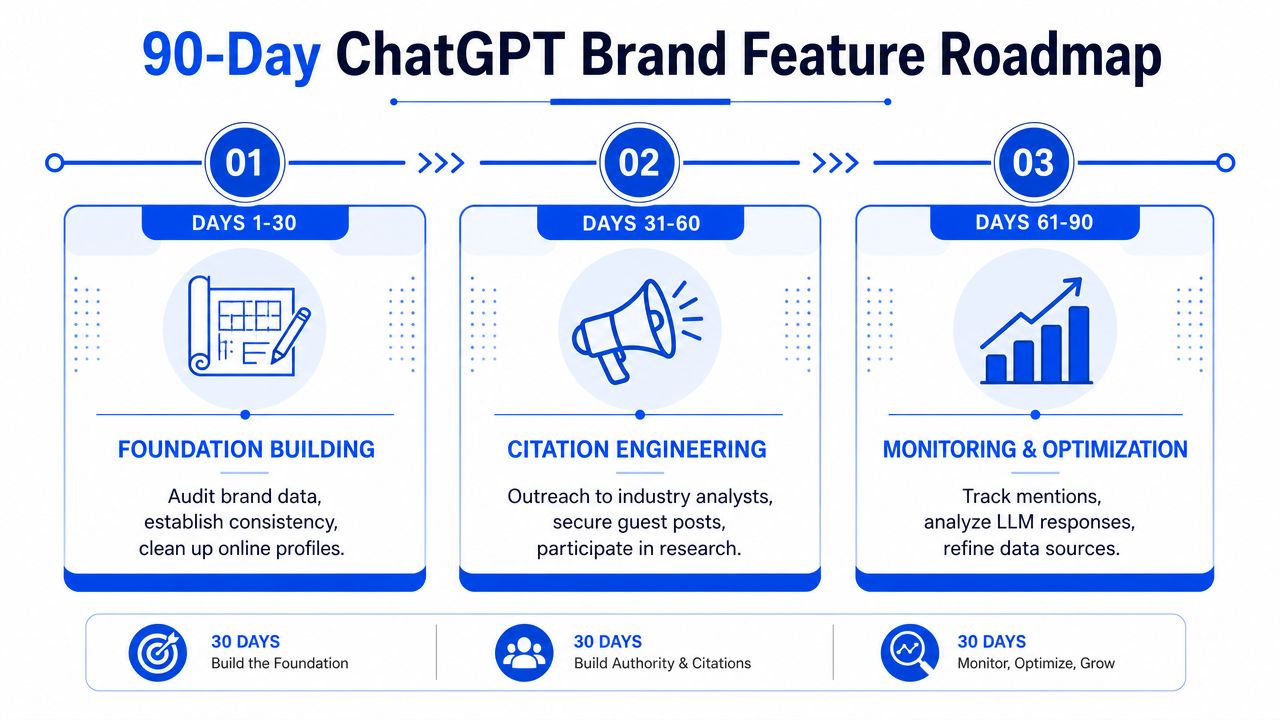
Days 1 to 30 fix the entity layer
The first month's priority is cleaning your identity before you publish anything new.
Start with the pages and profiles that shape assistant understanding fastest. Homepage. LinkedIn. Crunchbase. G2. Capterra. Founder bios. Press mentions. Your category label, one-line description, product naming, and buyer use case should match everywhere that matters. If one profile says "customer engagement platform" and another says "CRM for SMBs," you are feeding the model conflicting signals.
Set one canonical version and push it across the public footprint. Indian SaaS teams often skip this because it feels administrative. It is not. It is core distribution infrastructure for AI search.
By day 30, you should have one clean brand entity system that any assistant can classify correctly.
Days 31 to 60 build citation pathways
The second month focuses on external trust building.
Generic advice says "get on G2 and publish guest posts." That is too shallow. You need citation pathways that connect your brand to the prompts you want to win. Build a priority list of software directories, category roundups, integration partner pages, founder interviews, ecosystem listings, and niche publications that already appear in competitor citations.
Use competitor outputs as your map. If assistants keep citing the same review platforms, comparison pages, and publications for brands next to you, those are not optional. They are part of the trust layer you need to build.
This is also the phase to decide what you want to be retrieved for. Category prompts. Alternative-to prompts. India-relevant buying prompts. Industry-specific use cases. A focused roadmap beats random brand mentions.
Days 61 to 90 improve retrieval and reporting
Now fix the pages assistants are most likely to summarize. In practice, that means your homepage, product pages, solution pages, comparison pages, and FAQs. Tighten headings. Clarify category ownership. State who the product is for, what it replaces, and when it should be shortlisted. Remove vague copy that sounds polished but says nothing.
Then turn monitoring into a recurring operating rhythm. Review prompt clusters every month. Check how your brand is described, which sources are cited, and which competitors appear beside you. Match visibility shifts to the work shipped that month so your team knows what changed retrieval.
A disciplined 90-day sprint should leave you with:
- One stable brand entity across major public sources
- Stronger citation coverage in the places assistants already trust
- Cleaner retrieval pages built for summarization, not just rankings
- A repeatable reporting loop tied to prompt performance and competitor movement
This is the blueprint we use with SaaS teams that want measurable AI visibility, not scattered GEO activity. The upside is real when the system is built properly. As noted earlier, brands like Chargebee have seen strong visibility gains from this kind of coordinated work.
Frequently Asked Questions
How long does it take to get featured in ChatGPT?
You can see early movement within a quarter if your issue is mostly entity inconsistency and weak citation coverage. But don't expect instant inclusion from one technical fix. ChatGPT visibility improves when your brand becomes easier to verify across multiple sources, not when you publish one “AI-optimized” page.
Is G2 enough to get my SaaS recommended?
No. G2 helps, but by itself it's not a strategy. A brand needs a fuller citation profile and clear on-site positioning. Review platforms help establish legitimacy, while trade roundups, structured product pages, and consistent entity data help shape recommendation confidence.
Do I need to change my SEO strategy?
You need to expand it. Traditional SEO still matters, especially for category authority and discoverability. But if you want to know how to get your B2B SaaS brand featured in ChatGPT, you need to treat AI visibility as a separate operating layer with its own sources, prompts, and measurement model.
What should I fix first if my brand is missing from AI comparison lists?
Fix consistency first. According to independent SEO and reputation-management case studies cited in this reference on AI recommendation consistency, companies with matching NAP, categories, and descriptions on platforms like G2, Capterra, and LinkedIn are 70 to 80% more likely to appear in AI-generated comparison lists than those with mismatched entries. If your public profiles don't agree, everything else gets harder.
Do I need llms.txt and schema?
Yes, but don't treat them as magic. They support retrieval and clarity. They don't replace entity alignment, third-party citations, or structured comparison content. Technical signals help once your strategic signals are already coherent.
Should an Indian SaaS company approach this differently from a U.S. SaaS brand?
Yes, in one important way. Indian SaaS companies often sell into multiple markets at once, so category clarity has to travel well across geographies. Your wording should make sense to buyers in India, the U.S., and Europe without changing your core category identity. If your product sounds different in every market, AI systems will reflect that confusion back to buyers.
If your team wants a direct read on why ChatGPT, Gemini, Perplexity, or Claude aren't recommending your brand, talk to LLMBuddy. We help B2B SaaS companies in India turn entity clarity, citation engineering, and AI-focused content architecture into measurable visibility growth. Start with a request demo or get an AI search audit.