
Your Google rankings can look fine while your pipeline leaks from AI answers. A prospect asks ChatGPT for the best subscription billing platform, Gemini for a payroll system that fits an India-first HR stack, or Perplexity for a shortlist of onboarding software. If your brand doesn’t appear, your competitor shapes the shortlist before your sales team ever gets a chance.
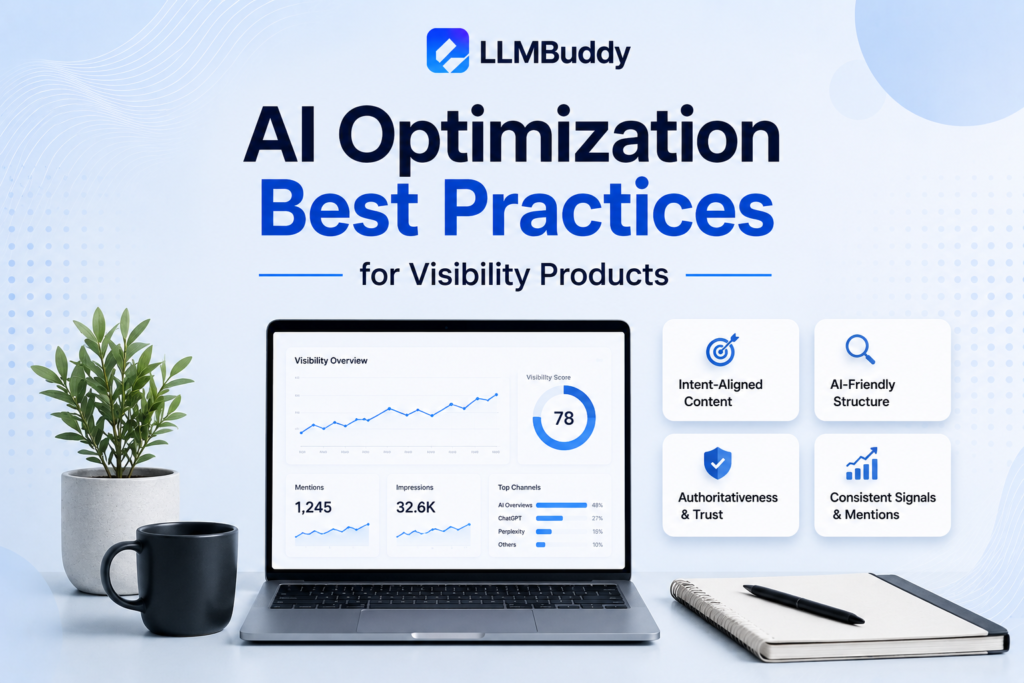
That’s the context behind AI optimization best practices for visibility products. This isn’t a side project for content teams. It’s a revenue defense function. Google’s own guidance makes the baseline clear: a page must be indexed and eligible to appear in Google Search with a snippet before it can appear in generative AI features, and the company explicitly recommends sticking to core SEO practices like crawlability, technical structure, and unique content instead of chasing hacks (Google’s AI visibility documentation).
At LLMBuddy, we see the same pattern in audits for Indian SaaS firms. Strong traditional SEO often hides weak AI visibility. The fix isn’t one trick. It’s a stack. You need cleaner entity signals, retrieval-friendly content, stronger third-party citations, and platform-level monitoring across ChatGPT, Gemini, Perplexity, and Claude. We’ve seen this playbook work with brands like Chargebee, Whatfix, and Keka, and it’s the same operating model we use in our AI SEO services.
1. Entity Authority Building and Knowledge Graph Optimization
If AI systems can’t clearly identify your company, product, category, and leadership, they won’t recommend you with confidence. Entity clarity comes first. Before you publish another comparison page or FAQ, fix how your brand is defined across your site and the wider web.
Start on your homepage. Your company description should be short, specific, and stable across your website, LinkedIn page, review profiles, and media mentions. Then extend that consistency to product pages, founder bios, documentation, and category pages. If your site says one thing, G2 says another, and LinkedIn uses different naming, you’re feeding ambiguity into the system.

What to define explicitly
Your entity map should spell out relationships that a machine can parse fast.
- Company identity: Use one canonical company name, one short company description, and one primary category.
- Product relationships: Connect each product to a category, use case, buyer role, and industry fit.
- Leadership signals: Add founder and executive profiles on-site, then match those profiles to public professional profiles.
- Structured markup: Add schema on the homepage first, then expand to product, organization, person, and FAQ pages.
Chargebee is a useful model here. Strong AI recommendation patterns usually follow strong entity definition. In our client work, we’ve seen that once a SaaS brand sharpens company, product, and founder attributes, AI answers become more accurate and more favorable. If you need deeper execution support, this is exactly what our Generative Engine Optimization services are built for.
Practical rule: If a new SDR can’t explain your company, product, buyer, and category from one page in under a minute, your entity signals are still too weak.
Your next move is simple. Audit your homepage schema, your company bio, and your leadership pages this week. Then run your brand through AI prompts like “What does this company do?” and “Who are its competitors?” If the answer is fuzzy, your entity layer needs work before anything else.
2. AI-Optimized Content Structure and Retrieval-Friendly Architecture
Most SaaS content is written to rank or persuade. Very little of it is written to be extracted cleanly by AI systems. That’s why pages that look polished to humans still get ignored or misread by ChatGPT and Perplexity.
You need pages built in retrieval chunks. Each section should answer one clear question in the first sentence or two, then support that answer with specifics. This structure gives AI systems something stable to lift, summarize, and cite without rewriting your meaning into something vague or wrong.
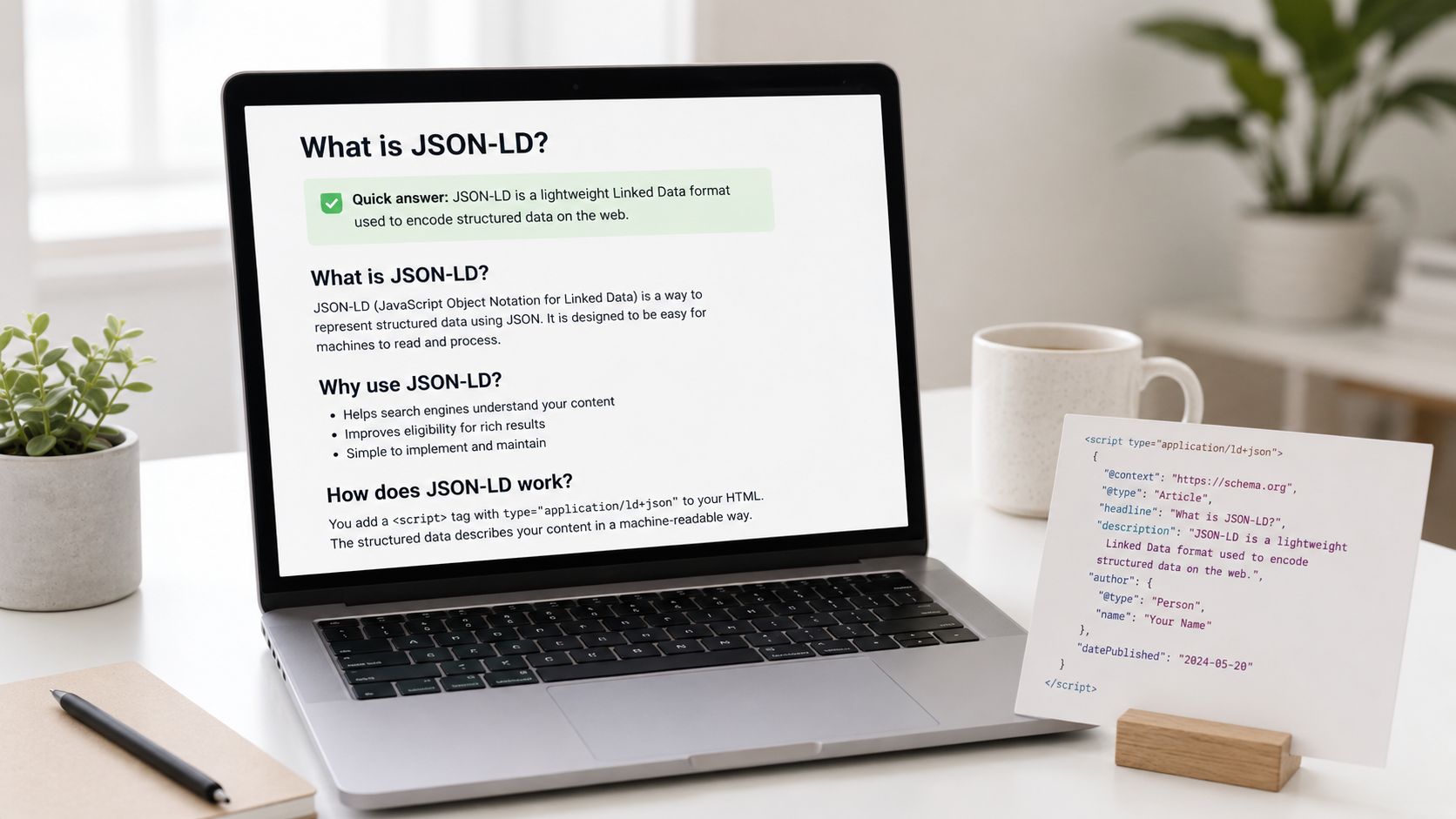
How to restructure pages for extraction
A good retrieval page isn’t longer. It’s cleaner.
- Lead with the answer: Open each major section with a direct response to the implied query.
- Break content into tight sections: Use clear H2s and H3s so AI systems can isolate ideas without pulling unrelated context.
- Use parseable data blocks: Mark up product attributes, FAQs, and organization details with structured data where it fits.
- Keep URLs descriptive: Flat, readable URLs help both users and systems understand page purpose.
Independent guidance on AI visibility keeps returning to the same themes: structured data, topic clusters, clear headings, topic sentences, cited facts, and regular updates help content perform better across AI search environments (20North Marketing’s AI visibility playbook). That lines up with what we’ve seen in content audits for B2B SaaS brands in India. Pages that answer directly and carry stronger structure get surfaced more often than pages that bury the point.
If your current library is dense, scattered, or written like a traditional SEO blog factory, rebuild your highest-value assets first. Start with solution pages, category pages, alternatives pages, and implementation guides. Then bring in a dedicated workflow for AI content optimization.
A practical test helps. Paste one of your pages into ChatGPT or Perplexity and ask for a summary. If the model misses your category, mixes up your use case, or ignores your differentiators, your page architecture is failing retrieval.
3. Citation Pathway Development and Third-Party Authority Building
Your website is only part of the story. AI systems look for confidence signals outside your domain. If your company barely exists on review platforms, analyst coverage, community forums, partner directories, and trusted industry publications, you’re asking models to trust your self-description without corroboration.
That’s not enough in B2B SaaS. Buyers expect validation. AI systems do too.
Where citation density actually comes from
For most software categories, citation pathways come from a predictable group of sources.
- Review platforms: G2, Capterra, and category-specific software directories.
- Industry commentary: Analyst mentions, comparison roundups, and ecosystem partner listings.
- Community proof: Technical forums, Reddit threads, implementation discussions, and expert blogs.
- Brand-controlled support: Case studies, founder interviews, and product documentation that get referenced off-site.
We’ve seen this pattern clearly with LLMBuddy clients. Whatfix is one example. As third-party citation density improved across forums and software discovery surfaces, the brand’s AI mention rate improved as well. The broader lesson is straightforward. If your competitors are better represented on trusted external sources, they’ll keep winning recommendation slots even when your website is stronger.
Most in-house teams get the sequence wrong. They publish more on-site content when they need more verifiable off-site presence. A stronger G2 profile, cleaner review copy, better category tagging, and more presence in the right communities often do more for AI visibility than another generic thought-leadership post.
AI visibility doesn’t come from publishing alone. It comes from being described consistently by sources that aren’t you.
If you want proof of what that looks like in practice, review the patterns across our client case studies. Then audit where your competitors are getting mentioned. If they show up in the same external sources repeatedly and you don’t, that’s your gap.
4. Multi-Platform AI Search Monitoring and Share of Voice Tracking
If you’re only checking Google rankings, you’re flying blind. AI visibility is fragmented by platform. Your brand can appear in ChatGPT and disappear in Gemini. You can be cited in Perplexity for category queries and absent in Claude for product comparisons. Without monitoring, you won’t know where revenue risk sits.
This is why we treat AI visibility as an operating metric, not a quarterly experiment. You need recurring query sets, platform-by-platform tracking, and a practical view of who gets mentioned alongside you.
What to monitor every week
A useful monitoring program is simple enough to run and strict enough to trust.
- Branded queries: Your company name, product name, founder name, and branded comparisons.
- Category queries: “Best payroll software,” “subscription billing platform,” “customer onboarding software,” and related buyer searches.
- Decision-stage queries: Alternatives, comparisons, implementation questions, pricing questions, and migration concerns.
- Mention quality: Whether your brand is framed as recommended, cited neutrally, or listed as an alternative.
The market guidance around AI visibility measurement points in the same direction. Teams should watch brand mentions, citations, share of voice, and traffic from AI-enhanced search experiences, rather than treating keyword rankings as the whole picture. That shift changes who owns the work. SEO, content, product marketing, and demand gen all need the same scoreboard.
At LLMBuddy, this is part of how we run AI Search Audits and ongoing visibility programs. We’ve found that once a team starts tracking query-by-query presence across ChatGPT, Gemini, Perplexity, and Claude, priorities become obvious. You stop debating theories and start fixing the pages, citations, and entities that correlate with missing coverage.
One more point. Don’t just report mention count. Report who beat you, for which query, on which platform, and with what citation source. That’s the level of detail a founder or CMO can act on.
5. Semantic Content Mapping and Topical Authority Clustering
Keyword targeting alone won’t carry your brand into AI recommendations. AI systems interpret topics through relationships. They need to see that your company has depth across a subject, not just one page that repeats a category term.
That means your content should look like a map, not a pile. A payroll SaaS brand shouldn’t stop at “payroll software.” It should also own connected territory like compliance workflows, employee self-service, HR operations, onboarding, attendance, and salary processing. A billing platform should connect recurring billing, dunning, invoicing, revenue workflows, and subscription lifecycle content in a way that makes the category structure obvious.
Build clusters that mirror buyer thinking
Start with the topics that define your category and your deals.
- Pillar topics: Core commercial themes tied directly to product category and use case.
- Cluster pages: Focused supporting pages around subtopics, industries, buyer roles, and implementation angles.
- Support assets: FAQs, glossaries, comparison pages, templates, and integration content that complete the topical picture.
We use this model constantly in audits. The companies that perform best in AI recommendations usually don’t just have more content. They have connected content. Internal links follow real semantic relationships. Terminology stays consistent. Product pages and educational pages reinforce each other instead of living in separate silos.
A founder can spot this problem quickly. Search your own site for your primary category plus the subtopics buyers ask about in sales calls. If your coverage is thin or fragmented, that weakness will show up in AI visibility. Build your topical clusters around revenue-driving themes first, then support them with the right internal architecture through AI SEO services.
Field note: Topic authority gets stronger when product marketing, SEO, and sales all use the same language for category, use case, and buyer pain.
That alignment matters more than another round of keyword stuffing ever will.
6. llms.txt Implementation and Retrieval Signal Optimization
AI visibility is often still treated like a content problem. It’s also a signaling problem. If your site doesn’t clearly state what your company is, which pages matter most, and how your products should be described, you leave room for confusion.
That’s where llms.txt helps. It gives you a direct way to publish machine-readable guidance about your company, products, use cases, and preferred reference points. It won’t replace crawlability, indexing, or good content. It supports them.
What to include in llms.txt
Keep the first version tight and factual.
- Company section: Official name, concise description, website, and market category.
- Product section: Product names, short descriptions, use cases, and key page links.
- Leadership section: Founder or leadership names where that context strengthens entity clarity.
- Citation preferences: Canonical pages for product details, documentation, pricing, and company facts.
The value here is accuracy. AI systems often compress, paraphrase, or blend product descriptions. A clean llms.txt file gives them a better chance of pulling the right framing from the start. We recommend pairing this with schema and canonical page cleanup so your retrieval signals point in one direction, not five.
For Indian SaaS brands with multiple product lines or regional pages, this matters even more. Cross-market messaging drift is common. Your India page, US page, app marketplace listing, and partner page often describe the same product differently. llms.txt helps enforce one machine-readable source of truth.
If your team hasn’t started this yet, fold it into a broader Generative Engine Optimization program. Build the file, publish it at the root, then review it every quarter alongside product messaging changes. Treat it like documentation, not a one-time hack.
7. Query Intent Alignment and Persona-Based Visibility Strategy
A CFO, a CTO, and an HR leader won’t ask AI the same question about your product. Yet most SaaS brands still publish one bland category page and hope it covers every buyer. It doesn’t.
You need a query map based on persona and buying stage. That means separating educational discovery prompts from shortlist prompts, implementation prompts, migration prompts, and risk prompts. The buyer asking “best employee management software for growing teams” is not the same buyer asking “how to switch payroll systems without compliance issues.”
Match visibility work to commercial intent
Here, revenue focus sharpens the whole program.
- Awareness queries: Broad category questions and pain-led problem discovery.
- Consideration queries: Comparison prompts, alternatives, feature-fit questions, and industry-specific shortlist requests.
- Decision queries: Pricing logic, implementation complexity, integration concerns, and migration risk.
- Post-sale queries: Support, onboarding, API, documentation, and rollout questions that influence expansion and retention.
We’ve seen this matter across SaaS categories. A billing platform needs one narrative for finance leaders evaluating compliance and another for product or engineering teams evaluating APIs and implementation complexity. The same goes for HR software, CRM, onboarding, analytics, and support products. One size doesn’t fit any serious buying committee.
Ask your sales team for the common questions buyers repeat on calls. Then test those prompts in ChatGPT, Gemini, Claude, and Perplexity. If your brand appears for awareness terms but disappears on high-intent comparison prompts, your visibility program is misaligned with pipeline goals.
This is also where founder involvement helps. Founders usually know the sharp commercial questions that signal buying intent. Put those into your tracking set and build pages that answer them directly. Don’t chase attention. Chase the prompts that influence shortlist creation.
8. Cross-Engine Optimization and Platform-Specific Visibility Tactics
Teams lose time when they assume one optimization will work everywhere. It won’t. ChatGPT, Gemini, Perplexity, and Claude don’t behave the same way. They pull from different source environments, expose citations differently, and vary in how they summarize or rank confidence.
That means your strategy has to be cross-engine by design. Not because it sounds advanced, but because fragmented visibility creates false confidence. A CMO sees the brand mentioned in one platform and assumes the job is done. Meanwhile, buyers on another platform never see you.
How to close platform gaps
Treat each engine as a separate testing environment with shared foundations.
- Run the same prompt set everywhere: Compare outcomes across ChatGPT, Gemini, Perplexity, and Claude.
- Trace the source pattern: Note whether each answer leans on your site, review platforms, docs, or third-party commentary.
- Adjust by platform behavior: Strengthen the source types that appear to matter for that engine.
- Prioritize by buyer usage: Focus first on the platforms your prospects use in research and evaluation.
We’ve seen this repeatedly in audits. Some brands have decent visibility in one engine because their general web presence is strong, then disappear in another because their review footprint, documentation structure, or third-party authority is weak. That’s why a single dashboard view matters. You need to know where the holes are, not just where you’re already visible.
If you want a direct read on those gaps, use a proper AI visibility optimization workflow that benchmarks by platform, query, and competitor set. Then fix the source pathways and content architecture that each engine appears to reward.
Don’t ask, “Are we visible in AI?” Ask, “For which buying prompts, on which engines, against which competitors?”
That question gets you to strategy. The first one gets you false comfort.
8-Point AI Visibility Optimization Comparison
| Tactic | 🔄 Implementation complexity | ⚡ Resource requirements & speed | 📊⭐ Expected outcomes | 💡 Ideal use cases | ⭐ Key advantages |
|---|---|---|---|---|---|
| 1. Entity Authority Building & Knowledge Graph Optimization | High, technical schema + cross-team entity mapping; ongoing maintenance | Moderate technical and data resources; 2–4 weeks initial setup, continuous updates | Stronger AI recommendation confidence; more consistent citations across assistants | B2B SaaS launching products or repositioning; brands needing authoritative AI recognition | Establishes long-term entity credibility in knowledge graphs; improves product-level visibility |
| 2. AI-Optimized Content Structure & Retrieval-Friendly Architecture | Medium, requires large-scale content rewrites and structural changes | High editorial effort; 4–8 weeks for audit and rewriting | 3–5x higher citation likelihood; improved summary accuracy and lower hallucination risk | Content teams, documentation owners, blogs aiming for AI snippets | Makes content easily extractable by LLMs; improves snippet and voice-search inclusion |
| 3. Citation Pathway Development & Third-Party Authority Building | High, outreach, PR, and platform-specific placement; limited control over third parties | Resource-intensive (outreach, review programs); 8–12 weeks to establish meaningful presence | Multiple authoritative citation paths; higher AI and human trust; SEO uplift | Growth and customer marketing teams focused on social proof and reviews | Builds external reference density that LLMs cite; defensive against competitor claims |
| 4. Multi-Platform AI Search Monitoring & Share of Voice Tracking | Medium, requires specialized tooling and continuous processes | Moderate tooling and analyst time; 2–3 weeks to set up, continuous monitoring | Clear visibility metrics, share-of-voice, and ROI measurement across AI engines | SEO managers, growth leaders, C-suite needing performance reporting | Data-driven insights for prioritization; early detection of visibility changes |
| 5. Semantic Content Mapping & Topical Authority Clustering | Medium–High, deep content inventory, reorganization, internal linking | Significant strategy and editorial resources; 4–12 weeks for audit and reorg, quarterly upkeep | Improved topical authority and broader semantic relevance for long‑tail queries | Content strategists and product marketers building category authority | Creates coherent topic structures LLMs recognize; enhances discovery across related queries |
| 6. llms.txt Implementation & Retrieval Signal Optimization | Low, technical file placed at site root; straightforward format | Low technical effort; 1–2 weeks initial, quarterly updates recommended | Reduced hallucinations and improved citation accuracy where supported by engines | Technical marketers and product teams wanting explicit LLM guidance | Direct signal to LLMs about entities and citation preferences; easy, high‑leverage step |
| 7. Query Intent Alignment & Persona-Based Visibility Strategy | Medium, requires research into personas and intent mapping | Moderate research and content creation; 2–4 weeks intent research, 8–12 weeks full rollout | Higher conversion-aligned visibility; targeted presence for buyer-stage queries | Demand gen, product marketing, sales-aligned campaigns | Focuses GEO efforts on high-intent queries; improves content ROI and conversion relevance |
| 8. Cross-Engine Optimization & Platform-Specific Tactics | High, continuous platform research and tailored content per engine | Resource‑intensive and ongoing; 3–6 weeks for research plus continual updates | Maximized visibility across multiple AI platforms; closes platform-specific gaps | Competitive B2B SaaS seeking broad AI presence across ChatGPT, Gemini, Perplexity, Claude | Tailored strategies for each engine increase total addressable AI visibility and resilience |
Your Next Step for AI Visibility
Most B2B SaaS teams don’t have an AI visibility problem because they lack effort. They have it because they’re applying old SEO habits to a new discovery layer. Ranking pages, publishing blogs, and refreshing metadata still matter. But they don’t solve the bigger issue on their own. AI systems need clear entities, clean retrieval structure, credible third-party validation, and constant monitoring across platforms.
That’s the practical value of these eight practices. They give you an order of operations. Start with indexability and technical eligibility. Tighten entity signals. Rebuild key pages for extraction. Expand citation pathways. Then monitor how your brand appears in ChatGPT, Gemini, Perplexity, and Claude. If you skip the sequence, you’ll keep working hard without fixing the core gaps.
For Indian SaaS founders and CMOs, this matters right now. Your buyers are already using AI tools for category discovery, shortlist creation, and vendor comparison. They’re asking for recommendations before they ever land on your website. If your brand is absent, or worse, inaccurately described, your sales team starts the conversation at a disadvantage.
At LLMBuddy, we approach this like operators, not theorists. We’ve seen that the companies who win in AI discovery aren’t always the ones with the biggest content teams. They’re the ones with tighter positioning, stronger off-site proof, better technical hygiene, and the discipline to track visibility as seriously as pipeline. That’s why our work spans entity authority, retrieval-ready content, citation development, and ongoing monitoring instead of isolated SEO tasks.
If you’re leading growth, the next step isn’t another generic content sprint. It’s measurement. You need a clear view of where your brand appears, where it’s missing, which competitors own the answer space, and which source patterns are driving those outcomes. Once you have that, the roadmap gets much clearer.
Frequently asked questions
Does traditional SEO still matter for AI visibility?
Yes. Google’s guidance is explicit that pages need to be indexed and eligible to appear in Search with a snippet before they can show in generative AI features. Technical SEO, crawlability, and unique content still form the base.
Which matters more for AI visibility, on-site content or third-party citations?
You need both. Your site defines your brand and product clearly. Third-party sources validate those claims. If one side is weak, visibility usually stalls.
Should Indian SaaS companies optimize separately for ChatGPT, Gemini, Perplexity, and Claude?
Yes. The foundation stays shared, but monitoring and source strategy should be platform-specific because visibility patterns differ across engines.
What pages should we fix first?
Start with your homepage, core solution pages, category pages, comparison pages, pricing-related pages, and high-intent documentation or implementation assets.
How do we know if our brand has an AI visibility gap?
Run a consistent set of buyer prompts across the major AI assistants, check whether your brand is mentioned or cited, and compare that with your direct competitors. If your search rankings look strong but your AI mentions are weak, you have a gap.
If your brand is ranking on Google but missing from ChatGPT, Gemini, Perplexity, or Claude, LLMBuddy can show you exactly where the gap is and how to fix it. Start with an AI Search Audit or explore LLMBuddy’s AI visibility services to build a focused GEO program around entity authority, content structure, citation pathways, and platform-level monitoring.
Enhanced by Outrank