
Most advice on generative AI search engine optimization is wrong. It tells you to add llms.txt, sprinkle schema across a few pages, and wait for ChatGPT or Gemini to notice you. That's lazy advice. It also misses how B2B SaaS buying functions.
For Indian SaaS brands, the primary challenge isn't page rank. It's whether ChatGPT, Gemini, Perplexity, and Claude mention your brand when a buyer asks about alternatives, pricing, implementation, security, or ROI. If your company is absent from those answers, your pipeline problem starts much earlier than your CRM can show.
I'm Ankur Pandey, and this is the lens we use at LLMBuddy with B2B SaaS teams. We've seen this with clients like Chargebee, Whatfix, and Keka. Strong Google visibility doesn't automatically carry into AI answers. You need a different operating model.
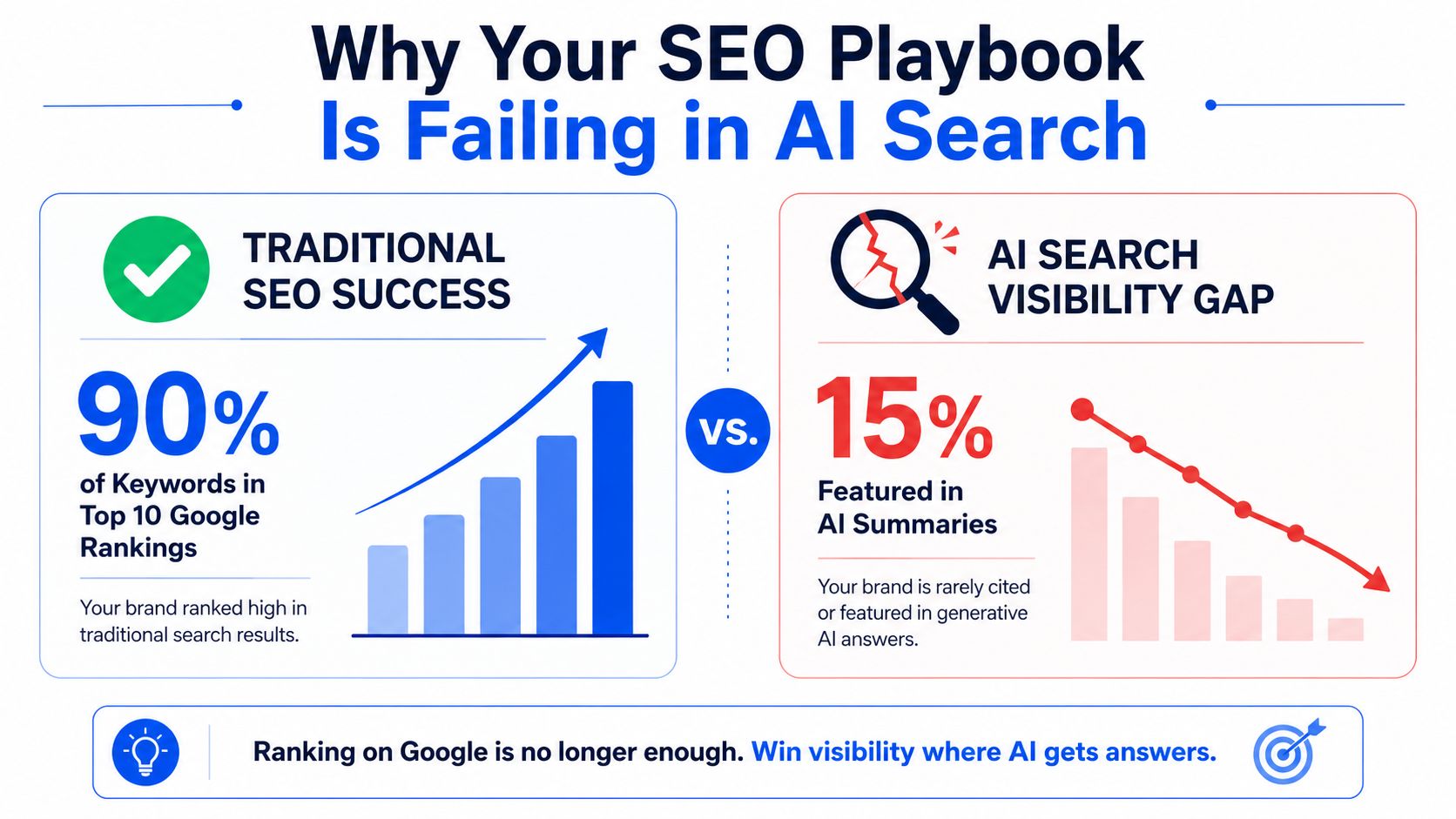
Why Your SEO Playbook Is Failing in AI Search
Most GEO advice treats AI visibility like a technical extension of SEO. That's the first mistake. The bigger shift is behavioral. Generative Engine Optimization is projected to become a $7.3 billion global market by 2025, driven by a 34% CAGR, and a July 2025 survey found that 55% of U.S. respondents now prioritize generative AI tools like ChatGPT and Gemini over traditional search engines for tasks such as travel planning and tech troubleshooting according to this GEO market and usage data.
That matters because your top of funnel has changed. Buyers don't always start with ten blue links anymore. They start with a synthesized answer. If your brand isn't in the model's answer set, your ranking report won't save you.
The popular GEO playbook is too narrow
A lot of teams obsess over page tweaks because they're easy to assign. Add metadata. Publish an AI file. Refresh FAQs. Those things matter, but they don't answer the harder question. Why would a model trust your brand enough to recommend it?
Recent analysis highlighted in arXiv research on third party authority in generative search argues that success hinges on building verifiable, third-party authority and prioritizing earned media over brand-owned and social content. That's the part many agencies skip because it's harder than on-page editing.
Practical rule: If your GEO plan is mostly technical tasks on your own site, it's incomplete.
This is exactly why your old SEO muscle memory fails. Traditional SEO trained teams to chase rankings on owned pages. AI systems often reward clarity, verifiability, and external authority instead.
What you should do now
Start by checking whether your brand appears in commercial AI prompts, not just informational ones. Ask ChatGPT, Gemini, Perplexity, and Claude the same questions your buyers ask sales.
Use queries like these:
- Category queries: “best HR software for mid-market companies in India”
- Evaluation queries: “Chargebee alternatives for SaaS billing”
- Risk queries: “whatfix security and implementation”
- Comparison queries: “keka vs zoho people for growing teams”
Then compare that against your existing SEO dashboard. The gap is your real GEO problem. If you want a deeper benchmark, an AI visibility optimization audit is the right place to start.
GEO vs Traditional SEO A New Set of Rules
Your SEO team is probably still optimizing for a result page. AI search rewards brands that can survive comparison inside the answer itself.
That is a different operating model.
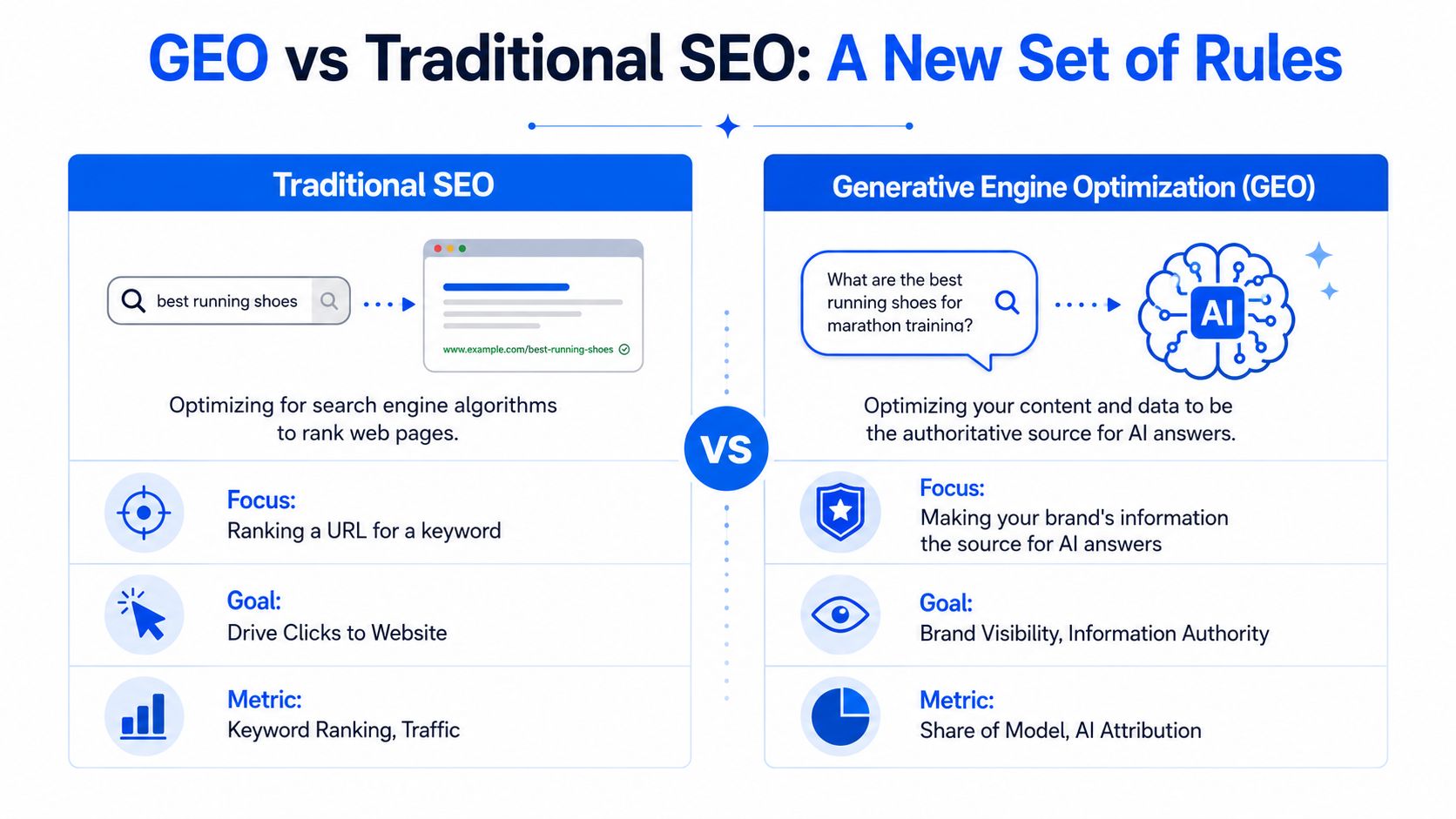
AI visibility follows retrieval rules, not just ranking rules
Researchers and operators studying generative search keep landing on the same conclusion. Citation patterns do not mirror Google rankings cleanly. Pages with weak organic visibility still appear in AI answers, while high-ranking pages often do not. The reason is simple. Models pull from sources they can parse, verify, and trust in context, then assemble an answer around those sources.
For B2B SaaS, that changes what you optimize for. A product page built to rank for a broad keyword is rarely enough. You need content that answers commercial prompts directly, plus third-party validation that gives the model confidence your brand belongs in the shortlist.
If your team wants a baseline before making changes, run an AI search audit for B2B SaaS visibility. It will show whether your brand is getting surfaced in buying-stage prompts.
The real shift is operational
The biggest mistake I see is treating GEO like technical SEO with new vocabulary. It is closer to revenue-focused market positioning.
Your search program has to answer five practical questions:
| Focus area | What strong GEO teams do |
|---|---|
| Research | Study real buyer prompts across discovery, evaluation, comparison, and risk |
| Content | Publish pages built to answer commercial questions with clear facts, proof, and product fit |
| Authority | Get cited on review sites, analyst pages, customer stories, partner ecosystems, and respected publications |
| Entity consistency | Keep claims, positioning, integrations, pricing context, and proof points aligned across the web |
| Measurement | Track mention rate, citation sources, prompt coverage, and pipeline impact |
That is the new ruleset. It is less about squeezing another page into the top 10 and more about making your brand easy to retrieve and easy to trust.
What B2B SaaS teams should change first
Start with prompt mapping, not keyword expansion. Your pipeline comes from questions like “best SOC 2 compliance software for startups,” “Rippling alternatives for global payroll,” or “is this tool secure enough for enterprise procurement.” Those are buying questions. They deserve dedicated pages, supporting proof, and external references.
Next, stop treating link building as the end goal. In GEO, the higher-value asset is contextual authority. A credible mention on G2, Gartner, Capterra, an industry publication, or a partner directory does more for AI recommendations than another generic backlink from a blog network.
Then fix ownership. Someone on your team should own prompt tracking, citation reviews, and source-gap analysis. If no one owns it, GEO becomes another side project inside content marketing and nothing changes.
You are no longer competing only for a click. You are competing to be named in the answer buyers read before they ever visit your site.
If your current agency is still selling blog volume as the plan, they are solving a traffic problem. GEO for B2B SaaS is a trust distribution problem. A more relevant starting point is a dedicated Generative Engine Optimization program built around AI retrieval, citation coverage, and commercial prompt visibility.
The Technical Foundations for AI Visibility
Before you chase citations, make sure AI systems can read your site. This is the plumbing. If it's broken, everything above it breaks too.
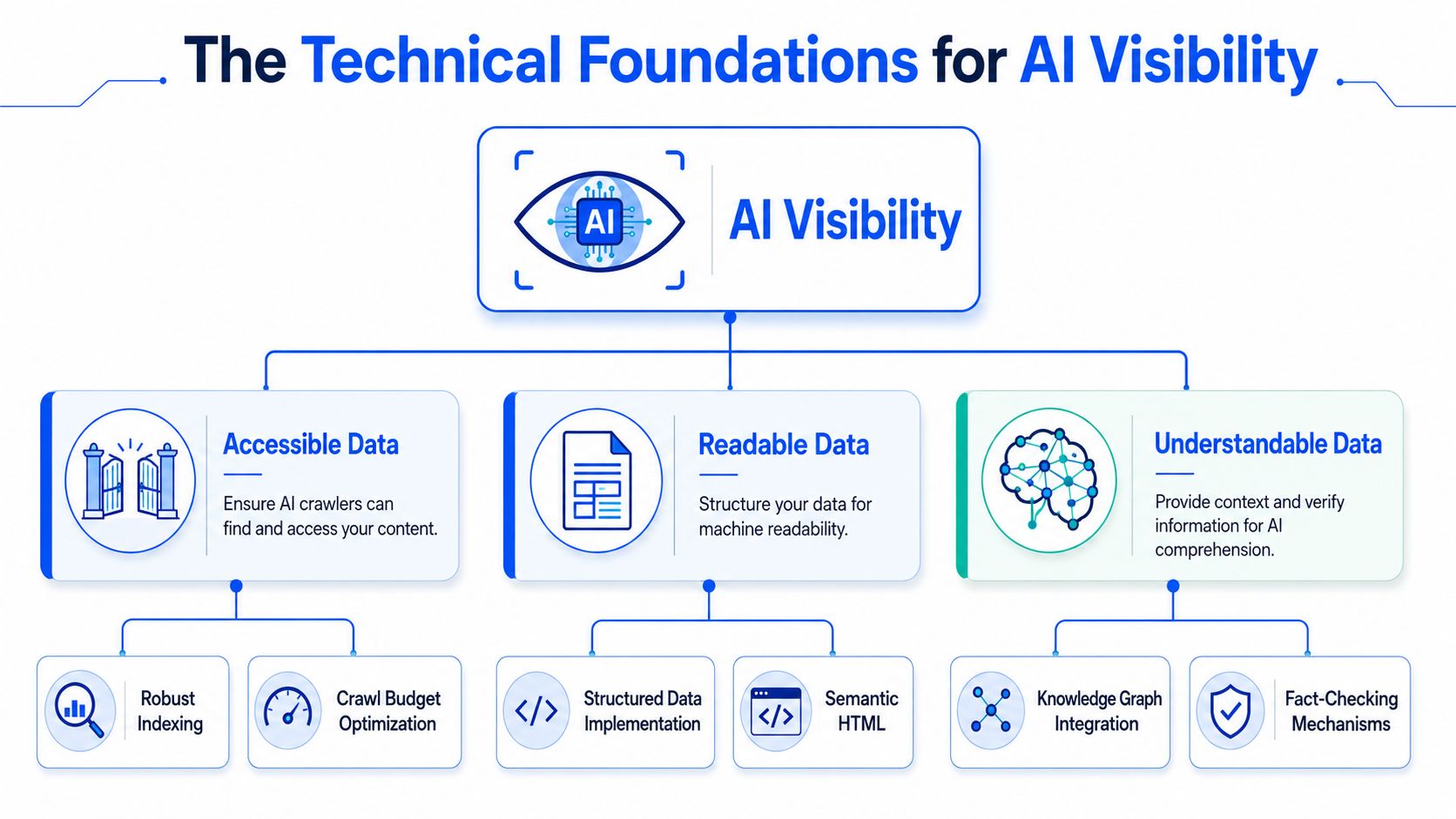
Make your content accessible in raw HTML
If your site depends on client-side React or Vue rendering for critical copy, some AI crawlers may struggle to parse it. Guidance summarized in this technical GEO guide on crawler accessibility and performance recommends Server-Side Rendering or static generation so important content exists in the initial HTML payload. The same source also recommends keeping Largest Contentful Paint under 2.5 seconds and Time to First Byte under 600ms so slow pages don't get skipped.
For B2B SaaS websites, this usually affects product pages, integration pages, pricing pages, and help content. If your comparison table only appears after JavaScript loads, you're taking a visibility hit before content quality even gets evaluated.
A quick check helps:
- View the raw page source: If your key product explanation is missing, AI crawlers may miss it too.
- Review speed bottlenecks: Heavy scripts, oversized assets, and delayed content rendering hurt crawlability.
- Prioritize commercial pages first: Fix pricing, product, security, and comparison pages before blog archives.
Structure pages so models can extract facts cleanly
Content implementing proper schema markup, including FAQPage, Article, and HowTo combinations, shows a 30 to 40 percent higher visibility rate in AI-generated answers than unstructured content based on this schema and AI visibility analysis.
That doesn't mean “add schema everywhere and hope.” It means your page should present facts in a way a model can parse without guessing.
Use this rule set:
- Define the product early: Your H1 should be followed by a plain-language explanation of what the product is.
- Use semantic HTML: Real headings, lists, tables, and labeled sections beat visual styling with poor markup.
- Validate schema: Check implementations with Google's Rich Results Test and Schema Markup Validator before publishing.
Technical standard: If a machine has to infer your meaning, you've already made the page harder to cite.
Treat llms.txt as a support file, not the strategy
I'm not against llms.txt. It can help clarify site structure and priorities. But don't build your whole program around it. The same broader research trend discussed earlier shows the market has overhyped technical artifacts while underinvesting in authority and content design.
That's why I treat llms.txt like sitemap hygiene. Good to have. Not the reason you win.
If you want a practical baseline, start with a focused AI search audit. It should test rendering, crawl access, schema quality, commercial page structure, and answer extraction readiness across your highest-intent URLs.
A Content and Citation Playbook for B2B SaaS
B2B SaaS teams lose AI visibility because they publish for traffic and hope it turns into pipeline later. That approach fails in generative search. Models recommend vendors during evaluation, not during vague awareness browsing.
Start with buying-stage prompts.
The B2B SaaS GEO playbook on buyer evaluation prompts gets this right. Prioritize queries around best, vs, alternatives, pricing, ROI, integrations, security, and implementation. Those are the prompts tied to shortlists, demos, and procurement reviews.
If you sell fintech software, another “future of payments automation” post will not help much. Build pages that answer the questions revenue teams hear every week:
- Best-fit prompts: “best subscription billing software for SaaS”
- Comparison prompts: “Chargebee vs Zuora pricing”
- Switching prompts: “alternatives to legacy billing platforms”
- Risk prompts: “billing software SOC2 implementation”
- Adoption prompts: “time to implement subscription management platform”
Your sales calls already contain the roadmap. Marketing should use it.
Fix the pages buyers and models actually use
A strong GEO content library is smaller than a typical SEO library. It is also more commercial, more structured, and easier to cite.
According to this guide on page structures for AI extraction, “What is [Product]” pages should include a clear definition immediately after the H1 and follow a strict 40-word rule. “Versus” pages and pricing pages should use HTML tables covering pricing tiers, core features with Yes/No formatting, and integration count.
That recommendation is correct. Extraction-friendly pages beat clever copy.
For a new SaaS client, I want this page set in place first:
- A “What is” page that defines the category, who it is for, and where your product fits
- Competitor comparison pages built with structured HTML tables instead of opinion-heavy prose
- Pricing pages with enough package detail for a model to describe your offer accurately
- Security and implementation pages written for procurement, legal, and technical evaluators
- Integration pages that make compatibility clear in seconds
If your pricing page hides the basics, AI systems will move to vendors they can explain with confidence.
Off-site authority matters more than another batch of blog posts
This is the part generic GEO advice keeps getting wrong. On-page cleanup helps. Off-site authority changes recommendations.
In audits across SaaS categories, the pages that shape AI answers are often third-party assets. G2 profiles, software directories, comparison roundups, analyst writeups, founder interviews, and product mentions on trusted publications give models external confirmation that your brand belongs in the answer.
As noted earlier, high-authority directories influence generative recommendations more than mid-tier media mentions. The practical takeaway is simple. Citation engineering beats content volume.
That means building a controlled footprint across the sources models already trust, then making sure your positioning, category labels, pricing language, and proof points are consistent everywhere. Random PR does not solve this. Vanity guest posts do not solve it either.
At LLMBuddy, our client work shows the same pattern. Chargebee saw +74%, Whatfix +84%, and Keka +82% in AI visibility after focused work on content structure, entity clarity, and citation pathways. The driver was not generic top-of-funnel publishing. The driver was tighter bottom-funnel content paired with stronger third-party validation.
If you are fixing this now, work both sides at once. Rebuild your commercial pages and clean up your citation footprint in the same sprint. If you need help turning existing assets into pages models can quote accurately, start with AI content optimization for B2B SaaS.
Measuring What Matters Share of Model and Business Impact
Traffic is a lagging, incomplete metric in AI search. You need a metric that tells you whether your brand shows up in the answer itself.
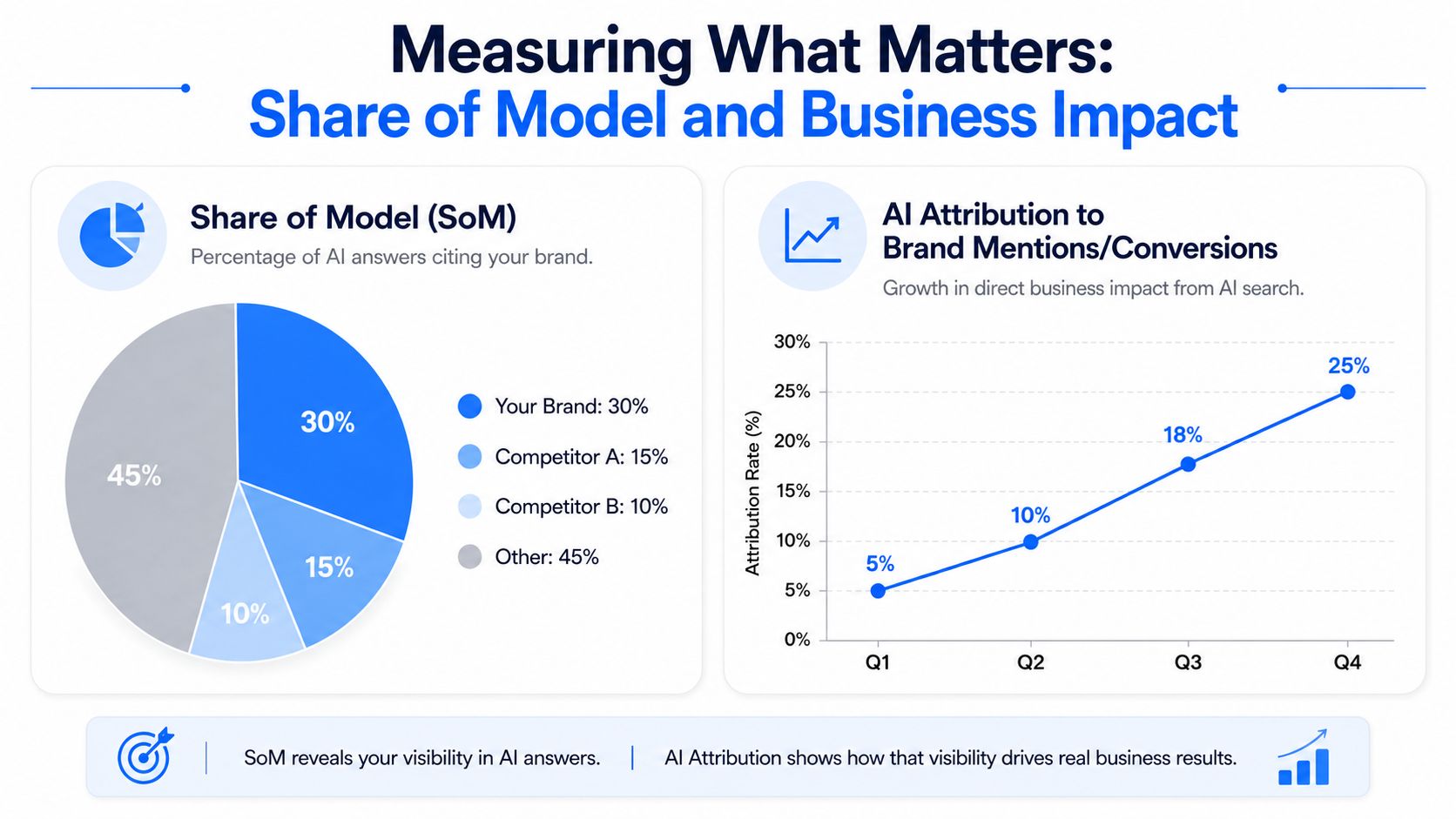
Start with Share of Model
Share of Model, or SoM, is the core GEO metric. It means running your 10 to 20 most important target queries weekly across ChatGPT, Perplexity, and Claude to track brand appearance frequency, mention position, and sentiment based on this definition of Share of Model for AI search.
This is the closest equivalent to keyword ranking in the AI era.
Track three things every week:
- Appearance frequency: How often your brand is mentioned at all.
- Mention position: Are you the first recommendation or buried later in the answer?
- Sentiment and framing: Are you described positively, neutrally, or with objections?
A brand that appears second or third with weak framing has a different revenue outlook than a brand that gets named first with clear proof points.
Then connect SoM to pipeline signals
Many teams struggle here. They can measure mentions, but not business value. The challenge is real. BrightEdge's GEO guide on attribution gaps notes that the industry still lacks a standardized method for tying AI-generated visibility directly to bottom-funnel actions, and that 85% of AI brand mentions originate from off-site sources like review platforms and PR, which makes attribution harder inside owned analytics alone.
So don't wait for a perfect model. Build a practical one.
Use a simple operating view:
| What to measure | Why it matters |
|---|---|
| Weekly SoM on commercial prompts | Shows whether AI platforms are recommending you |
| Demo request quality | Tells you if visibility is attracting better-fit buyers |
| Sales call language | Reveals whether prospects mention AI assistants in discovery |
| Off-site citation growth | Shows whether your authority footprint is improving |
Track recommendation presence first. Then validate whether sales conversations and demo quality move with it.
We've seen this with clients. Whatfix's +84% AI visibility growth mattered because the sales team could feel the difference in category-level awareness and shortlist presence. That's the frame growth leaders should use. Visibility is useful only if it shifts commercial consideration.
For live tracking and examples of how this looks in practice, reviewing B2B SaaS GEO case studies is more helpful than staring at a traffic graph.
Your First 90 Days A Practical GEO Playbook
If I were advising a new B2B SaaS client, I wouldn't start with a content sprint. I'd start with diagnosis.
Days 1 to 30
Run a baseline audit across ChatGPT, Gemini, Perplexity, and Claude for your highest-intent prompts. Pull your current visibility on category, comparison, pricing, security, integration, and implementation queries. Then inspect technical blockers on the pages most likely to earn citations.
At the same time, identify where your external authority is thin. Missing review depth, weak software directory profiles, poor comparison coverage, and inconsistent category definitions usually show up fast.
Days 31 to 60
Retrofit your commercial pages. Your “What is” page needs a precise definition near the top. Your pricing and versus pages need HTML tables and clear feature comparisons. Your security, implementation, and integrations pages need direct answers, not brand copy.
This is also the month to standardize product naming, category language, and core claims across your site. AI systems cite consistent entities more confidently than messy ones.
Days 61 to 90
Push on citation pathways. Improve review platform coverage, get your product referenced in the right industry sources, and clean up weak or outdated third-party descriptions. Then set a weekly SoM review process and assign someone to monitor answer changes.
One operating detail matters here. Guidance from this B2B SaaS GEO operations guide on content freshness and monitoring recommends updating cornerstone articles quarterly and running a weekly cadence to log answer changes, annotate releases, and fix inaccuracies or negative sentiment within two business days.
That's the right mindset. GEO is not a one-time project. It's an operating system.
Frequently Asked GEO Questions
Is generative AI search engine optimization just SEO with a new name
No. GEO changes the target.
Traditional SEO tries to win a click from a ranked page. GEO tries to get your company cited, compared, and recommended inside the answer itself. For B2B SaaS, that shifts the work toward off-site authority, clean product positioning, and content built around evaluation-stage questions. If your team is still treating this like a publishing calendar problem, you will miss revenue-driving prompts.
Should my SEO team own GEO
Your SEO team can own part of it. They should not own it alone.
The companies that win in AI search usually align SEO, product marketing, PR, customer marketing, and demand gen around the same buying journey. That matters because AI systems do not pull confidence from your site alone. They pull it from consistent claims across your site, review platforms, comparison pages, analyst mentions, community discussions, and third-party directories.
Is llms.txt worth doing
Yes. It is a cleanup task, not a growth strategy.
Use it if you want to make your site easier to interpret. Do not expect it to fix weak category association, thin third-party mentions, or vague commercial pages. B2B SaaS teams waste too much time on on-page hacks and too little time building the authority signals models trust.
Which pages should a SaaS company fix first
Start with pages that influence shortlist decisions.
That usually means your product definition page, pricing, alternatives, versus pages, integrations, security, and implementation content. These pages need direct language, clear comparisons, consistent terminology, and structured information that an AI system can quote without guessing. If your highest-intent pages read like brand copy, they will not get cited.
How long does GEO take to show movement
Faster than traditional SEO in many cases, especially when you fix answer extraction issues and strengthen citation sources around high-intent prompts.
The timeline still depends on your starting point. A company with strong third-party coverage and weak page structure can see changes quickly. A company with weak authority across the market needs more time because AI visibility follows trust, and trust is built across multiple sources.
How should founders think about ROI if attribution is messy
Treat GEO like pipeline influence, not a last-click channel.
Start by checking whether your brand appears in the commercial prompts that matter. Then look at downstream signals. Better-fit demo requests, more branded shortlist conversations, cleaner competitor comparisons in sales calls, and fewer category misconceptions all matter. If AI search is improving buyer understanding before the demo, revenue impact will show up before attribution gets tidy.
If your company shows up in Google but disappears inside ChatGPT, Gemini, Perplexity, and Claude, the problem usually is not one metadata field or one schema block. It is weak authority engineering and weak buying-journey coverage.
LLMBuddy works with B2B SaaS teams on AI search audits, citation pathway development, and commercial page optimization built for AI retrieval. If you want help diagnosing the gaps and fixing the pages and sources that influence pipeline, book a demo.