
AI search behavior changed fast in 2024. For B2B SaaS, that means standard rank tracking misses the real buying signal. What matters now is whether ChatGPT, Gemini, Claude, and Perplexity describe your product accurately, cite the right page, and surface you in commercial prompts where pipeline gets shaped.
Many SaaS teams we audit still track mention counts and call it visibility. That is a reporting error. A brand mention has little value if the model cites a weak source, mislabels your category, or frames a competitor more clearly in the same answer.
I see this constantly through LLMBuddy audits. Accuracy is the metric that matters first. If the model picks the wrong URL, uses the wrong positioning, or pulls from low-trust citations, your brand can show up and still lose demand.
This article gives you the framework we use to evaluate AI visibility tools for B2B SaaS in India. We test software the way buyers search, across ChatGPT, Gemini, and Claude, using repeat prompts, citation checks, answer consistency, and recommendation quality over time. If you are a founder or CMO, use that standard to choose a platform. Pick one that shows what the model said, why it said it, which URL it used, and whether the result stays stable week after week.
1. LLMBuddy
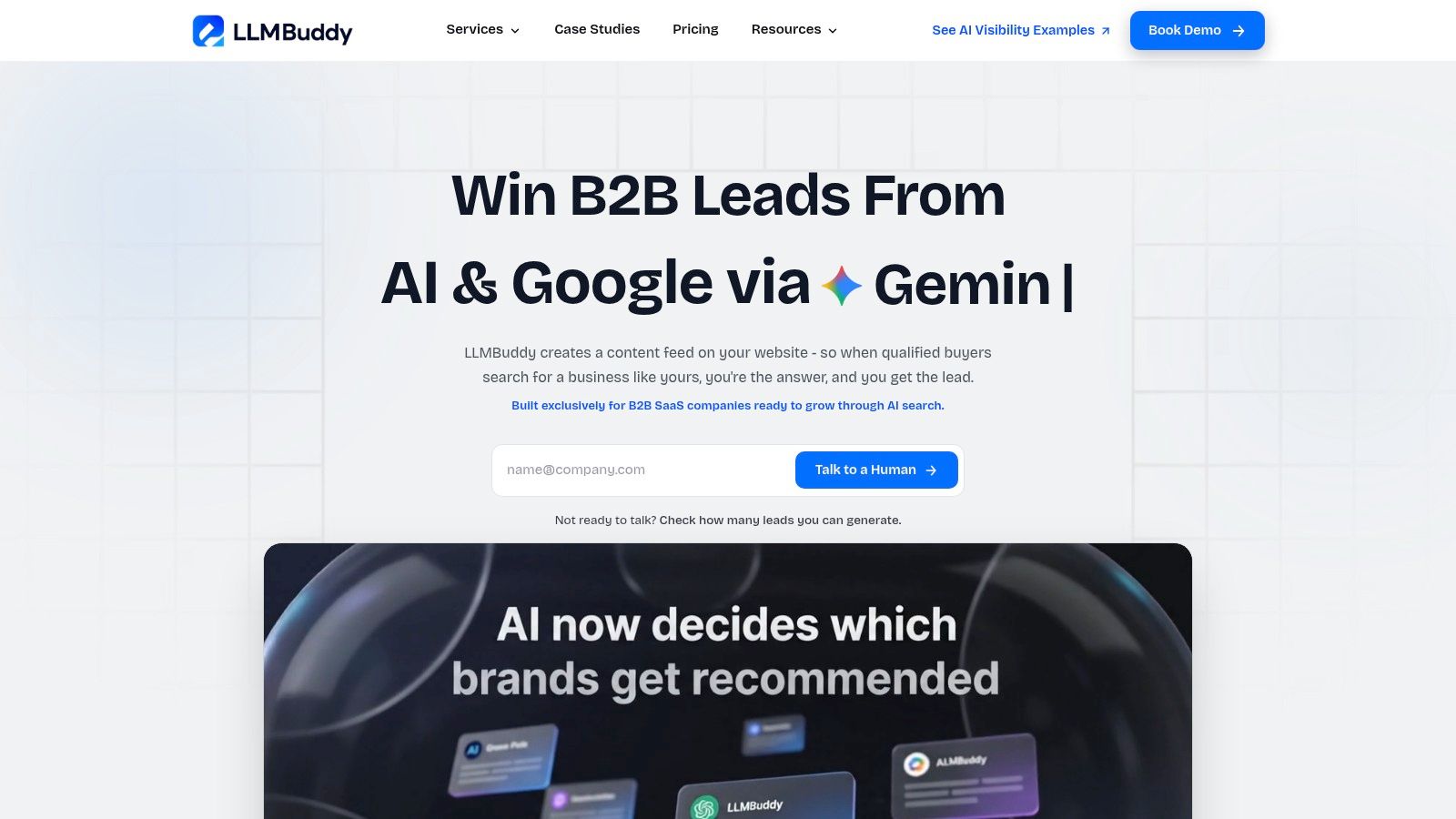
LLMBuddy is a strong fit for B2B SaaS teams that need two things at once: measurement and execution. It focuses on GEO workflows across ChatGPT, Gemini, Perplexity, and Claude, with an emphasis on whether models describe the product correctly, cite the right source, and stay consistent across repeated prompts.
That focus matters for SaaS.
In our evaluation framework, a tool earns its place if it helps you answer four questions fast: which prompts matter, which URLs models cite, where positioning breaks, and what changed week to week. LLMBuddy is built closer to that operating model than a general marketing suite. The workflow centers on audit, optimization, citation work, site structure, and ongoing monitoring. For a founder or CMO, the business value is simple. You can move from reporting AI mentions to fixing why the recommendation was weak.
Why LLMBuddy stands out for SaaS
LLMBuddy is strongest when your team wants a hands-on system, not just another dashboard. It covers AI search audits, citation mapping, content restructuring for extraction accuracy, schema and llms.txt work, and weekly monitoring tied to prompt behavior. That makes it more useful for teams dealing with category confusion, wrong landing page citations, or inconsistent answers across models.
The limitation is just as clear. If you want a low-cost self-serve tracker with broad marketing features, this will feel narrower and more consultative.
Where it fits
- Good fit for B2B SaaS: The product is built around commercial prompts, comparison queries, and software buying journeys.
- Useful if execution is the bottleneck: Teams that need recommendations plus implementation support will get more value here than from a pure reporting layer.
- Less ideal for broad market coverage: Consumer brands or teams looking for an all-in-one SEO platform may want a wider toolset.
- Worth pressure-testing in a demo: Ask to see prompt history, citation sources, URL-level attribution, and answer consistency across ChatGPT, Gemini, and Claude.
One rule I would use here applies to every platform in this list. If the tool cannot show which third-party citations shaped the model's answer, it will not help you improve recommendation accuracy.
2. Semrush AI Visibility Toolkit
Semrush is the practical choice if your team already lives inside Semrush and wants AI visibility folded into the same reporting stack. It tracks brand performance across major AI surfaces and ties that to the SEO telemetry most SaaS teams already trust. For a CMO who doesn't want another disconnected tool, that convenience is real.
The bigger reason to consider it is measurement philosophy. Semrush's own guidance says the four top AI platforms for visibility reporting are Google's AI Overviews, ChatGPT, Gemini, and Claude, and that good reporting should track three KPIs: AI referral sessions in GA4, branded search volume in Google Search Console or Position Tracking, and conversion rates from traffic landing on the homepage, as explained in Semrush's AI visibility measurement guide. That's the right lens for SaaS. You're not buying software to admire citations. You're buying software to understand whether AI discovery changes demand.
Best use case for Semrush
If your team already runs SEO, content, and reporting in Semrush, the AI Visibility Toolkit keeps operational friction low. Prompt tracking, competitor monitoring, and AI reporting sit closer to the workflows your team already uses. That means adoption is easier.
There are limits though. If you need deep Claude coverage, URL-level citation analysis, or a more GEO-native recommendations layer, Semrush can feel like an extension of an SEO suite rather than a purpose-built AI visibility product.
Semrush is strongest when you want AI reporting connected to existing SEO reporting, not when you need the sharpest standalone diagnostics.
You can evaluate plans on the Semrush AI pricing page.
3. Rankscale
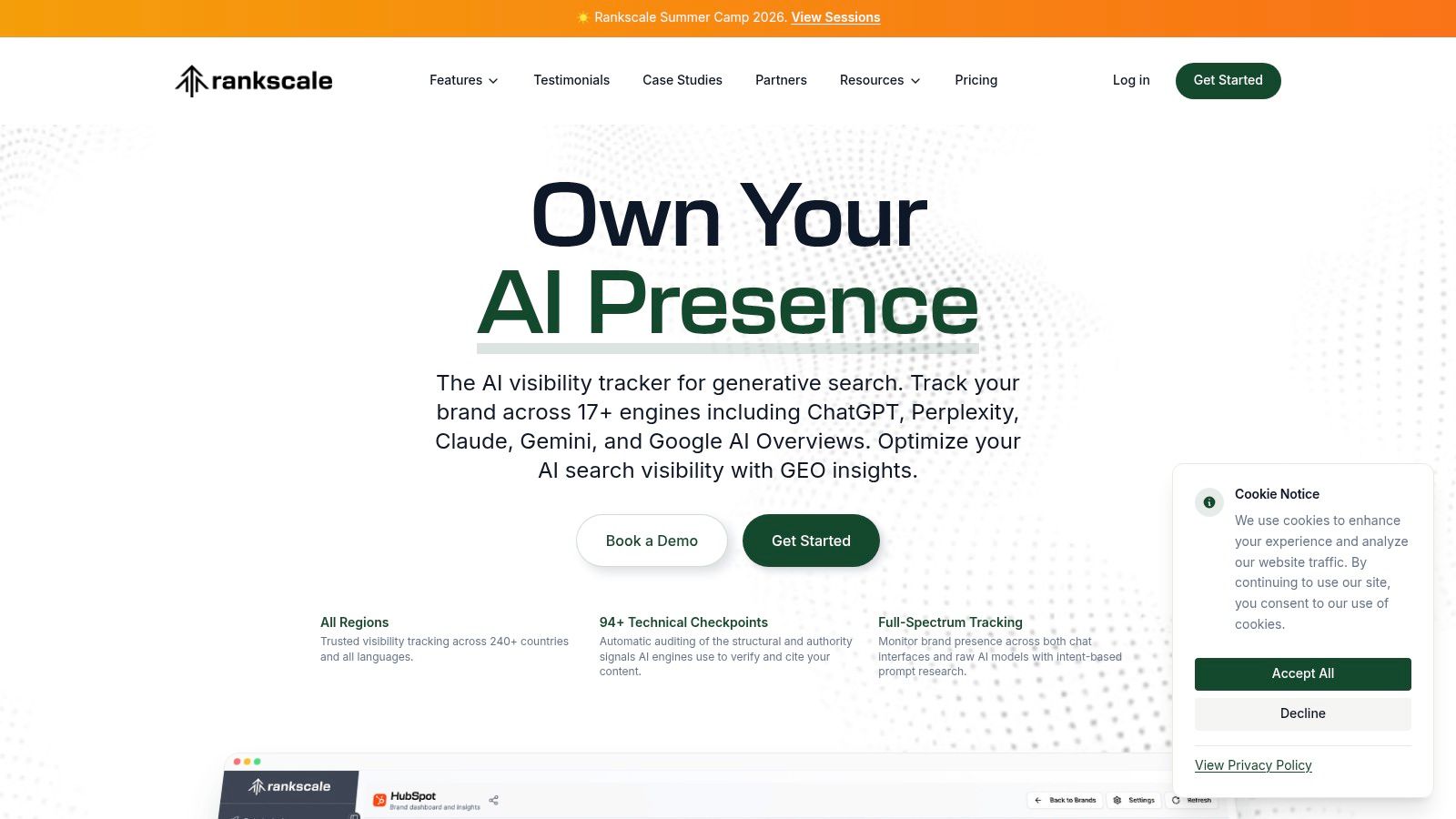
Rankscale stands out for one reason. Breadth. If your team wants to monitor more than the default shortlist of assistants, this is one of the first tools I'd test. It's built for wider engine coverage, agency-style reporting, and brand monitoring across multiple environments.
That matters because narrow tracking creates false confidence. A vendor that only watches one or two engines can tell you a story that falls apart when buyers ask the same prompt elsewhere.
Why engine coverage matters
One of the sharper benchmarks in this category says the most accurate software validates results across 8 to 12 distinct AI engines simultaneously rather than relying on a single platform source, and that narrow tracking can make reported visibility misleading by up to 40%, according to Dageno's analysis of AI visibility software accuracy. Rankscale's appeal is that it's built around that wider coverage model.
For B2B SaaS companies selling into global or technical audiences, that's useful. Your buyers may check ChatGPT first, but they also test Perplexity, Claude, Gemini, Copilot, and newer interfaces depending on workflow and region. Wider tracking gives you a better read on consistency and category control.
Who should buy Rankscale
Pick Rankscale if your team runs multi-brand portfolios, agency reporting, or international campaigns and needs visibility data beyond the standard four or five engines. It's also a fit if competitive tracking and audit depth matter more than buying from a legacy SEO vendor.
A few cautions are obvious.
- Broader doesn't always mean better for every team: If you only care about the core assistants your buyers use, you may not need the extra operational complexity.
- Pricing requires a sales conversation: That slows down evaluation if you want quick self-serve testing.
- Integration depth should be checked live: Especially if your RevOps or BI team expects exports and workflow automation.
You can request a walkthrough on the Rankscale website.
4. Prism
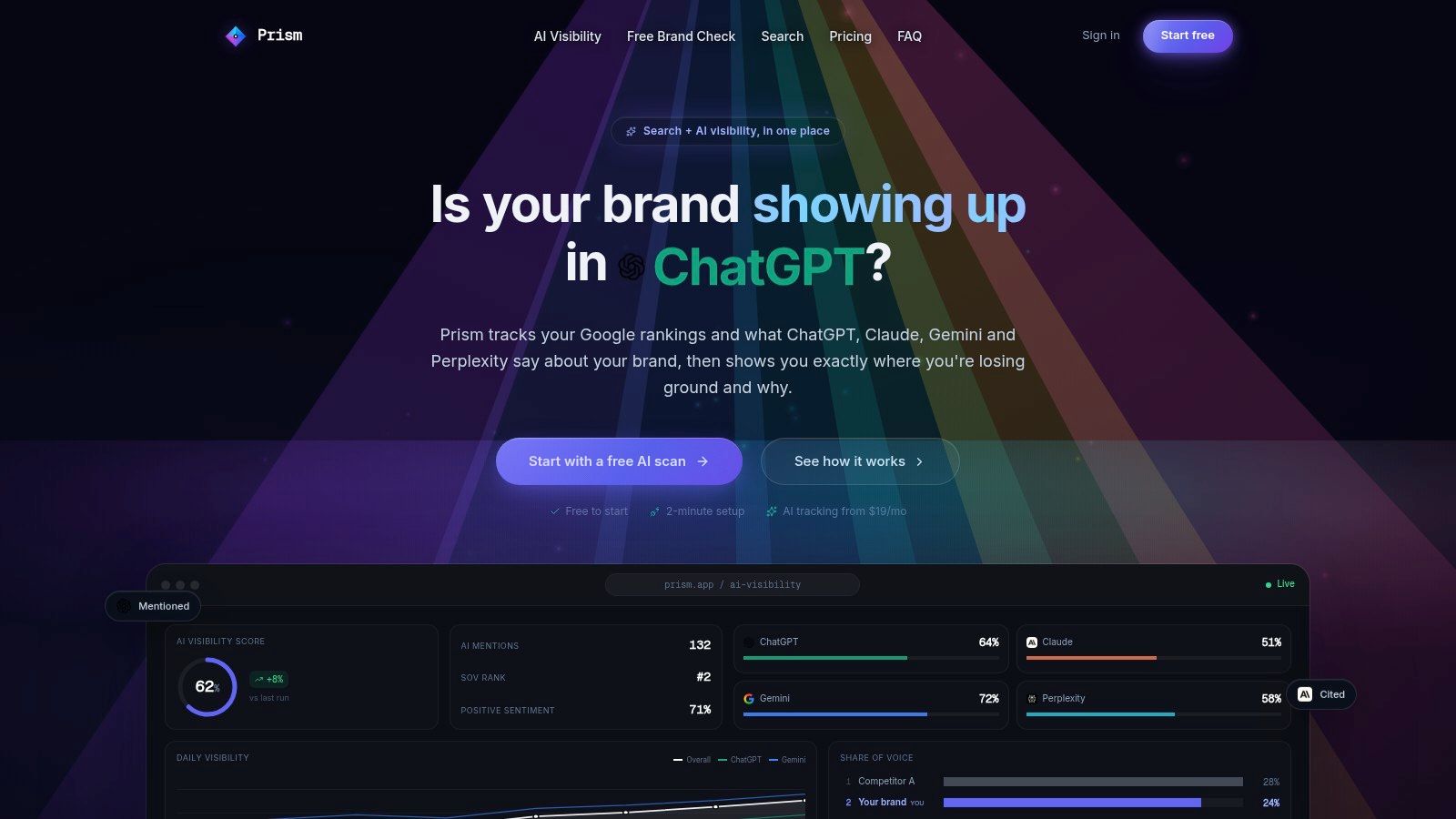
Prism is a solid starting point for founders and lean SEO teams that want AI visibility plus classic search telemetry in one place. It monitors major assistants daily, layers in sentiment and answer analysis, and keeps setup lighter than most enterprise tools. If you're early in AI search and want a usable baseline without buying a heavyweight stack, this is a sensible option.
Its practical value is speed. You can connect GA4 and search data, track prompts across ChatGPT, Claude, Gemini, and Perplexity, then start spotting where your brand gets mentioned but not cited well. For many SaaS teams, that's enough to identify the first batch of fixes.
Where Prism fits
Prism works best if your current problem is visibility ambiguity, not deep enterprise governance. A founder can look at daily prompt monitoring, answer-level sentiment, and AI-readiness scoring and quickly see where the site or content is weak.
The downside is scope. If you need broad niche-engine tracking or very large-scale monitoring, Prism's tighter focus on major assistants may feel limiting. Credit-based scanning also means you should keep an eye on cadence if your team starts testing lots of prompts and competitors.
You can explore it on the Prism website.
5. Rankshift
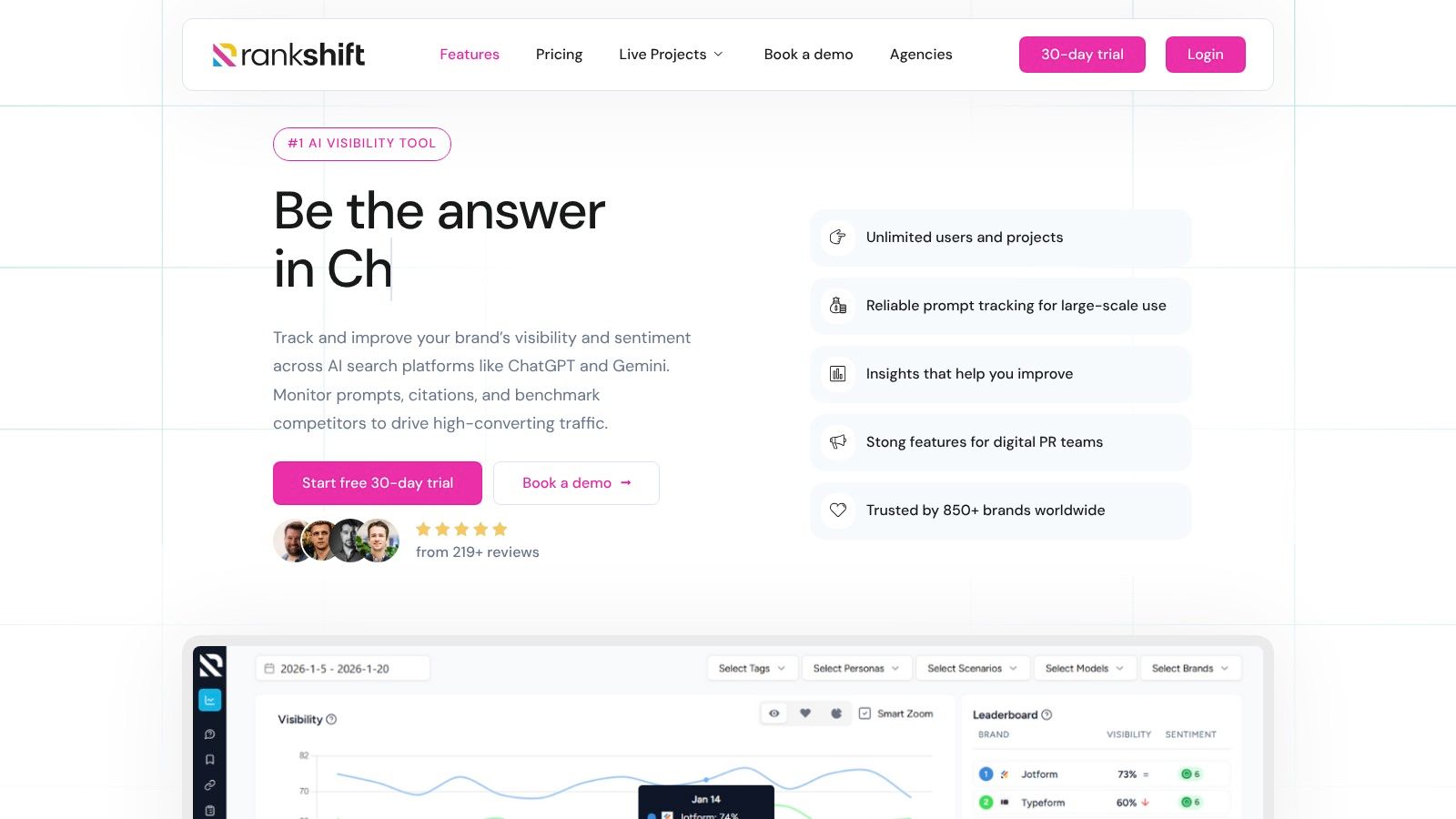
Rankshift is for teams that want flexibility. Not every SaaS company needs the same refresh frequency, the same engine mix, or the same reporting depth. Rankshift's credit model lets you spend more where it matters, which is useful if you care a lot about a few categories, geographies, or competitor clusters.
That's especially relevant in AI search because prompts aren't static. Some journeys deserve daily tracking. Others don't.
Why flexibility matters in accuracy
Reliable AI visibility tracking isn't a single-run exercise. Practitioner benchmarking shows results should be treated as a distribution across repeated runs, with consistency rates reported alongside point estimates, as outlined in Nick Lafferty's review of top AI visibility platforms. Rankshift's adjustable cadence makes that easier to operationalize if your team is disciplined about testing.
It also bundles content workflow tools with visibility tracking. If your team wants briefs, citation analysis, and GEO-focused writing support in the same environment, that can speed up execution after the data comes in.
My take on Rankshift
This is a good fit for mid-market SaaS teams that don't want a rigid contract around one monitoring pattern. You can focus spend on high-intent prompts, compare engines, and run more frequent checks where answer volatility is high.
Watch two things before you commit.
- Ask how exports and integrations work: Newer products often look good in demos and weaker in downstream workflows.
- Check how they handle citation granularity: If they stop at domain-level reporting, your content team won't know what to improve.
You can review the platform on the Rankshift website.
6. Genwolf
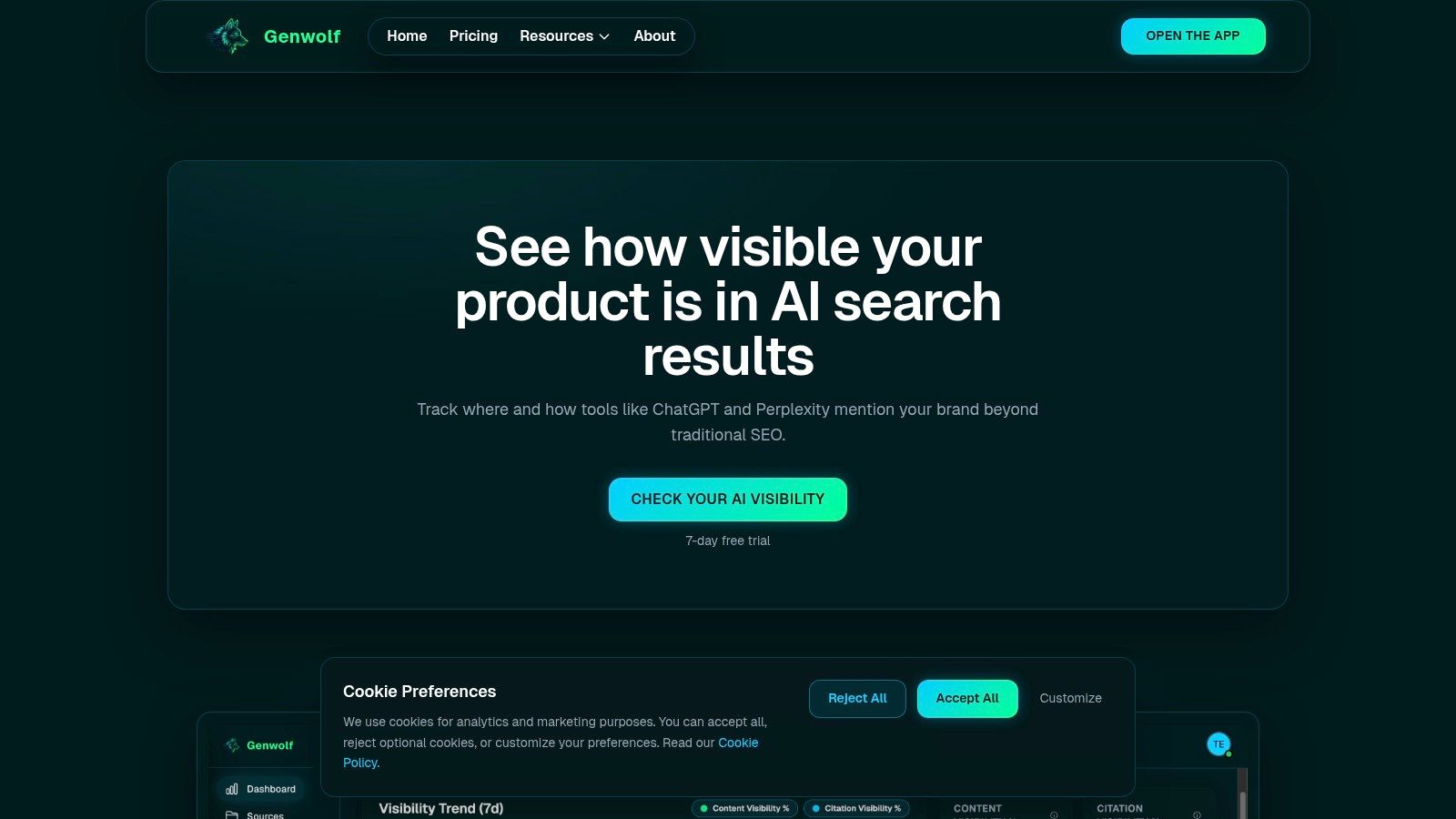
Genwolf appeals to a different buyer. If your team cares about auditability, self-hosting, and transparency, an open-source core is a strong differentiator. Most AI visibility tools ask you to trust their methodology. Genwolf gives technical teams more room to inspect it.
For compliance-conscious SaaS companies, that matters. If legal, security, or data teams want more control over storage and visibility workflows, self-hosting can remove a lot of friction.
Where Genwolf makes sense
Pick Genwolf if your engineering or platform team wants to be close to the data and the process. You'll get daily prompt runs, answer history, and clearer answer transparency than many closed tools provide. That can help when your team needs to validate whether a shift came from the model, the prompt set, or your own site changes.
The trade-off is predictable. Coverage appears focused on core engines rather than the widest possible market set, and smaller vendors often need extra diligence around enterprise support. For a technically mature SaaS company, that may be acceptable. For a lean marketing team that wants support and strategic interpretation, it may not.
You can learn more on the Genwolf website.
7. Airtrace
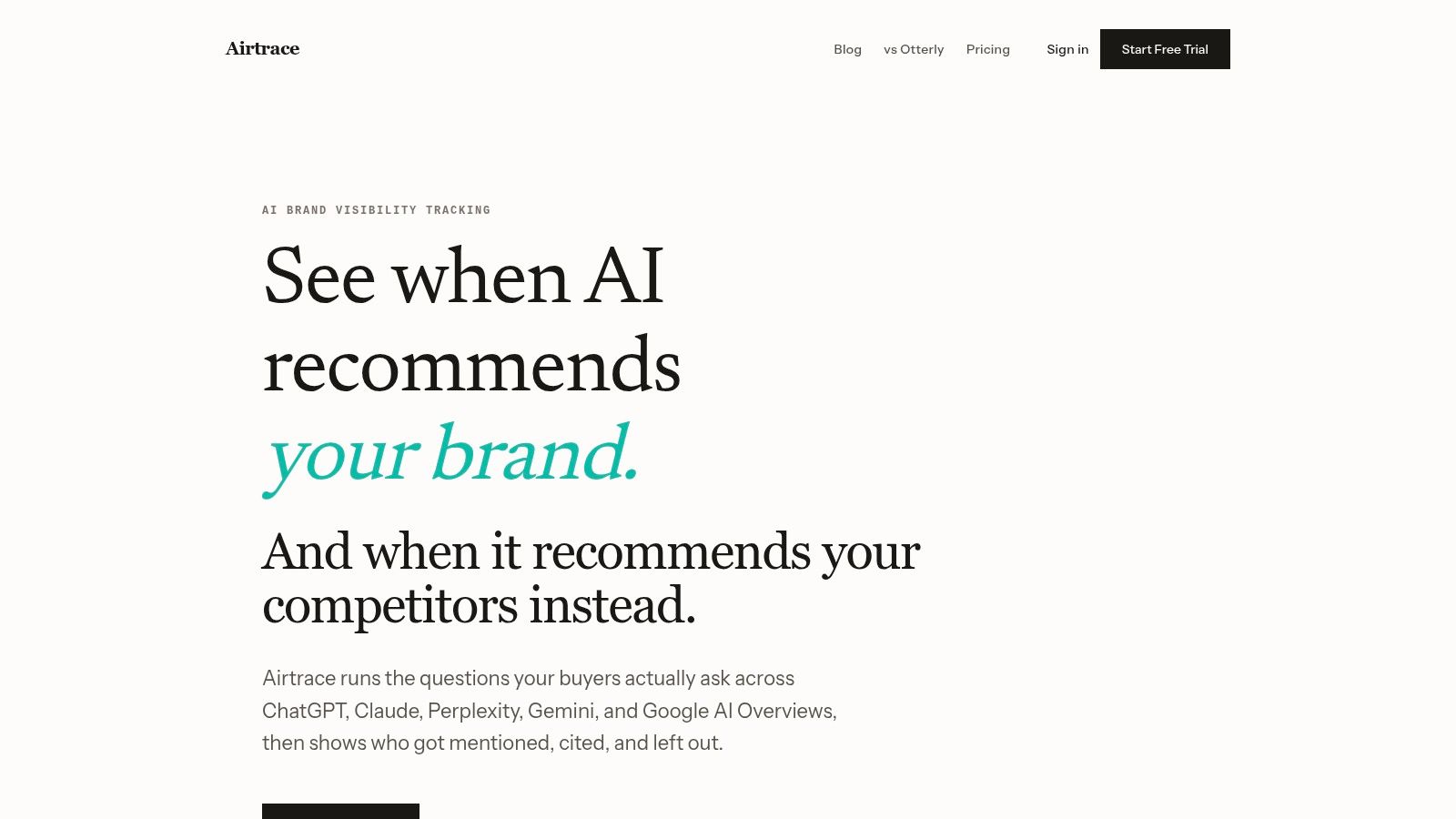
Airtrace is a good pilot tool. It runs buyer-intent questions across multiple assistants at the same time, reports mention rate, share of voice, and citations, and gets teams to a first read quickly. If your company hasn't operationalized AI visibility yet, speed matters more than feature sprawl.
I like tools like this for internal buy-in. A founder or CMO can see engine-by-engine output without a long implementation cycle, then decide whether deeper monitoring is worth funding.
What to look for in Airtrace
Airtrace covers the major five engines many teams care about first. That's usually enough for an initial baseline, especially if your audience is concentrated in mainstream AI assistants. The simultaneous scan model is also useful for comparing how a brand appears across providers for the same buyer question.
Still, this is not the broadest option. If you need niche-engine coverage, advanced exports, or heavier enterprise controls, confirm those requirements before rollout.
Run your highest-intent category prompts first. Don't waste your first scans on broad awareness questions that rarely influence pipeline.
You can test it on the Airtrace website.
8. FogTrail
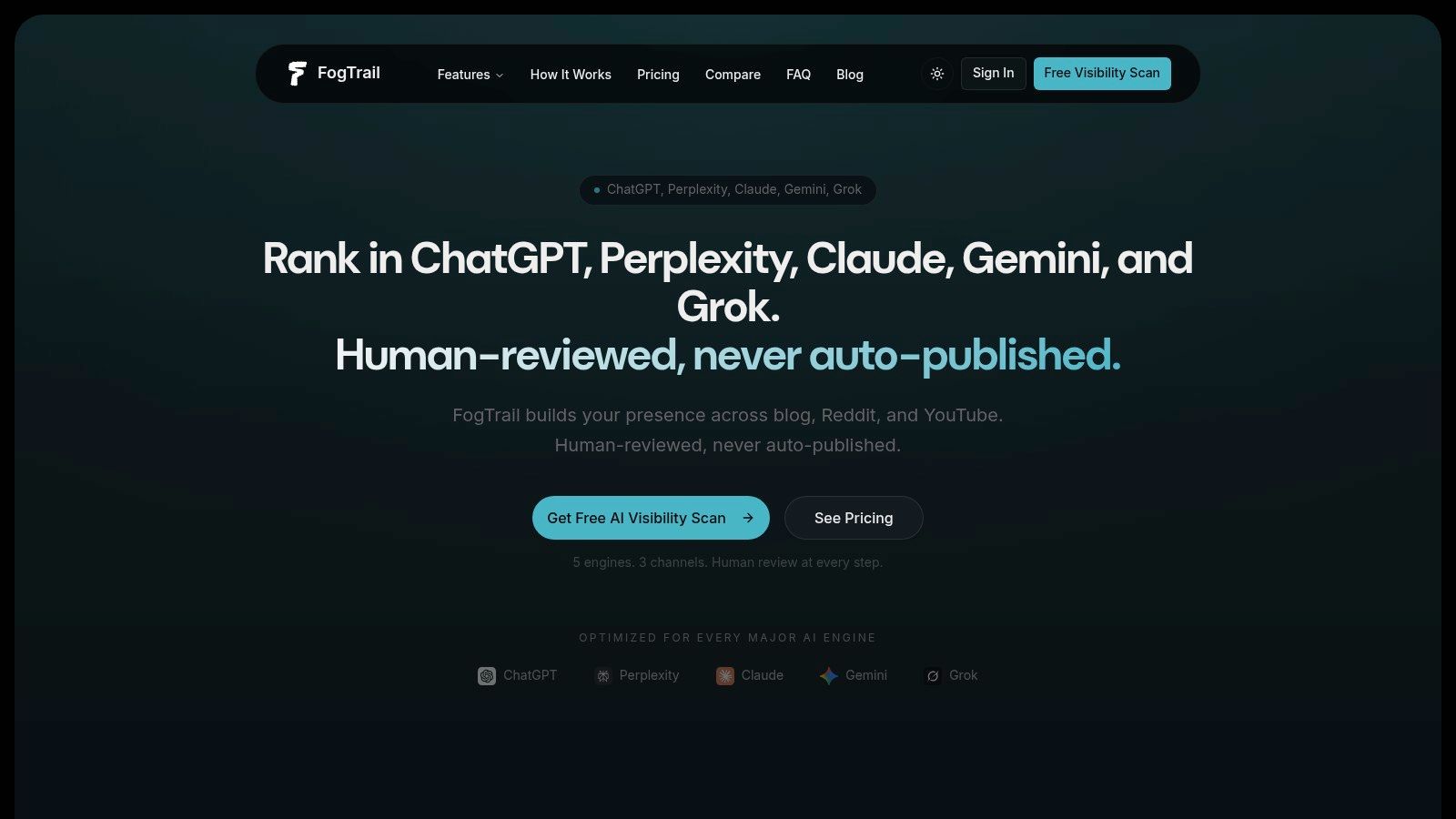
FogTrail is a practical entry point if you need a quick baseline to show stakeholders where your brand is missing. The free scan angle is useful because most companies still don't have a shared understanding of AI visibility. A fast multi-engine snapshot can fix that.
It also frames gaps in a way leadership can understand. You can show where your brand appears, where competitors dominate, and where cited sources are weak.
Best use case for FogTrail
Use FogTrail if you need an early-stage scan and a bridge into managed execution. It's especially useful for teams that need to educate internal stakeholders before committing to a bigger program.
The trade-off is that scan-led tools can be shallower on ongoing automation. If your growth team needs frequent recurring tracking from day one, ask hard questions about plan depth, update cadence, and exports before you buy.
You can try the scanner on the FogTrail website.
9. OpenSight
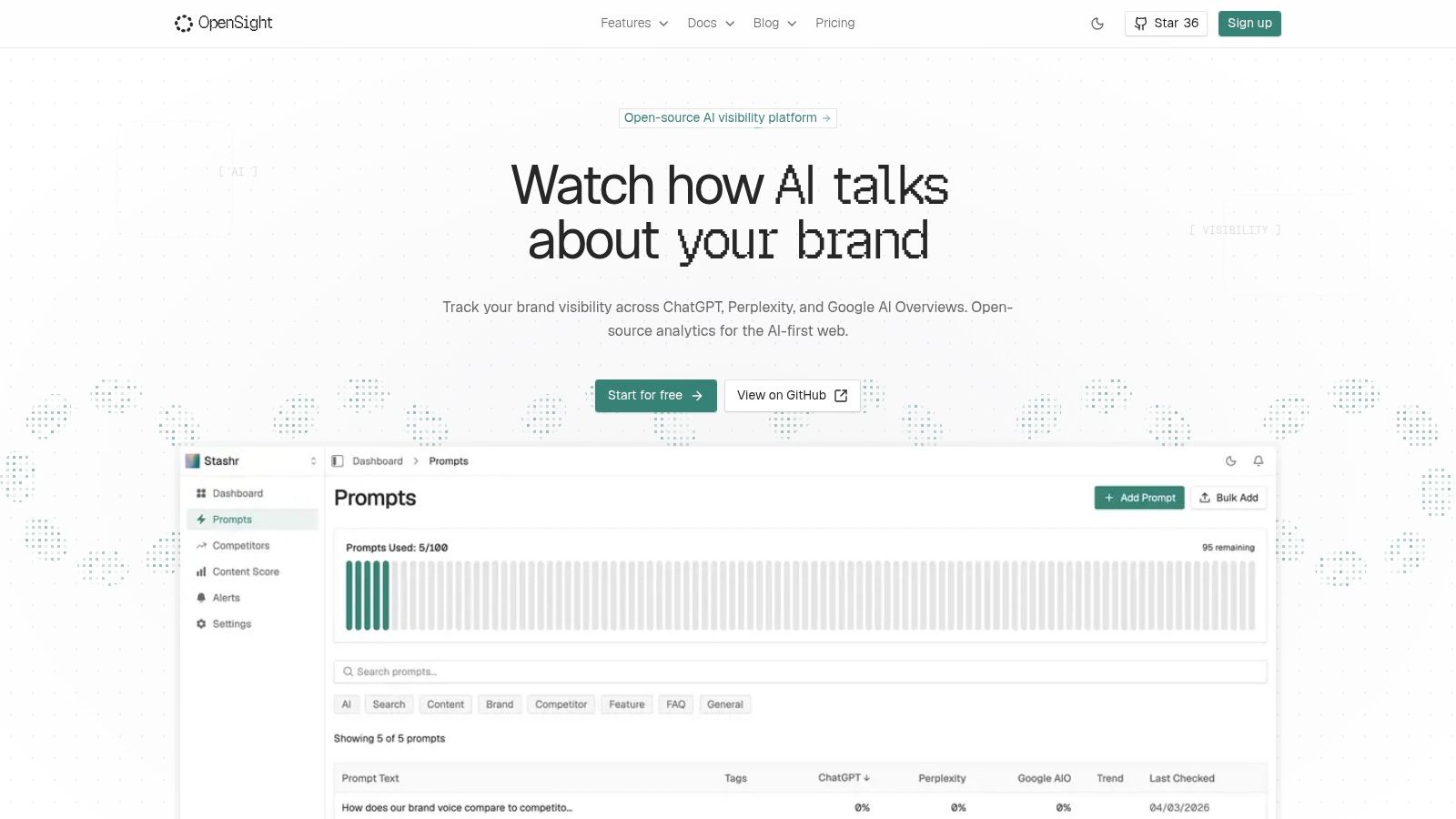
OpenSight is a strong fit for technical teams that want open-source flexibility without giving up a usable product layer. Self-hosting plus API access on every plan makes it attractive for companies that want to pipe AI visibility data into internal dashboards or product analytics.
That alone can be enough to justify a test. Marketing teams rarely need this level of control. Product-led or data-heavy SaaS companies often do.
Why developers may prefer OpenSight
If your team wants to build custom workflows around trends, alerts, and content scoring, OpenSight gives you more room than closed systems. You can own the infrastructure decision, connect the API into your stack, and shape reporting around your own operating model.
The obvious caution is engine breadth. If your revenue team depends heavily on Claude or a wider assistant mix, validate coverage before adoption. Self-hosting also creates overhead. That's not a flaw. It's a choice.
You can inspect the project and product on the OpenSight website.
10. Trakkr
Trakkr is the best specialist pick if ChatGPT is your main concern. It tracks daily buyer-intent prompts, separates ChatGPT memory behavior from live-search behavior, and captures cited URLs. That separation is useful because those two answer modes can produce very different visibility patterns.
For some SaaS brands, that's a real edge. ChatGPT often shapes category perception early, especially in software evaluation and workflow discovery prompts.
Why URL-level data changes decisions
The strongest tools don't stop at domain attribution. They identify the exact page an AI cites. That URL-level citation attribution is what lets you see which content asset drives inclusion in the buying journey, as explained in MyBrandi's analysis of accurate AI visibility software. Trakkr's cited-URL capture is the reason I'd shortlist it for ChatGPT-heavy programs.
If your team wants fast diagnostics tied to prompt shifts, this tool is easy to like. If you need broad multi-engine parity as much as ChatGPT depth, verify the other providers match your expectations before standardizing on it.
You can review it on the Trakkr website.
Top 10 AI Visibility Metrics Tools, Accuracy & Features
| Solution | Core GEO & AI SEO Features | Quality & Outcomes ★ | Distinctive Strengths ✨ | Target Audience 👥 | Pricing / Value 💰 |
|---|---|---|---|---|---|
| 🏆 LLMBuddy | Audit → Optimization → Citations → Architecture → Monitoring; llms.txt, schema, retrieval‑friendly pages; AI Visibility Platform (ChatGPT, Gemini, Perplexity, Claude) | ★★★★★ +87% avg visibility in ~90 days | ✨ Cross‑engine GEO, citation pathway engineering, B2B SaaS playbooks, enterprise programs | 👥 B2B SaaS founders, growth/SEO/content & product marketing (mid‑market → enterprise) | 💰💰 Contact for audit/retainer/enterprise quotes |
| Semrush, AI Visibility Toolkit | AI Visibility reports, prompt tracking, GA4/GSC integrations, prompt research | ★★★★ Mature, enterprise‑grade | ✨ Integrates traditional SEO telemetry with AI visibility | 👥 SEO teams & enterprises already using Semrush | 💰💰💰 Subscription + enterprise add‑ons |
| Rankscale, AI Visibility Tracker | Tracks 17+ engines, brand visibility dashboard, citation & sentiment analysis, international audits | ★★★★ Very broad engine coverage; deep reporting | ✨ Wide engine coverage for multi‑market monitoring | 👥 Agencies & global brands needing multi‑engine visibility | 💰💰 Demo/contact for pricing |
| Prism, Search + AI Visibility | Daily prompt monitoring (major assistants), Answer Intelligence, Page Intel AI‑readiness scoring | ★★★ Practical and budget‑friendly | ✨ Low entry price, fast setup with GSC/GA4 ties | 👥 Founders & small SEO teams starting AI visibility | 💰 Affordable, transparent plans |
| Rankshift, AI Search Analytics | Multi‑engine tracking (incl. Mistral), flexible credits, content brief generator, sentiment & citation analysis | ★★★ Flexible cadence; strong GEO tooling | ✨ Credit model for adjustable refresh + built‑in brief generation | 👥 Teams needing flexible cadence & content workflow | 💰💰 Trial / contact for plans |
| Genwolf, Open‑source Core | Daily prompt runs, mentions/citations/sentiment, full answer transparency, self‑host option (MIT core) | ★★★ Transparent & auditable | ✨ Open‑source core + self‑hosting for data control | 👥 Security/compliance teams, devs who want auditability | 💰 Free OSS core; paid hosted tiers |
| Airtrace, Multi‑Engine Tracking | Simultaneous 5‑engine scans, share‑of‑voice, citation tracking, scan diffs & email digests | ★★★ Fast onboarding; pilot‑friendly | ✨ Simultaneous multi‑engine scans; quick first scans | 👥 Teams wanting fast pilots and quick insights | 💰 Trial (14d) → subscription |
| FogTrail, Scans + Managed GEO | Free multi‑engine visibility scan, per‑engine citation status, competitor gap, managed remediation add‑ons | ★★ Good baseline & stakeholder education | ✨ Free scan for buy‑in; easy competitor framing | 👥 Teams seeking quick baseline & stakeholder-ready reports | 💰 Free scan; paid managed options |
| OpenSight, OSS + SaaS | Multi‑engine tracking, content scoring, competitor intelligence, API on all plans, self‑host option | ★★★ Developer & API friendly | ✨ OSS + SaaS with API included; self‑hostable | 👥 Technical teams, data‑governance & dev-focused orgs | 💰 Free self‑host; paid SaaS tiers |
| Trakkr, ChatGPT‑First Monitoring | Daily buyer‑intent prompt runs, visibility score, ChatGPT memory vs live search separation, prompt‑level alerts | ★★★★ Strong ChatGPT diagnostics & alerts | ✨ Unique memory vs live‑search separation; explainable citations | 👥 Teams prioritizing ChatGPT channel & explainability | 💰💰 Tiered plans / contact for enterprise |
Your Next Step From Metrics to Growth
Teams waste money on AI visibility software for one simple reason. They buy dashboards before they define an accuracy standard.
For B2B SaaS, the right question is not which platform has the most features. The right question is which platform produces reliable signals across ChatGPT, Gemini, and Claude for the prompts tied to pipeline, category discovery, and competitor evaluation. If a tool cannot show repeated prompt performance, citation accuracy, answer quality, and brand classification across engines, it is reporting activity, not decision-grade insight.
That is the framework to use when you choose. Start with engine coverage. Then test prompt repeatability. Then inspect cited URLs. Then check whether the model positions your product correctly against competitors. Only after that should you care about workflow, reporting, or pricing.
The tool should also match your operating model. Semrush fits teams that want AI reporting inside an existing search stack. Rankscale fits teams that need broad engine coverage. Genwolf and OpenSight fit technical teams that want control over data and implementation. Trakkr fits teams that treat ChatGPT as a primary channel and need prompt-level diagnostics.
Software only gets you measurement. Growth comes from what you do with the findings. That means rewriting weak pages, improving entity clarity, strengthening comparison content, fixing citation targets, and tracking whether those changes improve recommendation quality over time. If your team skips that step, the dashboard becomes a reporting layer with no business impact.
Use this shortlist the same way we do in agency evaluations. Run a controlled test set, score each platform on accuracy before convenience, and choose the one that helps your team act with confidence.
If you want outside help applying that framework, LLMBuddy offers AI visibility audits and implementation support for B2B SaaS teams that need a clearer read on what is influencing buyer-facing AI answers.
FAQ
What makes AI visibility metrics accurate?
Accurate measurement comes from repeatable testing across ChatGPT, Gemini, and Claude, then checking the actual answer quality behind the score. For B2B SaaS, that means four things: prompt consistency, citation accuracy, product positioning, and competitor comparison. If a tool only counts mentions, it will miss the cases that matter most, such as your brand appearing in an answer but being described incorrectly or cited through the wrong page.
Which AI engines should a SaaS company track first?
Track ChatGPT, Gemini, and Claude first. Those models shape a large share of buyer research for SaaS categories. Add Google AI Overviews if search is already a major acquisition channel. Add Perplexity if your buyers run research-heavy workflows and compare vendors in detail.
Should I buy software or hire an agency for AI visibility?
Buy software if your team can already run structured prompt sets, review citations, rewrite weak pages, and turn findings into content and positioning changes. Hire outside help if you cannot. The gap is not reporting. The gap is execution.
LLMBuddy is one option for teams that want support with audits and implementation, but the right choice depends on whether you need a platform, operator support, or both.
How often should I measure AI visibility?
Run recurring tests on high-intent prompts, and run each prompt more than once. Model outputs change. A single run is not decision-grade data. Weekly or biweekly testing is a practical starting point for most SaaS teams, with tighter monitoring for core category and competitor prompts.
What's the biggest mistake SaaS teams make with AI visibility tools?
They treat visibility as the outcome instead of treating recommendation quality as the outcome. If the model mentions your company but ranks a competitor higher, mislabels your product, or cites a low-conversion page, the business result is still weak. Choose the tool that helps your team find and fix those failures fastest.