
Most advice about a question answering search engine is already outdated. It tells you to chase rankings, add more blog posts, and hope AI tools scrape your site. That's lazy thinking. Your buyer doesn't care whether you rank first for a keyword if ChatGPT, Gemini, Perplexity, or Claude answers the question without mentioning your brand.
For Indian B2B SaaS, the shift is bigger than a new traffic channel. It changes what visibility means. You're no longer competing only for clicks. You're competing to be the passage an answer engine retrieves, trusts, and cites. That means your old SEO dashboard is missing the real fight.
Your SEO Playbook Is Now Obsolete
Stop treating rankings as the KPI that decides search visibility. For a B2B SaaS founder, the key contest now is retrieval confidence. If ChatGPT, Gemini, or Perplexity can answer the buyer's question without citing your company, your ranking report is a vanity document.
Traditional SEO trained teams to optimise pages. Answer engines reward sources they can extract, verify, and cite with low friction. That changes the job from publishing more content to engineering clearer evidence. Your brand wins visibility only when the model can retrieve the right passage, assign enough confidence to it, and repeat it in an answer.
That is the shift many SaaS companies still miss.
Rankings still matter, but only as infrastructure
Crawlability, indexation, internal linking, and topical relevance still matter because they help systems find your content. They do not guarantee inclusion in AI answers. Retrieval systems compare passages, not just pages. Generation systems prefer language that is specific, well-structured, and easy to attribute.
Weak SEO programs fail when they produce broad articles built for keyword coverage, then wonder why answer engines cite competitors with smaller domains. The issue is not just authority. It is articulation. If your pricing page, alternatives page, security page, or implementation page does not state claims in a form an AI system can quote cleanly, you lose the mention.
That is the Probability Gap. You may be relevant enough to rank, but not clear enough to be cited.
Strong teams are already reallocating effort from volume publishing to retrieval-focused content systems. If you need support building that architecture, AI SEO services for B2B SaaS are more useful than another quarter of keyword clustering and filler blogs.
Practical rule: Track which passages are likely to be cited for commercial prompts, not just which URLs rank for informational keywords.
What to do this quarter
Start with buyer-intent pages. Audit pricing, integrations, alternatives, migration, implementation, compliance, and use-case content before you touch another top-of-funnel post.
Then review each page at passage level. Can a model lift a 40 to 90 word block that answers a high-intent question directly? Does the passage include the product category, target user, core claim, and a concrete qualifier such as integration scope, deployment model, or security detail? If not, rewrite it.
Your old SEO playbook chased relevance. The new one must earn trust under retrieval. That is the difference between being indexed and being quoted.
The Shift from a List of Links to a Direct Answer
Clicks are no longer the main event. The answer is.
When a buyer asks ChatGPT, Gemini, or Perplexity a commercial question, the interface often resolves enough of the decision before your site visit ever happens. That changes what visibility means for a B2B SaaS company. Position matters less than presence inside the answer.

From page visit to answer influence
A question answering search engine does not just send traffic. It compresses research. The buyer gets a shortlist, a summary, and often a recommendation frame in the same screen.
For an Indian SaaS founder selling into mid-market or enterprise accounts, that has a hard implication. Your brand can lose the deal before the first click if the model names two competitors and leaves you out. Traffic reports will miss that loss. Pipeline will not.
This is the operating shift many teams still ignore. Google trained marketers to chase rankings at the URL level. Answer engines reward retrieval confidence at the passage level. If a model cannot extract a clean, specific claim from your page, it will cite a weaker domain with clearer wording.
That is why AI visibility optimization for B2B SaaS answer engines should start with buyer questions that trigger comparison and evaluation, not with another batch of awareness posts.
Zero-click does not mean zero impact
Consider a buyer asking, “Which subscription billing software handles enterprise pricing complexity?” The answer engine may produce a compact comparison with a few cited vendors, pricing qualifiers, implementation notes, and limits. That summary shapes the shortlist. The user may click one result, or none.
Your content still influenced the outcome if it was retrieved and cited. It failed if it was absent.
The Probability Gap becomes commercial. Ranking signals can make you relevant enough to be discovered. They do not make you easy to quote. The systems that win answer visibility reduce uncertainty for the model. They state who the product is for, what problem it solves, what constraints apply, and what proof supports the claim.
What to change on your pages
Stop treating pages as brochure copy. Treat them as evidence blocks that can survive extraction.
Use this standard:
- Answer the buyer question in the first useful block. Put a direct 40 to 90 word response under a heading that matches the query.
- Add decision-grade qualifiers. Include deployment model, integration scope, pricing fit, compliance coverage, implementation complexity, or team size.
- Write claims that can be lifted cleanly. Remove vague brand language and replace it with concrete statements.
- Support comparison prompts. Alternatives, migration, security, onboarding, and pricing pages should each contain passages a model can cite without rewriting.
- Keep critical details in plain HTML. If the key claim lives in tabs, accordions, or images, retrieval quality drops.
Your best commercial page is no longer just a destination. It is a citation candidate.
That is the fundamental shift. You are not only competing for a click. You are competing to become the sentence the model trusts enough to include.
How Modern Answer Engines Actually Work
Answer engines are not grading your site like a classic ranking system. They are deciding whether your content is reliable enough to retrieve, clear enough to interpret, and specific enough to cite. That is a different standard. If you still optimise only for rankings, you will miss the systems that answer the buyer directly.
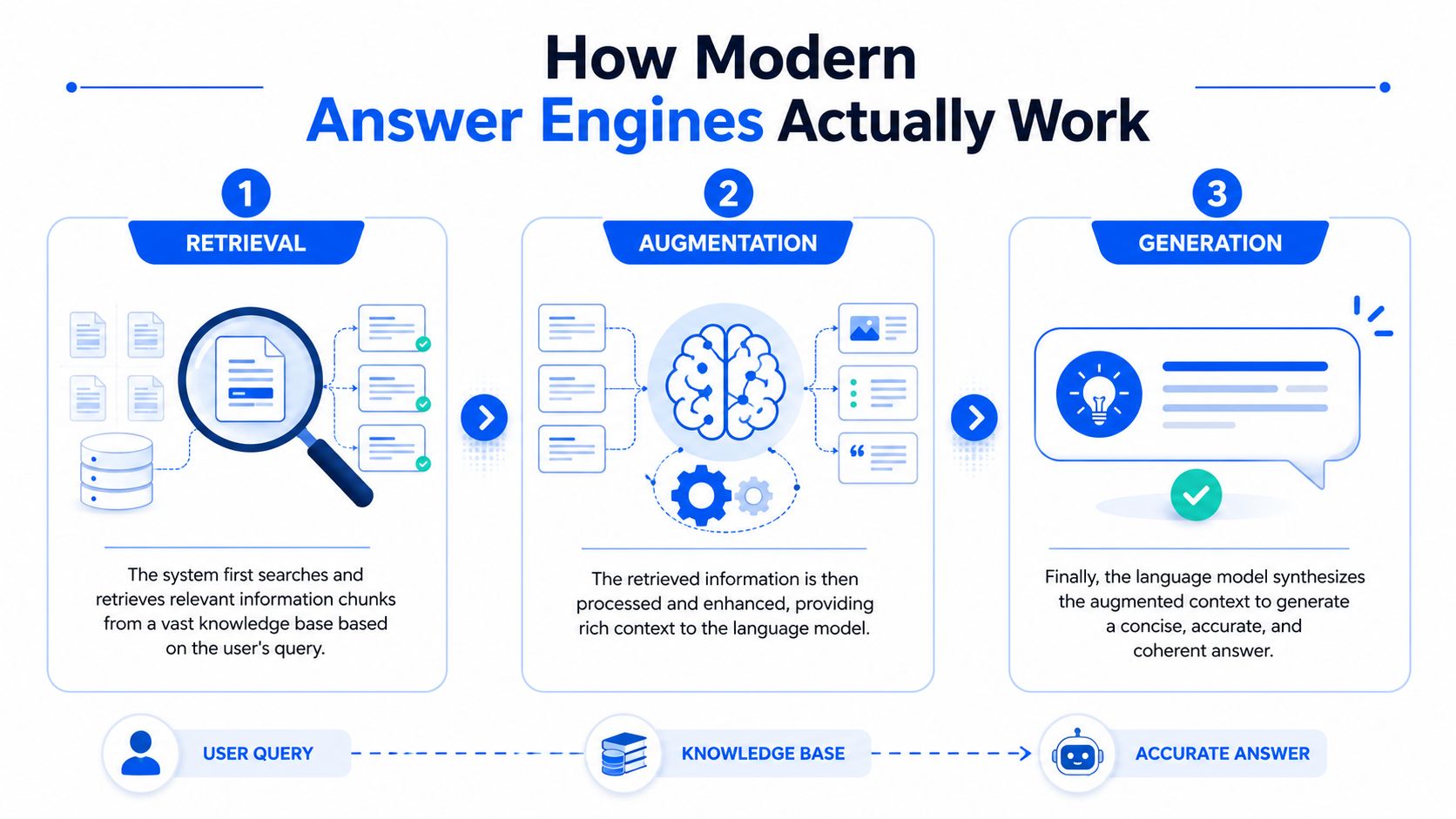
Modern answer engines usually follow a retrieval-augmented pattern with three stages. Retrieval finds relevant passages. Augmentation places those passages into the model's context window. Generation writes the answer from that supplied evidence. Your visibility depends far more on stage one than B2B SaaS teams want to admit.
Retrieval decides whether you get considered
The Toward Data Science explanation of question-answering architectures lays out the core mechanic clearly. In extractive QA systems, a Retriever finds candidate documents and a Reader pulls out the answer span. If retrieval misses the right passage set, the reader has nothing useful to work with.
For an Indian B2B SaaS founder, this should change how you audit content. Stop asking, “Why didn't the model mention us?” Ask, “Did we publish a passage that matched the query with enough specificity to be retrieved?” That is the Probability Gap in practice. Your company may be relevant in a buyer's mind but still absent from the model's candidate set.
A buyer asking, “Which HRMS tools in India support payroll, attendance, and compliance for mid-market companies?” triggers a retrieval task, not a homepage popularity contest. The engine looks across pages, help docs, comparison pages, listings, and third-party commentary for the chunk with the best semantic match and the lowest ambiguity.
Semantic match beats keyword stuffing
Older SEO habits fail here. Repeating category terms helps less than reducing interpretation work for the model. The arXiv paper on LLMs in search indexing explains how LLM-driven systems improve content understanding by using semantic relationships, not only exact terms.
That has a direct writing implication. If your page says “advanced platform for business growth,” retrieval quality drops because the system has to guess what you do. If your page says “employee onboarding software for distributed teams with policy acknowledgements, task workflows, and HRIS integration,” classification gets easier and citation confidence goes up.
That is the articulation barrier. Many SaaS companies know their product well but describe it badly. AI systems punish that faster than Google's old list of blue links ever did.
Site architecture now affects retrieval confidence
Answer engines break pages into chunks. They score those chunks for relevance, then pass a shortlist into generation. So your job is not just to publish a good page. Your job is to publish extractable units of meaning.
Use this standard:
- Use explicit section labels: “Pricing,” “Integrations,” “Security,” “Deployment,” “Best for,” and “Alternatives” are easier to classify than clever headings.
- State the answer before the brand story: Put the core claim in the first useful block under the heading.
- Keep qualifiers close to the claim: Team size, geography, compliance scope, implementation model, and pricing fit should sit in the same passage.
- Design comparison pages like source material: Prioritise factual structure, plain language, and scannable HTML over brand polish.
- Avoid hiding key facts in tabs, images, or PDFs: Retrieval works better when important details are available in visible page copy.
Passage design matters more than many teams expect. A weaker domain can still win citation share if it publishes a cleaner, more self-contained answer block with claim, context, and evidence in one place.
Operator's view: Generation does not fix weak retrieval. It amplifies whatever the system could confidently fetch.
If you need a working process for structuring pages this way, study a practical Generative Engine Optimization framework for B2B SaaS.
The New Arena for B2B SaaS Visibility
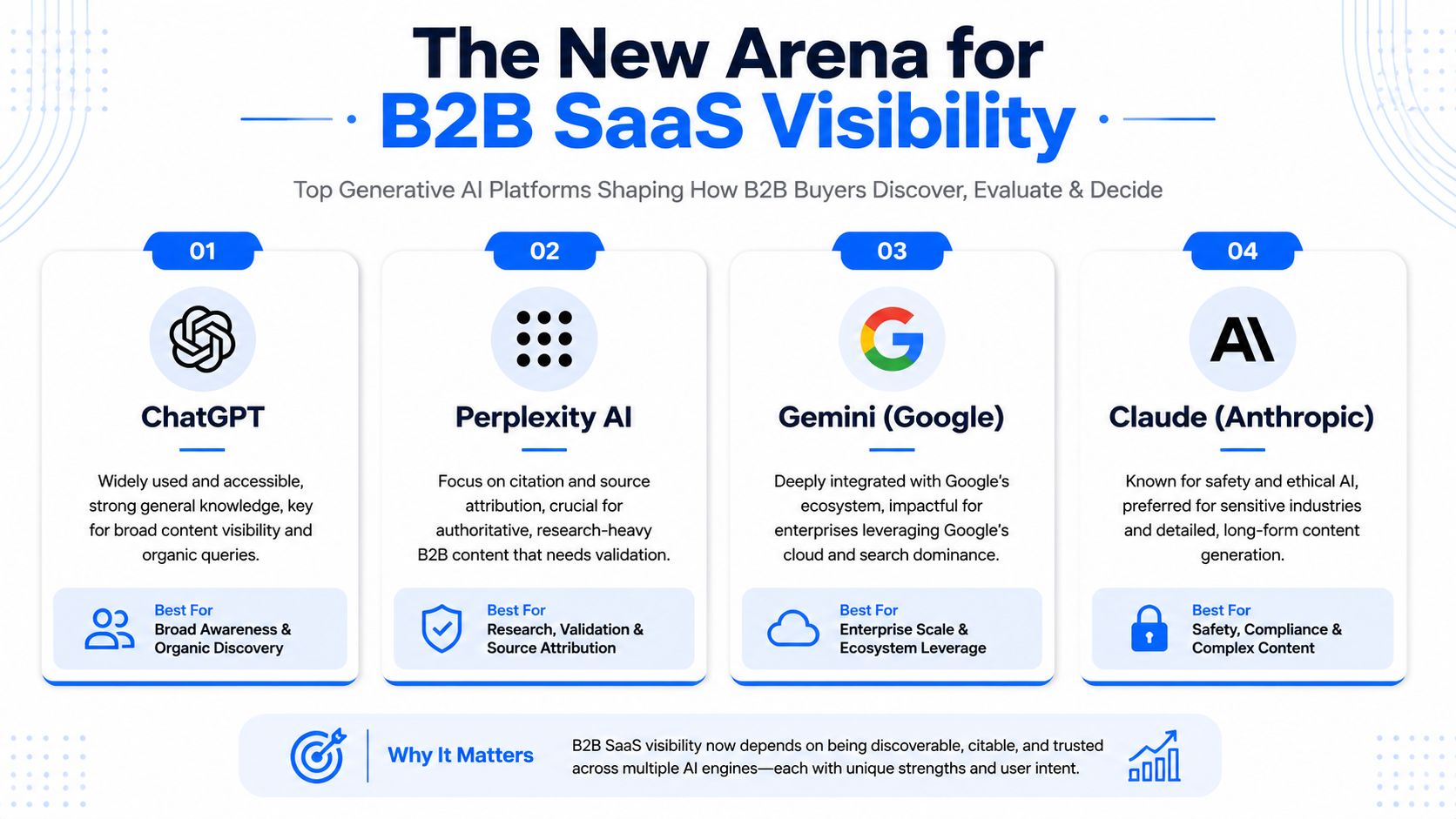
Your buyer isn't using one AI interface. They're moving across ChatGPT, Perplexity, Gemini, and Claude based on habit, task, and trust. If your visibility plan focuses on only one platform, it's incomplete.
The KPI has already changed. According to this discussion of AI share of voice and question-based search, approximately 8% of Google searches are explicit questions, and the more useful metric now is AI share of voice, which tracks how often your brand is mentioned in AI answers on platforms like ChatGPT and Perplexity. That matters more than a ranking report because the buyer may never click through to your site.
Each platform has a different role
ChatGPT is broad and familiar. It shapes early discovery and category-level comparison. Perplexity is stricter about citations, so it matters a lot for research-heavy B2B questions. Gemini sits close to Google's search environment, which matters when users move between classic search and AI summaries. Claude often shows up in longer, more analytical workflows.
That means your brand needs to appear consistently across platforms, not just spike on one. Consistency beats isolated wins.
Visibility means mentions, not just rankings
In our audits, the strongest SaaS brands are the ones that show up as entities. Their company name, product type, integrations, use cases, and proof points are clear enough that AI systems can restate them without confusion.
We've seen this with client work. Chargebee improved visibility by +74%, Whatfix by +84%, and Keka by +82% in AI search monitoring across commercial prompts. Those are the numbers growth teams should care about because they track presence where buyer evaluation now happens.
If you want to understand how that kind of presence is benchmarked across platforms, AI visibility optimization for SaaS brands is the right operating model.
| Platform | What it tends to reward | What you should optimize |
|---|---|---|
| ChatGPT | Broad relevance and source availability | Crawlable commercial pages and strong entity clarity |
| Perplexity | Citation-friendly passages | Clear claims with supporting detail |
| Gemini | Search-connected relevance | Structured content that maps tightly to intent |
| Claude | Detailed explanatory content | Long-form pages with precise, well-organized information |
Your next move is simple. Build a prompt set around your highest-value buying questions and check whether your brand is named, compared, or ignored across these platforms. That's your real category scoreboard.
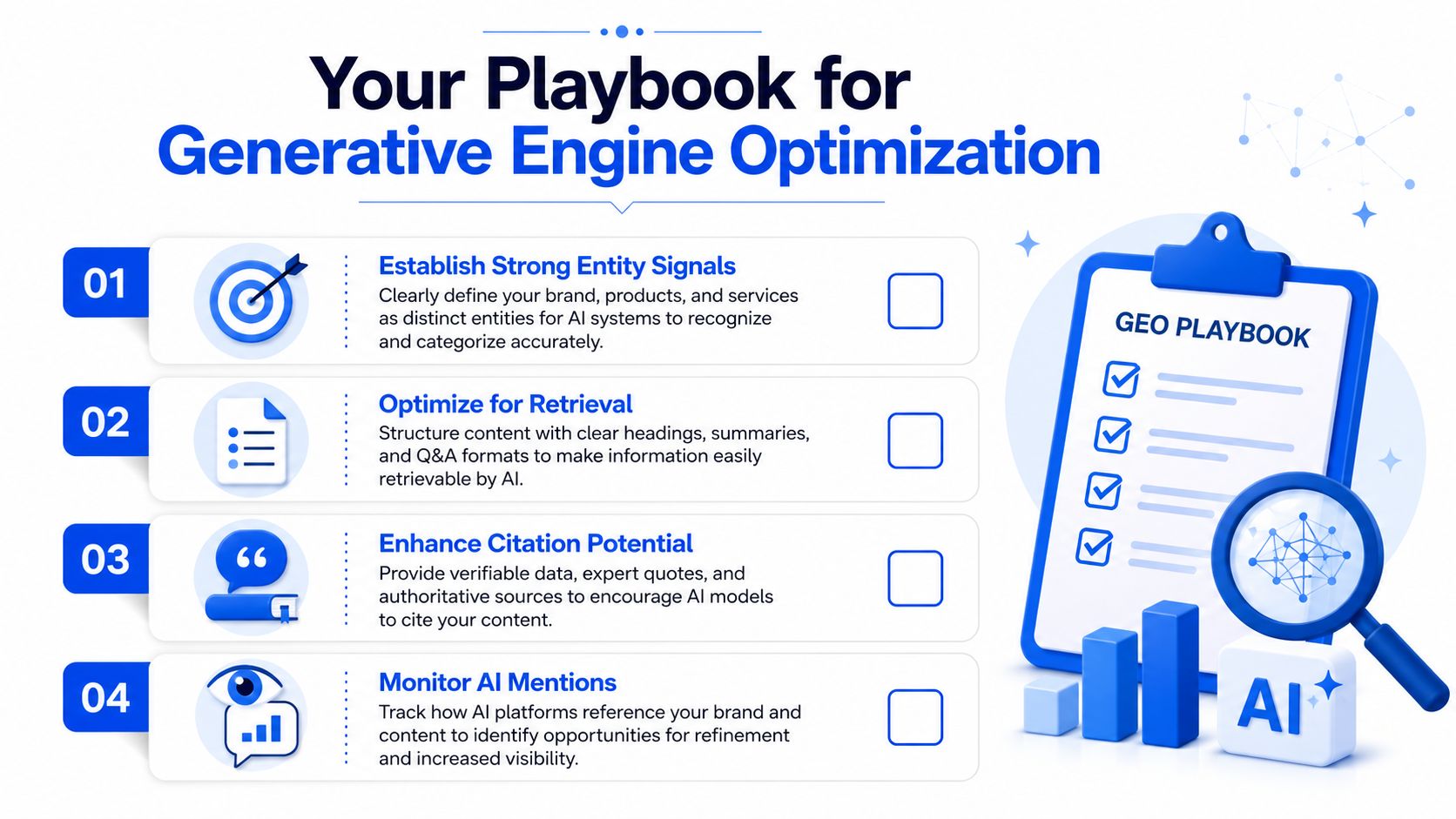
Your Playbook for Generative Engine Optimization
Stop treating AI visibility like a lighter version of SEO. It is a retrieval problem. The winner is not the page that ranks first. It is the source the model can parse fast, verify against other sources, and quote without rewriting your meaning.
That changes the job for a B2B SaaS founder. You are no longer publishing for clicks alone. You are engineering retrieval confidence. If ChatGPT, Gemini, or Perplexity cannot identify your category, isolate your product facts, and restate your proof points cleanly, you lose the answer even with a stronger domain.
The first fix is entity clarity. State your company, product category, ideal buyer, deployment model, pricing logic, integrations, and security posture in plain language. “All-in-one future of work platform” is useless. “Payroll software for Indian SMEs with statutory compliance, ESS, and HRMS workflows” is machine-readable.
Build pages for extraction, not applause
Your commercial pages need to work like source documents. That means structured facts, short claim blocks, and HTML elements models can extract reliably.
For B2B SaaS, one recommendation should move to the top of your sprint list. The LLM Clicks GEO guidance for SaaS recommends turning pricing and comparison pages into clean HTML tables with fields such as pricing tiers, inclusions, feature limits, integration counts, deployment options, and security standards such as SOC2 and HIPAA. That format is easier for answer engines to quote with confidence.
If your pricing is buried in design-heavy cards, JavaScript accordions, screenshots, or PDFs, fix that first.
Use this structure on core commercial pages:
- Comparison tables: competitor names, feature availability, implementation model, support scope, and switching notes
- Pricing tables: tiers, billing logic, minimum commitment, onboarding fees, and qualification rules in plain HTML
- Security blocks: certifications, hosting model, data residency, access controls, and audit details in one visible section
- Integration libraries: integration names, categories, use cases, and native versus API-based status
Close the Probability Gap
The core mistake in AI search strategy is assuming authority will carry weak articulation. It will not. In the iPullRank analysis of the Probability Gap in AI search, analysts argue that answer engines expand queries into many semantic variants and reward passages that directly answer those variations with high retrieval confidence. The same analysis notes that 60%+ of AI citations depend on semantic passage strength, not domain age.
This is the gap many Indian SaaS teams miss. Your product may fit the prompt, but your page may still fail retrieval because the answer is implied, scattered, or wrapped in brand language. That is the Articulation Barrier. The model cannot cite what you never stated plainly.
Write passages in a citation-ready pattern:
- Make the claim clearly
- Add supporting evidence or product detail
- Add buyer context, such as company size, region, compliance need, or implementation model
- Keep the full answer in one passage, not across five disconnected sections
Write the paragraph you want cited. Give the model less to infer.
Cover the infrastructure layer
Answer visibility still depends on basic technical access. The Bay Leaf Digital GEO best practices article says ChatGPT uses Bing for live search scenarios. If Bing cannot crawl, index, or interpret your pages, your odds of appearing in fresh answers fall.
Freshness also affects trust. The Contently article on GEO content maintenance recommends updating cornerstone content on a fixed cadence so models see current facts, examples, and timestamps. Run that process every quarter for pricing, competitor comparisons, integrations, compliance pages, and high-intent use case pages.
If your team needs the operating model behind this work, study this Generative Engine Optimization framework for B2B SaaS.
One final recommendation. Audit your top 20 revenue pages for machine readability, not brand polish. That is where AI answer visibility is won.
Measuring What Matters in the AI Era
Keyword ranking reports no longer answer the question your board cares about. They do not show whether ChatGPT, Gemini, or Perplexity trusts your content enough to surface it in a buying conversation. For B2B SaaS teams, the right scorecard measures retrieval confidence, citation frequency, and answer accuracy on commercial queries.
Start with a fixed prompt set tied to pipeline. Use queries a real buyer would ask before shortlisting vendors, such as payroll software for Indian SMEs, SOC 2 compliant CRM for mid-market teams, or WhatsApp automation tools for Indian fintechs. Then track four outcomes across the major answer engines: whether your brand appears, whether your site gets cited, whether you show up in comparison and implementation queries, and whether the answer describes your product correctly. A wrong answer creates the same revenue problem as no answer. It pushes the buyer toward a rival with cleaner machine-readable content.
The metric stack should look like this:
- Brand mention coverage: Your company appears in relevant AI answers
- First-party citation rate: Your own pages are cited, not just review sites or aggregators
- Commercial intent inclusion: You appear for pricing, alternatives, migration, integration, security, and deployment prompts
- Message accuracy: The model states your category, use case, buyer fit, and product capabilities correctly
- Competitor displacement: Your brand replaces or narrows rival visibility in prompts you should own
Review this weekly. Monthly is too slow if your category is competitive.
Use a simple table and force every metric back to a content or infrastructure decision:
| Metric | What it tells you |
|---|---|
| Brand mentions | Whether answer engines retrieve your brand for target buying queries |
| First-party citations | Whether your pages are trusted enough to support an answer directly |
| Competitor overlap | Which rivals have stronger retrieval confidence in your category |
| Query-level gaps | Which use cases, integrations, or proof pages need new passage-level content |
| Message errors | Where your positioning is being distorted by weak source material |
Founders often overlook the underlying issue. They treat low AI visibility as a distribution problem. It is usually a source quality problem. If Perplexity cites a competitor's implementation page instead of yours, your page probably lacks explicit deployment details, buyer context, or proof statements in a citation-ready passage. If ChatGPT mentions your brand but misstates who you serve, you have an articulation problem. Your site is not expressing category, ICP, and differentiation in a way retrieval systems can extract with confidence.
Run one benchmark before your next board review and keep the benchmark format stable after that. A proper AI search audit for your SaaS brand should show prompt coverage, citation sources, answer accuracy, and the exact pages losing retrieval confidence. That gives you an operating baseline. Another ranking screenshot does not.
Frequently Asked Questions for SaaS Leaders
The hardest questions from founders usually aren't about tools. They're about tradeoffs. Here are the ones that matter.
Buyer questions and direct answers
| Question | Answer |
|---|---|
| Are traditional SEO and GEO the same thing? | No. Traditional SEO focuses on rankings and clicks. GEO focuses on whether AI systems can retrieve, trust, and mention your brand inside answers. You still need crawlability and relevance, but the success metric has changed. |
| Why does our site rank on Google but barely appear in ChatGPT or Perplexity? | Because ranking a page and retrieving a passage are different tasks. Your site may be visible to classic search while still failing the retrieval step that answer engines depend on. Weak entity clarity, poor page structure, and hard-to-extract information are common causes. |
| What is the Probability Gap, and why should a SaaS founder care? | It's the gap between old deterministic SEO thinking and how AI search actually works. Answer engines expand queries, test semantic variants, and cite passages with higher retrieval confidence. If your page isn't built for that, your authority won't carry you. |
| How should we handle vague buyer queries? | You need to write for latent intent, not just exact wording. The Search Engine Land discussion of the Articulation Barrier notes that users are 158% more productive with AI for straightforward questions, but performance drops sharply when users can't clearly articulate the problem. Your content should cover the hidden sub-queries around pain points, use cases, and implementation concerns. |
| Which pages should we fix first? | Start with pricing, alternatives, integrations, security, and high-intent solution pages. Those pages influence commercial AI answers far more directly than generic educational blog posts. |
| Do we need a new content strategy or just better formatting? | Usually both. Formatting helps retrieval. Strategy decides which buyer questions deserve purpose-built pages. If your team only reformats old content without tightening the narrative, the gains will be limited. |
Founders usually ask whether AI search is a future problem. It isn't. Buyers are already using these interfaces to shortlist vendors before they ever book a call.
If you want a founder-level view of where your brand stands in ChatGPT, Gemini, Perplexity, and Claude, talk to LLMBuddy. We help Indian B2B SaaS teams improve AI visibility with structured content, stronger entity signals, and citation-focused GEO work. Start with an AI search audit or request a demo.