
If your growth plan still depends on ranking first on Google, you're already late. As of March 2026, ChatGPT holds a 78.16% global usage share among AI search engines, ahead of Gemini, Perplexity, Copilot, and Claude, which means AI visibility now shapes how buyers discover software brands (AI search engine usage data). That changes the brief. You aren't just looking for the best AI SEO agency. You're choosing a partner that can get your brand cited inside ChatGPT, Gemini, Perplexity, and Claude.
At LLMBuddy, we've seen this in client work across Indian B2B SaaS. Chargebee recorded +74% AI visibility growth, Whatfix +84%, and Keka +82% after focused GEO work. Those gains didn't come from chasing rankings alone. They came from fixing entity clarity, content extractability, schema, citation pathways, and platform-specific retrievability. Ankur Pandey and our team have audited over 100 B2B SaaS brands, and one pattern keeps repeating. Strong Google rankings often fail to translate into AI answers.
Here are seven agency partners worth evaluating if your company cares about pipeline, not vanity metrics.
1. LLMBuddy
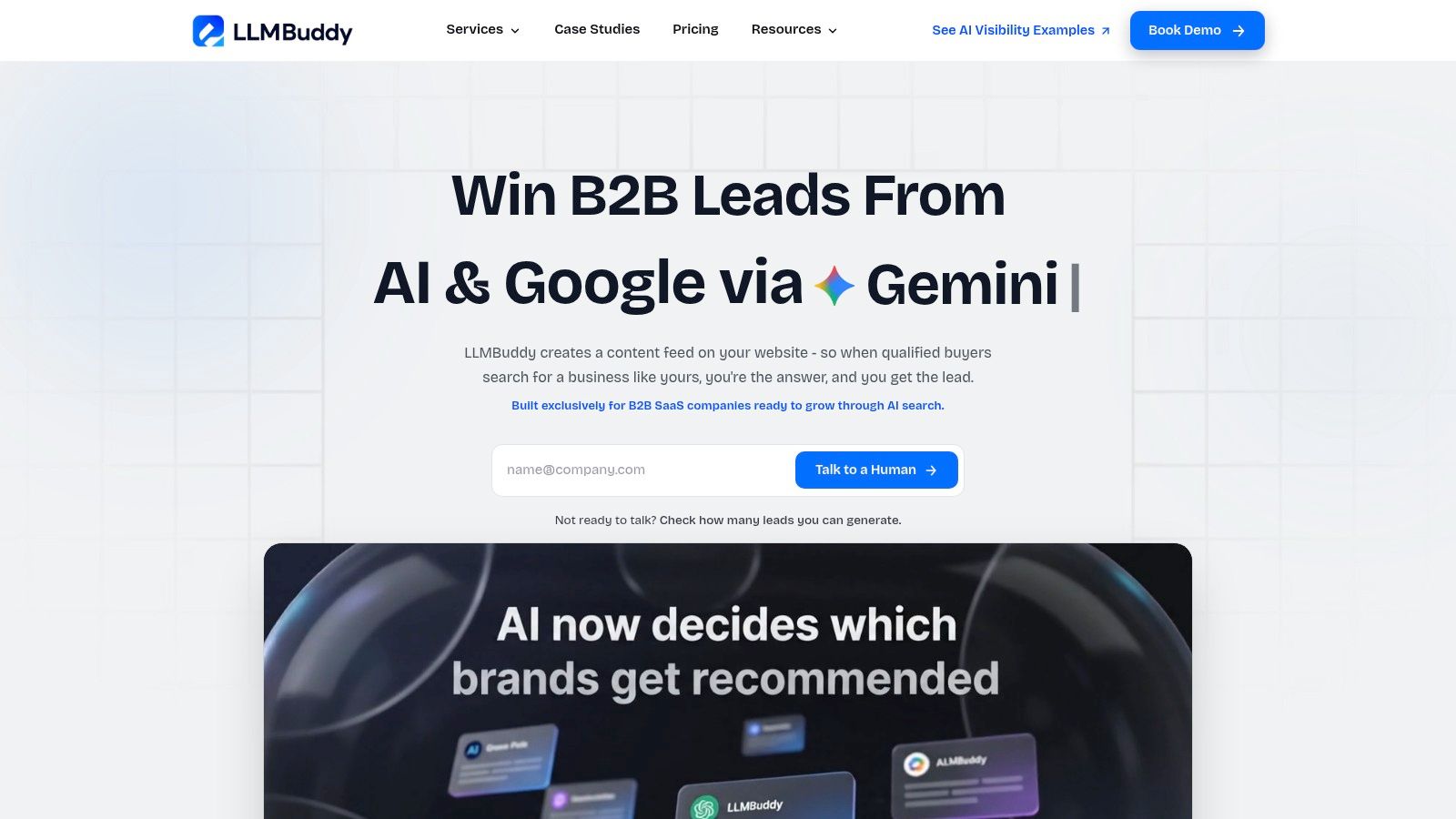
LLMBuddy is the clearest fit for Indian B2B SaaS companies that need a specialist, not a generalist. The agency was built around Generative Engine Optimization for software brands, with execution across India, the US, and the UAE. That matters because AI search programs fail when the agency treats GEO like a thin layer on top of old SEO.
The core offer is practical. You get an AI Search Audit, cross-engine AI SEO, ChatGPT optimization, retrieval-friendly page architecture, schema and llms.txt work, AI content restructuring, citation pathway development, and ongoing monitoring across ChatGPT, Gemini, Perplexity, and Claude. If your team is already producing content but still isn't showing up in AI answers, that's usually the missing stack.
Why LLMBuddy stands out for SaaS
Most agencies still confuse SEO automation with AI search visibility. LLMBuddy doesn't. The work starts with entity and topic mapping, then moves into page structure, third-party citation pathways on platforms like G2 and industry publications, and weekly measurement against actual AI outputs. For B2B SaaS, that sequence is right because software buying journeys are entity-heavy. Buyers ask for best tools, alternatives, comparisons, integrations, and category leaders.
We've seen this with Chargebee, Whatfix, and Keka. Chargebee improved AI visibility by +74%, Whatfix by +84%, and Keka by +82% after focused GEO execution. LLMBuddy also reports an average +87% visibility growth within roughly 90 days across its programs. That's the strongest B2B SaaS-specific signal on this list because it ties methodology to named software brands.
Practical rule: If an agency can't show you how it improves retrievability across ChatGPT, Gemini, Perplexity, and Claude, you're still buying traditional SEO with new packaging.
Best fit and trade-offs
LLMBuddy is best for founders, CMOs, product marketers, and SEO leaders who want a partner built for software demand capture, not ecommerce or local SEO. The agency is especially strong if your brand sells in India but competes globally, because you need visibility in US-led AI platforms without losing regional market context.
There are trade-offs. LLMBuddy is highly specialized, so it's not the right fit for most consumer brands. Public pricing isn't listed. And, like any serious GEO program, results depend on ongoing work rather than one-time fixes.
If you're evaluating them, start with their AI SEO services. Then ask for a platform-level audit, not a keyword deck.
2. Seer Interactive
Seer Interactive is a strong option if your team wants a measurement-led GEO partner with a documented point of view. Their value isn't that they're loud about AI. It's that they publish a defined methodology and connect AI visibility work back to analytics discipline.
That makes Seer appealing for larger SaaS teams where marketing leadership needs internal justification. If your SEO lead, revenue ops lead, and CMO all need to align on how AI search is measured, Seer is easier to work with than agencies that only sell broad positioning language.
Where Seer fits best
Seer makes sense for companies that already have mature SEO operations and now need a more formal AI search layer. Their resources and education around generative search help in-house teams get smarter, which is useful if you want your agency to transfer knowledge instead of staying opaque. You can review their approach on the Seer Interactive GEO page.
Their limitation is typical of enterprise-leaning agencies. GEO packaging and pricing aren't public, and the engagement model appears custom. For mid-market SaaS teams that want quick movement, that can slow things down.
You should shortlist Seer if your buying committee cares about analytics rigor as much as execution.
A practical next step is to ask them how they separate classic SEO reporting from AI answer visibility reporting. If the distinction isn't clear in the first conversation, move on.
3. Amsive
Amsive is useful for teams that need an agency fluent in executive communication. They frame the problem well for companies moving from old search assumptions into answer engines, and they publicly discuss AEO, GEO, and LLM optimization as connected but distinct layers.
For B2B SaaS, that can be helpful if your organization is still aligning on terminology. Some leadership teams are stuck debating labels while competitors are already building citation paths and answer-ready pages. Amsive is one of the agencies that can probably help settle that internal confusion quickly.
What they do well
Amsive integrates answer engine optimization into broader SEO programs and positions visibility across AI Overviews and LLMs as part of modern search strategy. They also reference tooling and partnerships for tracking mentions and citations, which suggests they understand the reporting problem. You can review their service direction on the Amsive SEO services page.
The issue is clarity at the operating level. Using multiple labels can make internal reporting messy unless your team sets one KPI framework early. Pricing also isn't public, which is common in this market but still inconvenient.
Here's the test I'd use if you're considering Amsive:
- Ask for KPI definitions: Get a clean explanation of how they report AI mentions, citations, and share of voice.
- Ask for platform coverage: Make sure ChatGPT, Gemini, Perplexity, and Claude are discussed explicitly.
- Ask for SaaS-specific examples: Generic enterprise search work won't tell you enough about software buyer journeys.
If your team needs a polished enterprise partner and can manage custom scoping, Amsive is credible.
4. Go Fish Digital
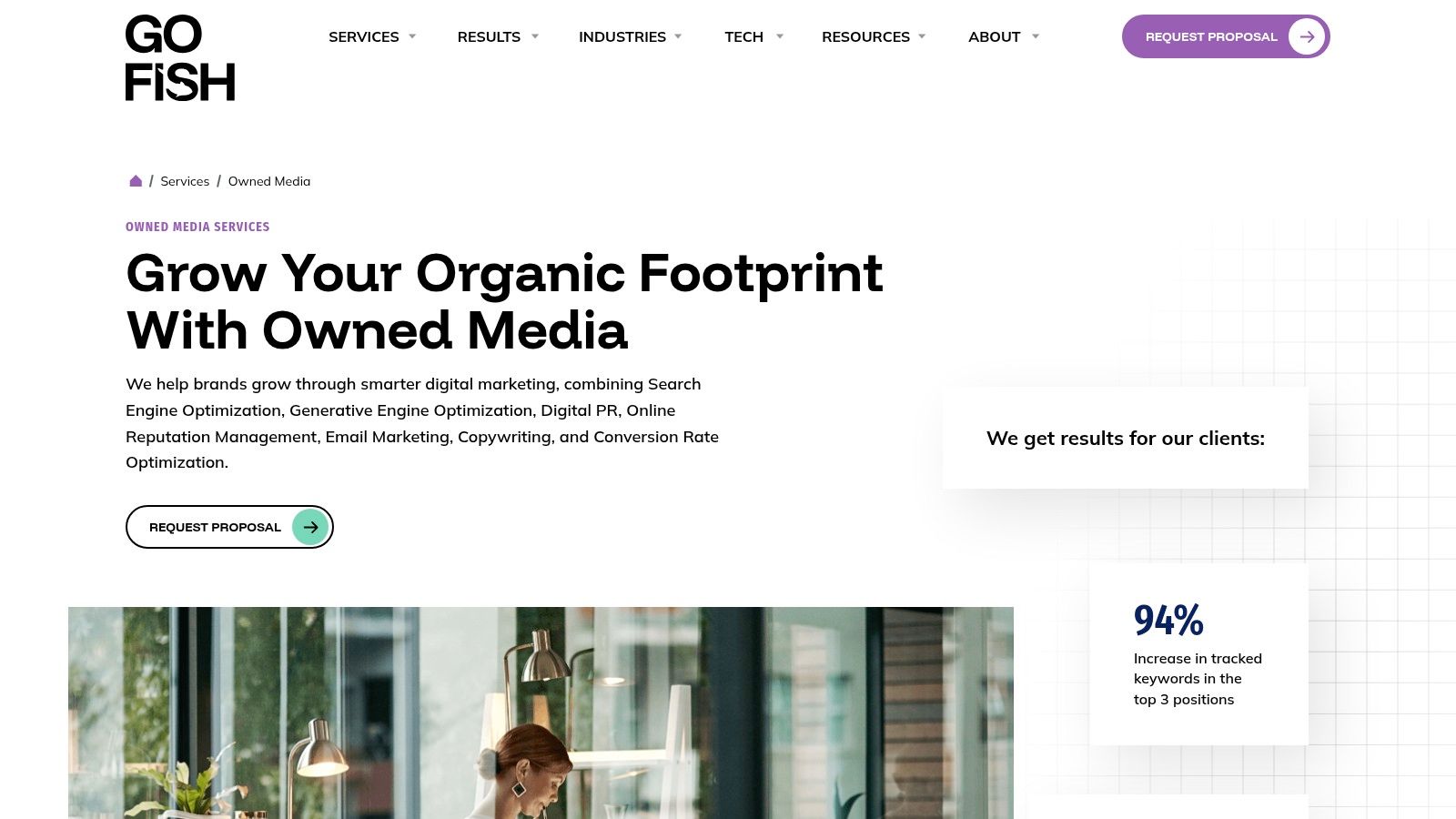
Go Fish Digital is the agency to look at if your AI search problem is partly a reputation and citation problem. That matters more than many SaaS teams admit. Technical fixes help, but LLMs also pull confidence from third-party references, digital PR, and off-site authority.
For companies entering crowded categories, that matters a lot. If your product is good but your brand footprint is thin outside your own domain, AI systems have less evidence to work with.
Why digital PR matters in GEO
Nearly 90% of pages cited in ChatGPT search results rank at position 21 or lower in traditional organic search, which shows how weak the old ranking-to-citation assumption has become (ChatGPT citation benchmarking). That's why agencies with strong digital PR and citation development often outperform pure content shops in AI search.
Go Fish Digital sits in that useful middle ground. They combine GEO, SEO, content, and digital PR. For SaaS firms trying to improve visibility in recommendation-style prompts, that blend can be more effective than publishing another set of keyword articles. Their owned media services are outlined on the Go Fish Digital services page.
Best use case
Go Fish fits best if your company already has a functioning content engine but lacks external authority signals. They are less appealing if you want highly detailed public proof of GEO outcomes before signing, because the public-facing evidence is summarized more than thoroughly broken out.
If your brand isn't present on review platforms, industry publications, and trusted comparison sources, AI systems have fewer reasons to mention you.
The practical takeaway is simple. Ask Go Fish to show how they build third-party citation pathways for software categories, not just backlinks.
5. iPullRank
iPullRank is the technical pick on this list for teams that want engineering depth. Their relevance engineering angle is a better fit for complex SaaS websites than agencies that mainly produce blog content and call it strategy.
That matters if your site has documentation layers, product hubs, use-case pages, integration libraries, knowledge base content, and a messy internal linking structure. In those cases, AI visibility problems usually start with architecture, not copy.
Why iPullRank deserves a look
The strongest reason to consider iPullRank is their information retrieval mindset. GEO is not just a content formatting task. It's a retrieval problem. If your site doesn't express entities, topics, and relationships clearly, LLMs won't interpret your brand cleanly even if your copy is strong.
For many mid-market and enterprise SaaS companies, that's the core issue. Traditional rank tracking can hide it for months. iPullRank's agency website shows that they think in terms of technical search systems, not only editorial output.
Their drawback is fit. Smaller SaaS companies may find the approach too enterprise-leaning, both in process and likely budget. Public materials also focus more on philosophy and methodology than on detailed AI citation reporting examples.
A smart buying move here is to ask them to audit one product line or content cluster first. If they can show where retrieval breaks down across your architecture, you'll know quickly whether they're the right technical partner.
6. Victorious
Victorious is one of the cleaner choices if you want a process-led answer engine optimization partner without a lot of noise. Their public positioning is straightforward. They focus on making pages answer-ready through on-page structure, internal linking, schema, content clusters, and entity development.
That sounds basic until you remember how often AI visibility fails because companies skip those basics. A lot of SaaS brands want mentions in ChatGPT or Gemini while their core pages are still written like category landing pages from five years ago.
Where Victorious is strong
Victorious is a good fit for teams that need operational clarity. Their AEO service page lays out concrete deliverables, and that can help if your internal team needs a clear line from technical work to content work. You can review the offer on the Victorious AEO page.
This is also where they have a limitation. Public proof of AI citation lift appears thinner than you'd want from a pure-play GEO specialist. So I'd treat Victorious as a strong process partner, but not necessarily the first choice if AI-native reporting depth is your top criterion.
Use this filter before you buy:
- Choose Victorious if: Your site needs structure, schema, internal linking, and entity cleanup before advanced GEO.
- Skip Victorious if: You need a partner with stronger public evidence around LLM citation outcomes.
For many SaaS brands, answer readiness is still a missing layer. Victorious can solve that.
7. Brainlabs
Brainlabs is the broadest agency on this list. If your company wants AI visibility tied to a larger paid, owned, and analytics setup, they're worth evaluating. That's particularly relevant for enterprise SaaS firms where SEO, paid search, media, and experimentation already run together.
Their AI visibility framing may not be as tightly defined as specialist GEO firms, but scale is the point here. Brainlabs can support multi-market programs where AI search isn't a standalone channel decision.
When Brainlabs makes sense
Google AI Overviews now appear in approximately 25% of all Google searches, with prevalence reaching up to 48% in commercial B2B verticals, and 91% of marketers actively use AI in SEO workflows while 70% report higher ROI from AI-integrated SEO strategies (AI SEO adoption and AI Overview prevalence). For enterprise teams, that means AI search can't stay in a test budget forever. It has to connect to broader demand capture.
That's where Brainlabs has a credible angle. Their main site reflects broader media and analytics capability, which can help if your leadership team wants AI visibility measured alongside other growth channels. The downside is terminology drift. You'll need to align KPI definitions early so “AI visibility” doesn't turn into a vague umbrella term.
Brainlabs is a fit if you need AI search folded into a larger go-to-market system, not if you want a narrow GEO specialist.
The next step is to ask how they isolate AI answer performance from general SEO and media performance. If they can't separate those clearly, the reporting won't help you make budget decisions.
Top 7 AI SEO Agencies Comparison
| Service | Implementation Complexity 🔄 | Resource Requirements ⚡ | Expected Outcomes 📊⭐ | Ideal Use Cases 💡 | Key Advantages ⭐ |
|---|---|---|---|---|---|
| LLMBuddy | 🔄 Moderate–High: entity mapping, schema, citation engineering | ⚡ Moderate: B2B SaaS expertise; multi‑month program and monitoring | 📊⭐ Measurable AI visibility lift (reported +87% avg ≈90 days); per‑platform metrics | 💡 B2B SaaS founders, growth and product marketers needing AI assistant citations | ⭐ B2B SaaS specialization; end‑to‑end GEO + monitoring; citation pathway engineering |
| Seer Interactive | 🔄 Medium: evidence‑driven testing and GEO measurement | ⚡ Moderate–High: analytics heavy; custom engagements | 📊⭐ Defensible, analytics‑backed GEO improvements and ongoing tracking | 💡 SaaS teams wanting data‑driven, testable GEO programs | ⭐ Transparent methodology, thought leadership, measurement focus |
| Amsive | 🔄 Medium: AEO/GEO framing across AI Overviews and LLMs | ⚡ Moderate: tooling and partner integrations for monitoring | 📊⭐ Cross‑channel AI mention and citation visibility improvements | 💡 Enterprise SaaS transitioning from SEO to AI search strategies | ⭐ Clear executive narrative; tooling/partnership approach; enterprise experience |
| Go Fish Digital | 🔄 Medium: combines SEO, content and digital PR for GEO | ⚡ Moderate–High: PR outreach plus content/SEO coordination | 📊⭐ Better third‑party citations and conversions in AI contexts | 💡 SaaS needing integrated SEO + digital PR to build reputation signals | ⭐ Strong SEO + digital PR backbone; applied GEO case work |
| iPullRank | 🔄 High: relevance engineering with information‑retrieval methods | ⚡ High: engineering resources and advanced technical SEO skills | 📊⭐ Technical retrieval and relevance gains for complex sites | 💡 Enterprise/mid‑market SaaS with complex architectures and data layers | ⭐ Engineering‑led methodology; information retrieval expertise |
| Victorious | 🔄 Medium: AEO integrated with core SEO (schema, linking, clusters) | ⚡ Moderate: SEO‑focused implementation and content work | 📊⭐ Pages prepared to be "answer‑ready" for AI systems | 💡 Brands seeking process‑driven AEO deliverables tied to SEO | ⭐ Clear, process‑driven AEO with concrete deliverables |
| Brainlabs | 🔄 Medium–High: AI visibility plus cross‑channel strategy and experiments | ⚡ High: scale, media stack and analytics capabilities | 📊⭐ Integrated paid/owned gains and ongoing AI search insights | 💡 Enterprise SaaS seeking cross‑channel experimentation and market coverage | ⭐ Scale and cross‑channel capabilities; active AI search research and POVs |
Your Next Step in AI Search Visibility
The agencies above are not interchangeable. Some are strong at technical architecture. Some are better at digital PR. Some are set up for enterprise buying committees. If you're an Indian B2B SaaS company, the right choice depends on whether you need foundational answer readiness, stronger citation signals, or a full GEO operating system.
What shouldn't be up for debate is the shift itself. Google rankings no longer guarantee AI visibility. A 2025 study cited by Ziptie found that 40% of top-ranked Google results are never cited by LLMs like ChatGPT or Perplexity (LLM citation gap analysis). That's why so many SaaS teams feel confused right now. They rank well, traffic looks acceptable, but the brand is absent from the tools buyers increasingly use for vendor discovery.
The business case is stronger than most companies realize. AI-referred B2B visitors convert at an average rate of 14.2%, versus 2.8% for standard Google organic traffic, which means the traffic you earn from AI answers is often higher intent from the start (B2B AI search conversion data). And for content format, the winning pattern is clear. Long-form, ungated guides with clear Q&A structure perform best for AI inclusion because models can parse and extract them more cleanly (GEO content structure guidance).
If you want the best AI SEO agency for SaaS, don't ask who has the biggest team or the flashiest deck. Ask who can make your brand retrievable across ChatGPT, Gemini, Perplexity, and Claude. Ask who can show entity work, citation pathways, and platform-level reporting. Ask who understands SaaS buying journeys in India and outside it.
See where your brand stands right now. Our AI Search Audit gives you a visibility score across major platforms, a benchmark against competitors, and a clear opportunity map.
FAQ
What should I look for in the best AI SEO agency for SaaS
Look for a partner that works on retrievability, not just rankings. That means entity-topic mapping, schema, llms.txt, answer-ready page structure, and third-party citation development. If the agency can't explain how it improves visibility in ChatGPT, Gemini, Perplexity, and Claude, it isn't doing real GEO.
How is GEO different from traditional SEO
Traditional SEO focuses on ranking pages in standard search results. GEO focuses on helping AI systems cite and recommend your brand in generated answers. The gap matters because top Google results often don't get cited by LLMs, which means ranking alone no longer protects discovery.
Does AI search visibility actually affect revenue
Yes, especially for B2B SaaS. AI-referred visitors tend to convert at a much higher rate than standard organic visitors, which is why AI visibility should be treated as a revenue channel, not a branding experiment. For SaaS teams, the right KPI isn't just mentions. It's qualified demand and pipeline impact.
Which AI platforms matter most right now
ChatGPT matters most because it holds the largest share of AI search usage. Gemini, Perplexity, and Claude also matter, especially if your buyers compare vendors, ask technical questions, or want cited answers. A good agency won't optimize for one platform in isolation.
How do I know if my brand is invisible in AI answers
Run branded and non-branded category prompts in ChatGPT, Gemini, Perplexity, and Claude. Check whether your brand appears, how it's described, and which sources get cited instead. If competitors show up consistently and you don't, you already have an AI visibility problem.
If your SaaS brand wants to win buyer discovery inside ChatGPT, Gemini, Perplexity, and Claude, LLMBuddy is built for that job. Start with an audit, see where your retrievability breaks, and fix the gaps before your competitors lock in the citations that should belong to you.