
Most advice on Generative AI content marketing is aimed at teams that want to publish faster. That's the wrong target for a B2B SaaS company selling to serious buyers.
Your buyer isn't asking ChatGPT, Gemini, Perplexity, or Claude for a random blog post. They're asking for vendors, comparisons, migration paths, alternatives, implementation guidance, and category leaders. If your brand isn't cited in those answers, your content program is underperforming, even if your team is shipping articles every week.
That's the shift Indian SaaS CMOs need to understand. Generative AI content marketing is no longer just a production problem. It's a citation problem.
Why Most AI Content Advice Is Wrong for SaaS
The popular playbook says this: use AI to write more, publish more, and scale content output. That works if your goal is raw volume. It fails if your goal is pipeline from high-intent buyers.
The reason is simple. Generative AI has become the dominant engine for content creation, with 93% of marketers using AI to generate content faster. However, with 86.5% of top-ranking webpages now containing some AI-generated content, simple production is no longer a competitive advantage, according to AI marketing statistics compiled by Jony Studios.
If everyone can draft faster, speed stops being your edge.
Volume creates sameness
In B2B SaaS, generic content is expensive. It doesn't just waste budget. It weakens positioning. Buyers comparing payroll platforms, product analytics tools, customer onboarding software, or finance automation products don't want padded explainers. They want precise claims, sharp category framing, and proof that your company actually knows the problem.
That's why a content engine built only around AI drafting usually collapses into three bad outcomes:
- Generic positioning: your pages sound like every other SaaS site in your category.
- Weak retrieval signals: AI engines struggle to identify why your brand should be cited.
- Low trust: your copy reads polished, but thin.
Practical rule: Don't ask whether AI helped your team publish faster. Ask whether your brand appears in buyer-facing prompts on ChatGPT, Gemini, and Perplexity.
B2B buyers need authority, not output
For SaaS, the job of content has changed. Your blog isn't just trying to rank in Google. It's trying to become source material for answer engines. That means your best assets are often not thought-leadership posts. They're comparison pages, capability pages, implementation guides, pricing explainers, and category definitions.
If you're still treating AI as a writing assistant only, you're thinking too small. The stronger move is to make your content retrievable, quotable, and attributable. That's the logic behind ChatGPT optimization for B2B brands.
The teams winning here aren't producing the most content. They're producing the most citable content.
The Real Goal Is Generative Engine Optimization
Traditional SEO tries to get your page ranked. Generative Engine Optimization, or GEO, tries to get your brand cited inside the answer.
That difference matters. A Google ranking gives you a chance at a click. A citation in ChatGPT, Gemini, Perplexity, or Claude puts your brand inside the recommendation itself.
Here's the visual version of that shift.
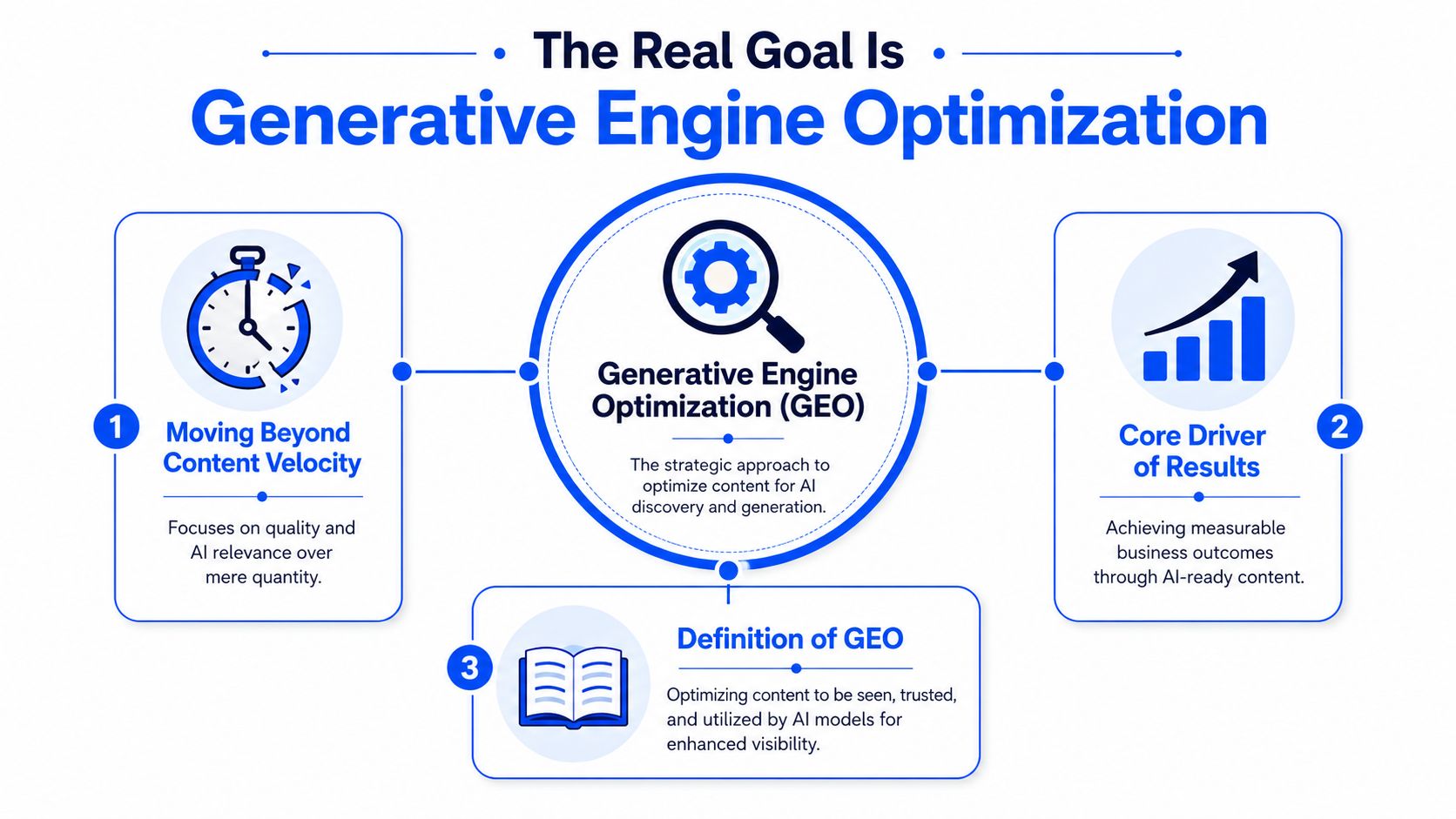
SEO gets you indexed. GEO gets you referenced
Think about it this way. In traditional search, your page is one result among ten blue links. In AI search, the model acts like an analyst compiling a short list. It doesn't just retrieve documents. It synthesizes a recommendation.
So your job changes:
| Traditional SEO | GEO |
|---|---|
| Rank pages | Earn citations |
| Target keywords | Build entities and topic authority |
| Win clicks | Win inclusion in answers |
| Measure sessions | Measure mention share and visibility |
That's why the old “more content equals more traffic” logic breaks down.
The emerging discipline of GEO is critical because traditional SEO is not enough. Google's own policies are shifting, and our data shows B2B brands can achieve +87% visibility growth in AI search within 90 days by aligning entity signals, structured data, and third-party citations with LLM retrieval patterns, as stated in this analysis of generative AI and content marketing risks.
The right mental model for SaaS CMOs
Stop thinking of your content as a library. Start thinking of it as interview material for an AI researcher.
The model is looking for sources it can trust, summarize, and cite. If your category pages are vague, your comparisons are self-serving, and your product language is inconsistent across the web, you won't get picked. If your brand is clearly defined, externally referenced, and supported by structured content, you have a shot.
That's the operating model behind Generative Engine Optimization services.
You don't need your brand to publish the most pages in the category. You need the model to treat your brand as one of the safest sources to mention.
For Indian SaaS companies, this matters even more in global markets. Your sales team may be targeting the US, UAE, or Europe, but AI assistants don't care where your HQ is. They care whether your brand shows up as a credible answer.
A Practical Framework for AI-Ready Content
Teams often overcomplicate this. The core work comes down to four connected moves. In our audits and client programs, this is the framework that turns AI content from a writing workflow into a visibility system.
For context, this is the operating model many SaaS teams need.
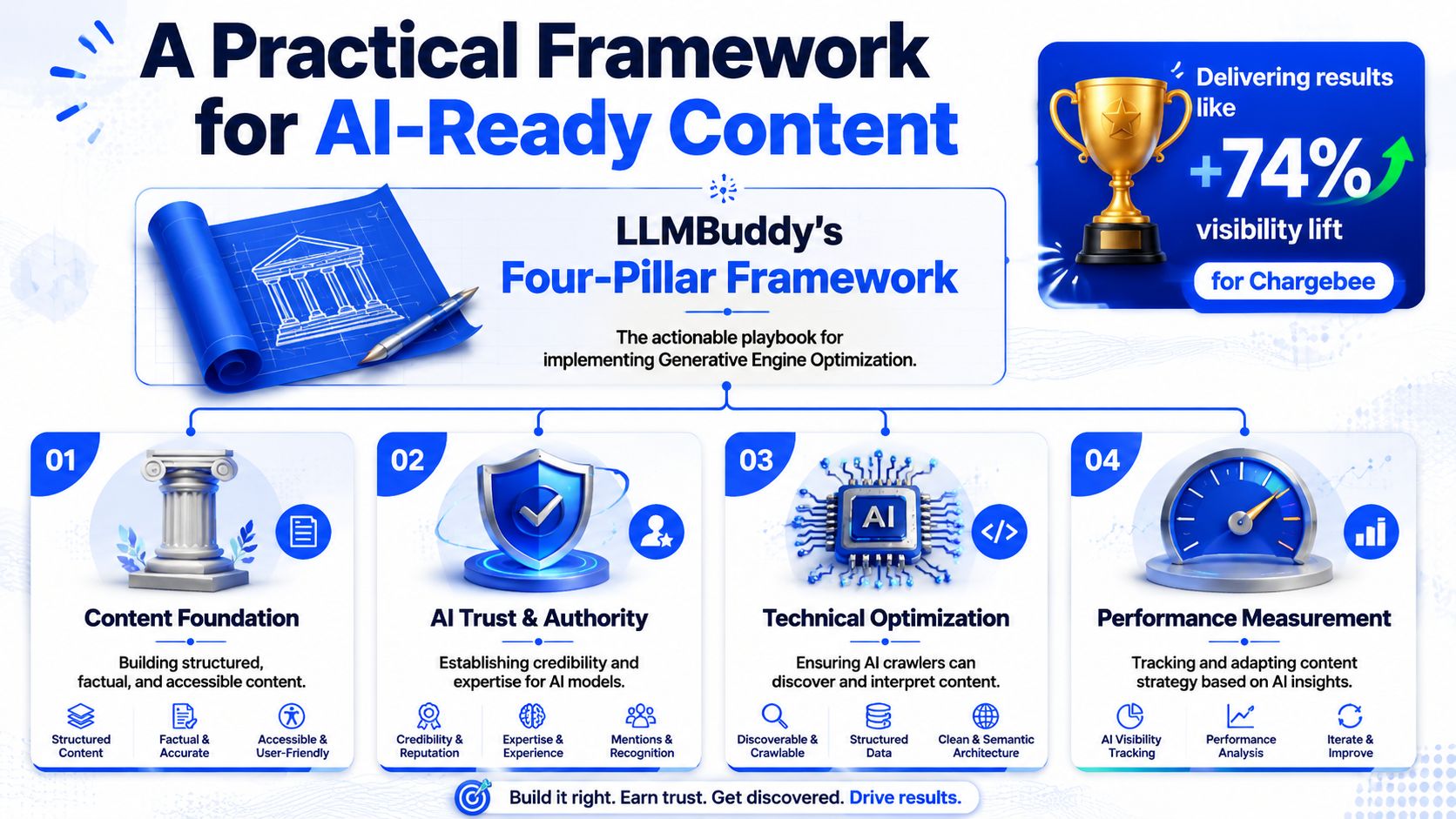
We've seen this directly with client programs. Chargebee recorded +74%, Whatfix +84%, and Keka +82% in AI visibility improvements across tracked prompt sets. Those results didn't come from pumping out AI blogs. They came from restructuring the content system around retrieval, authority, and citations.
Start with high-intent query strategy
The first mistake most SaaS teams make is building content around broad awareness keywords. AI search doesn't reward that nearly as much as buyer intent.
You should map prompts that buyers use in ChatGPT, Gemini, Claude, and Perplexity. Think in terms of:
- Alternatives queries: “[Competitor] alternatives”
- Comparison prompts: “Best HRMS for mid-market companies in India”
- Use-case prompts: “Payroll software for multi-entity teams”
- Evaluation prompts: “Tools like Whatfix for onboarding”
A real client example makes the point. One SaaS client generated 20+ free trial signups per month solely from AI search channels by targeting high-intent prompts in ChatGPT, Claude, and Perplexity and ensuring the brand appeared in comparison and listicle-style formats. That's not a traffic vanity win. That's bottom-funnel demand.
Do this: build pages around decision-stage prompts.
Not that: publish another “what is digital transformation” article nobody asks an AI assistant.
Build retrieval-friendly content architecture
Content structure holds greater importance than is often recognized. LLM benchmark data shows 44.2% of all citations are concentrated in the first 30% of text, and content with embedded statistics sees 28-40% higher visibility in AI search results, according to Averi's AI content marketing benchmarks report.
That means your opening section has to do real work.
Use the first part of a page to establish:
- what the page is about
- which entities matter
- what your product does
- what evidence supports the claim
If your strongest point sits halfway down the page, the model may never use it.
Editorial advice: Put proof near the top. Don't bury your strongest differentiator under a long intro your buyer won't read and the model won't cite.
A capability page should open with a clear problem statement, product fit, named use cases, and factual support. A comparison page should state who the page is for, where each product fits, and what trade-offs matter. This is the core of AI content optimization for citation readiness.
Use research-oriented prompting inside your workflow
AI is useful in content marketing. Its effective deployment isn't always reflected in widespread use.
Don't treat ChatGPT or Claude as a content machine first. Treat them as a research assistant that helps your team find semantic gaps, missing objections, comparison angles, and unclear product claims. Ask the model what a technical buyer would want clarified. Ask which assumptions your page leaves unresolved. Ask how a competitor is framing the category.
That gives your writers sharper inputs. It doesn't replace them.
Do this: use AI to expose weak reasoning in your draft.
Not that: paste a topic into a model and ship the output after light editing.
Engineer entity and citation signals
Most content teams operate with zero process; they write pages, but they don't build the external and structural signals that AI engines use to validate a brand.
You need consistency across your website, product pages, review profiles, author bios, comparison content, and third-party mentions. You also need category language that stays stable. If your homepage says “workforce intelligence platform,” your G2 profile says “HR software,” and your blog says “people ops operating system,” you're making retrieval harder.
For technical and industrial categories, this gets even more obvious. We've seen B2B manufacturer clients move from zero to 5–10 AI-attributed RFQs per month within exactly 90 days after publishing capability pages and engineering-grade content. Precision wins.
The Technical Layer for AI Visibility
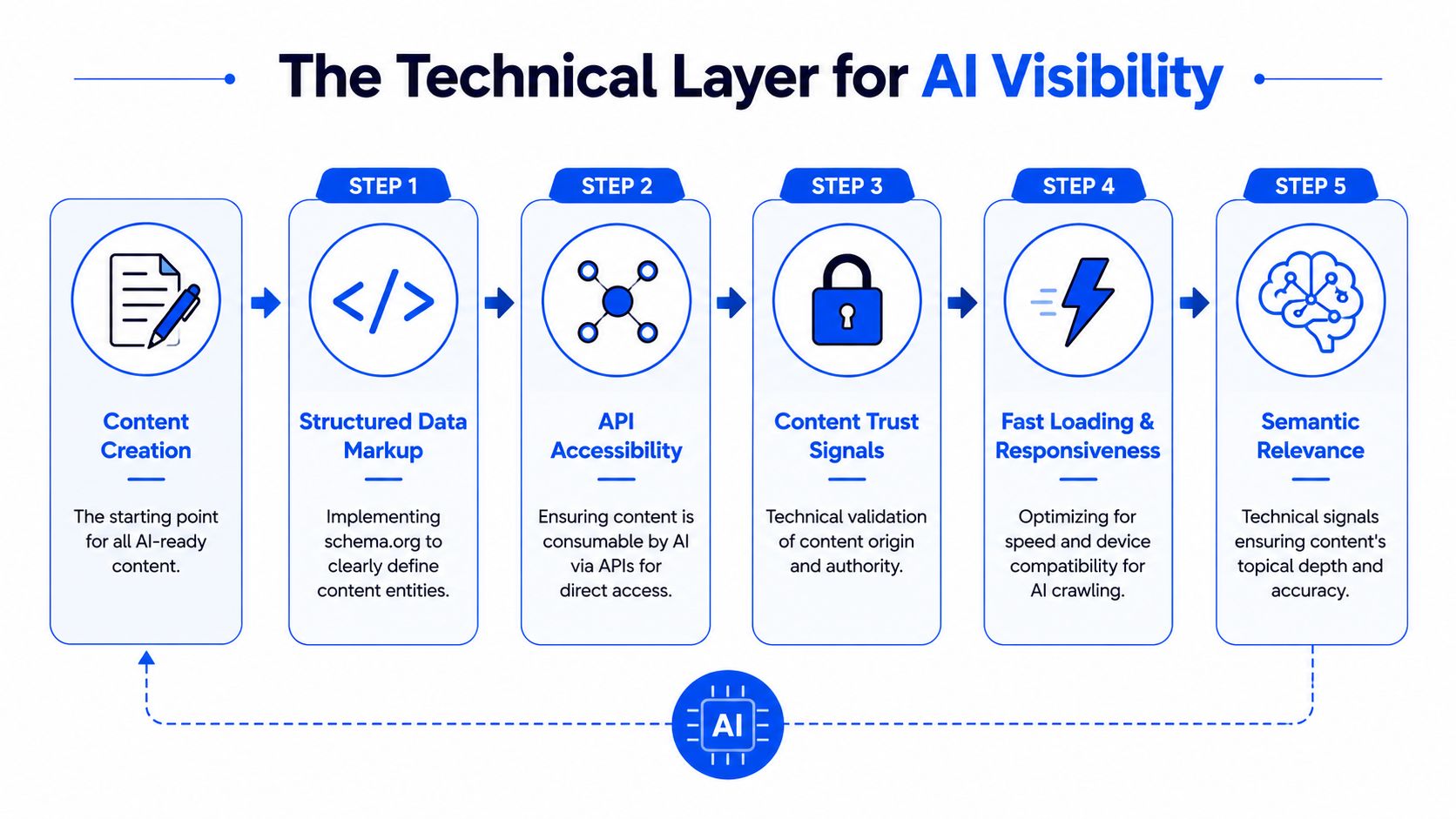
Good strategy without technical support doesn't hold up. If your content is hard for AI systems to interpret, your editorial work gets wasted.
The good news is that the technical layer is straightforward once you stop treating it like conventional SEO housekeeping. For AI visibility, the work is about clarity, access, and trust signals.
Here's the technical flow that matters.
llms.txt and retrieval guidance
An llms.txt file is a simple way to help AI crawlers understand which parts of your site matter, which pages represent source material, and how your content should be interpreted. It won't save a weak site, but it gives your strongest assets a cleaner path for discovery.
For a SaaS brand, that usually means highlighting:
- product pages
- integration pages
- capability pages
- comparison pages
- documentation and help content
- trust and proof assets
If your site has strong content scattered across subfolders with no retrieval logic, fix that first.
Schema and entity definition
Schema markup still matters, but not because it's trendy. It matters because it reduces ambiguity.
Your company, product, category, founder, review signals, FAQs, and key pages should be marked up in a way that helps machines map entities correctly. The cleaner your entity graph, the easier it is for AI systems to connect your product to the right use case and category.
This is one of the biggest gaps we see in SaaS audits. Teams write decent content, but they never define the company and product clearly enough for AI systems to process them with confidence.
Citation pathways and authority thresholds
You can't build AI authority only on your own domain. Models also rely on third-party references, reviews, mentions, and linked corroboration.
And authority isn't abstract. Benchmark data reveals that sites with 32,000+ referring domains are 3.5x more likely to be cited by ChatGPT, according to Salesforce's analysis of AI content marketing.
That doesn't mean every SaaS brand needs to obsess over one raw link number. It means your category authority has to be visible across the web. G2, trusted publications, ecosystem partners, podcasts, directories, comparison pages, and expert-authored content all matter because they create citation pathways.
If you need a benchmark for where to start, assess whether your technical setup supports inclusion across engines, not just search rankings. That's the point of AI visibility optimization.
Measuring What Matters in an AI-First World
If you're still looking only at organic sessions and assisted conversions, you're missing part of the picture.
AI discovery breaks attribution. A prospect reads a recommendation in ChatGPT or Perplexity, visits your site later, and analytics often records that as direct traffic. Your dashboard tells you nothing useful. Your team thinks branding improved. Your CFO thinks attribution got worse. Both are looking at incomplete data.

Why Google Analytics is not enough
Because AI-generated responses often do not pass referral data, clicks from models like ChatGPT or Perplexity appear as direct traffic. Brands must track citation share and visibility scores separately to measure true AI-attributed performance.
That changes how you report performance to leadership.
You need a measurement system that answers three questions:
| Metric | What it tells you |
|---|---|
| Citation Share | How often your brand is cited versus competitors for target prompts |
| Visibility Score | How visible your brand is across ChatGPT, Gemini, Perplexity, and Claude |
| Mention Sentiment | Whether your brand appears positively, neutrally, or negatively in AI answers |
What better reporting looks like
For a SaaS CMO, the useful dashboard is not “we published 18 AI-assisted blogs this quarter.” The useful dashboard is “we gained inclusion in comparison prompts, alternatives prompts, and category prompts that buyers use.”
We've seen this matter in client work. Whatfix recorded +84% in AI visibility lift, not because a traffic graph looked nicer, but because the brand appeared more often across tracked prompt clusters tied to real buying intent.
Track prompts, not just pages. AI search doesn't care how proud you are of a content calendar.
A strong starting point is a prompt baseline by platform. Run the same commercial, category, and competitor prompts across ChatGPT, Gemini, Claude, and Perplexity. Record whether your brand appears, where it appears, and how it's framed. Do that weekly. The pattern tells you more than pageview reports.
The Risks of AI Content and How to Mitigate Them
AI content isn't dangerous because it's artificial. It's dangerous because teams get lazy with it.
The first risk is brand voice dilution. Your category expertise gets flattened into polished, generic language. That's bad enough in any market. In B2B SaaS, it's worse because the buyer is often comparing precision. If your copy sounds interchangeable, your product starts to look interchangeable too.
The fix is simple. Create a brand voice constitution. Define your product language, banned phrases, proof standards, positioning boundaries, and category terms. Then force every AI-assisted draft through that filter.
Trust drops fast when AI feels obvious
There's also a trust problem. Studies show that when audiences know content is AI-made, they engage 12.2% less and perceive it more negatively, according to research on transparency without trust.
That means authenticity isn't cosmetic. It affects performance.
The second risk is factual hallucination. Models invent product features, oversimplify implementation details, or make unsupported claims. Your mitigation should be a human review process tied to a source-of-truth document from product marketing, solutions, and customer success. If a statement can't be verified, it doesn't ship.
Don't optimize for one engine only
The third risk is platform lock-in. Teams optimize for ChatGPT because it gets the attention, then discover they're weak in Gemini or absent in Perplexity. That's a strategic mistake because citation behavior varies by engine, and even minor edits can shift model recommendations. Adversarial edit case studies have already shown how unstable AI recommendations can be.
Your answer is cross-engine monitoring from day one. Test the same pages and prompts across ChatGPT, Gemini, Claude, and Perplexity. If one engine cites you and another ignores you, that's not a mystery. It's a signal that your retrieval setup, entity clarity, or citation support is incomplete.
Frequently Asked Questions
Does AI-generated content hurt SEO or AI visibility
It can, if you publish content that exists mainly to manipulate rankings or if the output is thin, repetitive, and unsupported. The better question is whether your content helps a buyer and gives AI systems enough reason to trust and cite it. If the answer is yes, AI assistance isn't the problem. Lazy publishing is.
Should my team still invest in traditional SEO
Yes. But don't confuse “still important” with “sufficient.” SEO helps your pages get discovered and indexed. GEO helps your brand get cited in answers. You need both. If your team treats them as separate silos, your reporting and content priorities will drift.
What type of content works best for generative AI content marketing in SaaS
For B2B SaaS, the strongest assets are usually capability pages, comparison pages, alternatives pages, integration pages, implementation guides, product explainers, and pages with specific proof. Generic thought-leadership posts rarely carry the same retrieval value. Build for buyer questions that show up late in the journey.
How long does it take to see results from GEO
The useful answer is this: you can often detect early visibility movement before standard pipeline reports catch up. In documented GEO work, B2B brands have achieved +87% visibility growth in AI search within 90 days through entity alignment, structured data, and citation development, as noted earlier. We've also seen faster movement in specific prompt clusters when a brand fixes weak comparison and capability content first.
Does my content team need to become technical
Not fully, but they do need technical partnership. Writers should understand retrieval-friendly structure, entity consistency, and what makes a page citable. Your SEO or web team should handle the heavier work around schema, crawl guidance, and site architecture. The win comes when editorial and technical teams stop operating separately.
What should an Indian SaaS CMO do first
Start with an audit of buyer prompts across ChatGPT, Gemini, Claude, and Perplexity. Check whether your brand appears for category terms, alternatives, integrations, competitor comparisons, and use-case prompts. Then inspect the pages most likely to earn citations. If those pages are vague, bloated, or unsupported, fix them before you commission more content.
If your team wants a clear read on how your brand appears across ChatGPT, Gemini, Perplexity, and Claude, get an AI search audit from LLMBuddy. If you're ready to move beyond rankings and build citation visibility that supports pipeline, request a demo or start with an AI search audit.