
Most advice on engine optimization software is wrong. It treats AI visibility like a copywriting problem, as if publishing another blog post will make ChatGPT, Gemini, Perplexity, or Claude suddenly trust your brand.
That's not how this works.
B2B SaaS buyers don't need another SEO dashboard with an AI label slapped on top. They need software that tells them whether their brand is being cited, recommended, and retrieved in AI answers. The gap is measurement. Most GEO content still ignores quantifiable visibility metrics, even though Evergreen notes that 87% of visibility growth in AI requires engineered citation pathways on third-party review sites such as G2. If your tool can't show citation frequency, answer presence, and where that visibility comes from, you're buying theater.
I've seen this firsthand in audits for SaaS brands. Some rank well in Google and still barely exist in AI answers. Others get picked up because their entity definitions are clearer, their technical structure is cleaner, and their brand appears in the right third-party sources. This represents the fundamental split in this market.
Ankur Pandey and the team behind this point of view have been blunt about it for a reason. Founders waste time on generic AI SEO promises while competitors build actual answer-level visibility.
Stop Looking for SEO Tools in an AI World
Founders still shopping for engine optimization software like it's an SEO category are buying the wrong product.
The problem is not content production. It is answer inclusion. If a platform cannot show whether your brand gets mentioned, cited, and repeated inside ChatGPT, Gemini, Perplexity, and Claude for commercial prompts, it is not an AI visibility tool. It is old SEO software with new packaging.
Content scores are a distraction
Vendors love to sell page audits, keyword suggestions, and AI writing workflows because those features are familiar and easy to demo. None of that proves your company appears in generated answers that influence pipeline.
B2B SaaS buyers ask comparison questions, implementation questions, pricing questions, and category-definition questions. AI systems answer those prompts by pulling from product pages, docs, review sites, analyst coverage, community discussions, and entity-level signals across the web. A tool that only grades your blog cannot explain why a competitor gets cited while you do not.
Use a simple test. Ask the vendor to show prompt-level data for your category across multiple engines. Then ask where the model likely sourced each mention. If they switch to vague language like “AI readiness” or “semantic authority,” end the call.
Practical rule: If the software cannot trace answer presence and likely citation sources, it cannot guide spend.
Weak evaluation wrecks budgets. Teams keep funding content velocity because that was the SEO playbook. Meanwhile, the actual gap sits in product documentation, schema quality, review-site coverage, comparison-page structure, entity consistency, and third-party citations.
We see this in audits constantly. One SaaS company can rank on page one for category terms and still disappear from AI answers for “best” and “vs” prompts. Another can have lower organic rankings but show up repeatedly because its docs are crawlable, its positioning is consistent, and its brand is reinforced on trusted external sources.
What founders should change first
Stop asking whether the tool helps your team publish more. Ask whether it measures share of answer, citation frequency, prompt coverage, and source dependency by engine.
That shift changes the buying process fast. Your SEO lead, growth lead, and product marketing team should evaluate software against retrieval evidence, not content output. If you also need execution support, pair the platform with AI SEO services for B2B SaaS teams that can fix the technical and off-site inputs behind those metrics.
The winners in this category are not the companies producing the most pages. They are the ones building a brand that language models can identify, retrieve, and trust.
Beyond SEO The Rise of GEO Platforms
Founders looking for "SEO software" to solve AI visibility are shopping in the wrong category.
Search tools report rankings, impressions, and backlinks. GEO platforms track whether ChatGPT, Gemini, and Perplexity surface your brand in commercial answers, comparison prompts, and category explainers. If the software cannot show answer presence by engine, citation frequency by source, and share of answer against named competitors, it is an SEO suite with new packaging.
GEO software measures answer outcomes, not page positions
The market changed because buyer behavior changed. B2B SaaS buyers now ask AI systems questions like "best SOC 2 compliance software for startups," "Clay vs ZoomInfo," and "how does usage-based pricing work for data tools." Those prompts do not return a clean list of ten blue links. They return compressed recommendations built from retrieval, source weighting, and synthesis.
That changes what the software must do.
A real GEO platform should tell you:
- Where you appear: prompt-level visibility across ChatGPT, Gemini, Perplexity, and other engines that matter to your buyers
- Why you appear: source attribution across your site, docs, review platforms, analyst coverage, and publisher mentions
- How you appear: answer framing such as recommended vendor, niche option, comparison mention, or excluded brand
- Who displaces you: competitor overlap on the same prompt set, by engine and by answer type
That is the standard for generative engine optimization platforms for SaaS teams. Anything less leaves your team guessing which inputs change AI recommendations.
B2B SaaS needs a different evaluation standard
Generic SEO advice misses the hard part. AI systems do not reward content volume by default. They reward clear entity definitions, consistent positioning, structured product information, extractable documentation, and repeated third-party validation.
We see this in client audits every month. One company dominates category keywords in Google and still gets omitted from "best" and "alternatives" prompts. Another has weaker organic rankings but appears in AI answers because its documentation is easier to parse, its category language is consistent, and external sources describe the product the same way.
That gap is why GEO became its own software category.
Vaporware signals are easy to spot
If a vendor talks about AI visibility but only shows keyword dashboards, publishing workflows, or generic content scoring, walk away. Those features help content teams operate. They do not tell a founder whether the brand is being cited or ignored inside AI answers that influence pipeline.
The stronger platforms act more like observability tools for brand retrieval. They monitor prompt sets, log answer inclusion, identify citation sources, and show how answer share changes after technical, content, or off-site updates.
We have seen visibility improve after teams fixed category definitions, product-page structure, docs architecture, and third-party profile consistency. In our work with Whatfix, visibility increased by 84%. The lift came from better extractability and stronger citation signals, not from publishing more top-of-funnel articles.
If your current tool treats AI search like a content calendar problem, replace it.
The Technical Foundations of AI Visibility
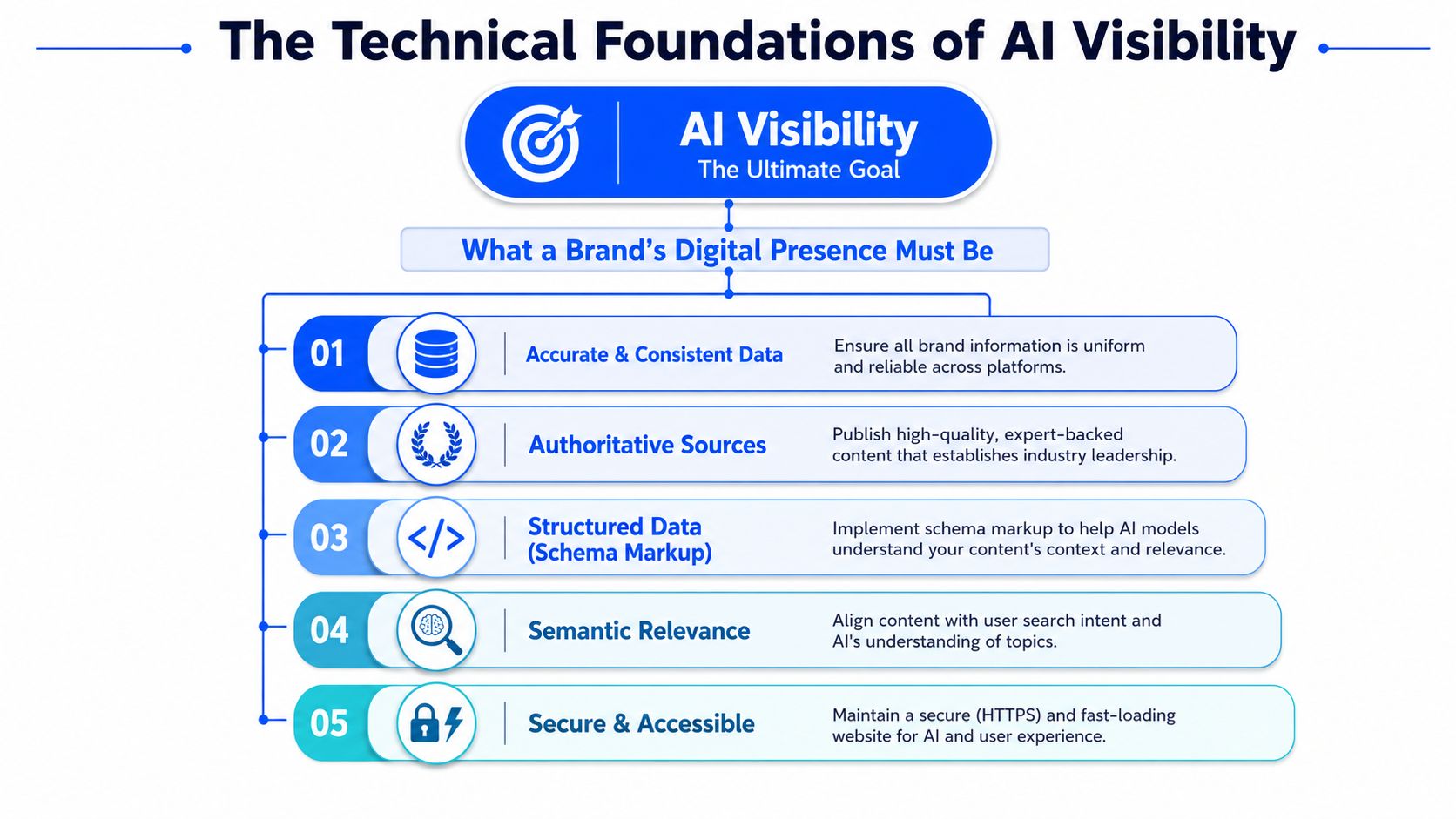
Ranking in Google does not guarantee inclusion in ChatGPT, Gemini, or Perplexity. Those systems reward content they can identify, extract, and cite with low ambiguity. If your category definition is muddy or your product facts are scattered across tabs, scripts, and vague marketing copy, the model moves on.
That is the technical core of AI visibility.
Start with machine-readable definitions
A surprising number of B2B SaaS sites still fail the first retrieval test. The homepage says what the company believes. It does not state what the product is, who it serves, and which category it belongs to in plain language.
LLMClicks states that AI models require explicit 40-word direct definitions immediately following H1 headers to prevent hallucinations and ensure accurate entity recognition. That recommendation matches what we see in audits. Pages with clean H1-to-definition structure are easier for models to classify and reuse. Pages that open with slogans create ambiguity, and ambiguity kills citation frequency.
Use a simple standard:
- Define the product directly: Say what the company or product is in one clear sentence.
- State the category without euphemisms: If you sell onboarding software, say onboarding software.
- Add the buyer and use case: Name the team, workflow, or problem you serve.
A proper AI search audit for B2B SaaS retrieval gaps should catch this on the first pass. If a platform misses weak entity definitions, it is not measuring AI visibility. It is grading copy.
Retrieval depends on page architecture, not just wording
Founders often hear "improve your content" and assume the fix is editorial. Usually it is structural.
The models that generate answers need stable, extractable facts. They perform better when pricing logic, product descriptions, integrations, implementation details, and category labels are visible in the rendered HTML, grouped logically, and repeated consistently across key pages. If the important material is buried in accordions, hidden behind tabs, injected late with JavaScript, or split across inconsistent templates, you lower your odds of being cited.
These are the technical checks that matter:
| Area | What your team should check | Why it matters |
|---|---|---|
| Schema | Product, organization, FAQ, and relevant structured data are present and accurate | Models parse cleaner entity relationships |
| Extractability | Core information isn't hidden in tabs, scripts, or design-heavy modules | Retrieval works better when answers are easy to lift |
| llms.txt | Your site provides a readable path to high-value content | AI crawlers get clearer guidance |
| Crawler access | Important pages aren't blocked or degraded for AI fetchers | Retrieval fails if access fails |
Here, weak GEO tools get exposed. They suggest headline edits and publishing cadence, then ignore whether the page can be fetched, parsed, and cited.
Freshness affects answer inclusion
Recency also matters, but treat it as a retrieval maintenance issue, not a blogging ritual. Contently's guide says generative engines weigh source freshness heavily by prioritizing content with recent last-modified dates, which requires brands to update cornerstone articles quarterly.
For B2B SaaS, that means your comparison pages, category pages, docs, implementation pages, and key glossary entries need scheduled review. Update product facts. Tighten definitions. Remove stale claims. Check whether external citations still match your current positioning.
A page can keep ranking in traditional search long after it stops being a reliable source for AI answers. Those are different systems with different failure points.
What shows up in real audits
The biggest gains usually come from boring fixes. Clear category labels. Better schema coverage. Cleaner page rendering. Documentation that explains the product in extractable language. Consistent company descriptions across site pages and third-party profiles.
That work changes measurable visibility. We have seen brands improve inclusion rates after fixing retrieval blockers first, then strengthening off-site citation paths second. Keka's visibility improvement is a good example of the pattern. The lift came from cleanup that made the brand easier for models to identify and quote, not from pumping out more top-of-funnel content.
If your software cannot point to specific retrieval failures, schema gaps, crawler problems, and weak definition patterns, it is not a GEO platform. It is a reporting layer with better branding.
What to Demand from Your GEO Software
Most GEO vendors talk big and measure softly. Don't buy that.
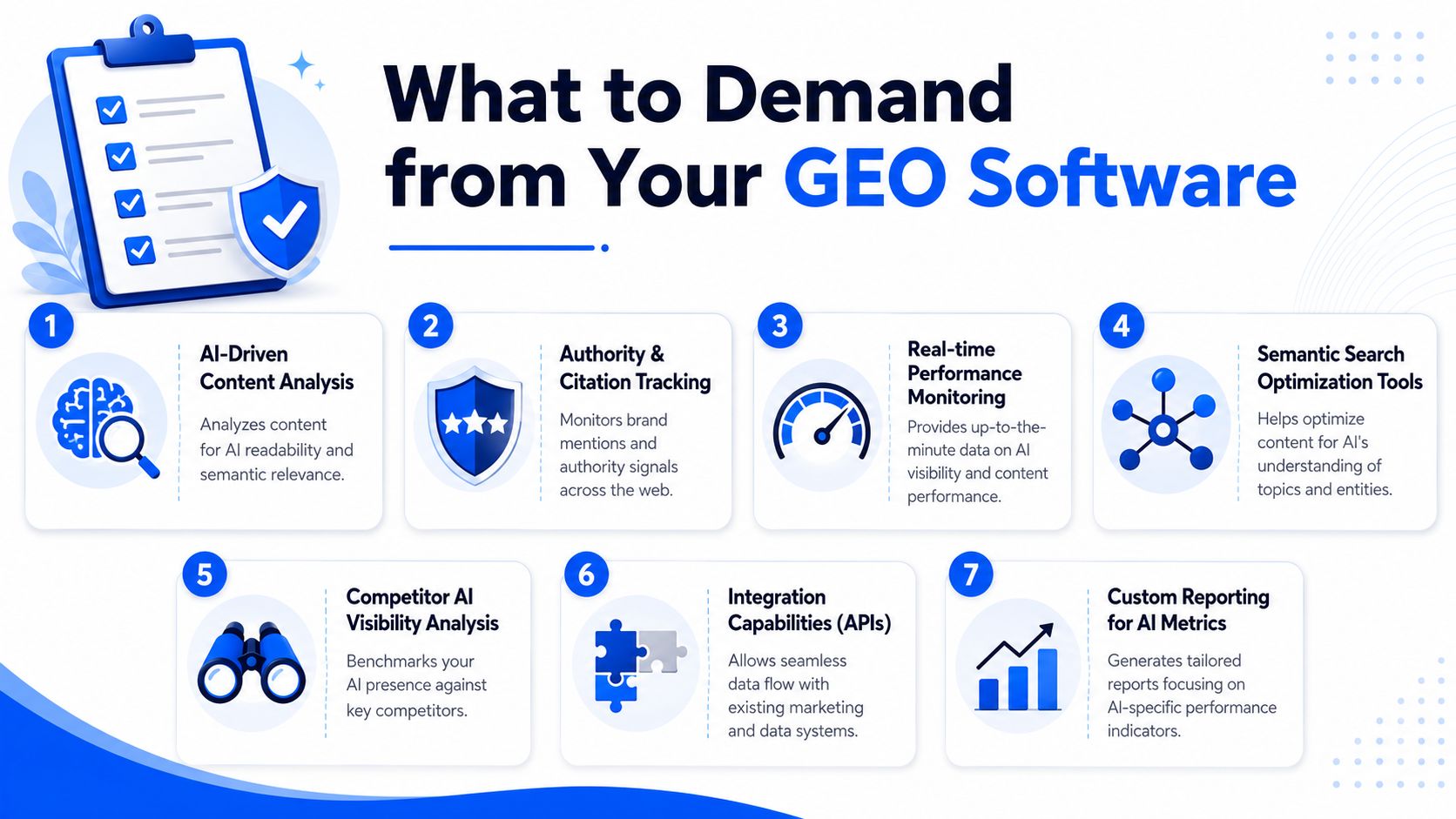
If you're paying for engine optimization software, you should demand proof that the platform measures real AI visibility, covers the engines your buyers use, and identifies technical fixes your team can implement.
The three capabilities that separate real tools from vaporware
The cleanest framework I've seen comes from ProofMap's report on generative engine optimization software, which says credible GEO software needs data provenance and measurement integrity, AI engine and surface coverage, and technical AI-readiness and audit.
That framework is blunt, and it should be.
First, data provenance and measurement integrity. If the platform models visibility instead of testing live engine outputs and first-party data, your benchmark is shaky from day one. You need to know whether the metric comes from actual responses or a vendor's assumption layer.
Second, AI engine and surface coverage. Tracking one assistant is lazy. Your buyers don't all use the same system. A serious platform tracks per-engine and per-citation visibility across ChatGPT, Gemini, Perplexity, and Claude.
Third, technical AI-readiness and audit. Dashboards are not enough. The software should identify concrete fixes such as schema errors, extractability issues, llms.txt gaps, and crawler-access problems.
Questions I'd ask every vendor in the demo
Don't ask “How does your platform use AI?” That invites marketing talk. Ask harder questions.
- Show the response source: Is this visibility score based on live prompts or a modeled estimate?
- Break out the engines: Can I see differences between ChatGPT, Gemini, Perplexity, and Claude?
- Show the fix path: If visibility drops, what exact technical or citation issue does the platform identify?
- Track external influence: Can I see which third-party sources are feeding my mentions?
A lot of vendors will stumble on the first question.
Buying advice: If a seller can't explain how they collect the data, assume the number is decorative.
Where founders get fooled
Founders often mistake activity features for visibility features. Content suggestions, prompt libraries, AI writing assistants, and competitive keyword maps can all be useful. None of them prove inclusion in generated answers.
The better way to compare products is this short table:
| Weak signal | Strong signal |
|---|---|
| “AI-ready content score” | Actual mention and citation tracking by engine |
| Generic competitor dashboard | Prompt-level competitor comparison in answers |
| Content recommendations only | Technical audit plus source-path insight |
| Single-platform monitoring | Cross-engine coverage |
We've seen this difference matter in the field. With Whatfix, Chargebee, and Keka, the wins came from systems that helped isolate where visibility was earned or lost, then tied that back to technical corrections and authority-building work. Keka's +82% result is a good example of why software procurement should focus on measurement integrity, not shiny UI.
If the platform can't connect visibility movement to an identifiable cause, you won't know what you're paying for.
Software vs Services A Hybrid Approach
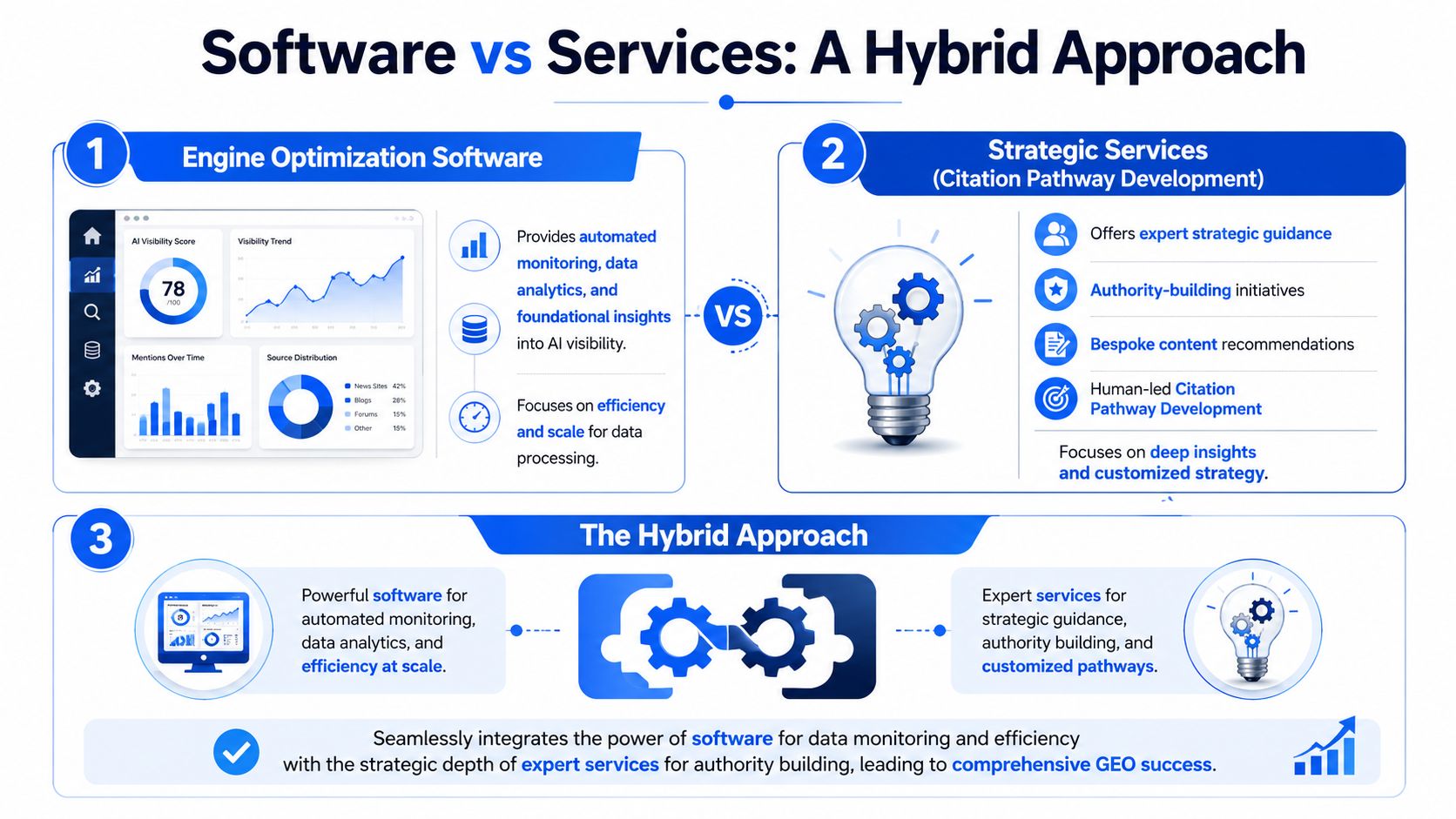
Founders waste time here by forcing a false choice. GEO software without execution turns into a reporting dashboard nobody acts on. Services without software turn into narrative-heavy retainers with weak proof. For B2B SaaS, the model that holds up is a hybrid. Software measures answer visibility and citation movement. Specialists fix the retrieval, entity, and source problems causing the gap.
What software should own
A serious platform should own the repeatable measurement layer. That means prompt set monitoring across ChatGPT, Gemini, Perplexity, and Claude, citation detection by answer, competitor share of answer, and change tracking after a page edit, schema fix, or off-site mention lands.
It should also expose root causes, not just scorecards. If your visibility drops for a category query, the platform should show whether the problem came from poor crawlable page structure, broken entity signals, missing third-party citations, or a competitor gaining source preference.
Use software for work like this:
- Prompt-level monitoring: Track whether your brand is recommended, cited, compared, or ignored across your commercial prompt set.
- Competitor answer share: Measure who owns the answer, not who ranks for a keyword.
- Technical issue detection: Catch extractability problems, schema errors, weak internal linking to core category pages, and inconsistent company descriptions.
- Source-path analysis: Identify which review sites, directories, docs, and publisher pages are feeding model answers.
That is the operating system. Without it, your team is guessing.
What services should own
Services should handle decisions that require judgment and cross-functional coordination. Software can tell you that G2, comparison pages, and partner listings influence retrieval for your category. It cannot decide which claims you can defend, which pages deserve consolidation, or how to rewrite positioning so your homepage, docs, and off-site profiles describe the same company.
Good consultants earn their fee by fixing category framing, clean up entity conflicts, prioritize citation targets, and pushing the work through content, SEO, PR, and product marketing teams that rarely align on their own.
For B2B SaaS, the service layer usually includes:
- citation pathway strategy
- entity and message alignment across owned and third-party pages
- technical recommendations for templates, schema, and content structure
- execution support with content, PR, reviews, and documentation teams
Why the hybrid model wins
The best results come from tight feedback loops. The platform shows where answer visibility is weak. The service team changes the pages and sources that influence retrieval. Then the platform verifies whether the fix changed citation frequency or share of answer.
That is how the work should run.
In client work with Chargebee, visibility improved when platform monitoring and execution stayed tied together. The lift came from fixing missing citation paths and tightening AI-facing page structure, not from publishing more top-of-funnel content. That pattern shows up again and again in SaaS. Measurement finds the gap. Execution closes it.
If you need a simple buying rule, use this:
- Choose software-first if your in-house team already knows how to handle technical SEO, structured content, digital PR, and third-party profile management.
- Choose a service-led hybrid if your team can ship changes but does not know which changes affect AI answers.
- Reject the vendor if they cannot connect their work to tracked movement in citations, mentions, or answer ownership.
Before you commit budget, run the numbers with an AI visibility ROI calculator. If the vendor cannot show how software and services map to measurable answer coverage, keep looking.
Your First 90 Days Monitoring and Next Steps
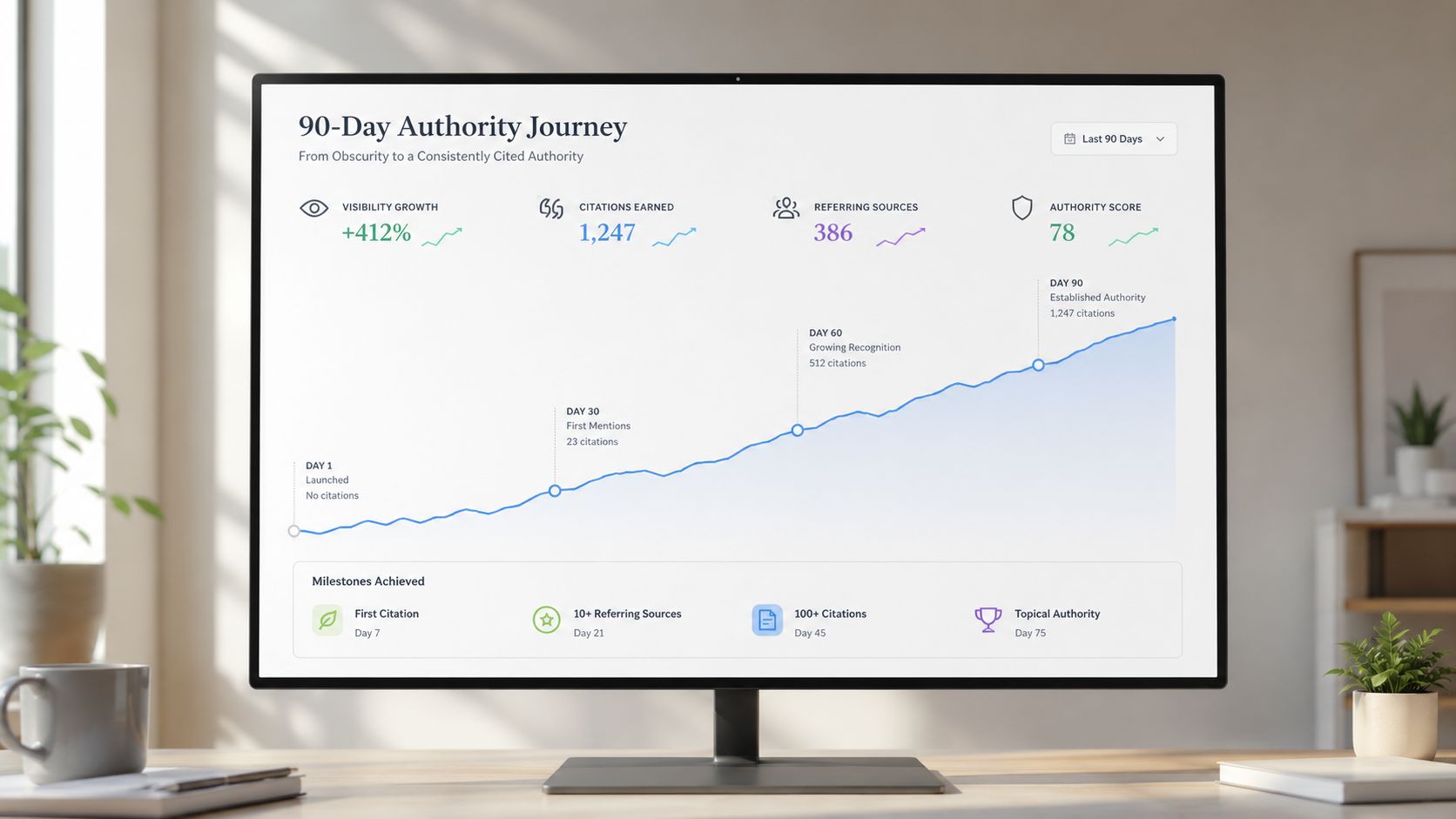
GEO is often made too broad at the start. Don't. Your first goal is to establish a baseline, fix one technical blocker, and build one high-value citation path.
Days 1 to 30
Run a full audit across ChatGPT, Gemini, Perplexity, and Claude. You need to know where your brand appears, where it doesn't, and whether the answer framing is accurate.
Then fix one issue with the highest retrieval impact. For many SaaS brands, that's a weak category definition, poor page extractability, or missing structured entity cues.
Days 31 to 60
Turn on weekly monitoring. Don't wait for quarterly reporting. AI visibility moves too unevenly for that.
At the same time, choose one citation pathway that matters for your category. For some companies that's G2. For others it may be industry media, product directories, or comparison-driven publisher pages. Use ROI planning tools to decide where effort is worth it before your team spreads itself thin.
Days 61 to 90
Review prompt-level movement, not just brand-level averages. You want to know where you're becoming a recommended answer and where competitors still control the conversation.
Start narrow. One audit, one technical fix, one citation path. That's enough to create momentum.
Whatfix's +84% and Keka's +82% gains are reminders that progress compounds after the foundation is right. The early phase isn't about doing everything. It's about doing the right few things with clean measurement.
Frequently Asked Questions on Engine Optimization
Is engine optimization software just another name for SEO software
No. Serious GEO software does a different job.
SEO platforms measure rankings, clicks, crawl health, and page performance. GEO platforms should measure citation frequency, share of answer, source presence, and recommendation rate inside ChatGPT, Gemini, Perplexity, and Claude. If a vendor shows you keyword dashboards dressed up with AI wording, skip it.
Which AI platforms should B2B SaaS teams monitor first
Monitor ChatGPT, Gemini, Perplexity, and Claude first.
Those four engines show up repeatedly in B2B buying flows, especially for category research, vendor comparisons, and shortlist building. A tool that tracks only one model cannot tell you how your brand is presented across the market. You need prompt-level coverage across engines, not a single-engine snapshot.
Can my team handle GEO with software alone
Software gives you visibility. It does not fix the underlying problem.
Founders usually need both platform data and operator judgment. Someone still has to clean up entity signals, tighten category positioning, improve page extractability, and build the external source profile AI systems keep citing. That work decides whether monitoring turns into gains.
What's the biggest red flag in a GEO platform demo
A single visibility score without evidence.
Ask the vendor to show the underlying prompts, the raw answers, the cited URLs, and how often your brand appears versus named competitors. If they cannot explain the collection method, the score is marketing, not measurement.
How should I measure progress if AI users don't always click
Measure recommendation presence before traffic.
The useful metrics are answer inclusion, citation quality, share of answer, sentiment of framing, and whether your brand shows up in commercial prompts that matter to pipeline. B2B SaaS teams that wait for last-click attribution will miss the signal. AI visibility often improves first. Traffic and pipeline attribution lag behind.
Do Indian SaaS brands actually need a GEO-specific program
Yes.
If you sell into crowded categories, mid-market buyers, or global accounts, AI assistants already shape discovery before your sales team gets a shot. Your brand does not need to rank first everywhere. It needs to be retrievable, correctly described, and cited often enough to stay in the consideration set.
If you want a straight answer on whether your current stack is real GEO software or recycled SEO reporting, talk to LLMBuddy. You can request a demo and see where ChatGPT, Gemini, Perplexity, and Claude cite your brand, where competitors outrank your narrative, and which fixes will change visibility fastest.